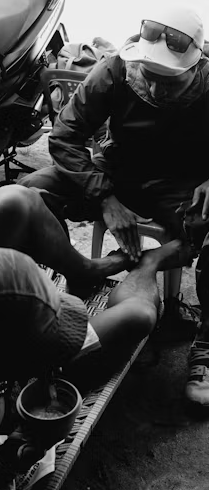
The Rt. Rev. Michael Curry, former presiding bishop of The Episcopal Church, built many of his sermons around a single, aching question from the prophet Jeremiah: “Is there no balm in Gilead? Is there no physician there? Why then has the health of my poor people not been restored?” (Jeremiah 8:22, New Revised Standard Version). It is one of the rawest lines in Scripture, not a statement of faith but a cry of grief. Jeremiah looked at a nation fractured by injustice, exile, and moral collapse, and he did not pretend the wound was small. He named it. He asked, aloud, whether healing was even possible.
Curry took that ancient lament and turned it toward the present. He knew that the question is really an invitation, that naming the wound honestly is the first act of faith, and that the old spiritual which answers Jeremiah’s despair with a defiant “there IS a balm in Gilead, to make the wounded whole” was not written by people who had it easy. It was written by the enslaved, by people who had every reason to conclude that no healing was coming, and who sang anyway.
That tension, between the prophet’s despair and the spiritual’s hope, feels close to home for anyone carrying real grief. It shows up in ordinary places: in a family stretched thin, in a friendship strained past repair, in a young person who has quietly stopped expecting things to get better. Jeremiah’s question is not a relic confined to scripture. It is still being asked, in different words, at kitchen tables, in hospital waiting rooms, and in the quiet of a pew: is there no balm? Is there no physician? Why is there no recovery?
What Curry understood, and what the spiritual insists on, is that lament and hope are not opposites. The prophet’s grief is not weakness; it is honesty, and honesty is the precondition for healing. A country that cannot admit its wounds cannot treat them. So, the despair many feel right now is not something to talk anyone out of. It deserves to be spoken plainly, the way Jeremiah spoke it: without spin, without the easy comfort that papers over real loss.
But the spiritual does not stop at grief. It answers Jeremiah’s question with a verse he never got to hear: “Sometimes I feel discouraged, and think my works in vain, but then the Holy Spirit revives my soul again.” That is not naivety. It is a discipline, a decision, made and remade, to keep showing up for the work of healing even when the evidence for hope is thin. The balm was never a guarantee that suffering would end quickly. It was a promise that the suffering was not the last word.
That is the pivot the life of faith calls for: not less honesty about what is broken, but more resolve about the work of mending it. Balm in Gilead was, historically, an actual remedy, a resin harvested and traded, applied to real wounds by real hands. Healing was not passive. It required someone to notice the wound, name it, and do the slow work of application, again and again.
Michael Curry has spent decades telling congregations that love is the way through despair, not a sentimental love, but the hard, patient kind that shows up in service, in listening, in the refusal to give up on one another. Jeremiah asked his question over two and a half thousand years ago. It is still worth asking honestly. And the answer, sung by generations who had far less reason for hope than we do, is still worth believing: there is a balm. It is made, in part, by those willing to apply it.
*Mr. McDaniel serves as co-chair of the diocese’s Commission on Racial Justice & Reconciliation. He also serves on the Executive Council for The Episcopal Church.
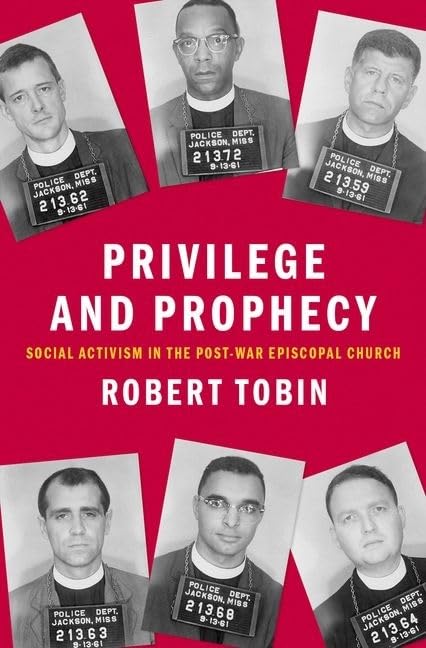
I recently learned about a book important to our Episcopal heritage. The Rev. Dr. Robert Tobin, chaplain at The Chapel of Sts. Peter and Paul at Old Royal Naval College inside the Maritime Greenwich UNESCO World Heritage Site, published Privilege and Prophecy: Social Activism in the Post-War Episcopal Church with Oxford University Press in 2022.
The Rev. Dr. Tobin draws upon extensive archival research to bring us this brilliant book in which he describes the people and situations that led The Episcopal Church into liberation theology and practice. He carefully reminds that The Episcopal Church has been and remains a catalyst for progressive change, but that doesn’t mean that The Episcopal Church has done everything right, fast enough, or well enough. He notes that the great progress in The Episcopal Church sometimes came at the neglect or oppression of black, female, LGBT, and working-class Episcopalians.
I believe that those of us who are putting ourselves daily into the world in ways that push against the status quo need inspiration in order to keep going. We must read ourselves into our continued commitment to justice and peace. We must read ourselves into our continued commitment to actively respect the dignity of every human being. Seeing ourselves in the lives of others, in the stories of people who did this work before us, can and should be a source of raison d’etre and will to keep on keeping on.
The Rev. Dr. Tobin provides the stories we need to hear. I commend his book Privilege and Prophecy to you as you seek purpose and joy in the work you do as change agents.
The Episcopal Church attracts people who know how to acknowledge their privilege and how to leverage that privilege for social justice action. The Episcopal Church learns from the past and grows in new directions for justice and peace. The people of The Episcopal Church recognize that the inherent dignity of every human being means that every person has some privilege in their own experience and offers that personally privileging experience for the good of others. The people of The Episcopal Church lift each other up and recognize Jesus in everyone, putting no one down.
My words are idealistic, I know. Of course, not every single person who calls themselves Episcopalian can be of the same mind. But we are a people of common prayer, so we have a common intention through that. I hope that as you read The Rev. Dr. Tobin’s Privilege and Prophecy that you will be inspired to continue to work for justice and peace and will find new ways within yourself to understand the dignity inherent in every other person of our shared world.
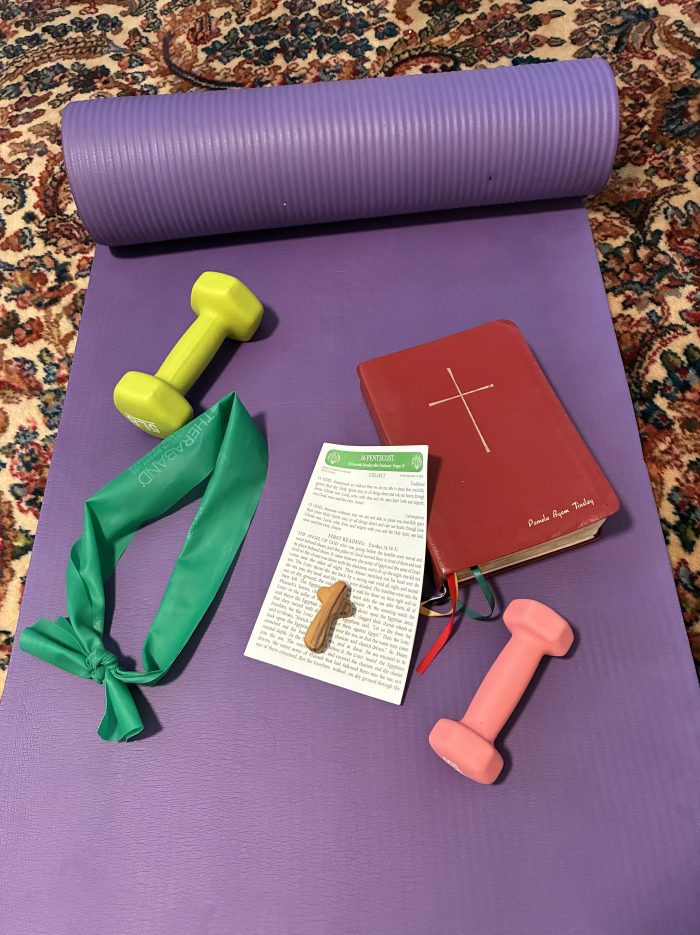
Last fall my oncologist referred me to ReVital prehabilitation physical therapy to help me prepare for a bone marrow transplant. I thought I was in moderately good shape, but after just six weeks, I was surprised by how much stronger I’d become.
Then came chemotherapy and transplant. Three weeks in the hospital along with significant weight loss quickly erased the results of all that effort. Muscle melted into loose skin. After I was finally discharged to home, I began the arduous work of rehabilitation with twice weekly physical therapy sessions at the “gym,” along with a daily exercise program in our “home gym.”
Progress was slow but steady. Six months ago, I needed to lean on a nearby piece of furniture to get up from the floor. Eventually, I discovered that I could rise from the floor without using my hands or my knees. Muscles appeared on my arms and legs, and I could even lift our 3-year-old grandson without hesitation. Persistence has its rewards!
Just as our bodies need regular exercise, so too does our spirit.
Epiphany Parish in Seattle, where I’ve served as an assisting priest, refers to itself as a spiritual gym – a place where we strengthen spiritual muscles to help live out Kingdom of God values. And, of course, this gym is open to people of all levels of “experience.” Like the YMCA with its diverse exercise programs – from the cardio room to the track to weights and the pool – a spiritual gym offers “coaches” and different types of workouts, such as worship, prayer, Christian formation, and pilgrimage – whether to a distant land or a half-day retreat.
The goal of our workout isn’t simply to check it off our list. Rather, it’s to become more deeply attuned to God’s values, to follow Jesus more closely, and to accompany others on their spiritual journeys, just as others accompany us.
The result? Strong spiritual muscles to carry us through the rest of the week – and for the challenges that life brings.
In his September 2 blog, the Rev. Scott Gunn of Forward Movement describes the importance of regular spiritual workouts this way: “As Christians, we are all works in progress. We’re never ‘done’ being formed as followers of Jesus. There’s always more to learn about God, about our faith.”
So, whatever your current level of spiritual fitness, why not give yourself a workout?
Snoqualmie Valley Railroad historic coaches pass just across the street from St. Clare’s front doors. (Photo courtesy of Northwest Railway Museum)
Last month, I had the joy of serving as a supply priest at a small church tucked near Snoqualmie Pass in the Cascade Mountains of Western Washington. It was a beautiful, sunny, summer day, and the church’s windows were open to allow a gentle mountain breeze to refresh us during the service. Windows behind the pulpit and altar opened to a parishioner’s magnificent garden that contributed stunning flowers for the altar. There were also windows on the other side, facing the town’s main street, just steps from the front door.
Thanks to the windows – open or closed – you can’t help realizing that the church isn’t secluded or insulated. The windows are an ongoing reminder to worshipers of the integral relationship of the church and the world – both the community and God’s creation. As if to emphasize this connection, an historic train runs up and down the track immediately across the street from the church. So, even while we were in church worshipping, we were also in the world.
Just as I was preaching about Jesus casting seeds with wild abandon, my words were drowned out by the sound of the train whistle! I saw the senior warden helping lift the small children of a young family so that they could see and wave to the passengers, for that was the day that a very special train engine had come to town: Thomas the Tank Engine!
Just as church bells are a call to worship, I was reminded that the train whistle for this congregation is a call to serve God’s people. It’s a reminder that worship and everyday life are closely entwined and that the purpose of our weekly worship isn’t to isolate us from the world, rather to prepare us to be Jesus’ hands and feet in the world.
It’s been a tough week. As I look at my list of “to-do’s” and the time on my calendar, I’m reminded of the “loaves and fishes” story from a couple of Sundays ago. And I’m reminded of what Jil Fiemeyer, a graduate of Luther Seminary writing for the “God Pause” blog, had to say about “feeding the 5,000” from Matthew (14:13-21):
“The disciples look at five loaves and two fish and see too little. Jesus looks at the very same meal and sees where to begin. I look at my calendar, my energy, my abilities, and wonder if they’ll ever be enough. But Jesus has never asked us to begin with enough.”[1]
Fiemeyer reminds us to notice the 12 baskets of left-overs – “The baskets remind me that Jesus doesn’t simply provide enough. He reveals the abundant heart of God. His grace is never measured in barely enough, but in the quiet assurance that God will faithfully provide what we need.
“Looking back, I can see moments when I wondered how I would make it through. Yet somehow there was enough strength for that day, enough hope for the next step, enough mercy to begin again.”[2]
The miracles of God’s abundance show up in our lives again and again. And especially when our trust in God outweighs our fears. “Because Jesus doesn’t begin with what we lack. He begins with what we’ve placed in his hands.”[3]
Fiemeyer closes with this prayer: “Gracious Jesus, when I focus on what I don’t have, help me trust you with what I do. Teach me to place my ordinary gifts into your hands, believing that you are already at work in ways I cannot yet see. Amen.”[4]
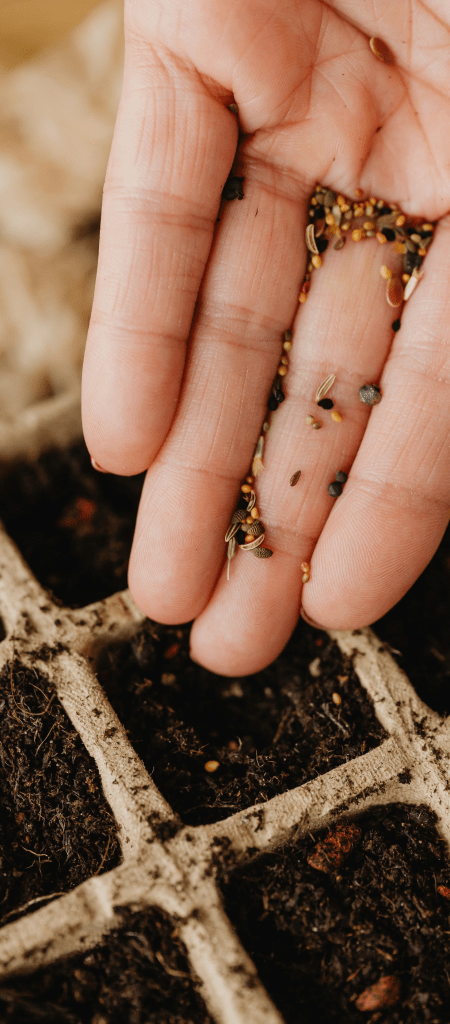
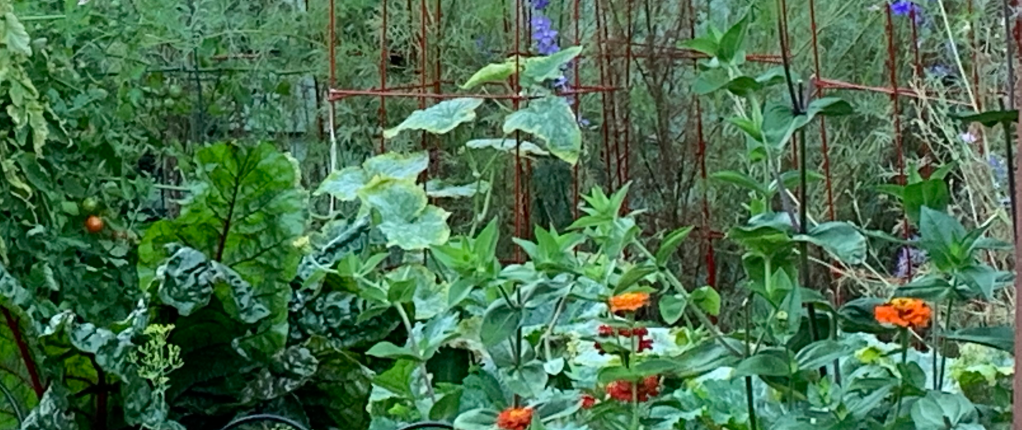
I love to garden, and – aside from tomatoes – I prefer growing flowers and vegetables from seeds rather than by purchasing starts. Each morning, I faithfully check to see if a sign of new life has emerged from the freshly tilled and enriched soil. By summer’s end, what began as a bare patch of soil teems with a bounty of vegetables and flowers.
This summer the Revised Common Lectionary has highlighted a string of Jesus’ parables in Matthew. I can’t help making the connection between my small-scale gardening and the work of the Master Gardener in the Kingdom of Heaven.
Jesus reminds “those with ears to listen” that the Kingdom begins in the smallest of places: a seed in the ground, a pinch of yeast in dough, an unnoticed act of kindness, a word of encouragement, a gesture of forgiveness. These little things, when nurtured by hope and inspired by love, become the very means by which God’s love permeates and flourishes in the world.
Little things in daily life are signposts to the riches of the Kingdom of Heaven and are often hidden in plain sight. A mustard seed grows into a great shrub that shields birds and other creatures from the sweltering sun. A small measure of yeast transforms an entire batch of dough, more than enough to satisfy our hunger.
God’s Kingdom works the same way. Hope planted in the midst of despair; love offered in the face of indifference; mercy extended where resentment would seem easier are all seeds of transformation. They quietly change lives, communities, and ultimately all of creation. The Kingdom grows through countless small acts of faithfulness that are easily overlooked. Yet each act ripples outward, farther and deeper than we might ever imagine.
The seeds of the Kingdom of Heaven are found in the ordinary rhythms of everyday life. The mustard seeds and yeast of our lives flourish in times of quiet faithfulness, unnoticed generosity, patient endurance, humble service, and within communities that choose hope over fear and love over self-interest. These small acts are not merely symbols of God’s Kingdom; they are the very places where God’s Kingdom takes root and grows.
For me, the crown jewel contained in the Episcopal Church’s 1979 Book of Common Prayer is the Baptismal Covenant. Born in 1949, a “cradle Episcopalian” as they used to call us, I was formed by the majestic cadences of the venerable 1928 BCP. I was 30 by the time the “new” prayer book was officially adopted. And I quickly discovered that the Baptismal Covenant filled a hole in my heart that I had hardly recognized was there – an outline of my faith and a guide for living it out. It has shaped my life ever since, and led to my partnership with Fletcher Lowe in writing Radical Sending as a primer for celebrating ministry in daily life as an every-day practice for all baptized Christians.
Living our daily lives can be hard, given all the interference we encounter along the way. A recent daily meditation from the Center for Action and Contemplation, titled “A Place for God to Move In,” included a quote from Richard Rohr: “You are a child of God, and always will be, even when you don’t believe it. And so is everyone else! God created us all. We are all God’s children.” [1]
Once we can claim that identity – and recognize that all those “others” around us have similar claiming rights – it’s a bit easier to allow God to move in, to take up space in our lives. Just as we hear in John’s Gospel: “The Word became flesh and blood, and moved into the neighborhood” (Jn 1:14 The Message). Greek scholars remind us that what is often translated “became flesh” is the Greek verb skēnoō, “to tabernacle” (or “live in a tent”) among us.
In that same meditation, Episcopal priest Elizabeth Edman reminds us that living our true identity means claiming fully our identity in God:
Christianity is all about being who you are. That’s what Jesus was trying to tell us: Orient your whole being to the sacred, he insisted. Not because I’m telling you to, not because it’s what Scripture demands; do it because it’s who you are. It’s who God created you to be. God made us to be complex creatures, every one of us, for a reason. So if you want to honor God, here’s the first step: Know who you are. Be who you are. Be the person God created you to be. Amen.[2]
But do we really, truly “belong”? Br. Jamie Nelson, SSJE, urges us to pay attention to those Jesus says “belong” in the kingdom of heaven: “Let the children come to me and do not stop them, for it is to such as these that the kingdom of heaven belongs” (Mt 19:14). Nelson calls us to remember the “such as these”:
One of the riches of the Episcopal Church’s Book of Common Prayer is the Baptismal Covenant, which includes five invitations for how Christians are called to live out our faith. The liturgy includes these lines:
•   Will you seek and serve Christ in all persons, loving your neighbor as yourself?
•   Will you strive for justice and peace among all people, and respect the dignity of every human being?
To which we respond, “yes, with God’s help.”
With God’s help, as you live out your baptismal vocation today, say yes to the vision of the kingdom of heaven Jesus proclaims here.
Say “yes,” and welcome your neighbor into the kin-dom of God. “Yes,” and allow God room to “pitch tent” in your heart, as well – right here, right now.
[2] Elizabeth M. Edman, video companion to the book Queer Virtue: What LGBTQ People Know About Life and Love and How It Can Revitalize Christianity (Beacon Press, 2016).
In the Revised Common Lectionary’s Gospel for June 28 (Matthew 10:40-42), Jesus commissions the apostles to take the Good News into the towns and villages. He then speaks of the radical welcome they might receive and its spiritual implications: “Whoever gives even a cup of cold water to one of these little ones in the name of a disciple – truly I tell you, none of these will lose their reward.” Radical welcome transforms both parties, those receiving hospitality, as well as those showing hospitality.
And in Jesus’ world, welcoming strangers meant welcoming everything that they represented, their tribe, their country, and their families.
This was a challenging message in Jesus’ day, and it is equally challenging today.
As hundreds of thousands of soccer fans and players attend the World Cup co-hosted by the United States, Jesus’ message about radical welcome intersects with the opportunity that we, as everyday Americans, have to show hospitality to people from different countries and cultures.
I used to think of the US as welcoming and hospitable, and for decades our country was a haven for tourists from other countries. Until recently. The political climate during the past two years has left many potential visitors from other countries hesitant to travel to the United States. Tourism from around the world has plummeted sharply due to the current administration’s antagonism toward other countries, the higher cost of travel, barriers to obtaining visas, and concerns about safety – including the possibility of detention by immigration officers. The winter snowbirds from our neighbor to the north who sought sunshine and warm temperatures in California, Arizona, Florida, and beyond have stopped coming to a country they now perceive as unwelcoming – even hostile.
Yet, as many soccer fans and players from all over the world are finding, the opposite is true. They are connecting with everyday Americans in restaurants, hotels, stores, and – of course – in the soccer stadiums. Ordinary Americans offer “cups of cold water” to visitors with friendly greetings, by offering directions, or initiating conversations and sharing stories. And then through simple hospitality, a miracle happens: both parties are transformed.
And, isn’t that what the Kingdom of God is all about? The Kingdom of God isn’t just a creed or a dogma. It’s a way of living; it’s being in relationship with one another. The Kingdom is revealed in ordinary acts of kindness and generosity offered in Jesus’ name. By sharing one cup of cold water at a time, we open a window to the infinite hospitality of God’s extravagant love.
Not only that, but when we welcome others, we often find ourselves being transformed. Every act of hospitality keeps the chain of God’s grace unbroken. Little by little, through everyday acts of love, God’s kingdom becomes visible among us. And little by little, we just might break down the barriers that divide us.
For prehistoric people, differences among people or species or environments triggered fear, and not without reason. Something new – different people groups, different environments, different foods, different customs – could pose an existential threat. And those nearly automatic survival responses are still present in our 21st century brains and bodies.
Among first-century Jews, the idea of crossing cultural, ethnic, or social boundaries was threatening and revolutionary. Scholars now believe that one of the potent attractors bringing people to early Christianity was the radical acceptance shown by those early believers – most of them at the margins of society – for the outcasts and the downtrodden. Richard Rohr, in a 2028 Daily Meditation, wrote, “From the perspective of occupying Roman powers, the Christian sect was radical because it encouraged alternative behaviors that were both attractive to those at the bottom and threatening to the worldview of empire. Rather than acquiring wealth, this new sect shared possessions equally. Followers of the Way lived together with people of different ethnicities and social classes rather than following classist and cultural norms.” [1]
In her book A People’s History of Christianity, historian Diana Butler Bass writes, “For all the complexity of primitive Christianity, a startling idea runs through early records of faith: Christianity seems to have succeeded because it transformed the lives of people in a chaotic world.”[2]
The notion that diversity and difference are desirable seems counter-intuitive to many of us. But looking at the incredible diversity found in nature, we begin to grasp the idea that abundance and variety are hallmarks of God’s creation. And the profusion of variations found in nature increases the odds of survival. Variety and evolution are the twin engines of life on Earth. Variety provides the raw materials (genetic differences), and evolution determines how those materials change over generations. That’s true not only for biology, but also for human systems.
Br. Curtis Almquist, SSJE, writes about God at work in and through differences:
"It is unjust that some people don't know that they belong: that their uniqueness because of their skin color, or cultural, or ethnic, or religious heritage, or education, or age, or abilities have been used against them to keep them out push them down. God’s intention is just the opposite. These differences are evidence of the majesty of God, who has created and shared life with us in a world with almost infinite differences."

What if we could understand that every variation, of every kind of matter, is an expression of the living God, who created and is at work in and through all of God’s creation?  Poet Steve Garnaas-Holmes offers a view of the infinite and ineffable God at work in the most unexpected places:
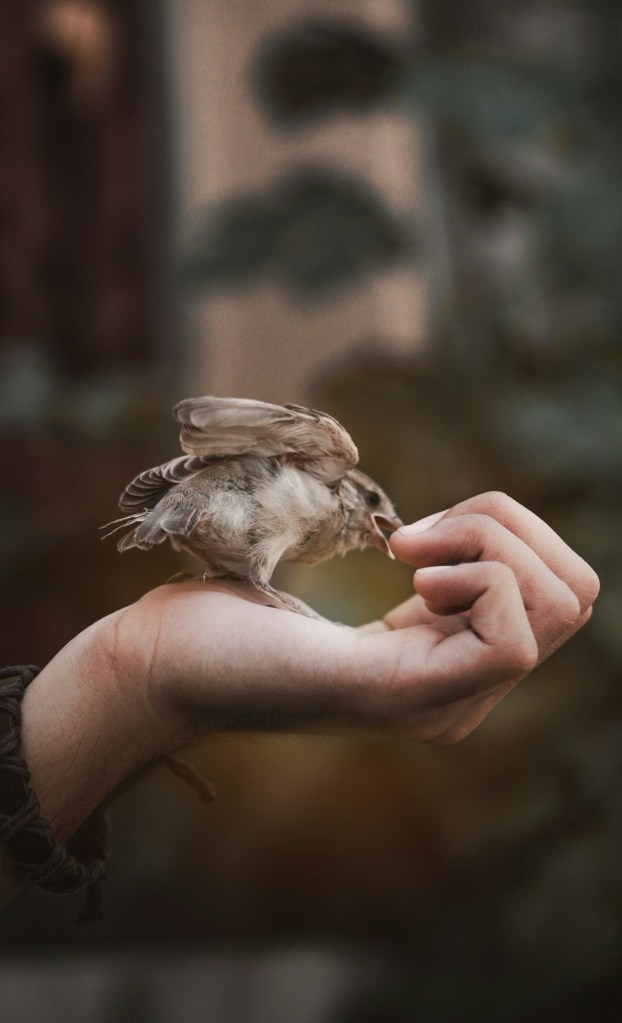
Sparrow

          Are not two sparrows sold for a penny?
          Yet not one of them will fall to the ground apart from your Abba God.
          And even the hairs of your head are all counted.
          So do not be afraid;
          you are of more value than many sparrows.
                                           —Matthew 10.29-31

They do fall.
But into the hands of God,
out of the sky that is God.

You will suffer.
But your sorrow is God,
divine consciousness,
mindful in you,

the love that has tended
every grain of your being,
every verb of your story.

Your pain is God,
divine vulnerability
alive in you.
That you are not a rock.

That you can fall
is God having woven divine light
into a body,

that you can drink the nectar of this world
and be filled,
that you can love at great cost.

Like God, who is also a sparrow,
unnoticed, in the open field.
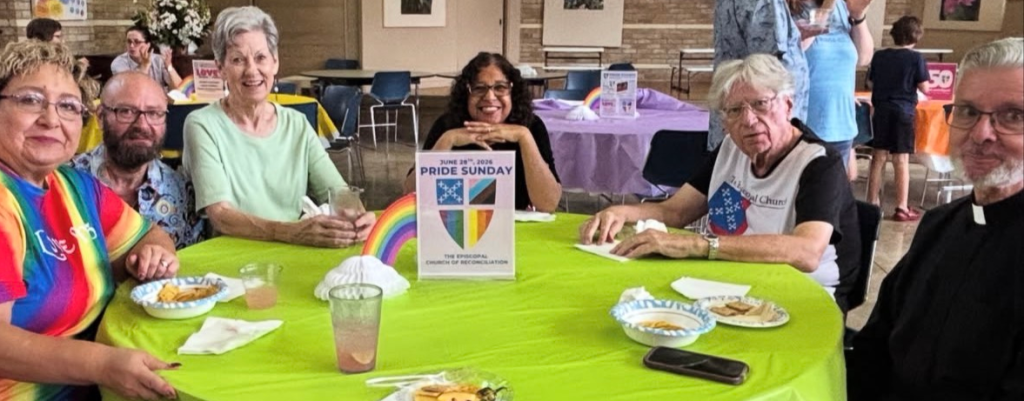
Pride at Church of the Reconciliation, San Antonio, TX, 2026. Photo by Tamara Talasek
May the words of my mouth and the meditations of all our hearts be acceptable in your sight, O God, our redeemer. Amen.
We are a diverse people gathered here tonight. Each of us has our own reason for being here, yet we’ve gathered for a common purpose and in common prayer.
No matter what brought each of us here, we are celebrating this Pride Eucharist together. We hold, in common, our Pride in the victories and accomplishments of queer people and lift up positive visibility, increasing inclusion, and new ways of being welcoming in our communities.
We also mourn, resist, and act against continuing societal attacks against the queer community. We cry out for peace and justice among all people. We continue to strive for full and equal respect to be given to every human being, knowing that each and every one of us is made in the image of God. We still have to teach the world the truth of who we are.
Just within my lifetime, our church has accomplished major changes in welcoming attitudes toward queer persons. This year we are celebrating the 50th anniversary of the passage of significant church legislation concerning our community.
50 years ago, at the 1976 meeting of the General Convention of The Episcopal Church two significant resolutions were passed that started a trend in church conversations toward Good News for queer people in our congregations. I want to share the language of the resolutions as they were written despite my own discomfort with the way our community is named in them. The word used is indicative of the time the resolutions were written, and our language of self-love and affirmation has evolved since then.
One resolution affirms, “that homosexual persons are children of God who have a full and equal claim with all other persons upon the love, acceptance, and pastoral concern and care of the Church,” and a second affirms, “That this General Convention expresses its conviction that homosexual persons are entitled to equal protection of the laws with all other citizens, and calls upon our society to see that such protection is provided in actuality.”
As we celebrate the fiftieth anniversary of the passing of those resolutions, the event that Presiding Bishop Sean Rowe, his staff, and our queer church leaders are preparing for in the fall in Minneapolis is appropriately called 50 Years in Pursuit of a Promise. We are still in pursuit of that promise the church made to us in 1976.
We may not be there yet, but we are still striving for that justice and peace and full and equal share in our church’s care and concern our General Convention voted to act toward.
As we celebrate who we are and how far we’ve come and also remember how far we still have to go, I think about the words we display on our church signs, bulletins, and bumper stickers – All Are Welcome.
church’s theology and traditions. We love our congregations and pray and labor for their health, growth and ministry. That does not mean we feel welcome.” (5)
She’s right. We are already here. And we always have been, but that doesn’t mean we always feel welcome to full and equal participation in our church, especially if we allow ourselves to unmask and to just simply be our whole selves.
Kentucky Latin Art-pop star Cain Culto recognized that lack of ability to be his full self in church all too well. He chose to leave church because he was already there but didn’t feel welcome.
Cain Culto is a first-generation child of Colombian and Nicaraguan immigrant parents, and he grew up as a bluegrass fiddle student and member of an indie Christian worship band.
In his own words he was “performing an inauthentic version of himself.”
“It got really dark and painful, because my parents and loved ones and my church leaders were also joining in on all that language [of hate]. It’s one thing to get hate from random people online. They don’t know me, but it hurt when it was from people who knew me personally. It forced me to develop thick skin because of that year of my life. You have to build internal confidence. If I know I’m on my path and it feels true to me, you just learn to not put as much weight on them. We, as people, have to decide, are we living for the validation and approval of others, or are we living for our own souls?”
So often queer community holds experiences of church hurt like Cain Culto’s. And so we make our church elsewhere; our church becomes the venues of Cain Culto’s performances or Lady Gaga’s concerts, Drag Brunches or Underground Ballrooms, gay bars or friends’ houses, because we find the life of our own souls in the ritual and liberation of the sacred spaces we create on our own.
In June 2021, St. Mary’s hosted a renaming liturgy for Ruby, a ceremony in the Episcopal tradition that marks the riddance of a transgender individual’s birth name in favor of the person it was their destiny to become.
As bursts of late afternoon sunbeams streamed through the skylight on that momentous Sunday, the church’s wooden pews teemed with [] faces, many of which belonged to family members and longtime friends. Just as some women have cotillions to mark their entrance into society, this rite of passage served a similar purpose: Surrounded by her dearest relations, Ruby would claim her womanhood for her own. She announced to the world not only a new name but also her true self after so many years of hiding.
The hour-long liturgical ceremony began with parishioners standing for an opening hymn and a song of praise before joining in a series of scriptural readings, including [Second] Corinthians 3:12-18, a promise that those who accept God’s love will be lifted toward the divine. “Now the Lord is the Spirit, and where the Spirit of the Lord is, there is freedom,” the passage reads in part. “And we all, with unveiled faces, beholding the glory of the Lord, are being changed into [God’s] likeness from one degree of glory to another.”
Episcopal rites are characterized by their soothing sameness, the comfort of already knowing the major plot beats. Worshippers have sung these exact numbers and read these parables aloud together dozens upon dozens of times throughout their lives, but placing Ruby’s journey at the center gave those familiar words new meaning.
Leading the church in a reflection, Ruby said that the verses from Corinthians represented being able to embrace herself fully and, by doing so, allow[ed] those around her to embrace her as well. Following a process of becoming that had sometimes proven turbulent, she proclaimed to her fellow churchgoers that the [scripture] offers a “message of peace.”
“It says that I shouldn’t worry about my body or what I wear, that I should just be who I am and be at peace with God,” Ruby said in her speech, towering above the altar as she addressed gatherers. “I think that message is something we all need to hear every day. So often we worry too much about things that don’t matter, no matter how real they may seem to us. I was so worried about what other people would think of me when I came out, but I really just can’t care about that. Jesus loves me, and he loves you, too. Frankly, that’s the most important thing to me.” (117-118)
As we continue to say “All are Welcome” and actively pursue ever more fervently the promise we made 50 years ago to queer people of full and equal claim upon the love, acceptance, and pastoral concern and care of the Church, I hope we see more stories like Ruby Carnes’s, which is rare and beautiful.
Fully and equally, I hope that when we meet people like Cain Culto in our pews and on our streets, we love them where they are, for who they are, so they, too, know Jesus’ love with that same immeasurable certainty we hear from Ruby; so that they too can proclaim without a doubt that they are welcome in our churches and, more importantly, in the world.
When God says through the prophet Isaiah (43:1-7), “I have called you by name. I will be with you. You are precious in my sight. I love you. I love you. I love you…” Let those be the only words of our mouths and hearts.
Just because we are here does not mean we feel welcome, but a little more love really can go a long way.
My mom recently told me that she wished everyone understood how important love and acceptance are to her as the parent of this queer and trans person. She was at a funeral and one of the three queer, adult children of our cousin, the deceased, stood up to speak to his mom’s small, rural, conservative church group – her daily companions in life – who didn’t know him, his brother, or either of their husbands and had not come to his trans brother’s funeral several years before. The son shared that he had told his mom, “You always made life easy for us. You gave us freedom to be who we needed to be even though that made your life hard.” He paused and looked at his mom’s neighbors. He said, “When I told Mom that last week, she looked at me and said, ‘It was never hard. All I had to do was love you.’”
All I had to do was love you.
I encourage you to leave here tonight and make plans to attend the “50 Years in Pursuit of a Promise” conference in September in Minneapolis with Presiding Bishop Rowe.
I encourage you to leave here tonight and ACT UP for your full and equal place in your church and in our society.
I encourage you to leave here tonight proud of who you are, proud of how much we’ve already accomplished, proud of your strength and resilience in the face of the oppression that still remains, and proud of the ways we’ll change hearts and minds for the next 50 years and more.
You are loved beyond measure. It was never hard. All any of us had to do was love you. Amen.