What counts as holy?

by Fletcher Lowe

“Engines and steel, loud pounding hammers, sing to the Lord a new song;

limestone and beams, loud building workers, sing to the Lord a new song.

He has done marvelous things; I too will praise him with a new song!”

So goes verse 4 of a great new (1968) hymn Earth and all stars, sung to an equally new and lively tune!

Included in this hymn are those for which we are singing a new song: hail and rain, loud blowing snowstorms; trumpet and pipes, loud clashing cymbals; classrooms and labs, loud boiling test tubes; daughter and son, loud praying members, sing to the Lord a new song!

How incarnate in daily life can we get!! Behind each element listed are people making things happen.  And behind each of those people, known or unknown, is the Incarnate Lord to whom new songs are being sung!!

What a view of life – no thing is out of bounds for us to sing praises to the Lord.

But that is key to who we are as followers of the Incarnate One: that God in Christ became a common and ordinary human being, grew up in a common and ordinary village with common and ordinary parent, met and preached to and healed and worked with common and ordinary folks. He blessed common and ordinary bread and wine: the holy communion, the holy common-union; the union of the hoy and the common in such common and ordinary things like bread and wine. Who are we to deny the sacredness of any things, any human being?

No day (e.g., Sunday) is more holy; no building (e.g., a church) is more holy; no person (e.g., clergy) is more holy; no food (e.g., Eucharist) is more holy. The Episcopal Church’s definition of a sacrament is “an outward and visible sign of an inward and spiritual grace.” Church-wise we may limit sacraments to Baptism and the Eucharist and maybe five others; but outside the church every thing can be a sacrament, an outward and visible sign that can bring us inward and spiritual grace – including rain and hail and loud blowing snowstorms.  For our God is the Incarnate One, “the Word [who] became flesh and pitched his tent among us” (John 1:18).  And that sense of en-fleshment opens up everything to be godly. “He has done marvelous things; I too will praise him with a new song!”

limestone and beams, loud building workers, sing to the Lord a new song.

He has done marvelous things; I too will praise him with a new song!”

So goes verse 4 of a great new (1968) hymn Earth and all stars, sung to an equally new and lively tune!

Included in this hymn are those for which we are singing a new song: hail and rain, loud blowing snowstorms; trumpet and pipes, loud clashing cymbals; classrooms and labs, loud boiling test tubes; daughter and son, loud praying members, sing to the Lord a new song!

How incarnate in daily life can we get!! Behind each element listed are people making things happen.  And behind each of those people, known or unknown, is the Incarnate Lord to whom new songs are being sung!!

What a view of life – no thing is out of bounds for us to sing praises to the Lord.

But that is key to who we are as followers of the Incarnate One: that God in Christ became a common and ordinary human being, grew up in a common and ordinary village with common and ordinary parent, met and preached to and healed and worked with common and ordinary folks. He blessed common and ordinary bread and wine: the holy communion, the holy common-union; the union of the hoy and the common in such common and ordinary things like bread and wine. Who are we to deny the sacredness of any things, any human being?

No day (e.g., Sunday) is more holy; no building (e.g., a church) is more holy; no person (e.g., clergy) is more holy; no food (e.g., Eucharist) is more holy. The Episcopal Church’s definition of a sacrament is “an outward and visible sign of an inward and spiritual grace.” Church-wise we may limit sacraments to Baptism and the Eucharist and maybe five others; but outside the church every thing can be a sacrament, an outward and visible sign that can bring us inward and spiritual grace – including rain and hail and loud blowing snowstorms.  For our God is the Incarnate One, “the Word [who] became flesh and pitched his tent among us” (John 1:18).  And that sense of en-fleshment opens up everything to be godly. “He has done marvelous things; I too will praise him with a new song!”

Bending imagination toward hope

Wipf & Stock, publishers

by Demi Prentiss

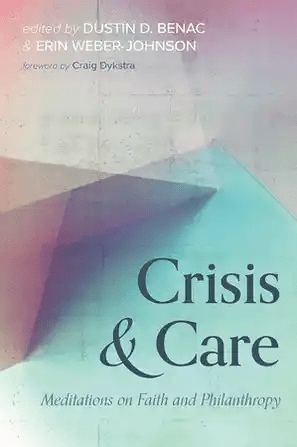
Dustin B. Benac and Erin Weber-Johnson are the editors who compiled the recently published Crisis and Care: Meditations on Faith and Philanthropy. The book examines the outpouring of care and funding that seemed to be unleashed by the crisis of the world-wide COVID-19 pandemic. In an Insights column for the Lilly Family School of Philanthropy, the editors wrote, “We could not have imagined a year like 2020 and yet, as an abundance of care rose to meet the gravity of crisis, we encountered people acting in new and life-giving ways. Their combined words and witness bend our imaginations toward hope.”

Benac and Weber-Johnson point to “shared philanthropic imagination” as igniting the generosity that helped support institutions, non-profits, and individuals through the adaptive challenges that threatened to overwhelm them. From the learnings gleaned through the pandemic, they offer four touchstones to guide all of us forward:

    1. Everything is an experiment.
    2. Generosity and justice shape a shared future grounded in a faithful, fragile belonging.
    3. Making space for tension is a significant act of generosity.
    4. Philanthropic imagination emerges on the edge of certainty.

It strikes me that living each day in the loving, life-giving, liberating pattern of Jesus is an incarnation of philanthropy – literally, the love of people.  Our usual understanding of philanthropy involves generous donations of money to support worthwhile causes.  I believe that even those of us who can’t claim the identity of philanthropist can use these statements to guide us toward generosity as an every-day lifestyle.

Taking Benac and Weber-Johnson’s touchstones as our guideposts for living, wouldn’t we all be better “people lovers” – just what Jesus called us to be?  Can we use these four statements to “bend our imagination toward hope”?

‘That’s who I am! That’s what I do!’

ILO / Apex Image

by Pam Tinsley

“That’s who I am! That’s what I do!” responded the gas station attendant to our heartfelt “Thank you!” for pumping our gas. Our interaction with him was a cheerful interlude during an otherwise long day of travel. Our previous stops at rest areas had felt a little odd since people still seemed cautious about interacting closely because of the pandemic. Then, in a small eastern Oregon town several miles from the freeway on a 101-degree afternoon, this cheerful guy brightened our day – simply by showing us the joy he took in his job.

That cheerful “That’s who I am, and that’s what I do” stays with me. What if all of us who are baptized repeated these words regularly to remind us of our baptism and baptismal ministry? When we remember to place Christ at the heart of our daily activities, those seemingly routine activities can take on new meaning. They can even become transformational. Maybe if our own attitudes might be transformed so that we feel the same joy as the gas attendant, and we then become leaven for the world around us.

Work blessings

by Fletcher Lowe

Facebook – IPRO – Intentional Professional – 11/19/19

I meet once a month with a small group of friends to discuss their experiences as Christians in their places of work. The discussion-starter is usually an article related to some aspect of the workplace.  Recently we talked about an article entitled “5 Ways to Bless Others with Your Words at Work,” published by the Theology of Work.  The underlying scripture was Numbers 6:24-26: The Lord bless you and keep you.  The Lord make his face to shine upon you and be gracious unto you.  The Lord lift up his countenance upon you and give you peace.  I added James 3:10: From the same mouth come blessing and cursing.

As we discussed each one of the five ways of blessing, we saw how it related not only to the workplace but to all other aspects of daily life.  For your own reflection let me share them:

  1. Express Welcome.  We felt that being approachable was at the heart of welcome.
  2. Eliminate Blame Shifting. It does involve holding people accountable, but focusing on the fault, not the person; the “sin, not the sinner.”  Also acknowledging that risk-taking is an asset that leads to some failures.  And that failures often lead to growth, more than successes.
  3. Reconciling Broken Relationship. This we really struggled with, for often people bring outside baggage into the workplace that triggers brokenness. And even within an organization/community/family it can be difficult to resolve, but try we must.
  4. Be Careful Not to Judge.  We found this to be connected with Blaming, looking to the fault, not the person.
  5. Show Appreciation: How important is this!!  Expressing gratitude – especially to those whose work is less glamorous or visible – is so very valuable and affirming.

The article concludes with these words:

Empowered by Christ

When we use our words to bless others, we do so knowing that we’ve been blessed in the same ways through our relationship with Jesus. Jesus welcomes us just as we are; makes us blameless – and therefore unafraid and unashamed – before himself and God; reconciles us to himself; and even describes us as “fearfully and wonderfully made.” Because we enjoy his kindness and friendship, we are empowered to extend blessing to those around us.

What if work *WAS* worship?

by Demi Prentiss

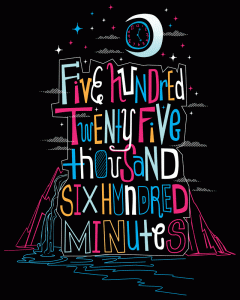
The musical Rent helps us know the math: “Five hundred twenty-five thousand six hundred minutes…. How do you measure … a year?”

Live.Love.Life – WordPress.com

How do you spend your year’s minutes?

  • Well, there’s work. Fifty weeks x 40 hours a week = 2,000 hours = 120,000 minutes.
  • Not to mention sleep. Fifty weeks x 7 days x 7.5 hours = 157,500
  • Just those two commitments eat up 277,500 minutes – more than half our year – leaving slightly more than 248,000 minutes – a bit over 4,100 hours.
  • And of course, there’s eating, and commuting, and personal time. . . .

Not too long ago, most faithful worship attenders spent an hour a week in worship – 3,000 minutes annually, leaving out two weeks for vacation. Not much time, in the scheme of things. And that’s if you’re attending worship every blessed week.

What if those 3,000 minutes – barely more than one half of one percent of our yearly minutes – expanded to fill much of our waking life? What if all of life was worship? What if worship became, for us, like breathing – something we do all the time, that becomes the very basis of our lives?

Philosopher and theologian James K.A. Smith has said, “If all of life is going to be worship, then the sanctuary [or the nave] is the place we learn how.”  

Imagine what life might be if, when we attended worship, the people at the front of the room were not called “worship leaders,” and instead were “worship starters,” as Fuller Theological Seminary professor Matthew Kaemingk calls them.  

Kaemingk and scholar Cory B. Willson became “convinced that theologies of work need to be practiced, embedded, and embodied in communities of worship.…The fabric of faith and work needs to be slowly and intentionally woven back together over a lifetime of prayer and worship.”

Their book Work and Worship – Reconnecting Our Labor and Liturgy was the result.  In an interview about their book Willson says, “We hope our book will help pastors and worship leaders see themselves as servants to the priesthood of all believers. Their primary role in worship is to equip and empower believers to live out their priesthood at the front edge of God’s mission in the world: the workplace.” 

What if all the minutes of our lives – not just the ones spent inside the church walls – became an expression of our love for God and all that God has made?

Doing hard things with Jesus at our side

Flickr – Nurse Teresa Hiller administers COVID-19 vaccine.

by Pam Tinsley

A friend has been working in a local hospital’s Covid-19 vaccination clinic since early winter. Although most of those at highest risk of infection in our county have now been immunized and the demand has waned, recent expansion of eligibility to include those as young as twelve has prompted a bit of a surge in appointments.

Catherine had had a pretty routine day, when a grandmother arrived with her twelve-year old granddaughter. The grandmother was rather uneasy, perhaps uncomfortable with the hospital environment and the number of people waiting – masked and socially-distanced – for their shots. The girl, however, was extremely apprehensive about everything, not the least of which was the shot itself. The grandmother exacerbated her granddaughter’s anxiety by berating her and telling her that she was holding up the line.

Catherine paused, ignored the woman, looked into the girl’s eyes, and gently took her hand. She said that she understood the girl’s fear, and then whispered, “We can do hard things,” quoting from Glennon Doyle’s Untamed. The girl smiled shyly and held out her arm.

When Catherine shared this touching experience with me, I noticed that she – an ER nurse who’s seen it all – was choking back tears. I asked her to tell me more about what she experienced. She said that although the clinic was busy, she felt it was important to take the extra time with the girl, not just for her Covid-19 shot, but to help calm fears about future appointments. She said, too, that when she saw Jesus in the girl’s face, she realized that she, in turn, could be Jesus’ caring voice and hands. The girl, who also has Down Syndrome, needed even more respect and dignity shown to her, especially in the face of the overly anxious grandmother. And, Catherine reminded me that we all can do hard things when we remember that we’re walking with Jesus.

Can you move the dial?

Flickr – Liz West – Sundial

by Fletcher Lowe

There is a significant movement within the English Anglican Church that is creatively focusing on the calling of all the baptized in their daily life and work.  Illustrative of that is this article by the Bishop of Leicester: 

Moving the dial towards everyday faith, by Martyn Snow, Bishop of Leicester

Inspiring Everyday Faith is a way of highlighting why and what is important in Christian discipleship. In the past 20-30 years, we have not been terribly good at equipping people for living their Christian faith in the whole of their lives. The Church has tended to focus on its own life, or its own outreach projects, and forgotten that for most people the majority of their time is not spent involved in church projects – it’s spent in their workplaces, home, social. Equipping people for faith in those contexts must be core to what the Church is all about. I think there has been a change in that over time, but during this pandemic and lockdown – as in so many other areas – it has brought new questions into focus.

Nick and I have a running joke about who first coined the phrase Everyday Faith. All I can say is it has ‘made in Leicester’ stamped on it, and we use that as our strapline now! Using that language of everyday faith has certainly been very significant. My role as bishop is to hold people to account and for them to hold me to account in what we decide under God we are called to be and do. We use the following questions to help each of us in this discernment:

  1. How are you enabling others to grow in the depth of their discipleship?
  2. How are you growing in numbers of disciples?
  3. How are you growing in loving service, enabling others to grow in loving service?

We have found it important that such questions are adopted across the whole life of the diocese….- Other ways … putting lay ministers’ licensing services and commissionings on the same standing as ordination in the life of the diocese. When I license a new clergy person in a parish, we have a ritual of partnership in ministry, so looking very clearly at joining a team of ministers within that church context –

Recently, we’ve done an exercise of gathering stories about faith during lockdown. We’ve had a particularly prolonged lockdown in Leicester, as you may know. We’ve asked people right across our churches what they have been learning about faith in this particular context. Those stories have been fascinating. There has been a sense in which it has shifted the dial along the scale. People are asking – 

+ Is my Christian faith something I do with a particular group of people in a particular building at a particular moment in time?  through to 

+ Is my Christian faith something I do in the whole of life?

The dial has been shifted during this period to what, actually, faith is about! What I do in my own home, what I do when I’m online, talking with my friends. Increasingly people are realising that we should all take responsibility for this. It’s not something somebody else does for me – I need to be enabling the practices that enable my faith to grow in my own home and in my workplace. I think the dial has been shifted and we’re starting to see more about everyday faith.

Ultimately, the more we’ve talked about everyday faith, the more we’ve started to understand the key role that lay ministers play in enabling the whole people of God to live out their faith in the whole of life.

In my own work, I’ve encountered numerous lay ministers lacking confidence, wondering what their role is and how they can best express their gifts within the body of Christ. As we’ve started to explore everyday faith – especially with the questions that are raised within the workplace, or within social networks – lay ministers have started to see that this is their area of expertise. They’ve struggled with questions about how to live out faith in these contexts themselves, and therefore their ministry can be focused on how they enable others to grow in their faith in those contexts as well. I think there’s been an encouraging shift in that sense and a growth in that understanding of clergy and lay ministers working together to enable the whole people of God in their everyday faith.

Whose miracle?

Pixabay – music4life

by Demi Prentiss

This past Sunday was the Feast of Pentecost, and many Christian churches celebrated “the birthday of the church,”reading a passage from Acts 2.  That story tells of tongues of fire lighting on the heads of Jesus’ apostles, and amazingly the apostles were understood by a crowd drawn from across the Mediterranean world, as though in their own language.  I’m always surprised to be reminded that that story is not Gospel. It’s not part of the four books of the Bible – Matthew, Mark, Luke, and John – that recount the story of the life, death, and resurrection of Jesus of Nazareth. It’s told by the Gospel writer Luke, who leads off his Gospel sequel – the Acts of the Apostles – with that amazing tale.

I’m surprised because I think of that story as foundational to God’s dream for us as children of God. Eric Law’s understanding of that story offers a lens that inspires me to see multiple levels in familiar Bible stories and in many moments of life as a Christian. In his book The Wolf Shall Dwell with the Lamb, Law offers the insight that the Pentecost story reveals two miracles, not just one.

Most of us see the “miracle of the tongue” right away, as the text says the apostles “began to speak in other languages, as the Spirit gave them ability.” (Acts 2:4) And then the text goes on to reveal that the crowd “was bewildered, because each one heard them speaking in the native language of each.” (Acts 2:6) A “miracle of the ear”! Between the apostles speaking and the crowd hearing, who could say which miracle was operating?

Law is clear that for those of us who are often silenced, and whose voices too often go unheard, the miracle that God unleashes is the miracle of the tongue – the gift of strength and courage to speak God’s truth. And for those of us who hold power and are accustomed to exercising it, the miracle of the ear is the true gift – the miracle of truly hearing those who speak, even though they may tremble to say the words out loud. Discerning which miracle we might pray for – or claim – is the work of a lifetime. As we live our lives in response to God’s covenant with us – sealed for us in our baptism – may we seek to discern when God urges us to claim the power of the tongue, and when to exercise the receptivity of the ear.  And may our choices be guided by the incarnate God known as the Word.

‘May God bless my screw driver…’

The Rev. Andrew Sohm blesses seed at the Newcastle farm of Sy and Ellen Kneifl, shown with their son Chad, on May 1 [2019]. The pastor at Catholic churches in Newcastle, Ponca and Jackson, Sohm annually visits the farms of parishioners who ask him to bless their seeds and fields during planting season. – Tim Hynds, Sioux City Journal

by Fletcher Lowe

Blessing the farms and the fields, blessing the boats and the bait….  So in more rural times, congregations gathered as a way of asking God’s blessings. What were our rural friends asking God’s blessings on, but the means of production: farms, fields, boats, bait, for a good harvest and a good catch. The Latin word for ask is rogare, hence Rogation in our Episcopal liturgy.

What about Rogation Days, the three days prior to Ascension Day, when we traditionally ask for God’s blessing on agriculture and industry? Is that an idea whose day is past because we are a more urban, industrial, technological society?  I don’t think so.  Aren’t our needs still the same – to ask God’s blessings upon our means of production? “Means of production” relates, whether it be rural or urban. 

In congregations I have served on Rogation Sunday, the 6th Sunday after Easter, people have been invited to place in a basket small symbols of the means of production in their lives: a screw driver, a computer chip, an appointment book, a prescription pad, a measuring spoon, a cell phone, etc.  At the Offertory they were processed up along with the money and the bread and wine with a prayer, asking (rogare) God’s blessings upon those whose labor is represented in those symbols.  All of us have our own means of production that enable us to live our daily lives regardless of our situation at home or community or work, whatever occupies our time and energy.  

What are your means of production?  As you identify them, would you rogare, ask God to bless them, and rogare, ask God to bless you in your daily life?

Is the Church in you?

CartoonChurch.com by Dave Walker

by Pam Tinsley

Eric, a new acquaintance, recently shared his story. He grew up participating in Christmas pageants, going to church every Sunday, singing in the choir, and regularly attending Bible study. He said that for the longest time he was in church, but that the church wasn’t in him.

Although he had a lot of knowledge about Jesus, he realized that he didn’t know Jesus. He felt that he had an association with Jesus, but that he didn’t have a relationship with him. The practices he embraced to get to know Jesus are similar to Presiding Bishop Michael Curry’s The Way of Love. He shared that his first step was to meet Jesus and to be open to Jesus’ invitation. He then listened to Jesus, meaning he paid attention to what Jesus was saying – in scripture and prayer, through others, and by listening to things he would rather not hear. And lastly, he approached Jesus; he turned to Jesus. His new experience of the risen Christ transformed him and his relationship with the people in his life.

The distinction between being in church versus having the church in us is essential! When we have the church in us, we carry the church – Jesus – into the world wherever we are.   

Shortly after my conversation with Eric, I saw a CartoonChurch.com post on FaceBook: Where the Church Is. In the sketch the church is everywhere except in a church building! The church can be everywhere – and should be everywhere – because the church is in us!

So, I ask, is the church in you? And where will you take the church today?