Will you be mine?

by Demi Prentiss

Did you send a valentine to anyone this year?  Did you receive a valentine? I hope it warmed your heart, and that it came to you from someone special.

This year, Valentine’s Day and Ash Wednesday were only days apart. And in the midst of all that, as the Sunday Gospel, we read Matthew’s story of the Transfiguration of Jesus (Mt 17:1-9).  That intersection of holy days and holidays and God-at-work over the centuries struck me as special.

Steve Garnaas-Holmes’s poetic imagination set my wonderings in motion:

                Transfiguration valentine

Do you know how you shine with my radiance?
Can you hear my name for you?
“My beloved, my delight.”

I said it to you at your baptism;
I whisper it to you every day.
You were born of light.

Sometimes it’s only a mountaintop experience
that reveals it clearly,
but once you’ve seen, you know.

No one can build a monument to it,
no one can capture it,
but it’s there, as secret as the sun.

Do you realize the ancients
walk with you, murmur to you,
cheer you on?

It’s true, from the mountain
you see the cross,
but also the horizon beyond.

Will you go there?
Will you walk in love?
My dearest, I want you with me.

Will you be my Valentine?
Will you take my love
to an uncertain world?

Will you carry my love
like a little red candy heart,
to a world needing to know?

I’m with you.
I love you.
Will you be mine?

Then Gail L. Miller, in Luther Seminary’s “God Pause,” chimed in with words of her own, adding a grace note to Pastor Steve’s “Transfiguration Valentine”:

“…Interestingly, it was [God’s] voice and not the vision that knocked the disciples to the ground and filled them with fear. But just as they were overcome by fear upon hearing God’s voice, they were comforted and encouraged by Jesus’ words to “get up and not be afraid.” “Get up!” Interestingly, in Greek it is the same word as Resurrection! Jesus gently resurrects the disciples this side of the grave, so that they can travel with him down into the valley, into the way things really are….”  

So even when we come down from the mountain and wear the ashes of repentance and mortality – when we’re surrounded, in the valley, with “the way things really are” – we can claim our identity as children of God, beloved and called, equipped by Christ’s gentle call to “Get up!” and go down into the valley, perceiving all around us the presence of Christ.

May you walk your path during Lent with God’s Transfiguration valentine in your pocket. “I’m with you. I love you. Will you be mine?”


Striving to be one with God

Reprinted from “Living God’s Mission,” Jan. 24, 2025

by Pam Tinsley

During this past two weeks, we have collectively remembered two individuals who dedicated their lives to seeking and serving Christ in each person they met. One was a pastor – Martin Luther King, Jr. – who dedicated his short life to civil rights and racial justice. The other was a statesman – President Jimmy Carter – who dedicated his long life to improving innumerable lives through his geopolitical and humanitarian work, in addition to his faithful support of Habitat for Humanity.

As I was reflecting on these two individuals and the many challenges facing our nation and the Church today, the following reflection from Forward Day by Day landed in my inbox:

Ephesians 4:6 One God and Father of all, who is above all and through all and in all.

The Message adds another sentence to this verse that helps me see the implication of Paul’s words: “Everything you are and think and do is permeated with Oneness.” Imagine what our lives, and what the world, would be like if we truly believed this, knew this to be true, and lived this truth out every day.

If those of us who say we know and love God acted as though God was Father of all, above, through, and in all – all people, every living thing on earth, the very earth itself – and that we are permeated with Oneness, how would things change? I think we can begin living this out by offering everyone kindness and compassion. This, then, grows into dignity and respect, which eventually evolves into harmony and peace and ultimately becomes simply Love. This is a world I want to inhabit. It begins with me, now and in each moment. May I live into the Oneness I know exists with God, my neighbor, and all things, and may you, too.

MOVING FORWARD: What step can you take today to living into this Oneness?

I’m reminded that – even in the most challenging of times – each of us is an instrument of God, called to reveal God’s love for all despite the many obstacles. We have voice, and we have agency because we serve the God of love, justice, and peace – and love will cast out fear.

Absorbing God’s abiding light

Photo by Oskar Kadaksoo on Unsplash

by Demi Prentiss

Isaiah 60:1-6
Arise, shine; for your light has come,
and the glory of the Lord has risen upon you.

For darkness shall cover the earth,
and thick darkness the peoples;

but the Lord will arise upon you,
and his glory will appear over you

In a sermon “for dark times,” sub-titled “Why Bullies Fear the Dark,” Lutheran pastor Nadia Bolz-Weber points out that this passage from the Book of Isaiah, a reading for the Feast of the Epiphany, speaks to her of the Magi, the kings who visited the infant Jesus in Bethlehem.  She contemplates whether Isaiah the prophet was reminding his Jewish hearers of “Let there be light” from the Biblical creation story, or perhaps of the pillar of fire that led them out of slavery in Egypt toward liberation. She wonders, “Maybe Isaiah’s audience needed reminding as we do, that those who walk in darkness can still see great light.”  She adds, “I think maybe The Magi carried the light of Christ within them because they had been close enough for it to soak in. And that is what lit their path [on their way home].” She’s thinking, “Phosphorescence.”

She continues:

“Phosphorescence in case like me, you forgot, works like this: the energy goes in quietly. The transformation happens unseen. And only later—often much later—does the light begin to show, but it’s only visible in the dark. Which is frustrating, frankly, for those of us who prefer immediate results or visible proof….

Phosphorescence.

Maybe this is how a life of faith actually works.

We tend to think of faith as something we work for. A virtue we strive to inhabit. A spiritual New Year’s resolution we keep.

We in the West are very determined people. We set a goal, determine the steps, take action, work hard, and achieve the thing. And look—that works great if you’re training for a 10K or trying to get your real estate license.

But the life of faith operates within a different order of reality. You do not, in fact have to create, muster, manufacture, or maintain your own light. I promise you have been absorbing enough of it for long enough to shine with it.

You have been absorbing God’s light all along—even when you don’t believe it, even when you aren’t paying attention, even when you are phoning it in, even when you are pious as all get out.

Because that is just what gently happens when we get to do things like baptize babies while renouncing evil in the process. This is what quietly happens when we light candles and say prayers, and read Scripture aloud and sing hymns… even when we don’t really “feel it”.

So if you too don’t feel particularly radiant right now—if it feels like Isaiah describes, that darkness covers the earth and thick darkness the peoples—and you are convinced you cannot possibly rub two sticks together to somehow create a spark, just know this:

Maybe you don’t have to. In fact, I wonder if manufacturing our own brightness can obscure a gentler light that God has provided for the path ahead.

And so when things get dark—and they will—the light of God’s word, shines enough to be a lamp unto our feet. Stumbling, maybe. Dancing, sometimes. But always the next step is lit. Not because you have made yourself dazzling.

But because the Light has already found you.

And no. I still do not know what the future holds.

All I know is that in Christ, in prayer, in word, in sacrament, we have quietly, unsuspectingly been absorbing everything we need to phosphorescently light the path before us wherever that leads.

Because the light of Christ does not vanish when the world goes dark.

It lingers.

It lingers in those of us who have sat in the presence of forgiveness—and thought nothing was happening.

It lingers in the children in these pews who seem distracted by coloring, but who are absorbing Scripture without realizing it.

It lingers in all who have heard that a light shines in the darkness and the darkness has not overcome it.

And then one day—
when the power fails,
when the star disappears,
when certainty collapses—

there you are.

Glowing just a bit.Not because you are shining with your own goodness or faith. But because you were once close enough to the Light of the world that it soaked into you. And that kind of light has a way of leading people by another road.

Honoring the heart of a stranger

Photo courtesy of Pam Tinsley

by Pam Tinsley

I was struck by an essay, The Greater Good, which the Irish Jesuits posted last month on their Sacred Space website:

In an individualist culture, perhaps more than ever, we need to learn from the lesson placed before us by Christ the King. We are our brothers’ and our sisters’ keepers. ‘We live in each other’s shadow,’ as one Irish saying puts it. While independence is all fine and well, inter-dependence is the greater good – a kind heart and open hand. The plight of war refugees has been well documented, but there were and are disquieting voices raising opposition.

The Irish Rune on hospitality says:
     We saw a stranger yesterday.
     We put food in the eating place,
     Drink in the drinking place,
     Music in the listening place.
     And with the sacred name of the triune God
     We were blessed, and our house,
     Our cattle and our dear ones.
     As the lark says in her song:
     Often, often, often goes the Christ
     In the stranger’s guise.

It is not uniquely Irish, of course, for many cultures instinctively know that we need to honour the heart of the stranger; we need to recognise how much like us the person is; we need to remember the humanity of each and every person. Welcoming the stranger blesses us as well as it aids the recipient of our hospitality.

In God’s family, there are no strangers, only kin or clan, as we might say. Kinship is God’s dream come true. It’s about imagining a circle of compassion and then imagining no one standing outside that circle. For whatever you do with love has eternal value.

Today Christ the King says to us, ‘What you do for others, you do for me.’ – Tom Cox, The Sacred Heart Messenger, November 2023

During this past month, I’ve found myself being the recipient of love and care rather than being the giver – to which I’m much more accustomed. As I’ve begun preparation for a bone marrow transplant, the importance of community speaks deeply to me. Although I’m certainly embraced by family, friends, and parish communities, I’m now being embraced by an ever-expanding network of caregivers, i.e., a new community. Outpatient clinic and hospital providers come together to form a team, of which I’m also an integral part. It’s clear that we are all walking this journey together, step by step. We were strangers yet now we are a community, dependent upon and honoring the particular gifts each one offers to complete the whole and pointing toward something greater than any one of us. And I am blessed not only by their professionalism, but also the warmth and hope that each person radiates.

Blessed are the ready

by Demi Prentiss

Jesus’s Beatitudes – known by some as the “be”-attitudes – help us recognize that, surprisingly, the marginalized, the despised, and the supposedly powerless hold a special relationship with God: the power of incarnating God’s relational power to transform a position of vulnerability to one of transcendence.  Authenticity, single-heartedness, and humility are the hallmarks of the blessedness that Jesus celebrates as signaling “the kingdom of God.”

Christians mark Advent as the season of hopeful expectation of the in-breaking of God’s reign, anticipating the counter-intuitive blessedness of those who suffer – the poor in spirit, mournful, meek, seeking, merciful, pure in heart, peacemakers, persecuted.  Advent reminds us that being equipped to proclaim the coming of the kingdom obliges us to cultivate another blessedness – being ready.  Ready to perceive God at work. Ready to stand with those who suffer. Ready to be brave. Ready to be open.

Poet Steve Garnaas-Holmes joins Matthew in reminding us to be ready:

                       Be ready

You must be ready, for the Human One is coming
at an hour you do not expect.
—Matthew 24.44

Grace flits in, a butterfly in winter.
Forgiveness dismantles gallows.
A child, frightened, stands anyway.

The minds of the dulled
are on other things.
Heaven passes unnoticed.

The naive keep waiting
for the white horse, the sword.
Foggy opera glasses.

Cynics, fearing the mystery,
can always prove otherwise.
The lock snaps shut.

The faithful are not sure
but open,
watching for the luminous.

A spirit, wholly given,
emerges
like a song among many.

Blessed are the ready, watching,
over and over,
for the world made new.

Deep Blessings,
Pastor Steve
__________________
Steve Garnaas-Holmes
Unfolding Light
www.unfoldinglight.net

Running with Jesus

Photo by John Tinsley

by Pam Tinsley

Last fall we were thrilled to watch our six-year-old granddaughter Sienna run cross country. (Yes, we are that kind of grandparents, the ones who beam with pride at pretty much anything she does.) When you run cross country, you encounter many obstacles: the terrain, the weather – especially in the wet Pacific Northwest, and your body itself. And running cross country was a huge milestone for Sienna because she suffers from severe asthma.

Despite her asthma, Sienna ran faithfully throughout the season. Not only did she work out with her teammates, but she also ran with her dad. And, whenever she ran, she had one goal. It wasn’t winning. It wasn’t how she placed.

Her sole goal was to do her best, to persevere and to run her race. And her favorite part of one race venue was running up the hill – at the end!

I’ve thought a lot about how healthy Sienna’s approach is. It’s also counter-cultural in today’s world which seems to value only winners, where the goal seems to be to find some way to “win” without doing the hard work that our values and our dreams demand.

We can apply this to our own spiritual lives when we seek to live our faith to our best – with love. Following Jesus isn’t easy. Following Jesus means to keep going, to persevere. It means putting one foot in front of the other, as we encounter obstacle after obstacle in the challenges and disappointments of everyday life. Just like Sienna’s obstacles to running her best in cross country are unique to her, our obstacles in living our faith to our best are also unique. And Jesus is with us always: during the easier stretches, through the unexpected obstacles, when we trip or fall, and as we persevere up the hill at the end of that long run after we’re already tired. In the end, it doesn’t matter to God whether we come in first or if we come in last. Instead, it simply pleases God when we live our faith to the best of our ability, every day.

The Lord is near

Photo by Alfons Taekema on Unsplash

by Demi Prentiss

The holy days we’ve just celebrated – All Hallows’ Eve (Hallowe’en), All Saints’ Day, and All Souls’ Day (Día de los Muertos) – form an autumnal triduum that, for me, is a hinge point in the Christian year, much like the Easter Triduum of Maundy Thursday, Good Friday, and Holy Saturday. These autumnal days are marked with rites and readings that point our imaginations toward end times and our mortality, alongside the Northern Hemisphere’s season of first frosts, fall color, leaf-raking, putting the garden to bed, and hibernation.  The ancient Celtic festival of Samhain (say “SAH-win”) recognizes the season as a time when the veil between the living and the dead is thin.  Many seasonal customs – pumpkin carving, bonfires, wearing masks and costumes, and even trick-or-treating – have grown out of Samhain traditions. The observance of Veterans’ Day early in November echoes the theme as we honor the lives of service members, living and dead and acknowledge their sacrifices.

The “autumnal triduum” offers us a chance to recognize that death is a part of life.  Just as the trees celebrate the harvest by going dormant, the shortening days call us to reduce activity and value what stillness and silence can teach us. We can begin to grapple with the mystery that dying can free us, disencumber us, so we can resonate with the “new thing” that God is beginning to set in motion. Fields that lie fallow for a season are primed for bearing fruit when the time is right. The cycles of nature remind us that this is an eternal, God-formed pattern.

This year’s lectionary readings between All Saints and Advent 1 continue to explore the immanence of the reign of God:

  • “For I know that my Redeemer lives…and at the last…I shall see God.” Job 19:26-27
  • “But for you who revere my name the sun of righteousness shall rise, with healing in its wings.” Malachi 4:2
  • “Now he is God not of the dead, but of the living; for to him all of them are alive.” Luke 20:38
  • “Surely, it is God who saves me; I will trust in him and not be afraid.  For the Lord is my stronghold and my sure defense, and he will be my Savior.”  Isaiah 12:5-6
  • “Blessed be the Lord, the God of Israel; he has come to his people and set them free.” Luke 1:68
  • “God is our refuge and strength, a very present help in trouble.” Psalm 46:1
  • “Be still, then, and know that I am God….“ Psalm 46:11
  • “He himself is before all things, and in him all things hold together.” Colossians 1:14
  • “Jesus, remember me when you come into your kingdom.” [Jesus] replied, “Truly I tell you, today you will be with me in Paradise.” Luke 23:43

As we claim our baptismal identity as beloved and called children of God, the autumn triduum reminds us to reflect on the paradox that shapes our calling:  truly, “we are but dust” AND “we are the image and likeness of God.”

Awake we may watch with Christ

by Brandon Beck

This is Cyrus Cassells. He is a poet, an actor, a cultural critic, and a professor. He earned the Jackson Poetry Prize and the Lambda Literary Award; a Guggenheim Fellowship and a Pushcart Prize; the William Carlos Williams Award, a Lannan Literary Award, a nomination for a Pulitzer Prize, and was a finalist for the NAACP Image Award. He has ten books of poetry published, two books of original translations of Catalan poetry published, and a plethora of articles of cultural criticism especially in the genre of film studies. His upcoming publications include two novels, one about a fictional Harlem Renaissance poet and another an historical fiction based on the life of St. Damien and the colony for victims of Hansen’s disease he served in Hawaii.

Cyrus Cassells strives for justice and peace among all people, respecting the dignity of all human beings through his poetry. One of his earliest poems, “Soul Make a Path Through Shouting,” tells the story of Elizabeth Eckford, the young girl who bravely, symbolically integrated public schools in Arkansas in 1957. His translations of the poems of Francesc Parcerisas strive to preserve and amplify the Catalan language. Poems from his collection Beautiful Signor explore the beauty of gay love. His experimental collection The Crossed-Out Swastika is research-based poetry telling the stories of young people facing the terror of World War II, and The World that the Shooter Left Us provides powerful commentary on violence in contemporary America.

When I pray Compline (Book of Common Prayer, p. 127) and repeat the Antiphon —

     Guide us waking, O Lord, and guard us sleeping;
that awake we may watch with Christ, and asleep we may rest in peace.—

God brings many associations to me, especially ways that God is creating justice for me and for people like me in God’s world. Tonight, as I repeated this Antiphon, Cyrus Cassells came to mind. Cyrus Cassells’ poetry guides me waking and guards me sleeping as I watch with Christ for justice and peace in this world.

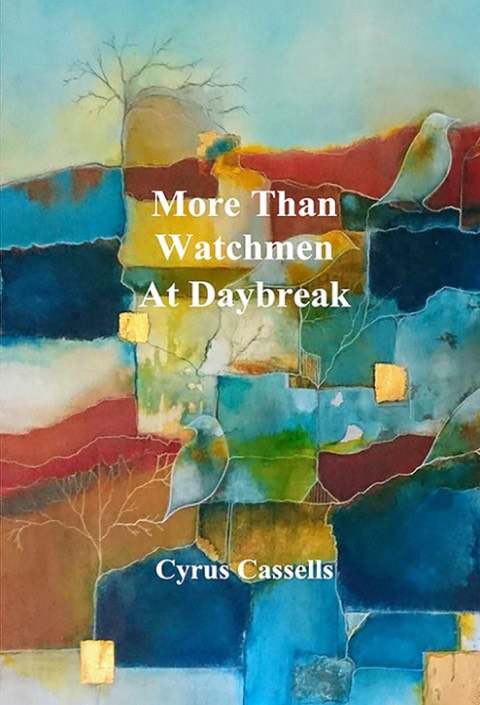
In 2019, Cyrus published a short collection of poetry he wrote while staying at Christ in the Desert Monastery for a writing residency. He took the title of his collection from Psalm 130:5-6:

I wait for the Lord; my soul waits,
    and in his word I hope;
my soul waits for the Lord
    more than those who watch for the morning,
    more than those who watch for the morning.

In the poem with the same title as the collection, “More than Watchmen at Daybreak,” Cyrus says,

     I’m thirsty, fallible,
     Incensed and restive in this desert monastery,
     But not yet resigned,
     Full of questions and parrying
     From wolf’s hour to blue hour
     To burgeoning dawn —

He is the “watchman” from Psalm 130 in today’s political and social climate. The watchman of Psalm 130 is not unlike the oracle the prophet Habakkuk saw, who, in Chapter 1, as read on Proper 26, Year C, Track 1, Sunday November 2, 2025, cries out:

     O Lord, how long shall I cry for help,
and you will not listen?
Or cry to you “Violence!”
and you will not save?

That Psalm 130 watchman, that Habakkuk oracle, Cyrus in the desert today, me praying Compline now — we are all “not yet resigned.” We are all willing to strive for justice and peace among all people because, as Cyrus says in his poem,

     the soul says,
Yes, I was there.

I was there, just as the watchman was, when she looked out of the monastery to cry to the monks, “The sun is up; it is time to pray.” I was there, just as the watchman was, when she looked out of the military fortification and shouted to those she protected, “They attack! To arms!” I was there, just as the watchman was, when he awoke from accidentally falling asleep, and cried, “Jesus! You are betrayed!” I was there, just as the watchman was, when we all knelt together and prayed:

     O God our Father, whose Son forgave his enemies while he
was suffering shame and death: Strengthen those who suffer
for the sake of conscience; when they are accused, save them
from speaking in hate; when they are rejected, save them
from bitterness; when they are imprisoned, save them from
despair; and to us your servants, give grace to respect their
witness and to discern the truth, that our society may be
cleansed and strengthened. This we ask for the sake of Jesus
Christ, our merciful and righteous Judge.
Amen. (BCP, 823)

and

Grant, O God, that your holy and life-giving Spirit may so
move every human heart [and especially the hearts of the
people of this land], that barriers which divide us may
crumble, suspicions disappear, and hatreds cease; that our
divisions being healed, we may live in justice and peace;
through Jesus Christ our Lord.
Amen. (BCP, 823)

God loves you, and you, and you!

Photo by Pam Tinsely

by Pam Tinsley

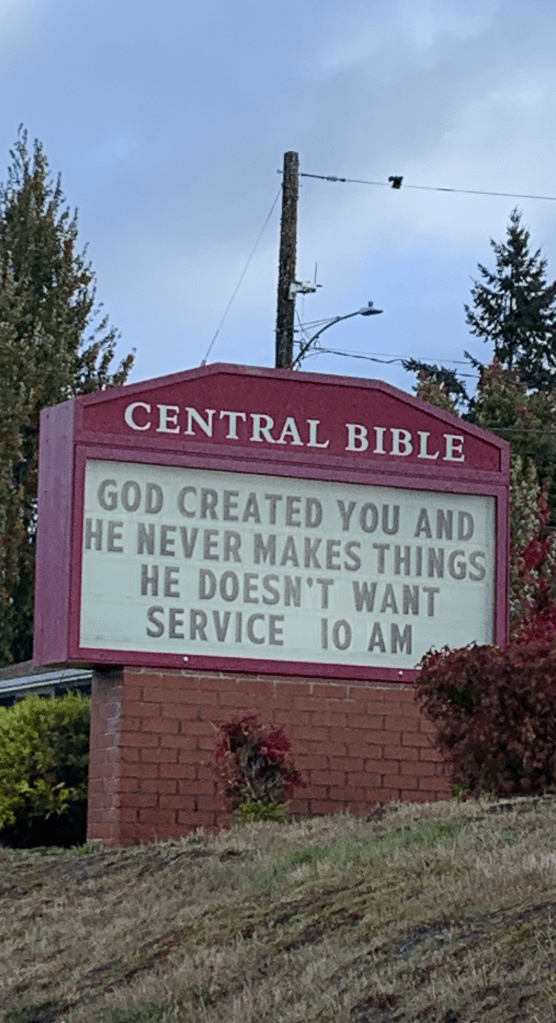
“God created you and he never creates things he doesn’t want” is the message on the reader board outside a church I often drive by. What an important message for us today and every day, especially when we hear so many messages to the contrary!

God loves us, even when we try to hide our flaws. God loves us even when we pretend to be worthy. God loves us, even if we feel we’re unworthy. God loves us, especially when others tell us we are worthless. God knows us intimately – our sitting down, our rising up, and every word on our lips, as the Psalmist observes (Ps 139) – and still God loves us simply because God’s essence is love.

Today, the world stokes our fear and insists that we must choose sides. Choosing a worldly viewpoint serves only to intensify our feelings of separation from one another and from God. Again and again, Jesus and angels assure us not to be afraid. Playing on our fears sends the message – and especially to the weak, the lost, and the vulnerable – that God doesn’t love us; that God doesn’t care; that God has turned God’s back on us.

But God’s way is love, and love is God’s way of saying that none of this is true.

When we claim the truth that we are loved, we free ourselves from the shackles of fear and can open our hearts to receive God’s abundant love. We’re then called to respond to God’s love by walking in love, not fear, hate, or indifference. We’re called to put our love into action by reaching out to others, regardless of whether we believe that they are worthy. We’re called to pass on the never-ending love we receive because there is no end to God’s fountain of love.

And why should we choose love instead of fear? Because God created us and will never stop loving us. Because God created our neighbors and loves each and every one of them. And because God never creates anything that God doesn’t love.

The work beneath the work

by Demi Prentiss

There is holiness in our workpaid and volunteer, work we’re called to and work we resist, work that’s rewarding and work that drains us.  We come closer to making our life a prayer when we can discover that holiness. When we can perceive God present in the work itself.

My work colleague, Josh Anderson, composed this prayer and recently graced a staff meeting with his work.  For me, it opens a door into a new vision of holiness in the everyday.

A Prayer for the Work Beneath the Work

Before we begin,
let us remember that beneath every agenda there is a heart,
and beneath every report,
the quiet pulse of shared purpose.

We come together carrying many things—
tasks to complete, questions unresolved,
worries we haven’t yet named aloud.
The world beyond these walls feels unsteady,
and the ground beneath us sometimes shifts faster than we can find our footing.

Still, here we are.
Gathered.
Pausing before the work.
Listening for what is deeper than the noise.

Let us remember that even in seasons of change,
the Spirit does not abandon us.
It moves quietly among us,
in small mercies and steady hands,
in the grace of a kind word,
in the courage to keep showing up.
Stillness is not a waste of time—
it is the way the soul catches up to the body.
It is how we remember who we are
and why we do this work.

So may what is heavy find a place to rest.
May what is uncertain find patience.
May what feels fragmented find its wholeness again.
May what is hidden in shadow find light.

And may we—in this brief hour together—
remember that even in the work of planning and doing,
there is holiness.
That God is here,
in the silence before we begin,
in the words we will speak,
and in the quiet that follows when our work is done.
Josh Anderson