Mistakes allowed; uncertainty abides; love wins

Veil Nebula supernova remnant picture by the Hubble Space Telescope. Source: NASA

by Demi Prentiss

My extended, blended family is, probably like many other similar families, repeatedly in the throes of learning how to be with one another.  Lately, we have a mantra to fall back on when things get tough: “We are allowed to make mistakes.”  That’s not designed to avoid accountability, or foster a laissez faire attitude about not doing our best. It does, often, open a door to grace – recognition that human beings are fragile and prone to unforced errors, and often in need of toleration. We need safe space where we can risk and be wrong. Fail fast, learn from mistakes, seek forgiveness, and even when we fall down, persist in falling forward.

A priest friend, looking at the Genesis story of “The Fall” and Adam and Eve’s ejection from the Garden of Eden, often said that original sin had nothing to do with sex, and not even with lust for knowledge. “The original sin is the desire for certainty,” he would pronounce, with a wink to those who recognized the irony of his daring to be so certain.

We human beings – made in the image of God, say the prophets – really do seem to prefer black-and-white, cut-and-dried, take-it-or-leave-it dichotomies, with clear boundaries and the opportunity to categorize outcasts and insiders.  The only trouble is that Jesus – and the rest of the Trinity, apparently – are much less into stark differentiation and more into a willingness to focus on similarities rather than differences. That whole “God is love” thing.

As we seek to be followers of the Son of God, part of the walk of faith is the willingness to take the next step, following God’s calling, without the luxury of certainty. Christian theologian Paul Tillich wrote, “Doubt isn’t the opposite of faith; it is an element of faith.”[1] And author Anne Lamott answers, “[The] opposite of faith is not doubt, but certainty. Certainty is missing the point entirely. Faith includes noticing the mess, the emptiness and discomfort, and letting it be there until some light returns”[2]

“…until some light returns.” That’s a tough space to wait in. And Christians are called to speak out for God’s truth and light even when darkness appears to prevail. The Good News includes, “You shall know the truth, and the truth shall set you free” (John 8:32). God’s truth, revealed in the cosmos, reminds us that God’s incredible, enthusiastic diversity is a more trustworthy guide to truth than single-minded certainty. The “first testament” – all of creation – speaks that truth. Difference – and mess – everywhere!

Richard Rohr’s Daily Meditation for Aug. 31, 2024 offers a prayer from author Cole Arthur Riley, “A Prayer for Those Who Thought They Knew,” a “prayer for those who have left spiritual spaces of certainty”: 

God of wisdom, 
It’s hard to know what to say to a God claimed by those who have wounded us. Can we trust you? We have known what it is to exist in spiritual spaces that are more interested in controlling us than loving us. To have the room turn against us when our beliefs diverge from the group’s. We thank you for giving us an interior compass, an intuition that no longer trusts spirituality that feels like captivity. Free us from those spaces. But as we depart, keep us from relinquishing our own connection to the divine. Help us to approach you slowly in the safety of our own interior worlds before granting another spiritual space access to us. And when we’re ready, guide us into new and safe communities—communities capable of holding our deepest doubts, our beliefs, the fullness of uncertainty, without being threatened. May we approach shrewdly and carefully, for our own protection, as we search for spaces that honor the whole of us. 
Ase.
 

Riley offers this prayer to use with the breath: 

INHALE: I am free to not know. 
EXHALE: I can rest in mystery. 
INHALE: I may not know what I believe, 
EXHALE: but I know it will sound like dignity. 
INHALE: My doubts are sacred. 
EXHALE: God, stay close as I wander.

[1] Paul Tillich, Systematic Theology, Volume 2 (University of Chicago Press: Feb. 15, 1975), pp 116-7. Dec 08 . 2015

[2] Anne Lamott, Plan B: Further Thoughts on Faith, (Riverhead Books: 2005)

Infused with transfiguring love

by Pam Tinsley

During a small church gathering in early August, a group of us were reflecting on the Feast of the Transfiguration and the glory of God that Jesus’ disciples Peter, James, and John experienced. We talked about our own desires at times to linger in “mountaintop” experiences, resisting the call to return to our sometimes-messy daily lives. So, when the facilitator asked us what “transfiguration” looked like in our daily lives, the conversation shifted to how our lives – even at their messiest – might glorify God.

One story was especially poignant. Cindy had accompanied a good friend for her first chemo appointment. Being diagnosed with cancer is distressing enough. The anxiety around one’s first chemo appointment is even more so. Because Cindy is one of those people who radiates God’s grace – and glory – in pretty much everything that she does, I can’t imagine a better person to accompany anyone to such an anxiety-inducing appointment!

But it turned out that Cindy’s friend was equally at peace with the infusion process. The two of them decided to give names to the infusion bags. The most potent chemo drug happened to be in a red bag, so they called it the Red Devil. They also looked around the room at the other infusion patients and quietly offered prayers for them.

Cindy then felt a sense of peace, light, and God’s radiance. The infusion room – which typically is a room filled with fear and anxiety – had been transfigured by God’s presence into a sacred space. Cindy and her friend savored the sacred moment together.

Pondering this story, our little congregation realized how God transforms us spiritually by God’s radical love. And, like Jesus’ disciples, we can’t remain on the mountaintop and bask in the radiant glow of God’s love. Instead, we are called to return to the messy world so that we, Christ’s body, might radiate his love and glorify God.

Just for today . . .

[Your reading experience will be better on a larger format screen – laptop or tablet.]

by Demi Prentiss

This past week’s Gospel reading – “deny [your]selves and take up [your] cross and follow me” – inspired a convicting reflection on the scripture (Mark 8:27-38) by Brian Malison, a graduate of Luther Seminary, in their daily posting “God Pause”:

“Christianity has a PR problem. It is impossible to put a positive spin on the statement, ‘Come join our church and learn how to deny yourself.’  There are no books on how to diminish yourself. It just isn’t the American way. There are plenty that tell you how to maximize your potential or how to become your very best self, but self-help books on taking up your cross are rarely to be found. Which may be why Jesus isn’t popular. Unless, that is, you are sick and tired of keeping up, you have found the pursuit of happiness to end in disappointment, or you have discovered that your very best self is not someone you like. Then the alternative of following Jesus, who welcomes all and offers redemption, sounds pretty good. Losing one’s fake life for the sake of Jesus is actually gaining real life. Now, how do we market that?”

Almost as though he was responding to Malison’s search for a “self-denial” tool, my longtime friend Christopher Thomas, rector of St. Thomas the Doubter in Dallas, TX, recently offered this “prayer for daily use” to his congregation and his Facebook followers. It serves as a powerful reminder that living the baptismal covenant – the outline of the calling God has placed on our lives – is not “one and done.” It’s intended to be a daily pattern, a “just for today” surrender to the fullness of life that God desires for us.

May God lead us to practice our baptismal promises intentionally today and every day, experiencing God at work through us. That’s the self-denial that allows us to become our truest self – the image of Christ that God dreams for us. That’s the promised transformation – of self and of the world around us – that sells.

Holy work

“The glory of God is the human being fully alive.” – Irenaeus
(Photo by Zac Durant on Unsplash)

by Pam Tinsley

Almighty God, you have so linked our lives one with another that all we do affects, for good or ill, all other lives: So guide us in the work we do, that we may do it not for self alone, but for the common good; and, as we seek a proper return for our own labor, make us mindful of the rightful aspirations of other workers, and arouse our concern for those who are out of work; through Jesus Christ our Lord, who lives and reigns with you and the Holy Spirit, one God, for ever and ever. Amen. (Prayer for Labor Day, BCP, p. 261).

Do you think of the work you do or your job as holy? Maybe if you work in a church or serve in church ministry, you might consider that part of your life as holy work. But, I mean all of your work: your job; your household chores; raising your children or grandchildren; or serving your community. Do you think of that as holy?

Well, God does! Whatever work you do is holy because it is an integral part of you. And God loves you. All of you.

Too often, we consider only church-related activities – be they serving at worship, serving on church committees or vestries, participating in Christian formation – to be holy because we refer to it as ministry. We tend to segregate our secular lives from our spiritual lives without considering two important  factors:

  • God sees and loves our wholeness, and
  • our daily work matters to God.

Throughout Scripture we read about the dignity of work, beginning in Genesis with God’s own work of creation. After all, Jesus was a carpenter, and we know that his disciples’ occupations were important to them – fishermen and even businessmen. Luke the Evangelist was a physician. And in addition to the Apostle Paul’s ceaseless evangelism throughout the Mediterranean, he continued his work as a tent maker (Acts 18:3). Lydia, who became a convert after listening to Paul, was a seller of purple cloth. In his letters, Paul doesn’t call disciples to abandon their – and our – daily work. Instead, he encourages us to center our lives on Christ as we go about our labors.

And even today, our labors are woven into our worship at the Eucharist when we present the fruits of our lives and labors to God at the offertory. Then the gifts that God’s earth has formed, and human hands have made[1]– bread and wine – become the very gifts of God for the people of God.

So, during this Labor Day week – and, God willing, throughout the year – may we all be reminded of the holiness of the work that each one of us is called to, and may we honor God by offering it to God.


[1] Enriching our Worship, Eucharistic Prayer 3

Pentecost unbound

(For optimum viewing, use desktop or tablet.)
Do you appreciate our weekly postings? Want to support our work to further empower lay voices at General Convention? Please consider contributing here. To learn more about our work as part of The Consultation, read our March 5 post.

by Demi Prentiss

All of them were filled with the Holy Spirit and began to speak in other languages, as the Spirit gave them ability. — Acts 2.4

Pentecost was not, as some say, “the undoing of Babel” —
now we all speak the same language!
No, it was the opposite: the blessing of Babel.
We learn one another's languages.
We embrace diversity, and learn to listen to each other,
to see from another's perspective,
to give voice to a life other than our own,
to make central a language that's not our own,
to communicate grace that's not on our own terms.
We acknowledge the differences in our lives,
honor one another's various home places and cultures,
and cross over the boundaries of comfort and familiarity.

On that Pentecost day I don't imagine they were eloquent.
They spoke in halting Phrygian, mangled Mesopotamian.
It probably took some back-and-forth, some double-checking.
It required not just proclaiming but listening, relating,
and patience on the part of the hearers,
and courage and humility on the part of the speakers —
willingness to be beginners, to risk, to appear foolish,
to forgo the safety of being in the dominant group.

Pray for such humility and courage, to risk for the sake of love,
to be foolish for the sake of relating,
to let other people's reality be real.
In such loving, the Holy Spirit will speak, loud and clear.
by Steve Garnaas-Holmes

We’re barely past Pentecost and already we’re tempted to put those tongues of fire back in the box until next year. “Not yet,” we’re inclined to say.  Then Brian McLaren reminds us

The good news is that the Spirit is already here, living and active – and has been since the dawn of creation. Our challenge – as we pray “Come, Holy Spirit, come” – is not to persuade the Spirit to be present. May we pray to be born anew, so that we may see the reign of God. Allow us to see through God’s eyes to perceive the Spirit at work everywhere around us.

To the members of Christ's body,
to the branches of the Vine,
to the Church in faith assembled,
to her midst as gift and sign:
Come, Holy Spirit, come.
– Carl P. Daw, Jr. – “Like the murmur of the dove’s song”

 [1] Brian D. McLaren, We Make the Road by Walking: A Year-Long Quest for Spiritual Formation, Reorientation, and Activation(New York: Jericho Books, 2014),203, 205. 

Who are you? Whose are you?

by Demi Prentiss

How do sacraments make sense in a 21st century context?  What are Christians proclaiming when they list two – or seven – “means of grace”? What’s the point, enacting such ancient “outward and visible sign[s] of inward and spiritual grace”? Are we stuck with “It’s tradition” as the best explanation we have?

Still walking what has been, so far, a 70-year-long journey in faith, I understand baptism as the foundational sacrament of Christian life. When we are embraced by baptismal waters, when we are the subject of the words “You are my beloved,” we are assured that the Creator of the universe acknowledges us as lambs of God’s own flock. We are, in the words of the Book of Common Prayer, “marked as Christ’s own forever.”  Those words are written on our hearts, even if our brains don’t always remember them.

Baptism is, above all, a sacrament of identity. Our identity rooted in God, acknowledged and affirmed in and through community. What we do in our lives is shaped by innumerable variables; who we are – and whose we are – is brought to life by the God who made us and loves us, everlastingly. Our identity is defined by the God whose name is love, and whose love is unconditional.

Identity, however, is not enough. After all, the God who loves us just exactly the way we are is never content to leave us unchanged. Setting out on a journey with God always involves growth, metanoia, transformation.   Appropriately, the second major sacrament – communion, eucharist, the Lord’s Supper – is the sacrament of growth.  Celebrations of communion involve confession, forgiveness, being inspired and encouraged, claiming our role in community, being fed, and being sent out into the world to carry God’s good news to others. Each of those elements call on us to grow, and to participate in our own development.

Each time we remember our baptism or celebrate eucharist, we are reminded that God is at work in both our identity and our growth. The church’s other sacraments give further evidence of God’s tender concern for us, shaping our identity and growth in aspects of a healthy spiritual life.

    • Confirmation – a sacrament of identity and growth through participation in community
    • Reconciliation – a sacrament of identity and growth in forgiveness
    • Marriage – a sacrament of identity and growth through relationship
    • Unction – a sacrament of identity and growth in and through healing
    • Ordination – a sacrament of identity and growth through developing a community

And it all arises from our baptism, that affirmation of our identity, our belovedness, and our being called into lifelong relationship with the God who made us. That calling summons us to fullness of life.

With respect to words . . .

by Pam Tinsley

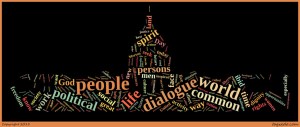
#Tagxedo Wordcloud: Pope Francis’s address to a joint meeting of Congress, September 24, 2015

“Will you respect the dignity of every human being?” was one of the questions we were asked as we renewed our baptismal promises on the First Sunday after the Epiphany (Book of Common Prayer, p. 305). This question was especially poignant in the face of the vitriol spewed by the administration’s leaders which resulted in an impasse that requires hundreds of thousands of government employees to work without pay. The longest government shutdown in our nation’s history is having a rippling effect on some people and a tsunami effect on others, such as those who rely on the government for essential services like food inspection, airport security, food for children and their families, and loans for already financially strapped farmers, not to mention paychecks for contract workers required to work and who will not receive back pay.

Will you respect the dignity of every human being?

As we wait for our elected officials to lead, I’m reminded that each one of us is a leader within our own sphere of influence. The words we proclaim on Sunday mornings when we renew our baptismal promises are not meant to be for Sunday only, or for only within the walls of the church. They are words meant for every day. They are words meant for each situation we encounter when we relate to others, regardless of whether they look like us, where they are from, or whether they hold the same opinions or beliefs as we do. Merely words? No! Words that shape how we live.

Living by the words of our baptismal covenant, including “will you respect the dignity of every human being,” requires us to hold our leaders accountable. This includes speaking up when the dignity of others is violated, because silence, after all, is consent. Our baptismal promises also call us to respect the dignity of those with whom we disagree. And therein lies the challenge.

Mind your business

by Pam Tinsley

I recently saw a stage production of Charles Dickens’ A Christmas Carol. He wrote his novella in 1843, in outraged response to the dire working conditions of the poor, especially of women and children, as England became more industrialized. I’m sure you’re familiar with the story of Ebenezer Scrooge, a slave of greed – heartless and mean-spirited – who is visited first by the ghost of his deceased business partner, Jacob Marley, who voices his life regrets. He is then visited by the Spirits of Christmas Past, Present, and Future, before he awakens humbled and transformed on Christmas morning.

As I listened to Jacob Marley’s words of deep remorse for his life failings, I was struck by how they reflect our promises at baptism. After Scrooge extols Marley’s virtues as a businessman, Marley retorts,

Mankind was my business. The common welfare was my business; charity, forbearance, and benevolence were, all, my business. The dealings of my trade were but a drop of water in the comprehensive ocean of my business!…. Why did I walk through the crowds of fellow-beings with my eyes turned down, and never raise them to that blessed Star, which led the Wise Men to a poor abode! Were there no poor homes to which its light would have conducted me!

Marley had realized belatedly that the most important aspect of his daily work as a business owner was to seek and serve Christ in his neighbor; to strive for justice; and to treat everyone he encountered with dignity and respect – using our baptismal language. Helping to create a more caring and just world was his true purpose in life.

Visits by the Spirits of Christmas Past, Present, and Future reveal to Scrooge the joy he experienced in his youth before greed corrupted him; the dismal plight of the world around him; and the bleak future that lies ahead. After the Spirits’ ominous visits, Scrooge awakens on Christmas morning a new man with his softened heart filled with love and generosity for others. Humbled, he heeds the Spirits’ warnings and is transformed – and learns always to keep Christmas well.

Although A Christmas Carol is a work of fiction, it reminds us all that humankind is our business. We, too, can keep Christmas in our hearts every day and show the world God’s love through our caring words, but especially through our actions where we live and work, each and every day.

Being a missional church

by Edward Lee

Peyton G. Craighill, a priest and missiologist, is a founding member of Episcopalians on Baptismal Mission. In fact, he’s been an advocate and interpreter of ministry in daily life for most of his professional and personal life which includes years of service in China as well as the USA. Recently Parkinson’s disease has silenced his speaking voice and made writing difficult. But there is a backlog of his written materials that are as relevant now as when they were first crafted. Here is one of them:

Peyton Craighill

THE MISSIONAL CHURCH MOVEMENT AND THE EPISCOPAL CHURCH


by Peyton G. Craighill


In America, congregations generally assume that their success is measured in terms of how many mem­bers they are able to attract. They also assume that their power to attract and hold members depends on their ability to produce programs that meet the spiritual and social needs of their members. The most successful congregations are those with the most attractive power.


The problem with these assumptions is that they ignore why God created – and continues to create – congregations. The Church came into being when God sent his Son into the world to live, die, and rise again for that world and to commission his followers to spread the Good News of God’s love and justice through word and action into all that world.

The Church exists not primarily to attract people into congregations but to send people out to share with God in his mission in all areas of daily life. When we were baptized into Christ, he commissioned us all to participate with him in his mission, Monday through Sunday.


The paradigm shift from an attractional to a sending model of congregational ministry calls for a major reconsideration of every aspect of church life – worship, formation, community, and service. Mission is no longer on the periphery of church life. Mission is why congregations exist. Parish programs need to be re­ thought in terms not only of the corporate life of congregations, but also in terms of how they inspire, guide, and support each member in his or her missions in all areas of daily life – home, work, leisure, community, church, and the wider world.


In regard to the missional church movement in the Episcopal Church, what sets our approach apart from other Churches is our emphasis on baptism and the baptismal covenant. As Christ’s mission began with his baptism, so too our mission, shared with Christ, begins with our baptism. In particular, the five commitments we make in the Baptismal Covenant provide us with invaluable inspiration and guidance for our missions in Christ.


We recognize of course, that in mission-oriented congregations, attraction remains an important part of ministry. Unless congregations attract members in, there will be no missionaries to send out. But attraction is subordinated to sending. Indeed, the best way to attract people into congregations is when those congregations inspire and support all their members to live out their faith in their everyday lives.

Baptismal accountability

by Edward L. Lee, Jr.

In Wayne Schwab’s recent posting for Living God’s Mission titled “Designing the Right System” he posited this insight: If we want a church that gives primary emphasis to the concept of ministry in daily life then we have to  “redesign the system to produce the results you want.” That’s a big task given our current denominational and congregational traditions, practices, and governance structures. But he’s right.

An essential element in any redesign of our church systems will have to be member accountability. Why?  The church is a voluntary association of leaders and members. There are ways, both formal and informal, to hold leaders accountable. But there is little if ever any likelihood that all members will be held accountable for attitudes and behavior that contradict the norms and values of the church’s mission and ministry embodied in Baptism and articulated in the Baptismal Covenant (see Book of Common Prayer, pp. 304-305).

What is meaningful accountability in a community, a congregation of the baptized? Accountability means simply that: the ability to give an account. I Peter 3:15 puts it this way: “Always be prepared to make your defense to anyone who demands from you an accounting for the hope that is in you.” (NRSV) That hope is grounded in faithfulness to our baptism and the covenant we have with Christ in God’s mission in and for the world. That mission is daily and not just Sunday. It is in the fullness of our lives and not just in the confines of our home parish. The latter should be a place and community of empowerment, a system for supporting and affirming ministry in daily life.

How might a congregation exercise baptismal accountability? First, it makes it an expectation of membership, of what it means to be “sealed by the Holy Spirit in Baptism and marked as Christ’s own forever.” In short, that being baptized is serious and solemn business day in and day out.

Second, offer members regular opportunities to “give an accounting,” a mutual sharing of what ministry in daily life entails with all of its complexities, contradictions, challenges, and confusions.

And third, trust the community of the baptized to help answer the question, “How am I doing?” Baptismal accountability is not an inventory of success or failure, of pride or repentance, but of assessing with others how we live into and live out our baptismal mandate to see and serve God in the world as we daily encounter, endure, and embrace it.