What a glorious vision of what takes place at every baptism, and even at the four yearly occasions when Episcopalians renew our baptismal covenant (Feast of the Baptism of our Lord, Easter, Pentecost, and All Saints’ Day): “Rooted in the very life of Christ.” Like the tree planted by the water, we recognize that we are sustained by the Word of God (Jesus Christ, especially as revealed in scripture) and the water that represents God’s sustaining love, bathing us at all times and in all places.
The opening quote above was written by Mark S.B. Docken, a 1982 graduate of Luther Seminary, in a reflection on Psalm 1. To offer more context:
….[T]here was a severe drought when I served in northeast Montana, and the Big Muddy went dry. Nevertheless, the cottonwoods were sustained by the subterranean moisture invisible to the eye. When we encounter the arid times of depression, oppression, loneliness, ill-health, and grief, we trust that God will sustain us even when we cannot sense it. For in the water and the Word of baptism, we have been rooted into the very life of Christ. “It is not I who lives, but Christ who lives in me” (Galatians 2:20). We trust that God is an ever-flowing stream of justice, unconditional love, and blessing.
Each day, each hour, each minute we are immersed in the blessing of being rooted in Christ. Our challenge is to claim and proclaim it, by living into our identity as members of Christ’s Body.
How Full is Your Bucket Is the title of a book I read years ago for professional development.Authors Tom Rath and Donald Clifton’s premise is that each of us has an invisible “bucket,” and each interaction with another person can help fill our “bucket” by making us feel more valued, more positive. Conversely, when we say or do negative things, we diminish other people and ourselves. Those interactions affect our physical health; our mental health; our productivity; and even our longevity.
Each of us also has an invisible “dipper.” When we use that dipper to fill other people’s buckets – by saying or doing things to increase their positive emotions and energy[1] – not only do we fill their buckets, but we also fill our own bucket.
I was reminded of this book on the first Sunday in Lent when we read in Luke’s Gospel that Jesus is full of the Holy Spirit as he is led in the wilderness by the Holy Spirit. It’s no surprise that Jesus is full of the Holy Spirit. After all, he’s just been baptized in the Jordan River by John the Baptist and anointed by the Holy Spirit. He’s also been affirmed as God’s beloved Son, with whom God is well-pleased. As Jesus fasts for 40 days in the wilderness, the devil keeps trying to empty Jesus’ bucket by tempting him.
At baptism, we, too, are anointed and affirmed. We’re sealed by the Holy Spirit and marked as Christ’s own – forever. Our buckets are full. They’re full of the Holy Spirit. They’re full of love – because God created us in love and for love.
Every day, throughout the course of our lives, each of us has multiple opportunities to fill someone else’s bucket – or to dip from it. Each such encounter is a choice. We can fill someone’s bucket, or we can dip from it. We do this by choosing to be loving and kind – especially in the face of adversity and even cruelty. By choosing to be kind we can profoundly shape our relationships, our health, and our spiritual well-being. This Lent, I’m choosing a daily practice of kindness. And I invite you to join me in this practice, as together we spread Christ’s love in a way that just might offer hope and healing to our hurting world.
[1] Tom Rath and Donald Clifton, PhD. How Full is Your Bucket (New York: Gallup Press, 2004), 15.
Veil Nebula supernova remnant picture by the Hubble Space Telescope. Source: NASA
by Demi Prentiss
My extended, blended family is, probably like many other similar families, repeatedly in the throes of learning how to be with one another. Lately, we have a mantra to fall back on when things get tough: “We are allowed to make mistakes.” That’s not designed to avoid accountability, or foster a laissez faire attitude about not doing our best. It does, often, open a door to grace – recognition that human beings are fragile and prone to unforced errors, and often in need of toleration. We need safe space where we can risk and be wrong. Fail fast, learn from mistakes, seek forgiveness, and even when we fall down, persist in falling forward.
A priest friend, looking at the Genesis story of “The Fall” and Adam and Eve’s ejection from the Garden of Eden, often said that original sin had nothing to do with sex, and not even with lust for knowledge. “The original sin is the desire for certainty,” he would pronounce, with a wink to those who recognized the irony of his daring to be so certain.
We human beings – made in the image of God, say the prophets – really do seem to prefer black-and-white, cut-and-dried, take-it-or-leave-it dichotomies, with clear boundaries and the opportunity to categorize outcasts and insiders. The only trouble is that Jesus – and the rest of the Trinity, apparently – are much less into stark differentiation and more into a willingness to focus on similarities rather than differences. That whole “God is love” thing.
As we seek to be followers of the Son of God, part of the walk of faith is the willingness to take the next step, following God’s calling, without the luxury of certainty. Christian theologian Paul Tillich wrote, “Doubt isn’t the opposite of faith; it is an element of faith.”[1] And author Anne Lamott answers, “[The] opposite of faith is not doubt, but certainty. Certainty is missing the point entirely. Faith includes noticing the mess, the emptiness and discomfort, and letting it be there until some light returns”[2]
“…until some light returns.” That’s a tough space to wait in. And Christians are called to speak out for God’s truth and light even when darkness appears to prevail. The Good News includes, “You shall know the truth, and the truth shall set you free” (John 8:32). God’s truth, revealed in the cosmos, reminds us that God’s incredible, enthusiastic diversity is a more trustworthy guide to truth than single-minded certainty. The “first testament” – all of creation – speaks that truth. Difference – and mess – everywhere!
Richard Rohr’s Daily Meditation for Aug. 31, 2024 offers a prayer from author Cole Arthur Riley, “A Prayer for Those Who Thought They Knew,” a “prayer for those who have left spiritual spaces of certainty”:
God of wisdom,
It’s hard to know what to say to a God claimed by those who have wounded us. Can we trust you? We have known what it is to exist in spiritual spaces that are more interested in controlling us than loving us. To have the room turn against us when our beliefs diverge from the group’s. We thank you for giving us an interior compass, an intuition that no longer trusts spirituality that feels like captivity. Free us from those spaces. But as we depart, keep us from relinquishing our own connection to the divine. Help us to approach you slowly in the safety of our own interior worlds before granting another spiritual space access to us. And when we’re ready, guide us into new and safe communities—communities capable of holding our deepest doubts, our beliefs, the fullness of uncertainty, without being threatened. May we approach shrewdly and carefully, for our own protection, as we search for spaces that honor the whole of us.
Ase.

Riley offers this prayer to use with the breath:

INHALE: I am free to not know.
EXHALE: I can rest in mystery.
INHALE: I may not know what I believe,
EXHALE: but I know it will sound like dignity.
INHALE: My doubts are sacred.
EXHALE: God, stay close as I wander.
[1]Paul Tillich, Systematic Theology, Volume 2 (University of Chicago Press: Feb. 15, 1975), pp 116-7. Dec 08 . 2015
[2] Anne Lamott, Plan B: Further Thoughts on Faith, (Riverhead Books: 2005)
These days, little towns and suburbs of the big metropolises grow fast in Texas. Buda, a suburb of Austin, is no exception. In 2022, the population was reported to be about 16,000, yet this growing suburb is home to a bright promise of Baptismal Living – St. Elizabeth of DWTX.
St. Liz, as the Budans fondly call their little Buda mission, is served by Vicar Fr Mike Woods and his family. On Sunday, September 8, 2024, Fr Mike exegeted Mark 7:24-37 from the week’s lectionary Gospel reading. I’m quite sure most if not all of you experienced exegesis of this passage Sunday. I highlight Fr. Mike today for what I name his Baptismal Covenant Preaching of the Word.
When I name this Baptismal Covenant Preaching, I am highlighting a preaching that emphasizes an exegesis that includes an analysis of and call-to-action from a scripture passage that derives from all or part of The Episcopal Baptismal Covenant. Fr. Mike did that on Sunday, September 8, with Mark 7:24-37, yet he never even had to utter the words “baptism,” nor the words printed on pp. 304-5 of the Book of Common Prayer. Fr. Mike embodied the baptismal covenant and called all of us to do the same by sharing an analysis of Mark 7:24-37 that describes the Syrophoenician woman and the deaf man of Sidon and Jesus himself as people who need to be open to hearing from God, people who need simply to be open to new ideas, new ways of thinking and seeing, and to people not like themselves.
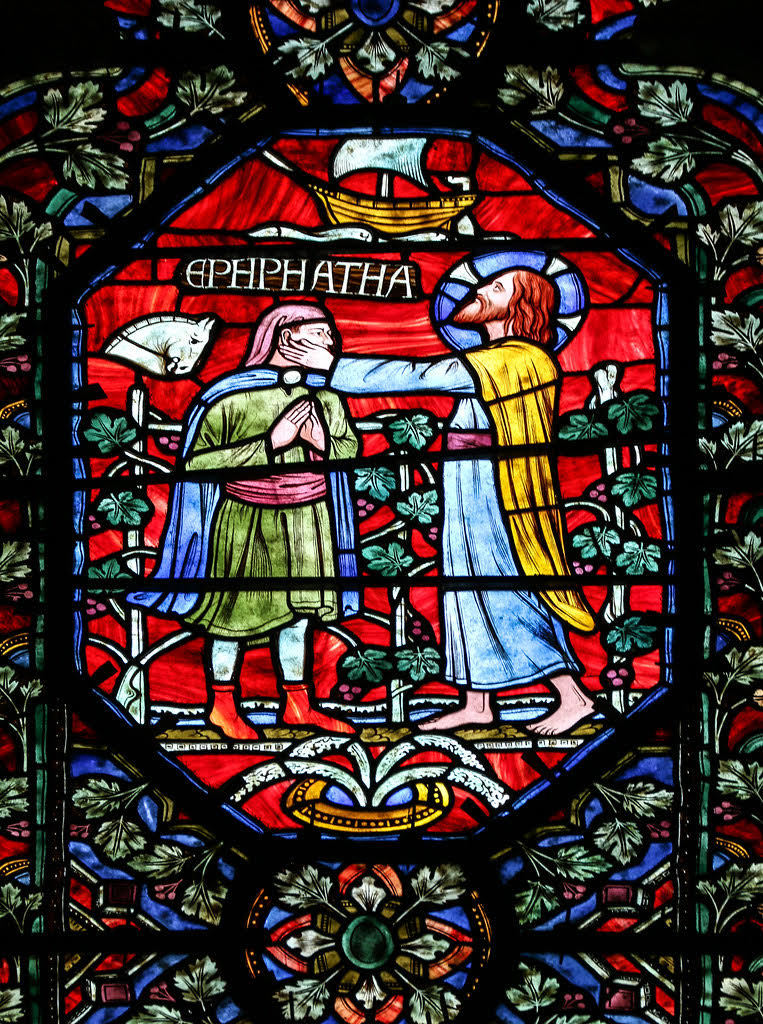
Fr. Mike spent time relating the word from v. 34 εφφαθα [ephphatha] to ideas of openness and how the need to be open to others and to hearing from God has not diminished but has in fact increased since the time in which the Syrophoenician woman reminded Jesus of this part of his own ministry. The Syrophoenician woman calls Jesus to be open to a blindspot, a cognitive dissonance, between how he’s treating her and what he’s been teaching. Εφφαθα – be open to me, to us, to difference.
Jesus’ own tomb is opened by that magic word – εφφαθα – just as Jesus becomes open to the need and faith of the Syrophoenician woman and then opens the ears and mouth of the man in Sidon. Just as so many of us begin our own words with a prayer of “May the words of my mouth and the meditations of my heart be acceptable to You, O God.” Open us. Open us.
Fr. Mike never had to say explicitly that we must remember our Baptismal Covenant, but we were reminded of it nonetheless, as he spoke to us of Mark 7:24-37 and εφφαθα – we were opened to new ways of thinking about this scripture and of applying it to our lives today.
As people who “seek and serve Christ in all persons, loving neighbor as self” and “strive for justice and peace among all people, and respect the dignity of every human being,” we cannot help hearing “εφφαθα,” as Fr Mike speaks it as a call to be open to every person in our midst today.
It might not be a Syrophoenician woman asking for healing for her daughter, but you might have a new kind of “neighbor” on whose behalf God is crying εφφαθα. Do you have ears to hear? Or shall Jesus come back and stick his fingers deep down in there?
On the website of St. Liz, the welcome message says, “We are an open, inviting, and inclusive community of Christ followers who seek to love our God and our neighbors by being a loving presence in the communities of Buda/Kyle and surrounding areas.” Sounds like Mark 7:24-37 and the Baptismal Covenant to me.
Mandy Patinkin as Inigo Montoya, The Princess Bride
Shakespeare, in Romeo and Juliet, has Juliet ask, “What’s in a name?” In what’s become a famous soliloquy (Act 2, Scene ii), Juliet wonders why her family and Romeo’s should keep their love from being known.
Semiotics, the study of signs and symbols and their use in communication and meaning making, has been applied by philosophers, linguists, anthropologists, theologians, and others. Ferdinand de Saussure (1857-1912) was a Swiss semiotician who worked in the subfield of semiology, focusing on the bilateral nature of the sign – the signifier and the signified. Saussure taught that words only have meaning in social context. What I say and think I mean only have meaning when you hear it and assign it value.
In The Princess Bride, a 1987 comedy-adventure film based on the 1973 book of the same name, Inigo Montoya says to Vizzini, “You keep using that word. I do not think it means what you think it means.”
Finnish academic Osmo Wiio’s somewhat satiric, yet accurate, laws of communication, state, “If communication can fail, it will.”
I live in Texas. Our Legislature meets every two years. In the last several sessions, one topic has held traction in the House and the Senate – anti-LGBTQ (especially anti-trans) legislation. Session after session, activists and advocates in the legislature, in the lobby, and in the public square have thwarted efforts to disenfranchise LGBTQ Texans. This year was different.
Texas, as of Friday 19 May 2023, is near enacting a law banning diversity offices in public universities. SB14 passed and will go to Gov Abbot, who says he will sign it. This bill bans minors from receiving trans-affirming medical care. The House has approved SB15 which bans transgender athletes from participating in sports based on gender. A bill that would have ended a law criminalizing homosexuality in Texas did not make it to the floor.
What’s in a name?
My name is Brandon. It hasn’t always been, but it is now.
He and She are signifiers of gender. The person to whom the pronoun refers is the signified. My pronouns are he/him. I am male.
How do you know what someone means when they use a word to describe a group of which you’re a part? Does the word really mean what you think it means?
Supporters of SB14, during the hearings, described transgender Texans as a “social contagion.”[1]
Communication fails.
Even Jesus’ Law of love:
43 “You have heard that it was said, You must love your neighbor and hate your enemy. 44 But I say to you, love your enemies and pray for those who harass you 45 so that you will be acting as children of your Father who is in heaven. He makes the sun rise on both the evil and the good and sends rain on both the righteous and the unrighteous.46 If you love only those who love you, what reward do you have? Don’t even the tax collectors do the same? 47 And if you greet only your brothers and sisters, what more are you doing? Don’t even the Gentiles do the same? 48 Therefore, just as your heavenly Father is complete in showing love to everyone, so also you must be complete.[2]
We enter a covenant with Jesus and reaffirm it again and again at Baptism:
I will follow the apostles’ teaching; I will be in community, break bread, pray; I will resist evil, repent, return; I will proclaim by word and example the Good News; I will seek and serve Christ in ALL PERSONS; I will LOVE my neighbor as myself; I will strive for justice and peace among all people; I will respect the dignity of every human being.
This love that Jesus teaches – of whose name we seem to have forgotten, whose signified is nearly lost, whose meaning seems absent these days – this love of Jesus we have allowed to fail to be communicated to our neighbors In Biblical Greek “love” is ἀγάπη (agape), considered the highest form of love – that between God and God’s Son – incarnational love – sacrificial love – perichoretic love – mysterious love. Nothing should be desired more or shared more than the love we receive from heaven.
When we promise to live baptismally, repeating those words everytime we support a newly baptized sibling in Christ, what are we signifying? What do we really mean? Do our words and actions toward all our neighbors, no matter their name, demonstrate the love of God – Three-in-One?
The Gospel for this week reminds us, “I came that they may have life, and have it abundantly” (Jn 10:10). For many, Jesus’ promise seems laughable, as we have faced the isolation enforced by Covid prevention measures and now the reduced attendance many congregations are experiencing. The past few years have cramped our vision and promoted scarcity thinking. Fear cripples our imaginations, and perceiving abundance challenges our common sense.
In Isaiah 54:2 the prophet reminds the Israelites to think bigger: “Clear lots of ground for your tents! Make your tents large. Spread out! Think big! Use plenty of rope, drive the tent pegs deep” (The Message). Like Israelites returning from exile, we in the post-Covid church are called to widen our vision and our embrace. Open our doors to welcome unfamiliar people and experiences. Sharpen our vision to perceive who our supporters and our allies are. Be courageous to invite contributions – both monetary and intangible gifts. Partner with both modest givers and big spenders alike.
Last week’s Gospel story of two dispirited disciples walking to Emmaus has always invited my speculation: What was the “tell” that allowed the two breaking bread with Jesus to, at last, recognize him? When the Risen Christ broke the bread, did they catch a glimpse of the nail holes in his hands? Was it the distinctive way he blessed the bread, or broke it, or poured the cup of wine that tipped them off? Perhaps it was the way he said “Abba” as he asked God’s blessing for the meal? Or the gestures he used as he handed food and drink to the others at table with him?
I like to think that the real giveaway was his hospitality – the way he embodied the message of open-handed abundance as he presided at the meal. “Enough is as good as a feast.” All who dine with Christ experience abundant life.
Jesus challenges believers to see him in the people we encounter every day – the stranger on the road, the surprise visitor, the people at our table, even those who are not our favorite companions. Where we see Jesus, we are called to see the abundance that he brings. As we widen our vision and our embrace, we enlarge the site of our tent – we make plenty good room, and shift our perception from scarcity to a heightened awareness of gift and opportunity. For us personally and for our society, our recovery – from pandemic, from hard-fought elections, from the dangers of everyday living and the fear of the unknown – may well depend on our ability to incarnate the abundance Christ promises. “Risen Lord, be known to us in the breaking of the bread.”
I live in a town named for Mark on a river named for Mark.
Archaeological surveys show that people have inhabited this land for around 12,000 years, and Spanish settlers, under the leadership of conquistadors and missionaries, settled here around 1648.
The names of the river and town recognize Spanish colonialism – San Marcos; the name of the church recognizes the subsequent Anglo invasion – St. Mark’s. But what became of the indigenous names?
My friends Mario Garza and Maria Rocha strive for justice and peace every day by remembering and speaking the language of their people – the people of this land – the Coahuiltecan People, by educating others about the history of this land and its people, and by living their own heritage as modern Coahuiltecans authentically.
The Feast of St. Mark is a time when our church gathers at the San Marcos River for baptisms, blessings, and barbecue (actually fried chicken, but I like alliteration).
As we promise together to strive for justice and peace among all, and pledge to respect the dignity of the Earth and every human being – when we gather at the river to pray with St Mark and all the Saints – may we remember those who predate us and our names.
In January, many of us celebrate the promises of our lives together in our church through annual parish meetings and parochial reports.
Some of us celebrate a Recovery Sunday with liturgical, musical, and educational focus on the sacramental and covenantal relationship of recovery people and programs among us.
Some of us celebrate Lunar New Year – this is the Year of the Rabbit, in case you were wondering – respecting the dignity of the diversity of ways of being people in this world.
Perhaps we lifted up the saintly Rev. Dr. Martin Luther King, Jr., on his birthday and will again on the day, in April, when he was taken from his earthly mission by gun violence.
Perhaps we held memorial vigils in remembrance of the genocidal violence of the Holocaust.
These are all parts of life in the church in January.
Supposedly, St. Benedict said, “Always we begin again.” This 6th century Italian hermit-turned-father of monasticism drew people into themselves, onto a path he followed, and along The Way with his divinely inspired meditations and writings, contemplations, and connections.
Whether or not he actually said, “Always we begin again,” is neither here nor there; for, we do always begin again.
What better way to live into the promises of our baptismal covenant than to weave these two sacred triangles together – God, ourselves and others with past, present, and future?
What symbols in the church, in nature, in your life remind you of this idea?
I see the triquetra and think of these 6 words which I say with gusto every time I witness a baptism because they remind me that always we begin again, together, to expand Love for creation: believe, continue, persevere, proclaim, seek, strive. These words that begin the versicles of our covenantal pledge weave together God, ourselves and others with past, present and future in a spinning, spiral, triquetra that always begins again and helps us celebrate just as we do every January, every year and shall every day.
After over two empty years – thanks to the pandemic – at Saturday’s Great Vigil of Easter we had the joy of gathering around the baptismal font as it was filled with water! By the Paschal candle’s light, we prayed with keen anticipation as the waters of new life in Christ flowed and were blessed. And although we’ve renewed our baptismal promises several other times since the pandemic’s inception, this renewal was clearly different. We renewed our baptismal vows with fervor, kindled by the power of the Holy Spirit.
Flickr – Lars Hammar – Baptismal Font
With God’s help, we proclaimed our promises to
continue in the apostles’ teaching and fellowship, in the breaking of the bread, and in the prayers;
persevere in resisting evil, and, whenever you fall into sin, repent and return to the Lord;
proclaim by word and example the Good News of God in Christ;
seek and serve Christ in all persons, loving your neighbor as yourself; and
strive for justice and peace among all people, and respect the dignity of every human being.
Then, as the priest showered us with holy water from the font, we were reminded: “Remember your baptism! Remember your baptism!”
We might think, for a moment, that the renewal of baptismal vows ends there. However, this renewal offers us a new beginning. After being fed and strengthened at the Lord’s table, our renewed baptismal promises prepare us to go forth into the world, dripping wet, as bearers of Christ’s light and love, rejoicing in the power of the Spirit! Alleluia! Alleluia!
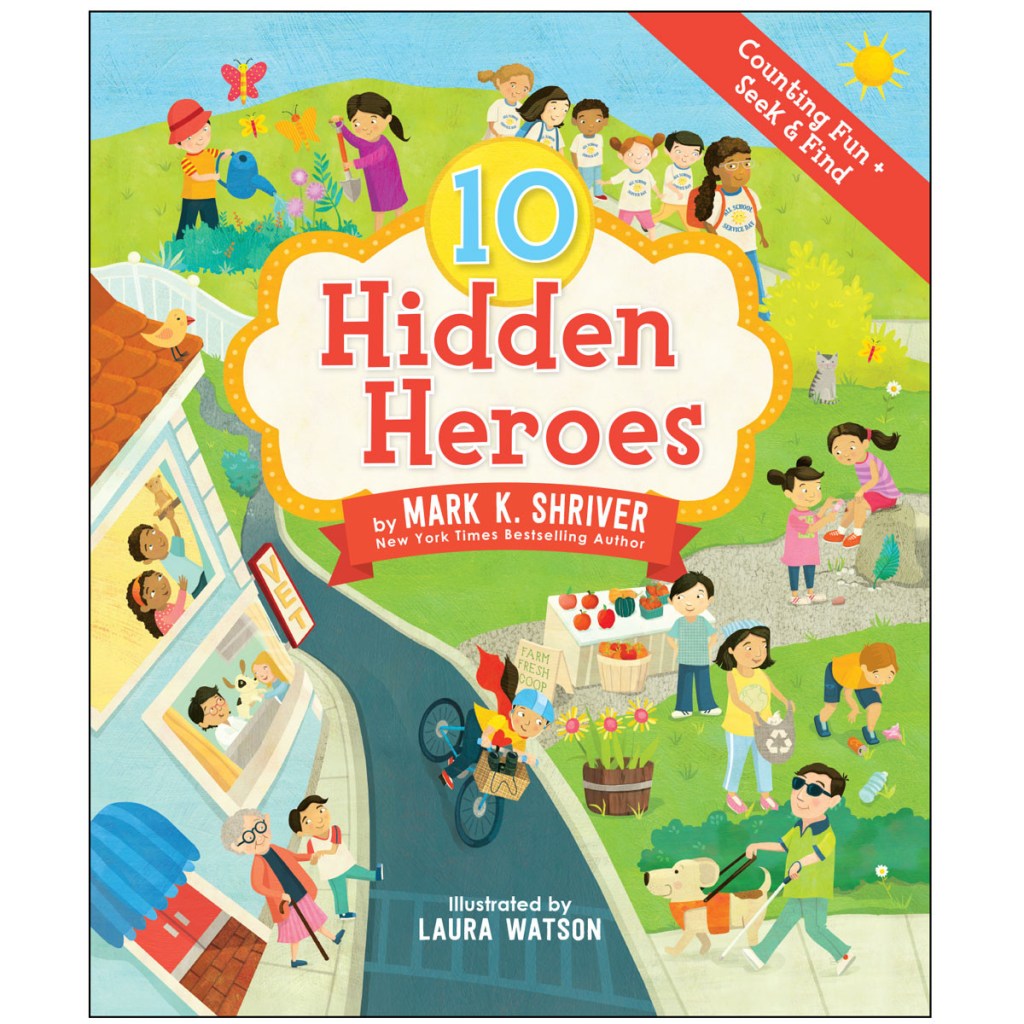
“Be Kind” were the words written on our 2½ year-old granddaughter’s shirt on the same day that a new book arrived. The cover of the book, 10 Hidden Heroes, shows children and adults helping others as they go about their everyday lives. Because I believe strongly in making our world more loving by living out our baptismal promises in daily life, I was eager to share this book with our little granddaughter.
She and I sat down together and searched through the pictures on each two-page spread. One set of pictures features hidden heroes nursing others back to health. Although one setting was in a hospital with nurses and doctors caring for patients, there was also a child tending to another child’s scraped knee and a girl caring for her injured cat. Another set of pictures highlights hidden heroes striving to protect the environment by planting trees, recycling, composting, and riding bikes. A boy stocking shelves in a food bank shows young readers how to serve those less fortunate. There are even hidden heroes who invent and do research to develop medicines and “treasures for humankind.”
Hidden Heroes author, Mark K. Shriver, is the president of Save the Children Action Network, and hopes that it can help children and their parents make the world a better place. When I read the book with our granddaughter, not only is she learning to count as she searches for the hidden heroes in the pictures, together we’re also making connections as we look to her family, friends, preschool, and community for examples of kindness and compassion. And this is a time for talking, too, about how she herself can be kinder and more compassionate.
Who are the hidden heroes in your life, and how might they inspire you – us – to make our world more loving and just?