During a small church gathering in early August, a group of us were reflecting on the Feast of the Transfiguration and the glory of God that Jesus’ disciples Peter, James, and John experienced. We talked about our own desires at times to linger in “mountaintop” experiences, resisting the call to return to our sometimes-messy daily lives. So, when the facilitator asked us what “transfiguration” looked like in our daily lives, the conversation shifted to how our lives – even at their messiest – might glorify God.
One story was especially poignant. Cindy had accompanied a good friend for her first chemo appointment. Being diagnosed with cancer is distressing enough. The anxiety around one’s first chemo appointment is even more so. Because Cindy is one of those people who radiates God’s grace – and glory – in pretty much everything that she does, I can’t imagine a better person to accompany anyone to such an anxiety-inducing appointment!
But it turned out that Cindy’s friend was equally at peace with the infusion process. The two of them decided to give names to the infusion bags. The most potent chemo drug happened to be in a red bag, so they called it the Red Devil. They also looked around the room at the other infusion patients and quietly offered prayers for them.
Cindy then felt a sense of peace, light, and God’s radiance. The infusion room – which typically is a room filled with fear and anxiety – had been transfigured by God’s presence into a sacred space. Cindy and her friend savored the sacred moment together.
Pondering this story, our little congregation realized how God transforms us spiritually by God’s radical love. And, like Jesus’ disciples, we can’t remain on the mountaintop and bask in the radiant glow of God’s love. Instead, we are called to return to the messy world so that we, Christ’s body, might radiate his love and glorify God.
[Your reading experience will be better on a larger format screen – laptop or tablet.]
by Demi Prentiss
This past week’s Gospel reading – “deny [your]selves and take up [your] cross and follow me” – inspired a convicting reflection on the scripture (Mark 8:27-38) by Brian Malison, a graduate of Luther Seminary, in their daily posting “God Pause”:
“Christianity has a PR problem. It is impossible to put a positive spin on the statement, ‘Come join our church and learn how to deny yourself.’ There are no books on how to diminish yourself. It just isn’t the American way. There are plenty that tell you how to maximize your potential or how to become your very best self, but self-help books on taking up your cross are rarely to be found. Which may be why Jesus isn’t popular. Unless, that is, you are sick and tired of keeping up, you have found the pursuit of happiness to end in disappointment, or you have discovered that your very best self is not someone you like. Then the alternative of following Jesus, who welcomes all and offers redemption, sounds pretty good. Losing one’s fake life for the sake of Jesus is actually gaining real life. Now, how do we market that?”
Almost as though he was responding to Malison’s search for a “self-denial” tool, my longtime friend Christopher Thomas, rector of St. Thomas the Doubter in Dallas, TX, recently offered this “prayer for daily use” to his congregation and his Facebook followers. It serves as a powerful reminder that living the baptismal covenant – the outline of the calling God has placed on our lives – is not “one and done.” It’s intended to be a daily pattern, a “just for today” surrender to the fullness of life that God desires for us.
May God lead us to practice our baptismal promises intentionally today and every day, experiencing God at work through us. That’s the self-denial that allows us to become our truest self – the image of Christ that God dreams for us. That’s the promised transformation – of self and of the world around us – that sells.
“The glory of God is the human being fully alive.” – Irenaeus (Photo by Zac Durant on Unsplash)
by Pam Tinsley
Almighty God, you have so linked our lives one with another that all we do affects, for good or ill, all other lives: So guide us in the work we do, that we may do it not for self alone, but for the common good; and, as we seek a proper return for our own labor, make us mindful of the rightful aspirations of other workers, and arouse our concern for those who are out of work; through Jesus Christ our Lord, who lives and reigns with you and the Holy Spirit, one God, for ever and ever. Amen. (Prayer for Labor Day, BCP, p. 261).
Do you think of the work you do or your job as holy? Maybe if you work in a church or serve in church ministry, you might consider that part of your life as holy work. But, I mean all of your work: your job; your household chores; raising your children or grandchildren; or serving your community. Do you think of that as holy?
Well, God does! Whatever work you do is holy because it is an integral part of you. And God loves you. All of you.
Too often, we consider only church-related activities – be they serving at worship, serving on church committees or vestries, participating in Christian formation – to be holy because we refer to it as ministry. We tend to segregate our secular lives from our spiritual lives without considering two important factors:
God sees and loves our wholeness, and
our daily work matters to God.
Throughout Scripture we read about the dignity of work, beginning in Genesis with God’s own work of creation. After all, Jesus was a carpenter, and we know that his disciples’ occupations were important to them – fishermen and even businessmen. Luke the Evangelist was a physician. And in addition to the Apostle Paul’s ceaseless evangelism throughout the Mediterranean, he continued his work as a tent maker (Acts 18:3). Lydia, who became a convert after listening to Paul, was a seller of purple cloth. In his letters, Paul doesn’t call disciples to abandon their – and our – daily work. Instead, he encourages us to center our lives on Christ as we go about our labors.
And even today, our labors are woven into our worship at the Eucharist when we present the fruits of our lives and labors to God at the offertory. Then the gifts that God’s earth has formed, and human hands have made[1]– bread and wine – become the very gifts of God for the people of God.
So, during this Labor Day week – and, God willing, throughout the year – may we all be reminded of the holiness of the work that each one of us is called to, and may we honor God by offering it to God.
If you’ve stumbled and fallen, if your initial fervor and zeal have faded away, if you haven’t been true to your promise to love and serve God with your whole heart, if you’re keenly aware of your weakness, don’t be troubled. Don’t waste time wallowing in guilt and shame. Simply return, in repentance and faith, and offer yourself once again. There can be no doubt that God will welcome you with open arms. – Br. David Vryhof, SSJE
Amos (Botswana) and Jewett (USA), assist one another across the finish line in the 800-meter semi-finals at the Tokyo Olympics. (AP News photo)
Looking at the history of the Israelites, the stories of Jesus’s disciples, and the church as we know it today, Br. David sees our fervent desire to grow as God’s people combined with our daily – perhaps hourly – need to turn around and renew our relationship with God.
Mirabai Starr, author and teacher, has offered a fresh translation of the work of Julian of Norwich, a 14th century English mystic. Julian is thought to be the first woman to write a book in English which has survived. Starr reminds us that Br. David’s understanding of our need to return to the heart of God is not new:
Julian informs us that the suffering we cause ourselves through our acts of greed and unconsciousness is the only punishment we endure. God, who is All-Love, is “incapable of wrath.” And so it is a complete waste of time, Julian realized, to wallow in guilt. The truly humble thing to do when we have stumbled is to hoist ourselves to our feet as swiftly as we can and rush into the arms of God where we will remember who we really are.[1]
There was a time in my life when I would have dismissed these thoughts as “cheap grace.” How could the journey of a holy life be so simple? Surely there had to be more to it – more effort, more toil and sweat. Not to mention more suffering and more cowering in fear of an angry God. Somehow the spiritual life ought to be more stressful and dramatic – shouldn’t it?
Sometimes, I think, we resist the truth that God, who is love, longs for that magnetic love to compel our return. Longs for humility and God’s grace to outweigh our pride and our stubbornness. Longs for us to practice persistence in surrender as the naturally-chosen life-giving path, back to the welcoming arms of our “prodigal father.” Our arrogant notion that the high drama of our suffering might persuade God to forgive us, though enthralling, is just not God’s way.
The story is told that, when asked what monks do all day in the monastery, the abbot answered, “We fall down and we get up, we fall down and we get up.” In the Beloved Community, “fallen” is not our spiritual home. God calls us to get up, and take the next step in grace.
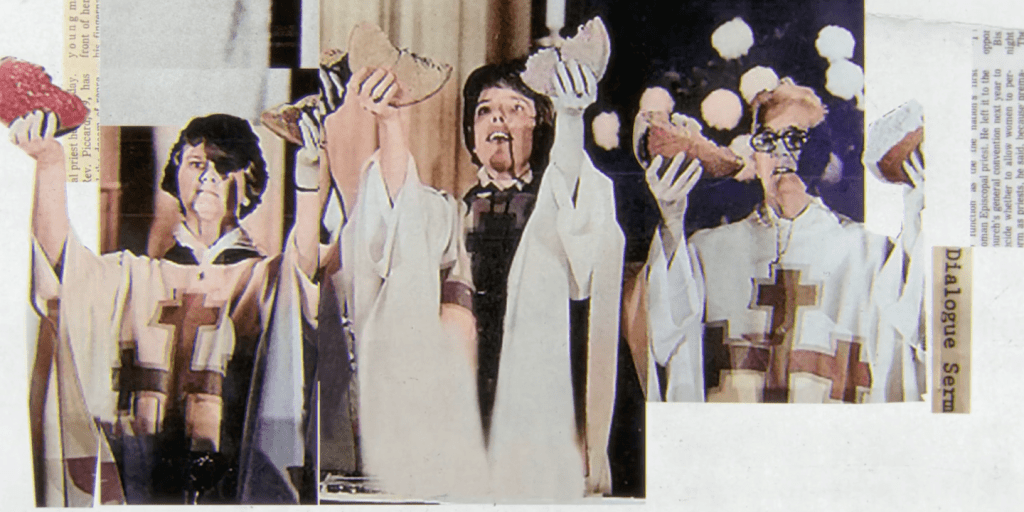
Today – July 29, 2024 – is the fiftieth anniversary of the “irregular” ordinations in Church of the Advocate, Philadelphia of “The Philadelphia Eleven.” The courage brought to life in those ordinations cracked opened the door to priestly ordination in The Episcopal Church for “others” of all sorts.
That day, “the earth [was] remade,” as one of The Eleven later described it. The recognition that God’s call – like God’s love – extends to all God’s people has reshaped Episcopalians’ understanding of the Baptismal Covenant. (Book of Common Prayer, 304-305).
Have you seen Margo Guernsey’s documentary film The Philadelphia Eleven?Episcopal News Service explained, “The film tells the story of what it calls ‘an act of civil disobedience.’ The ordinations took place two years and a few weeks before the General Convention agreed that it was permissible for women to become priests and bishops. The 11 were harassed and received death threats.”[1]
In his welcoming remarks at the film’s premier, Bishop Daniel Gutiérrez (Diocese of Pennsylvania) said, “…the cataracts on the eyes of the church and society were removed” when the Philadelphia 11 were ordained. The event confirmed that “the divine image cannot be defaced or distorted by patriarchy, ignorance, hate, fear, marginalization or any of the -isms or constrictions we tend to create,” he said.
One of those eleven pioneers, Alla Renée Bozarth, wrote of that day:
Call
Inspired by “Mountain Moving Day,” 1911,  by the Japanese Feminist Poet, Yosano Akiko.

There is a new sound
of roaring voices
in the deep
and light-shattered
rushes in the heavens.

The mountains are coming alive,
the fire-kindled mountains,
moving again to reshape the earth.

It is we sleeping women,
waking up in a darkened world,
cutting the chains from off our bodies
with our teeth, stretching our lives
over the slow earth—

Seeing, moving, breathing in
the vigor that commands us
to make all things new.

It has been said that while the women sleep,
the earth shall sleep—
But listen! We are waking up and rising,
and soon our sisters will know their strength.

The earth-moving day is here.
We women wake to move in fire.
The earth shall be remade.[2]
[1] By Mary Frances Schjonberg, posted Oct 3, 2023
[2] Published in Womanpriest by Alla Renée Bozarth, Paulist Press 1978,revised edition Luramedia 1988, distributed by the poet; Gynergy by Alla Renée Bozarth, Wisdom House 1978; audio cassette Water Women by Alla Renée Bozarth, Wisdom House 1990, distributed by the poet; and Stars in Your Bones: Emerging Signposts on Our Spiritual Journeys by Alla Bozarth, Julia Barkley and Terri Hawthorne, North Star Press of St. Cloud 1990. All rights reserved.
Misinformation. Disinformation. Outright lies. Twisted truth. So many of the words we hear and see are not intended to communicate truth or inspire hope. The outcome for many is a deep, corrosive cynicism or paralyzing despair – or both.
We can often find more clarity when we venture beyond words, and use the real world for our touchstone. The deeper truths of life are plainer when we, as they say, “touch grass” – ground our experiences in the natural world, and ponder the truth we encounter there. Cultivating a bedrock foundation of creation’s wisdom as we engage wonder instead of analysis.
While the speed and complexity of communications have magnified the difficulty of remaining grounded, the need to go deep is not new. Every time we run into God’s gift of diversity, the resulting culture shock compels us to question where we look for deep truth, and how we discern our North Star.
Mei Li, a new immigrant from China in the Rodgers and Hammerstein musical Flower Drum Song, offers wonder as a tool for gaining clarity: “My father says That children keep growing, Rivers keep flowing too. My father says He doesn’t know why, But somehow or other they do.
They do! Some how or other they do.
“A hundred million miracles, A hundred million miracles Are happening every day, And those who say they don’t agree Are those who do not hear or see. A hundred million miracles, A hundred million miracles Are happening ev’ry day!”[1] Lyrics By Oscar Hammerstein II Music By Richard Rodgers
The miracles aren’t confined to the natural world. Amazingly, when we choose to partner with God as cocreators, we can grow in ways that we can hardly imagine.
As Br. Curtis Almquist, SSJE, reminds us, “The most amazing thing about miracles is that they happen. They still happen. Saint Paul had his own miraculous experiences, repeatedly, which led him to write that ‘[God’s] power at work within us is able to accomplish abundantly far more than all we can ask or imagine.’ Don’t give up. Give in. Give into the reality of God’s magnificent, sometimes amazing work in us and through us. Watch for it. Wait for it.”
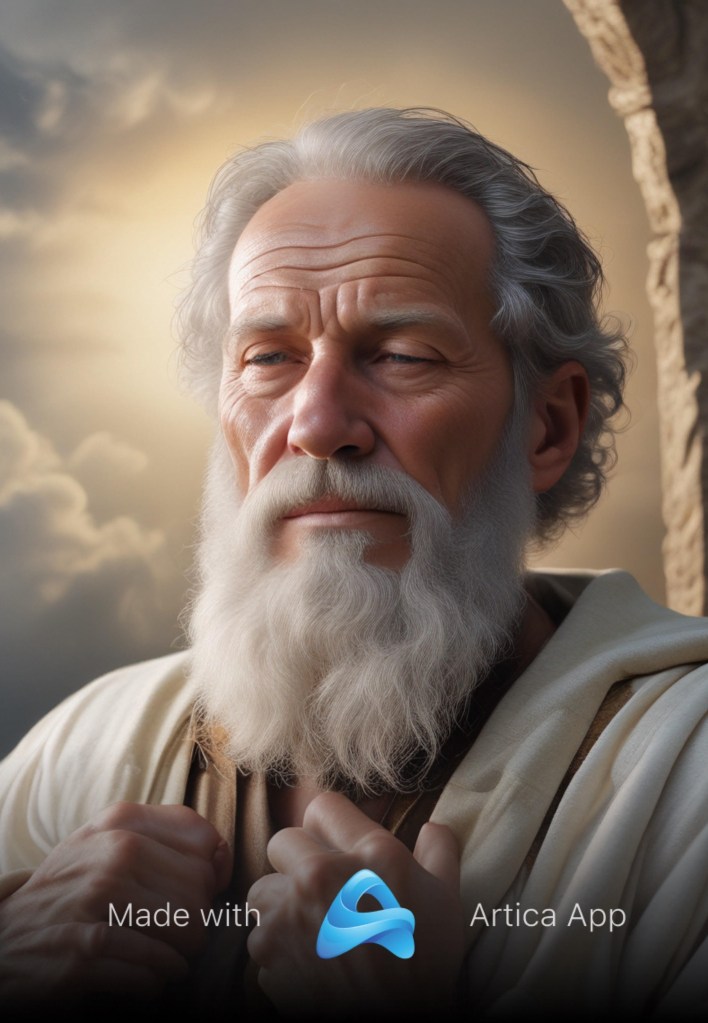
Paul’s revelation: “My grace is sufficient for you, for power is made perfect in weakness.” – AI-assisted illustration by Brandon Beck
by Brandon Beck
“I know a person in Christ who fourteen years ago was caught up to the third heaven – whether in the body or out of the body I do not know; God knows. And I know that such a person – whether in the body or out of the body I do not know; God knows – was caught up into Paradise and heard things that are not to be told, that no mortal is permitted to repeat. On behalf of such a one I will boast, but on my own behalf I will not boast, except of my weaknesses. But if I wish to boast, I will not be a fool, for I will be speaking the truth. But I refrain from it, so that no one may think better of me than what is seen in me or heard from me, even considering the exceptional character of the revelations. Therefore, to keep me from being too elated, a thorn was given me in the flesh, a messenger of Satan to torment me, to keep me from being too elated. Three times I appealed to the Lord about this, that it would leave me, but he said to me, ‘My grace is sufficient for you, for power is made perfect in weakness.’ So, I will boast all the more gladly of my weaknesses, so that the power of Christ may dwell in me. Therefore I am content with weaknesses, insults, hardships, persecutions, and calamities for the sake of Christ; for whenever I am weak, then I am strong.” (2 Cor 12:2-10, RCL)[1]
On this blogon July 9, the Rev. Pam Tinsley posted a brilliant narrative of her experience preparing an eight-year-old child for baptism. Rev. Pam focused on grace in her story. In reflecting on the July 7 Epistle reading from 2 Corinthians through the lens of Rev. Pam’s story, I am struck by the revelation to Paul of God’s message, “My grace is sufficient.”
Even having heard this 2 Corinthians passage, especially this small fragment of verse 9, time and time again, and having studied the Pauline epistles in EfM, small group Bible studies, and divinity school, Rev. Pam’s words offer me an encounter with God through her eyes – and through Merritt’s eyes, the child whom she prepared for baptism.
Paul’s mysticism and focus on body-spirit divide, his further struggles with legalism, and unresolved identity development have always called the academic in me to wrestle with his words and the unknowable psychology of the man Paul rather than the potential Christ revealed in the stories he tells.
But today I encountered God through someone else’s eyes. These other eyes are Rev. Pam’s and her eight-year-old student Merritt’s. These eyes are Paul’s – with letting go of my need to psychoanalyze him.
God’s words to Paul – “My grace is sufficient” – draw me back to verse 2 of this passage. Paul says, “I do not know.” What a powerful pairing of ideas – “I do not know” and God’s “grace is sufficient.” May we all continuously encounter God with awareness and hope, remembering that seeing through someone else’s eyes might just open our own hearts to a new experience of the Divine that’s been encountering us all along.
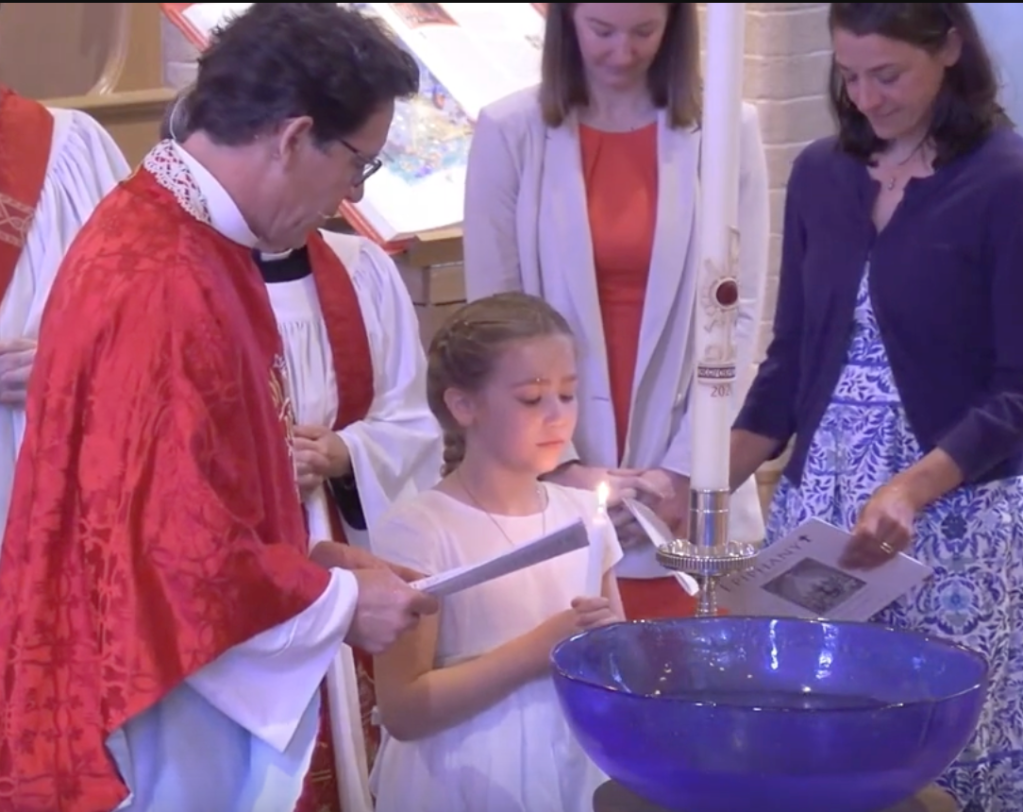
Pentecost baptism at Epiphany parish, Seattle, Washington
At Pentecost I had the joy of preparing an eight-year-old child for baptism. As I met with Merritt, her parents, and her sponsors, I loved how engaged she was. I was also excited to learn she was the one who had expressed a desire to be baptized.
I shared how Jesus himself was baptized by John the Baptist before he began any of his ministry and that by being baptized Merritt was taking her first formal step in following Jesus. Baptism, I said, is the beginning of a life-long journey of faith – a faith that has love at its heart. So, baptism is about choosing to love others each day, because God loved us first. All of humankind and all of creation are God’s beloved.
Throughout our conversations, Merritt asked several questions, and then she asked the one that opened the door to amazing grace! I had shared that baptism was the first sacrament Jesus initiated, which – of course – led to the definition of a sacrament, an outward and visible sign of inward and spiritual grace. Merritt had been wondering what grace was because her family sings the beloved hymn Amazing Grace during bedtime prayers.
Merritt’s eyes lit up as I quoted the Book of Common Prayer: Grace is God’s favor towards us, unearned and undeserved; by grace God forgives our sins, enlightens our minds, stirs our hearts, and strengthens our wills. We talked more about grace: how nothing we can do will make God love us any more; how nothing we do will make God love us any less; and how baptism happens because of God’s grace. As we talked about Pentecost and – above all – about God’s love and God’s grace, I felt enveloped by the Holy Spirit. When Pentecost arrived, Merritt stood by the font and solemnly made her baptismal promises. And we all were embraced by God’s amazing grace as she was baptized, sealed by the Holy Spirit, and marked as Christ’s own forever!
Do you appreciate our weekly postings? Want to support our work to further empower lay voices at General Convention? Please consider contributing here. And learn more about our work as part of The Consultation.
To PBL’s disappointment, the House of Bishops at the 81st General Convention of The Episcopal Church this week decided to “take no further action” on Resolution D002: Review canonical requirement for Holy Communion. The House of Bishop’s lack of action effectively kills the resolution. Despite the question now rendered moot for this General Convention, Partners for Baptismal Living (PBL) urges the church to find appropriate ways to celebrate the life-giving invitation that Holy Baptism represents. Bishop Edward Lee, a member of PBL, offers these thoughts:
by Edward Lee
The current Canon (1.17.7) reads: “No unbaptized person shall be eligible to receive Holy Communion in this Church.”
Contrast that with what the Book of Common Prayer (p. 308) proclaims in the Holy Baptism liturgy: “You are sealed by the Holy Spirit in Baptism and marked as Christ’s own for ever.”
The former is negative, juridical, exclusive, and judgmental in its prohibition. Its blunt tone is that of a membership requirement to a country club. The latter is a solemn, inclusive, affirmative and challenging mandate for an intentional lifelong journey in Christ’s radical mission of redemption, renewal and release. The former is conditional; the latter is covenantal. The former is proscriptive; the latter is relational.
This contrast is why D002 in its current or an amended form must come to the floor of this Convention for discussion and action. The House of Bishops, the initiating body, is strongly urged to make this happen. Letting the present Canon stand or just be deleted is unacceptable. Both options would ignore and undermine the profound solemnity of Holy Baptism that is inherent in the Prayer Book liturgy. After almost a half century its centrality is secure in the worship and practice of the church. But what is yet to be fully realized is the radical character of what it means to be indelibly sealed and marked as Christ’s own disciple for ever.
Contained and found in this sacramental action is the unique Christian identity and vocation for ministry of every baptized person starting with the laity (99% of the church) and sequentially by the (1%) clergy. See the Catechism on The Ministry, BCP, p. 855. Therefore it is asked of all of us, how seriously do we understand, claim and embrace this baptismal mandate of seeing ourselves as ministers and our lives as ministry?
What has also brought this matter to General Convention’s attention is the increasingly common practice in many parishes of inviting and welcoming worshippers to receive Holy Communion whether they are baptized or not. There is no prior checking or public alert. Clearly a contradiction of the existing Canon but a point of entry and welcome for uncertain seeking and searching persons. It’s regarded as radical hospitality consistent with Jesus’s association with and inclusion of religiously unqualified persons of his time. It is radical as it should be, yet it should not diminish the centrality and solemnity of Baptism. It’s not an either/or matter but rather a both/and.
The suggestive language in the enumerated resolves of D002 propose an understanding of the connectedness of the Eucharist, Baptism and the inclusive fellowship that constitutes Christian community. For example, a revision to the canons that would be “a positive statement affirming that the fullest meaning of our Holy Eucharist is lived out through our Baptism and Baptismal Covenant.” (#6) Also, “develop a generous pastoral and invitational rubric to Baptism and Communion” in the Payer Book. (#5)
Hopefully this General Convention will not bypass this crucial theological, sacramental and pastoral matter that grounds and informs our Church’s mission and our daily baptismal ministries.
Edward L. Lee, Jr.
Steering Committee, Partners for Baptismal Living
Bishop, Diocese of Western Michigan, 1989-2002
Assisting Bishop, Diocese of Pennsylvania, 2003-2017
Do you appreciate our weekly postings? Want to support our work to further empower lay voices at General Convention? Please consider contributing here. And learn more about our work as part of The Consultation by reading this post.
The Consultation – a collaboration of six progressive organizations, including Partners for Baptismal Living – opened its booth today in Louisville, KY, at the 81st General Convention of The Episcopal Church. The Consultation is inviting all attending the convention to participate in an open space experience in the General Convention exhibit hall. All are invited to engage live and in person with friends and not-yet friends in ways that allow all to learn and grow together, speaking the truth in love, and respecting the dignity of every human being.
Here are some of the ways all participants are invited to connect:
Earnest Questions – Each day of General Convention when the exhibit hall is open (June 21 through June 27), The Consultation will publicize – on the Consultation Commons (booth #1214), via ISSUES, social media, and in-person conversations – several questions.
Come to The Consultation Commons in the exhibit hall to post your response in words, pictures, or other art expression.
Come engage in live, real-time conversation with others who are open to questioning the status quo and engaging the future.
Convene your own meet-up to explore your “earnest question.”
Lunch-time Speakers – 12-2 pm at The Consultation Commons (booth #1214)
Sunday, June 23 – TransEpiscopal presents the Revs. Cameron Partridge and Gwen Fry, who will host a conversation to share their perspectives on the work TEC has done, is doing, and that needs to do to fully embrace trans and non-binary people in the Church and the wider world, in a time of intense attack on trans and nb people.Tuesday, June 25 – Episcopal Peace Fellowship – Palestine Israel Network presents Jonathan Kuttab, “What’s Going on in The Holy Land?: Behind the Headlines”
Wednesday, June 26, Episcopal Peace Fellowship presents “Gun Violence Prevention”
Community Sing – Saturday June 22 and Monday June 24, 12:30-1:30pm, come to The Consultation Commons (booth #1214) to join in paperless music and “turn-and-talk” minutes with fellow singers. Fill the exhibit hall with song! “Those who sing pray twice.”
Meet-ups – Schedule a 60-90 minute conversation on a vital topic. You bring the “earnest question” and the facilitator, The Consultation Commons provides the space. Sign up at The Consultation Commons (booth #1214).
Exploration – Learn more about the work of The Consultation and of its individual member organizations. Come engage with one of The Consultation’s booth hosts at booth #1214.
Come – Come and see!
Come engage with fellow Episcopalians!
Agreement not guaranteed.
Come as you are for creative, generative, boundary-breaking conversation!







 Living God's Mission