Pentecost unbound

(For optimum viewing, use desktop or tablet.)
Do you appreciate our weekly postings? Want to support our work to further empower lay voices at General Convention? Please consider contributing here. To learn more about our work as part of The Consultation, read our March 5 post.

by Demi Prentiss

All of them were filled with the Holy Spirit and began to speak in other languages, as the Spirit gave them ability. — Acts 2.4

Pentecost was not, as some say, “the undoing of Babel” —
now we all speak the same language!
No, it was the opposite: the blessing of Babel.
We learn one another's languages.
We embrace diversity, and learn to listen to each other,
to see from another's perspective,
to give voice to a life other than our own,
to make central a language that's not our own,
to communicate grace that's not on our own terms.
We acknowledge the differences in our lives,
honor one another's various home places and cultures,
and cross over the boundaries of comfort and familiarity.

On that Pentecost day I don't imagine they were eloquent.
They spoke in halting Phrygian, mangled Mesopotamian.
It probably took some back-and-forth, some double-checking.
It required not just proclaiming but listening, relating,
and patience on the part of the hearers,
and courage and humility on the part of the speakers —
willingness to be beginners, to risk, to appear foolish,
to forgo the safety of being in the dominant group.

Pray for such humility and courage, to risk for the sake of love,
to be foolish for the sake of relating,
to let other people's reality be real.
In such loving, the Holy Spirit will speak, loud and clear.
by Steve Garnaas-Holmes

We’re barely past Pentecost and already we’re tempted to put those tongues of fire back in the box until next year. “Not yet,” we’re inclined to say.  Then Brian McLaren reminds us

The good news is that the Spirit is already here, living and active – and has been since the dawn of creation. Our challenge – as we pray “Come, Holy Spirit, come” – is not to persuade the Spirit to be present. May we pray to be born anew, so that we may see the reign of God. Allow us to see through God’s eyes to perceive the Spirit at work everywhere around us.

To the members of Christ's body,
to the branches of the Vine,
to the Church in faith assembled,
to her midst as gift and sign:
Come, Holy Spirit, come.
– Carl P. Daw, Jr. – “Like the murmur of the dove’s song”

 [1] Brian D. McLaren, We Make the Road by Walking: A Year-Long Quest for Spiritual Formation, Reorientation, and Activation(New York: Jericho Books, 2014),203, 205. 

Safe

New Episcopal Shield released for Pride, May 16, 2024

by Brandon Beck

Won’t you help me if you can – find a safe place to be myself?

I learned a new song Sunday, May 19, 2024. What an appropriate day in the church calendar to learn new words, right? The Holy Spirit came down like tongues of fire, as if a sound of rushing wind, and I was changed. I felt the Spirit move not just in me but in all those gathered as the choir director read the composer’s words from the cover of the score to this 2019 song I’d never heard before – this song written by a progressive, Baptist, music minister, singer, composer, teacher, and all-around-super-cool South Carolinian named James Kevin Gray. Gray, in that note to this 2019 score, writes:

[This composition] was inspired by a young friend of mine who bravely shared his story of being bullied. Hearing him recall and confront this issue inspired me to research it further and spend time listening to others tell them into a narrative of pain and redemption. Near the end…you will hear the choir surround the vocal narrator(s) with the phrase, “You are not alone – I am with you.”

We must challenge ourselves to get up off of the sidelines and call out abuse. When a “one” is joined by another, the “one” becomes a “they,” and as the group grows, so does its power. This is the force that can be used for the sake of peace, love, and understanding.

I would encourage each choir who performs this piece to set aside some time for sharing and validation of individuality. You might be amazed at the healing you witness in the process.

You are not alone – I am with you.

James Kevin Gray says this in his 2019 choral piece “Safe Place.” Is he echoing The Holy Spirit flaming on the disciples and all the nations on Pentecost? Echoing YHWH speaking to the people through Moses?

We are turning toward June in the next few days. June marks many justice events, but I appreciate that we have been marking Pride in June in some form or fashion since the Queens and trans women and men and gay men and lesbians of New York City began rioting near the Stonewall Inn on June 28, 1969. They were asking the world, “Won’t you help me if you can – find a safe place to be myself?”

As we enter June of 2024, can we each ask ourselves and then extend our inquiry to our congregations, “How am I/are we helping someone find a safe place to be themselves?”

You are not alone – I am with you.

Can we say that we have embodied the philosophy of YHWH, Jesus, and the Holy Spirit this Pride Month? Have we shown someone they are not alone? I’m not asking if we’ve paid lip-service to someone with the nonchalant, passing phrase, “You’re not alone.” Rather, I’m wondering when and how you’ve changed how you behave so that a person who has “bravely shared [their] story of being bullied” sees you “get up off the sidelines and call out abuse.”

Listen to composer James Kevin Gray share his story of change after listening to his young friend, his hopes for how we will hear his song, and learn to reach out, speak up, come together, and be loving, liberating, and life-giving.

After, maybe you and your congregation will even go attend your local Pride event or celebrate a Pride Eucharist for your community.

Need resources? Check out TransEpiscopal and LGBTQ+ in the Church. Or let get in touch with me or my colleagues at Baptismal Living; we’re always ready to talk with you.

Baptized for hope

Do you appreciate our weekly postings? Want to support our work to further empower lay voices at General Convention? Please consider contributing here.  To learn more about our work as part of The Consultation, read our March 5 post.

Hope Starts at Home – photo by the Rev. Paul Lebens-Englund, rector of St. Andrew’s Episcopal Church, Tacoma, WA.

by Pam Tinsley

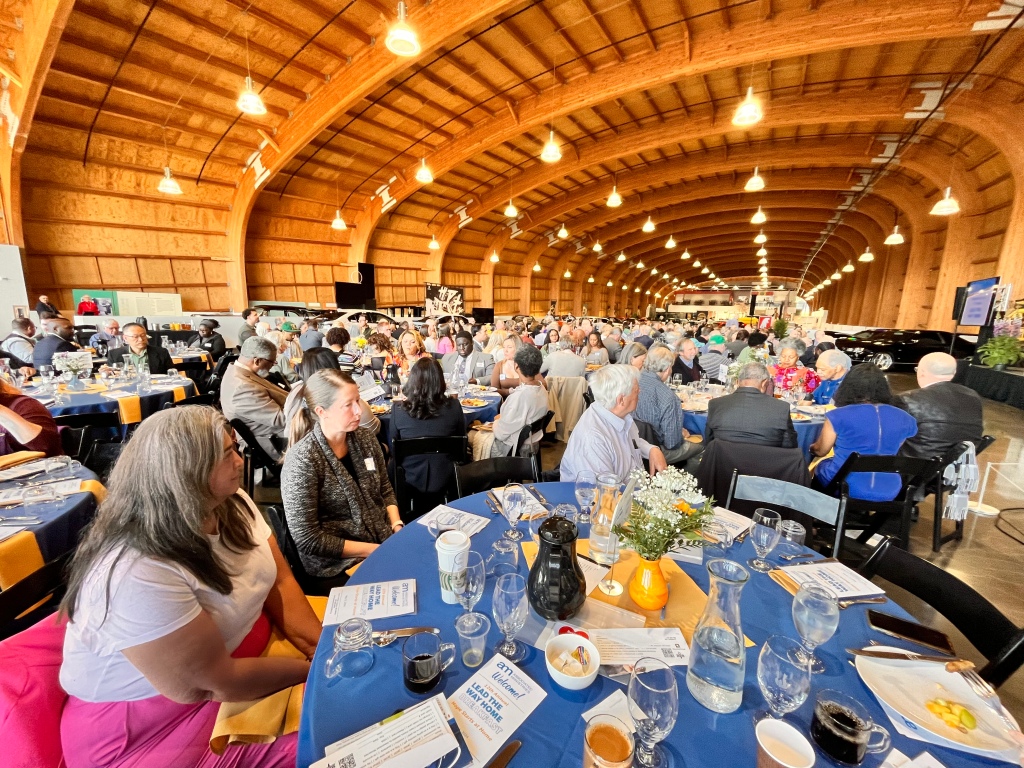
Last week I attended a breakfast to support our local interfaith organization, Associated Ministries. Most of the 400 attendees were community volunteers and leaders. A few clergy were also present. It’s clear that AM’s strength in the community rests in the hands of lay people who are committed to making our local community – and ultimately our society – more loving and just.

The breakfast’s theme was Hope Starts at Home. It was immediately apparent that each one of these faithful individuals is a beacon of hope in a world seemingly overwhelmed by hopelessness. Thanks to their commitment and partnership with community-supported businesses, they show that one person can act in faith and work with others to transform lives – not least of all, their own.

What they say and do can change individual lives, one-by-one. And when one person’s world changes, then that person can work to change another person’s world. We heard an inspiring story of hope from a woman who left an abusive relationship over a decade ago. With help from the AM community – including subsidized housing for herself and three young children – she overcame incredible obstacles to eventually earn not only a high school diploma, but then her bachelor’s degree! She is now employed by AM, walking with and serving as a beacon of hope for others.

In his inspiring remarks, Michael Yoder, executive director of Associated Ministries, shared the following quote from poet Clarissa Pinkola Estes:

Ours is not the task of fixing the entire world all at once, but of stretching out to mend the part of the world that is within our reach. Any small, calm thing that one soul can do to help another soul, to assist some portion of this poor suffering world, will help immensely.

It is not given to us to know which acts or by whom, will cause the critical mass to tip toward an enduring good. What is needed for dramatic change is an accumulation of acts – adding, adding to, adding more, continuing. We know that it does not take “everyone on Earth” to bring justice and peace, but only a small, determined group who will not give up during the first, second, or hundredth gale.[1]

You and I are called by our baptism to be part of this small, determined group who are willing to persist in seeking and serving Christ each day – and always with God’s help.


[1] Excerpted from Do Not Lose Heart, We Were Made for These Times ©2001, 2016

What could be, or what is? (Links repaired)

Thanks for your support, Friends of Partners for Baptismal Living, sponsors of this blog –  If you appreciate our weekly postings and would like to support our work to further empower lay voices at General Convention, please consider contributing here.  If you want to know more about our work as part of The Consultation, please read our March 5 blog post.

by Demi Prentiss

Scot McKnight commented recently on Dietrich Bonhoeffer’s Life Together and the compelling question of whether we love the church for what it could be, or for what it actually is.

To quote from McKnight’s March 4 Substack post:

[U]ntil we realize that the eucharist table is at the front of the church under the cross – [that] those who come into the fellowship are “cracked Eikons” in need of grace and healing – we will not comprehend what the church is. Eucharist is for those in need of grace, not for those in need of a medal for their heroic faith.

Leaving the church because it does not meet unrealistic expectations is failing to understand what a church is; we have a church because we have failed to meet God’s expectations. Failed expectations, then, are the foundation for the church and the reason for its existence. Leaving the church because it does not meet our expectations is to create a church for ourselves. It is, if I may be so bold, idolatry.

Photo by Josh Eckstein on Unsplash

The Episcopal Church is preparing for its General Convention in June. As in most organizations governed by legislative bodies, in spite of being living members of the Body of Christ, the church is bringing conflicting opinions and competing lofty goals to the meeting. Contentious issues are breeding competing claims as to what the church should be and what “wins” will bring the organization closer to those aspirations. There are many who see General Convention as beneath the church’s dignity, or as a waste of time and money and energy, or as boring theatre.

I love General Convention. I love the push and pull of competing priorities, and the hard work of collaborating and building consensus in order to make progress toward being the church God calls us to be.  We come closer to that calling only by incremental steps. Progress is almost always slower than we’d like, and sometimes we fall short or misdirect our efforts. Sometimes circumstances shift, and our last incremental step turns out to have been misdirected. (Or perhaps the step we took 37 steps ago!)

It can be a struggle to offer grace to one another. Often it’s hard to remember that nearly all of us are striving to remain connected to the True Vine. Too frequently we miss the mark. Mercifully, the Holy Spirit has been known to show up to further our work.

Please, in the coming days, pray for our church – both the Episcopal branch of the Jesus Movement and the 2,000-year-old Body of Christ. Pray for more love, less confusion; more abiding in Christ, less need to control; more joy, less fear. And in the ways you can, offer your gifts and your graces to further the work God has given us.

O God of unchangeable power and eternal light: Look
favorably on your whole Church, that wonderful and sacred
mystery; by the effectual working of your providence, carry
out in tranquillity the plan of salvation; let the whole world
see and know that things which were cast down are being
raised up, and things which had grown old are being made
new, and that all things are being brought to their perfection
by him through whom all things were made, your Son Jesus
Christ our Lord. Amen.   (BCP, p. 291)

Listening

For optimal reading, view this post on a larger-screen platform (laptop or tablet).

Drone Shot of Man Balanced on Rope by Adam Khasbulatov, Dagestan, Russia, Pexels

by Brandon Beck

The best arguments in the world won’t change a person’s mind. The only thing that can do that is a good story.

Listen. There’s something you need to hear.

These lines are from the 2019 Pulitzer Prize in Fiction, The Overstory by Richard Powers (Norton, 2018, 9780393635522). Indeed, fiction and story continue as tools of change. (Note that I am not indicating that fiction and story are the same or interchangeable but that they can overlap.) The news media played a role in the views of the civilian perspective on US involvement in Vietnam; an example of this is the publication of the AP photograph taken by Nick Ut of Kim Phúc outside Trăng Báng after a US napalm airstrike in April of 1963. This photo story changed minds in ways that arguments hadn’t before.

This method of storytelling is a Biblical tool to changing minds, as well.  In fact, Jesus’s constant refrain, “If you have ears to hear, then hear!” is echoed by Powers’s, “Listen. There’s something you need to hear.” And Jesus changes minds through stories – good stories – not by arguing. His followers go on to use that same model. The Bible is, itself, a collection of stories – stories of Creation, of History, of Theology, of Wisdom, of Prayer – a collection of the stories upon which we base what little understanding of our God we have. From studying these stories and telling these stories, we change our own minds and the minds of others along that proverbial “arc of the moral universe” that is “long, but…bends toward justice.” (Martin Luther King, Jr.)

As we take our experiences, tradition, scripture (and interpretation), and reason to the General Convention with us, I pray that we remember to tell each other stories and ask to hear each other’s stories. I pray that we listen to each other. There’s something we each need to hear, and it’s possible that any one of us could change anyone else’s mind about anything.

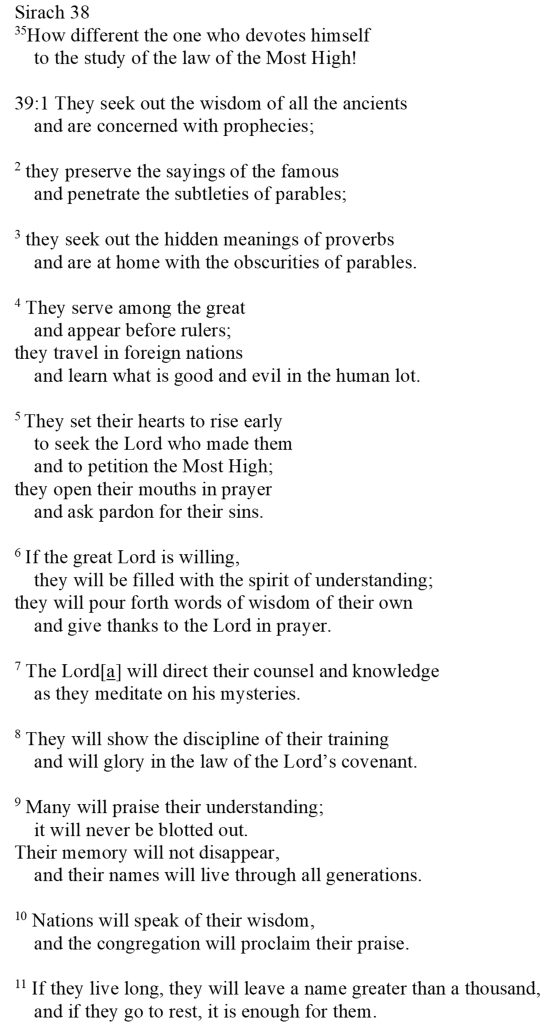
May we all be given just a little more of the gift of the Scribe as outlined in Sirach 38-39 – that powerful wisdom to discern, to listen, and to study – so our understanding of scripture, tradition, and reason truly form a three-fold cord of strength and beauty, able to be tied to each other in creating change and not frayed apart in controversy.

Amen.

Little ones are not small things!

by Pam Tinsley

“Filled with the loving presence of God, I ask God to bless me and guide my steps as I go to do God’s work in my daily life,”[1] are words I pray each morning. The prayer reminds me that all I do or say is to be for God’s glory, not for mine. It also reminds me of my vocation – to seek and serve God in daily life and not only when I am engaged in parish ministry.

Photo by Robert Collins on Unsplash

I’m always mindful that baptism is the foundation of all ministry, that is, that all ministry begins in baptism rather than ordination. While at a retreat where we explored Ikigai – looking at actions/roles objectively and then engaging them with our feelings or hearts, similar to the Ignatian Examen – we were invited to reflect on where we find God in the small things.

While my prayer life and leading worship are certainly cornerstones of my priestly vocation, the role I felt drawn to share with my small group was from my ministry in daily life: about how I savor each moment I spend with my two young grandchildren. I love to watch how God is shaping our five-year-old granddaughter, as we read stories from her children’s Bible, talk about Jesus’ profound love for her and for all of the world, or offer thanks to God before a meal or bedtime. Likewise, I cherish how she listens to hymns and praise music and sings along. And then her baby brother begins to dance to our singing!

It’s a gift to be able to help nurture our grandchildren’s faith during these tender years, helping them learn the values of God’s Kingdom, which we embrace at baptism. Together we experience wonder and awe not only at big moments of God, but also when we experience God in little things, such as seeing a bald eagle soaring overhead or stopping to offer a granola bar to a homeless person at an intersection. As we pray on the second Sunday of Easter, may we show forth in our lives what we profess in our faith in all that we do – with God’s help.


[1] From sacredspace.com

Ladder

by Brandon Beck

I find myself writing a lot about two things recently: 1) history and 2) ladders.

It is not the history of ladders which has consumed me, though. I suspect some of you have guessed already, perhaps even by the simple title of “Ladder,” that it is Jacob’s Ladder which has me captivated at the moment but, perhaps, not in the way you might suspect.

Two people are given historical recognition for their writing down of “rules” for monastic communities: Benedict in the West and John in the East. In the late 5th and early 6th century in Italy, Benedict withdrew from the city and political life to practice the purity of his faith and to draw closer to God through a pattern of silence, work, prayer, and study. As others followed him to learn from him, communities formed around his practices. Based on earlier, less accessible texts, he set down what is now known and widely used among monastic groups, The Rule of Benedict. Benedict writes to assist the men who have come to him, offering their prayer and work in efforts to reach God in wholeness and peace. In Chapter 7 of his Rule, Benedict outlines this mystic goal by way of Jacob’s Ladder:

If we want to attain true humility, and come quickly to the top of that heavenly ascent to which we can only mount by lowliness in this present life, we must ascend by good works, and erect the mystical ladder of Jacob, where angels ascending and descending appeared to him. That ascent and descent means that we go downward when we exalt ourselves, and rise when we are humbled. The ladder represents our life in this world, which our Lord erects to heaven when our heart is humbled. And the sides of the ladder represent our soul and body, sides between which God has placed several rungs of humility and discipline, whereby we are to ascend if we would answer his call.

In the East, on Mt. Sinai, the community now called St. Catherine’s Monastery claims John; however, we don’t really know much of John’s biography. What we do know is that he wrote a rule for monastics sometime in the late 6th to early 7th century in the area of the Sinai peninsula. He begins the letter with a salutation identifying himself as the hegumen (abbot) of the monks of Mt. Sinai and says that he has written this at the request of John, hegumen of the monastery at Raithu. In Chapter 9, John of Sinai tells us of his Jacob’s Ladder strategy:

The holy virtues are like Jacob’s ladder, and the unholy vices are like the chains that fell from the chief Apostle Peter. For the virtues, leading from one to another, bear him who chooses them up to Heaven; but the vices by their nature beget and stifle one another.

John has come to be known as John Climacus, named for his ladder; ladder is a translation of climacus for ladder or staircase.

As an adolescent, I had what might be referred to as visions or might be referred to as panic attacks. The label doesn’t matter. These occurred in university related to my gradual loss of sense of self, “Who am I? Where did I come from? What am I doing here? Where am I going?” Such deep, Sapiential questions. I did not have a grounding, an Ekklesia in which to plant myself, from which to climb toward Heaven. I was mired in this earthly body, trapped by the “seven forms” of the “fourth power.” (See Gospel of Mary Magdalene, Chapter 8.)

Illustration by Brandon Beck, Ladder Between Two Worlds, created using Gemini by Google

In my mind, I would see myself starting to climb stairs and then falling down. When I’d fall, a video game screen would appear flashing, “Game Over. Please insert another quarter.”

I’ve ascended many stairs/rungs of the imagaic ladder in twenty-five years; I’ve also stumbled, slipped down a rung or two, but I have not had to insert another quarter or seen the “Game Over” sign. I’ve learned from the Ekklesia (which I did find eventually) that asking Sapiential questions is good, true, and beautiful. First and foremost, I continue to ascend Jacob’s ladder because I, like Isidore in Chapter 4 of John’s Ladder, am willing to ask for prayer and help.

As we celebrate Holy Week and Easter, I remember the meaning of baptism, the symbolism of baptism, and the power of the Ekklesia in holding the ladder in place and in balance as someone new starts their ascent; the power of the Ekklesia in pointing to the strong footholds and warning of those who will try to pull you off the ladder.

After all, “There is one Body and one Spirit; There is one hope in God’s call to us; One Lord, one Faith, one Baptism; One God and Father of us All.” (BCP, p. 299).

We affirm our support of all in their faith, of each other in our faith; the ladder supports us as we ascend, just as it supported Jacob’s vision and the monks of Benedict and John.

As Christ rises again, let us follow him and find our ladder by which we can climb to meet him. Let us be a ladder, reaching up and out, connecting ourselves and others together and to God.

Amen.

Love begets love

Share Your Light – Photo by Steve Gilliland

by Pam Tinsley

“Gratitude begets gratitude” was the guiding principle of the late Carl Knirk, Canon for Stewardship in the Diocese of Olympia. Carl maintained that stewardship determines the type of person we are and will become, reminding us that everything we have is a gift from God. And although we often think of stewardship in terms of money and material items, stewardship embraces all aspects of our lives, especially our relationships with others.

As Holy Week approaches, Carl’s words come to mind when I think of Jesus’ last meal with his disciples. Jesus gave both the Twelve and us – his present-day disciples – a new commandment: “Just as I have loved you, you also should love one another. By this everyone will know that you are my disciples, if you have love for one another.” Jesus incarnates God’s unconditional love and proclaims it to be all-inclusive and all-embracing.

The very essence of God is love. And because we are created in God’s image, every day each of us is called to bear God’s love into the world by how we live and how we love one another – with God’s help. When we love one another generously, we make God’s love known to others. When we love genuinely, others are inspired to love, as well. Love, then, becomes an antidote for hatred, indifference, injustice, and fear. When love spreads, it has the power to transform our relationships, our communities, and even our world. It has the power to point to the Kingdom of God that is right here, right now – unfolding in our midst.

In other words, love begets love!

Asking your support

Lent 2024

We invite your financial support of Partners for Baptismal Living (formerly Episcopalians on Baptismal Mission and creators of the LivingGodsMission.org blog). We are a group which continually seeks ways to remind us Christians that we are all empowered by baptism – the Church’s first order of ministry – to proclaim and live out God’s Beloved Community in our daily lives, here and now. We are appealing to you because we know you care deeply about the calling of all the baptized, 99% of whom are lay people.

PBL is a small group with church-wide impact. Our work leading up to the 2018 General Convention, created and passed Resolution C005. That resolution formed a task force that has worked to see baptismal ministry intentionally implemented throughout the church. A member of PBL served on the task force that promoted passage of Resolution A037, “Establishing a New Standing Commission on Formation and Ministry Development,” during the 2022 80th General Convention. This new standing commission focuses on affirming, developing, and upholding the ministry of all the baptized.

With no paid staff and no building or equipment to maintain, PBL’s expenses are modest and fall into two main categories:

  • Participation in the work of The Consultation, a collaboration of advocacy organizations in the Episcopal Church. Partnership with this group multiplies our impact.  Although most meetings are virtual, one meeting per year calls for in-person attendance by two individuals.
  • Attendance and participation at General Convention, assuring that PBL’s voice and presence are known and recognized in the larger church.

Every gift makes a difference. If you’d like to sponsor a specific expense (brochures and stickers for General Convention, Consultation dues, etc.), we’d be happy to offer “sponsorship opportunities” tailored to your interests. And, because we are a 501(c)(3), we are happy to provide a tax statement for your contributions.

You can support PBL monetarily by

  • making an online donation at PBL’s blog site www.livinggodsmission.org  OR
  • mailing a check/money order made payable to Partners for Baptismal Living to:

        Partners for Baptismal Living
c/o Pamela Tinsley, Treasurer
4810 N. 28th St.
Tacoma, WA 98407

Can we rely on YOU to help continue this transformational work and build on our continuing successes?

With gratitude for your generous support,

The Steering Committee of Partners for Baptismal Living
Brandon Beck, PhD (Dio W Texas)
Nanci Gordon (Dio Vermont)
The Rt. Rev. Edward Lee (Dio Western Michigan)
Adam Lees (Dio Alaska)
Demi Prentiss (Dio Colorado)
Tieran Sweeney-Bender (Dio Olympia)
The Rev. Pamela Tinsley (Dio Olympia)
The Rev. Dr. Jennifer Woodruff Tait (Dio Lexington)

And Colleague Founders
now in God’s nearer presence:
The Rev. J. Fletcher Lowe
The Rev. Peyton Craighill
The Rev. A. Wayne Schwab

P.S. Your tax-deductible contribution to PBL’s work means more people will be on mission every day, wherever their daily life takes them. Thank you for your support!

Share the change

by Brandon Beck

We sing, “Lift high the cross, the love of Christ proclaim,” in Hymn 473, “Jesus Christ Our Lord” (1982 Hymnal according to The Episcopal Church).

The newly consecrated bishop of the Diocese of West Texas, the Rt. Rev. Dr. David G. Read, at our 120th diocesan council celebrating the 150th year of our diocese, spoke “Lift high the cross” into a theme for our diocese for this year. Bp Read calls on Galatians 6:14:

May I never boast of anything except the cross of our Lord Jesus Christ, by which the world has been crucified to me, and I to the world, (NRSV)

as an invocation. Bp Read says that it is our Baptismal promise to “lift high the cross” and to “proclaim by word and example the Good News of God in Christ” (BCP, p. 305).

Supposedly, Benjamin Franklin said, “When you are finished changing, you are finished,” and this lifting high of the cross and baptismal promise to do so through sharing the Good News is a story of change.

Brandon Beck – Image created using ChatGPT

Birth is a change from life in the womb – with lungs full of fluid and sustenance supplied via umbilicus – to a life of oxygen and food and circulation and noise and scent and independence. Jesus’s story begins with human birth; he too makes this change with the rest of us and has to learn to breathe.

Coming of age is a change, as St. Paul describes in 1 Corinthians 13:11 (NRSV), “When I was a child, I spoke like a child, I thought like a child, I reasoned like a child; when I became an adult, I put an end to childish ways.” We see Jesus come of age in Luke 2 when he reads from the scroll in the temple at age 12 and goes from there, in verse 52, “increased in wisdom and in years, and in divine and human favor.”

Graduation, getting married, starting a career, having kids, retiring – these are all changes in our human lives. Calling the disciples, being transfigured, being tempted, retreating to pray, healing the sick – these are all changes in Jesus’s life.

And when we stop changing, “it is finished” (John 19:30, NRSV), right?

Our final change is death. Jesus died on the cross. His final change was death on the cross.

Except it wasn’t. It isn’t. Change is not final, and, even in death, perhaps even because of death, we must always be changing.

We know that death isn’t final because we “lift high the cross” as an example and reminder that after death, Jesus lives again, and we do too. “He…rose again on the third day” (Nicene Creed). We take and eat bread and wine in the Eucharist in memory of Jesus on the cross, not just for our own piety but to empower ourselves and others to go forth sharing the ways that we are changed by Jesus and Jesus’s followers.

We, too, are changed, over and over again.

Share the story. Show the change.