Share the change

by Brandon Beck

We sing, “Lift high the cross, the love of Christ proclaim,” in Hymn 473, “Jesus Christ Our Lord” (1982 Hymnal according to The Episcopal Church).

The newly consecrated bishop of the Diocese of West Texas, the Rt. Rev. Dr. David G. Read, at our 120th diocesan council celebrating the 150th year of our diocese, spoke “Lift high the cross” into a theme for our diocese for this year. Bp Read calls on Galatians 6:14:

May I never boast of anything except the cross of our Lord Jesus Christ, by which the world has been crucified to me, and I to the world, (NRSV)

as an invocation. Bp Read says that it is our Baptismal promise to “lift high the cross” and to “proclaim by word and example the Good News of God in Christ” (BCP, p. 305).

Supposedly, Benjamin Franklin said, “When you are finished changing, you are finished,” and this lifting high of the cross and baptismal promise to do so through sharing the Good News is a story of change.

Brandon Beck – Image created using ChatGPT

Birth is a change from life in the womb – with lungs full of fluid and sustenance supplied via umbilicus – to a life of oxygen and food and circulation and noise and scent and independence. Jesus’s story begins with human birth; he too makes this change with the rest of us and has to learn to breathe.

Coming of age is a change, as St. Paul describes in 1 Corinthians 13:11 (NRSV), “When I was a child, I spoke like a child, I thought like a child, I reasoned like a child; when I became an adult, I put an end to childish ways.” We see Jesus come of age in Luke 2 when he reads from the scroll in the temple at age 12 and goes from there, in verse 52, “increased in wisdom and in years, and in divine and human favor.”

Graduation, getting married, starting a career, having kids, retiring – these are all changes in our human lives. Calling the disciples, being transfigured, being tempted, retreating to pray, healing the sick – these are all changes in Jesus’s life.

And when we stop changing, “it is finished” (John 19:30, NRSV), right?

Our final change is death. Jesus died on the cross. His final change was death on the cross.

Except it wasn’t. It isn’t. Change is not final, and, even in death, perhaps even because of death, we must always be changing.

We know that death isn’t final because we “lift high the cross” as an example and reminder that after death, Jesus lives again, and we do too. “He…rose again on the third day” (Nicene Creed). We take and eat bread and wine in the Eucharist in memory of Jesus on the cross, not just for our own piety but to empower ourselves and others to go forth sharing the ways that we are changed by Jesus and Jesus’s followers.

We, too, are changed, over and over again.

Share the story. Show the change.

Journey between two crosses

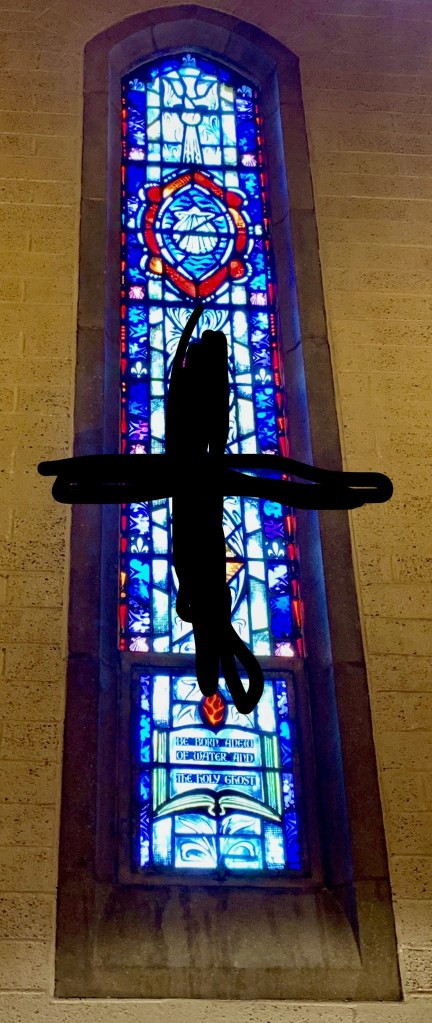
“Be born anew, of water and the Holy Ghost.” – Ashes and baptismal window – Photo by Pam Tinsley

by Pam Tinsley

When our 40-day Lenten journey began on Ash Wednesday, the cross of ashes on my forehead reminded me of the cross of chrism oil that was marked on my forehead at baptism. This Lenten reminder of my mortality – Remember that you are dust, and to dust you shall return – is also a reminder of baptism and the promises we make. We renounce Satan, evil powers, and sinful desires and turn to Jesus as our Savior, promising to seek and serve him in all persons and in all that we do. In other words, we promise to faithfully follow him in word and action.

And then as I read the Gospel from the first chapter of Mark on the First Sunday in Lent, not only was baptism at its heart, there was also a certain déjà vu. Just six weeks ago, on the First Sunday after the Epiphany, we heard a portion of the same passage: “Jesus…was baptized by John in the Jordan. And just as he was coming up out of the water, he saw the heavens torn apart and the Spirit descending like a dove on him. And a voice came from heaven, “You are my Son, the Beloved, with you I am well pleased.”

That initial passage in Epiphany (Mark 1:4-11) begins with John the Baptist’s call to repentance and then climaxes with Jesus’ baptism by John. At his baptism Jesus’s divinity is affirmed, he’s anointed by the Spirit, and God commissions him for mission and ministry.

And although Mark’s Gospel this First Sunday in Lent begins with the very same story of Jesus’ baptism, it culminates with Jesus’ temptation by Satan. Only after Jesus is driven into the wilderness and tempted and tested for 40 days – and relying on God alone – is Jesus ready to proclaim the Good News and begin his ministry.

It strikes me how repentance, baptism, wilderness, and ministry are all intricately intertwined and that it’s only with God’s help that we persevere. So, as we begin Lent – this period of self-examination, repentance, fasting, giving, and prayer – I invite you to reflect on how your baptism grounds you spiritually, sustains you in the wilderness, and strengthens you for your ministry in daily life – with God’s help.

Extending, embracing, becoming – more

Water in the desert– Rivers bring change, new life, and generativity to barren ground.   United States Geological Survey photo

by Demi Prentiss

The Feast of the Presentation, Feb. 2, commemorates Jesus’s being presented in the temple to be circumcised and dedicated to God, as was customary for first-born sons in first-century Judaism. The Gospel story of that event features Simeon and the prophet Anna, who proclaim the child’s role in Israel’s salvation. (Luke 2:22-40) The feast day, midway between the winter solstice and the spring equinox, is marked as Imbolc in the Gaelic calendar, and celebrates the returning of the sun that brings new energy, inspiration, and creative forces. It’s known as Saint Brigid’s Day, and honors both the Christian saint and the pagan goddess.

It’s taken by some as a “turning” toward the light of the Resurrection cycle:  Lent, Easter, and Pentecost.

Especially for those of us in the Northern Hemisphere, all these shifts point toward new life and generativity, and toward the possibility of change that is enacted in our identity and way of being.

In the days ahead, as we move from the Feast of the Presentation toward Ash Wednesday, Br. Luke Ditewig, SSJE, offers wisdom for our journey toward the “turning” that Lent calls for – the metanoia urged by Christ that we sometimes call a ”change of heart”:

ChangeWhat is changing in yourself that is hard to accept? By God’s invitation and grace, who are you becoming? Change may present a crisis, might be confusing or painful. Listen for God amid it all. Following Jesus means ongoing radical change which God enables: extending further, embracing wider, becoming more.      – Bruce Ditewig, SSJE

Extending. Embracing. Becoming. May Lent inspire us to partner with such God-enabled change that we may come to Holy Week with truly changed hearts.

Ready?

by Brandon Beck

Alleluia! Christ is Risen! Can you believe that we’re already getting ready for Easter?

Breathe in! Pause. Breathe out.

Getting ready for Easter is a slow, peaceful time. Even for those of us who work in the Church. I was reading in Chapter 6 of Diarmaid MacCulloch’s Christianity, for my Church History class this week, about the early observances of Lent as the Church was just taking some sort of shape we might recognize.

In the 4th century Roman Empire under Constantine, the Church grew and took shape because Constantine wanted it to. He asked clergy for advice, asked his soldiers to pray, gave them a symbol of Christ’s protection to wear into battle, and gave Christians money to build churches.[1]

When Constantine won a key victory at the Milvian Bridge in 312, he saw a vision of a cross of light in the sky above the sun with an inscription that said (translated): “Conquer by this.”[2]

The first mention of the penitential season before Easter is in the Council of Nicaea (325). The preparation for celebrating a festival in remembrance of the Resurrection was marked by vigil, abstinence, retreat – to emulate Christ’s desert 40 days. Catechumens of the early Church, awaiting baptism, spent those 40 days, especially, anxiously awaiting their turn to be received during the celebration of Easter.[3] And from that practice we have Lent. I wonder how much our practices look like theirs?

Personally, I prefer not to be anxious. I get it; they were actively anticipating Jesus to re-arrive at any moment. They believed that they needed to be free of all fleshly things to be ready for Jesus when he arrived. I believe Jesus is here, now, as he always has been and always will be, so I am able to let go a little more and try not to let anxiety set in. When I take on the ash on February 14 and contemplate it for 40 days, I will dwell on the creative force that is the Trinity and on the newness that comes even in death.

Amen.


[1] Diarmaid MacCulloch. 2010. A History of Christianity : The First Three Thousand Years. London: Penguin, 189-193.

[2] MacCulloch, Christianity, 191.

[3] Ibid, 199-200

CORRECTED: New roads, step by step

by Pam Tinsley

As the chaplain for our diocesan Daughters of the King, I offer an opening scripture reflection for our board meetings. We reflected at our January meeting on the Magi’s visitation to the Messiah (MT 2:1-11) and pondered the question: What new road is God calling you to “travel” this year?

Trail near Ouray, CO – photo courtesy of Pam Tinsley

Daughters have committed themselves to a rule of life that consists of prayer, service, and evangelism, and many of our board members are engaged in both parish and diocesan ministries. So it came as no surprise that several responded that the new road they hope to travel entails letting go of some ministries to create space to engage more deeply in fewer ministries. One woman prays that her travels lead to reaching out to those she might normally avoid. Another woman’s new road leads to engaging in civic activism by encouraging and helping people get out to vote. Still another reminded me of how important it is to speak up with love in the face of injustice – of how silence is deemed approval.

I was struck by what these journeys have in common: each Daughter found her new road by listening to God; embarking on a new road requires no equipment aside from a loving heart; each new road begins today amid our daily lives; and no sister travels alone. She is supported by her faith community and by Jesus.

And, while each step along the path may seem small, it has the power to transform our world with love and with justice.

We, too, can hear God’s call to travel the “new road” that God sets before us when we listen carefully. What new road is God calling you to “travel” this year?

New roads, step by step

by Pam Tinsley

Trail in Ouray, CO – photo courtesy of Pam Tinsley

Daughters have committed themselves to a rule of life that consists of prayer, service, and evangelism, and many of our board members are engaged in both parish and diocesan ministries. So it came as no surprise that several responded that the new road they hope to travel entails letting go of some ministries to create space to engage more deeply in fewer ministries. One woman prays that her travels lead to reaching out to those she might normally avoid. Another woman’s new road leads to engaging in civic activism by encouraging and helping people get out to vote. Still another reminded me of how important it is to speak up with love in the face of injustice – of how silence is deemed approval.

As the chaplain for our diocesan Daughters of the King, I offer an opening scripture reflection for our board meetings. We reflected at our January meeting on the Magi’s visitation to the Messiah (MT 2:1-11) and pondered the question: What new road is God calling you to “travel” this year?

I was struck by what these journeys have in common: each Daughter found her new road by listening to God; embarking on a new road requires no equipment aside from a loving heart; each new road begins today amid our daily lives; and no sister travels alone. She is supported by her faith community and by Jesus.

And, while each step along the path may seem small, it has the power to transform our world with love and with justice.

We, too, can hear God’s call to travel the “new road” that God sets before us when we listen carefully. What new road is God calling you to “travel” this year?

‘We need saints who…’

by Demi Prentiss

Dancing along with the saints at St. Gregory of Nyssa, San Francisco, CA (c) 2006 David Sanger

Oct 28, 2023, Pope Francis preached in the Casa Santa Marta, where he celebrates daily mass. He urged the church to be a place of open doors, and not of people who seek to control the faith.  He called for broadened expectations of how we might recognize saints among us:

We need saints without veils, without underwear. We need jeans and sneaker saints. We need saints to go to the movies, listen to music, and hang out with their friends. We need saints that put God first and stand out in University. We need saints who seek time to pray every day and know how to fall in love with purity and chastity, or who consecrate their chastity. We need modern day saints, 21st century saints with spirituality embedded in our time. We need saints committed to the poor and the necessary social change. We need saints who live in the world, sanctify themselves in the world and who are not afraid to live in the world. We need saints who drink Coke and eat hot dogs, who are internet users, who listen to iPod. We need saints who love the Eucharist and who are not ashamed to have a beer or eat pizza on the weekend with friends. We need saints who love cinema, theater, music, dance, sports. We need sociable, open, normal, friendly, joyful, fellow saints. We need saints who are in the world and know how to taste the pure and good things of the world, but without being worldly.

Pope Francis is urging us all to be “people of the Incarnation” – people who embody their faith in the ways they choose to live their daily lives.  Seeking to live faith daily narrows the gap between our bodies and our spirits, our world and the promised reign of God. In this season we have moved from the Feast of the Incarnation – Christmas, the celebration of the Word made flesh – into the season of Epiphany – the January 6 celebration of the visit of the Three Kings begins the season of God’s self-revelation. We are immersed in the mystery of human flesh becoming a home for divinity.

Richard Rohr, an American Franciscan priest and writer, described the transformational power of an incarnational worldview in a recent daily meditation:  An incarnational worldview is one in which matter and Spirit are understood to have never been separate. Matter and Spirit reveal and manifest each other. This view relies more on awakening than joining, more on seeing than obeying, more on growth in consciousness and love than on clergy, experts, morality, scriptures, or prescribed rituals.

In the weekly summary of meditations for the closing week of 2023, Rohr’s meditation practice encouraged sitting with our breathing as a way to participate in the mystery of incarnation:

Every time you take in a breath, you are repeating the pattern of taking spirit into matter, and thus repeating God’s creation of humankind (in Hebrew, ‘adam).

And every time you breathe out, you are repeating the pattern of returning spirit to the material universe. In a way, every exhalation is a “little dying” as we pay the price of inspiriting the world.

Your very breathing models your entire vocation as a human being. You are an incarnation, like Christ, of matter and spirit operating as one. This, more than anything we believe or accomplish, is how all of us — either knowingly and joyfully, or not — continue the mystery of incarnation in space and time.[1]


[1]  Adapted from Richard Rohr, The Universal Christ: How a Forgotten Reality Can Change Everything We See, Hope for, and Believe (New York: Convergent, 2019, 2021), 99.

A most wonder-ful time of year

by Brandon Beck

As I sit typing this reflection, the material remnants of Christmas Day and The 12 Days of Christmas are scattered about. Burnt Advent candles, an unfinished 12 Days of Christmas puzzle, a Nativity scene, empty candy dishes, cardboard boxes galore.

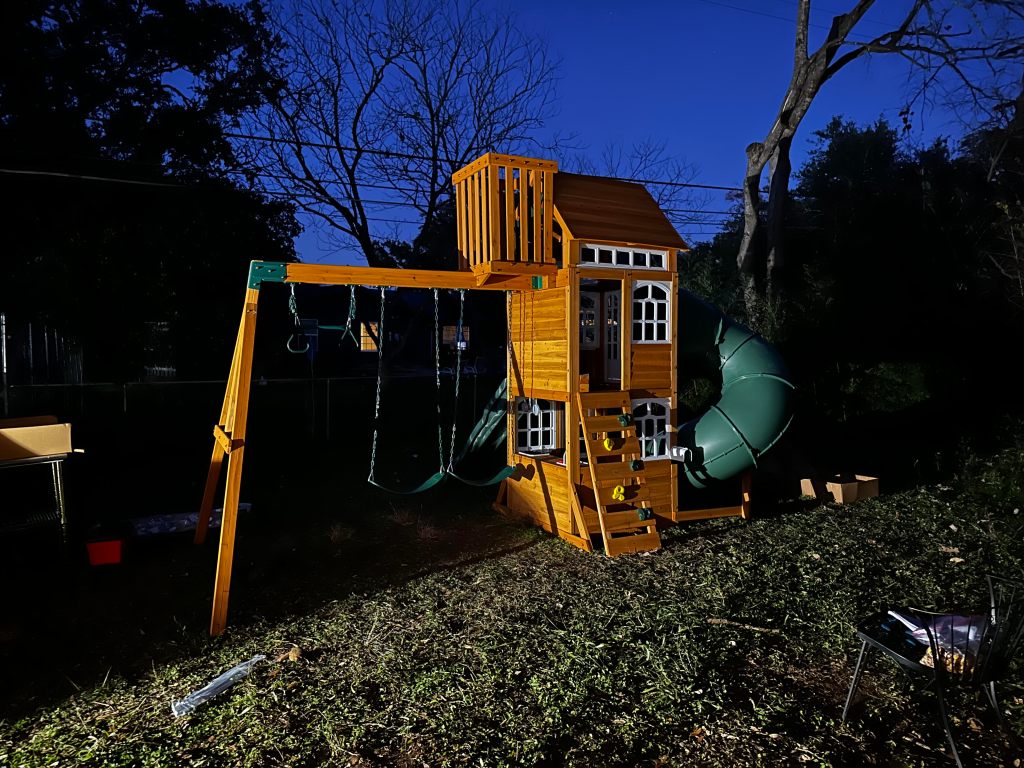
The play set – photo courtesy of Brandon Beck

I’ve just finished constructing the new playset in the backyard (with a lot of help from friends and family).

And as much joy as I receive from watching the kids play with the Nativity set and light and blow out the Advent candles, climb in and out of the cardboard boxes, work on the puzzle in fits and starts, jump and scream and slide and swing on the playset, I find myself struggling to stay in the moment.

My tendency toward anxiety creeps in. Will they start fighting? Will the three neurotypicals bully the two with autism? Will the one girl get left out? Will the new puppy get trampled? Will the new puppy’s puppiness scare one of the little ones? Who will have the next toddler or autistic meltdown?

Will I be able to keep regulated so that I can help them regulate when they need it?

According to The Gospel of Thomas, Logion 2, Yeshua says, “If you are searching, you must not stop until you find. When you find, however, you will become troubled. Your confusion will give way to wonder. In wonder you will reign over all things. Your sovereignty will be your rest.” (Trans. Lynn Bauman, PhD)

I take a deep breath and say this Logion to myself. I remember that this is the Most Wonderful Time of the Year. Every moment with these kids is, if I stay in the moment.

I can let go of all my anxieties and stay in the moment by seeking Jesus in them. I cannot stop until I find Jesus in the little children. Even when I become troubled, I begin again and again because I know Jesus is there even in the trouble. This is where I co-regulate with them. “I love you,” I say. “You are doing great,” I say. “I wonder what… I wonder how… I wonder if…,” I say. And in wonder, I have a new mastery over my thoughts, feelings, and actions. I step into a freedom to play with the kids rather than worry about them, and that play is so restful!

Amen.

You are light!

by Pam Tinsley

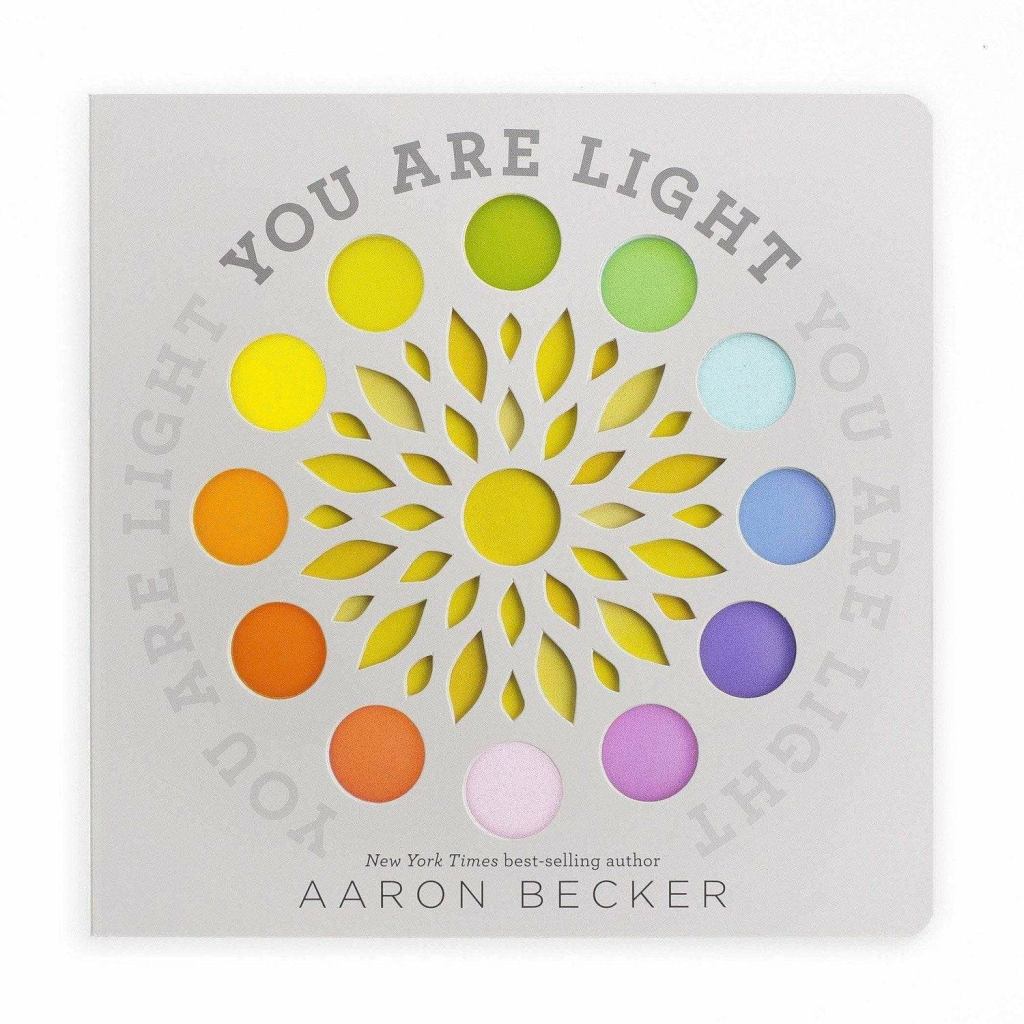
As I walked along the undercroft beneath our church’s nave with its display of preschool books, a title caught my eye. The book’s cover looked like a painter’s palette, with colors in a circle, perfect for a small child to touch. Its title, You are Light[1], spoke to me of the physical qualities of light – especially as we move through the winter solstice with hours of daylight just beginning to cease their waning.

More significantly, as we moved through Advent to Christmas, the book’s title spoke to me of light’s spiritual qualities: We reflect on the light that was coming into the world at the first Christmas. Since then, the poetic words from John’s Prologue have been whispering to me: The true light, which enlightens everyone, is coming into the world!

I’ve also been reflecting on what Christ’s light means for us today. Too often it feels as though we’re sitting in darkness in the shadow of death. Our country is being torn apart by political divisions, leading to threats of violence and threats to our democracy; wars rage around the globe; and concerns about the impact of climate change on our planet are raised daily.  

Although at times it seems next to impossible to believe that the light breaks through, the Incarnation and the Resurrection assure us that the light – the True Light – has not only broken through but cannot be overpowered by darkness.

Not only that, but we are also part of the ongoing light of Christ that shines in the darkness. The newly baptized are often given a candle, lit from the paschal candle, with the words “receive the light of Christ.”

A white square with colorful circles

Description automatically generatedWe, the baptized, continue to bear Christ’s light into our dark and broken world, offering hope through our words and through our actions. We are light. We are Christ’s light in the world. And so, I invite you to reach out to those you know and love and to those you encounter in your daily life with the same love with which God looks upon you. Then you might just cast the light of Christ upon someone who feels as though they live in darkness. Because “You are Light!”


[1] Becker, Aaron. You are Light (Somerville: Candlewick Studio, 2019)

What’s my Advent vocation?

by Demi Prentiss

I’ve been thinking a lot about vocation during these weeks of Advent, and the season has shifted my sense of how I’m seeking to live into the call God has placed on my life.  What is my Advent vocation? And how does that shape my life as a “child of God, beloved and called” during the other seasons?

Some of the Advent vocations from our lectionary’s Year B Advent Gospel readings that have sparked my imagination:

  • To practice engaged waiting, like the faithful doorkeeper – “Keep awake!” (Mark 13:37) – Advent 1. How will I practice the role of doorkeeper? On my watch, who will find welcome – or a locked door – as they seek to encounter Jesus?
  • To remember my baptism in the Holy Spirit. (Mark 1:8) – Advent 2. Having been “marked as Christ’s own forever” (BCP p. 308), how has that mark shaped me? And would the world recognize that I bear that mark? What evidence would they notice?
  • To shout in the wilderness, “Prepare the way for the LORD’s coming! Clear the road for him!” (John 1:23, NLT) – Advent 3. Am I – or can I become – a “way-clearer”? An “edge-walker”? Am I brave enough to shout? Would Jesus choose to walk the trail I’m blazing?
  • To call on love to cast out fear…. For nothing will be impossible with God. (Luke 1:30, 37) – Advent 4. Grateful for the angel’s assurance that nothing is impossible, I have learned that if I can concentrate on the “loving” part, God works on the “casting out fear” part. When I focus on seeing where God is in action in those around me, fear loses its hold on my spirit.

A recent Advent reflection from the brothers of the Society of St. John the Evangelist (SSJE) named for me the Advent vocation I find the most challenging – To be Christ’s light in a dark world. To shine Christ’s light, we can be a blessing. We can draw on the faces of compassion that Jesus modeled for us:

  • When we see people marginalized and put down, we can be fierce in love and in our calls for justice – like the blazing sun.
  • When we encounter pain and loss, we can be tender by offering warmth and hope and healing – like a candle in the night.
  • When we face stuckness, we can be playful as we frolic through shadow and light, drawing those around us into joy – like the slivers of an eclipsed sun dancing in the leaves.[1]

The Advent 1 collect urges us, with grace and courage, to “cast away the works of darkness and put on the armor of light” (BCP, p. 211). Where will we be bold enough to offer a word or a sign that kindles a spark of hope? How will we share the light of Christ that is within us, acknowledging that the Holy Spirit’s power will magnify our small light?

My English born-and-raised friend from long ago shared a favorite song from her 1930’s Depression-era childhood that I like to remember when I’m feeling challenged to be Christ’s light:

“Jesus bids us shine with a pure, clear light, Like a little candle burning in the night!

In this world of darkness, so let us shine – You in your small corner, and I in mine!” Dear Lord, lead me to be the Light for someone who is seeking you.


[1] With thanks to Rob Voyle, “Compassion and the Crazy Wisdom of Jesus.”