How race shapes baptismal living

by Fletcher Lowe

We at Partners for Baptismal Living have been exploring how race impacts our daily lives. There is a major contrast.

Here are conversations with two African Americans.  A former CEO of a large Richmond, VA hospital said that white privilege is subtlety present as he interacts with white folks in the workplace. He has also been aware that in promotion, his path has been harder than others who were white, having been passed over even when he felt he was more qualified.  An African American lady, shared that fear was omnipresent when she goes out – fear of police pulling her over because she is in the wrong neighbor or driving too fancy a car.  In stores she always gets a receipt lest she be accused of stealing.  She also feels that the playing field is not level with both her race and her gender being liabilities.

Now for the contrast.  For the white folks we have conversed with, the racial issue is less the backdrop of one’s daily life. Awareness of race comes less from how it affects these whites directly and more from how it affects people of color connected to their work situations. A friend who is in Virginia state government’s office of Conservation and Parks mentioned how they are reaching out to employ more people of color in his agency and how they are training the Park rangers in dealing with situations of racial harassment among visitors.  A head of a mental health non-profit spoke of how his agency works with Black congregations to help them help their members overcome the mental illness stigma that sometimes prevents them from getting treatment.

Some of us white folks are often blinded by our racial assumptions.  The CEO mentioned above was in the church building of the multiracial congregation of which my wife and I are a part.  In came a couple of white tourists for the building has historical significance. They began a conversation with the CEO and asked him how he liked his job as the sexton. Without losing a beat, he replied, “I am not the sexton, I’m the Senior Warden!”

As each of these people is a committed Christian, it raises the question for us: How do we work to level the playing field, to work so fear is not a constant undercurrent. The Advent message of preparation for the coming of the Prince of Peace calls us to work for that peace among races that manifests itself in diversity, equity, and inclusion.

Embrace your call

by Demi Prentiss

“There is not a single Christian who has not been equipped by God for the particular tasks which God has given him or her. There are no exceptions. All of us are ministers of God and ministers of the Church. All of us have been equipped in some way to participate in this important mission.”

Br. David Vryhof

The Society of St. John the Evangelist chose “minister” as their Word for the Friday after Thanksgiving. They drew inspiration from a message preached by Br. David more than four years ago – before the 2016 Presidential election, before COVID-19, before the economic downturn linked to the pandemic. One of the great lessons of 2020 has been reinforcement of the message: The church is not a building; the church is the people of God, on mission. The fear and isolation we are experiencing reminds us, viscerally, that our faith community is a lifeline in our daily practice of faith. And every single one of us plays a vital part.

Br. David goes on to remind us that our primary mission responsibilities are to teach others and, always, to proclaim God’s Good News – to collaborate in God’s work of wholeness among us, bringing compassion and healing to all we encounter.

“You are ministers of God in the world, laborers sent into the harvest…. You are the means he has chosen to extend his love and grace into all the world.  Embrace your call.”

What’s your brand?

by Demi Prentiss

Are your shoes Nikes? Is your workout gear Under Armour? Is your car a Tesla? Or a Ford? Or a Toyota? Does your hoodie say Mystics or Storm? Does the logo on your sweats stand for Harvard or Howard or Texas State?

What we wear brands us. Often, people who meet us can instantly know something about our loyalties and our values, just by reading the signs of what we are wearing or driving – even without badges or bumper stickers.

Being “branded” used to mean carrying a scar – an identifying mark seared in the flesh that made clear what “herd” you belonged to. Now “branding” is a communication essential: Distinctive logo plus well-placed promotion can mean recognition that “boosts your brand,” adding value.

Being baptized is a branding experience. We are, with water and with oil, “marked as Christ’s own forever.” We may not choose to recognize it, and we may not be scarred, but it’s permanent. For some of us, that brand is recognized and valued, as we are reminded by those who love us that we a “child of God, beloved and called.” For some of us, we are treated as “knock-offs” and devalued. For many of us, claiming our authentic brand is a struggle, especially when we have been persuaded that we must be “fakes.” Sometimes it’s hard for us to “own” our brand – that baptismal mark may align us with a crowd we don’t really feel part of. And every once in awhile, remembering that we carry Christ’s brand, we have the courage to be the person we were made to be – loving and just, caring and creative, a beloved child of God.

When the saboteurs in our inmost thoughts attack us, when the disparaging outside voices wear us down, may we hear the Truth that sets us free: “See, you have nothing to fear. I, who made you, will take you back. I have chosen you, named you as My own.” (Isaiah 43:1, The Voice) Our hearts carry the Creator’s indelible mark, and it calls us to wear our baptismal brand “with pride, with dignity, and with integrity.”

Who will equip the saints?

by Fletcher Lowe

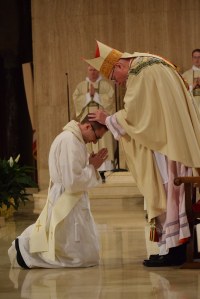
The ordination of Gwynn Crichton (Facebook Live screen shot) September 14, 2020, at St. Paul’s, Richmond, VA

…making some apostles, some prophets, some evangelists, some pastors and teachers to equip the saints for the work of ministry….

So the Episcopal bishop, in quoting Ephesians, began the consecration of my good friend, Gwynn, as a priest recently.

I heard those words as I “attended” virtually her ordination. Aside from my joy in joining with her as she enthusiastically responded and celebrated, my mind began to look at the service through the lens of how the new priest is called to empower the Baptized in their daily lives. Although the service was specially about her calling, there were some nuggets reminding both her and us of her calling to empower us all in our calling as a holy priesthood (1 Peter2:5).

For all members of your Church in their vocation and ministry that they may serve you in a truly and godly life. we pray to you, O) Lord. 

Those words, coming early on in the Litany for Ordinations, reinforces Ephesians, underscoring that all the Baptized have vocations and ministries.

When my friend was examined by the bishop, some of these words resonated:

All Baptized people are called to make Christ known as Savior and Lord and to share in the renewing of his world, and You are to nourish Christ’s people from the riches of his grace and strengthen them to glorify God in this life and in the life to come.

Then I heard words that, in this specific case, are for the priest, to radiate out to all the Baptized:

Will you do your best to pattern your life in accordance with the teachings of Christ, so that you may be a wholesome example to your people?

Will you persevere in prayer, both in public and in private, asking God’s grace both for yourself and others, offering all your labors through the mediation of Jesus Christ and in the sanctification of the Holy Spirit?

Along with these relevant quotes from the service, one other thing struck me.  Because of the virus, there were only ten people in person at my friend’s service.  It reminded me of one of my visions about the relationship of Baptism and Ordination.  My vision is that when we have fully restored the centrality of Baptism, the major sacrament, in the life of the Church, Baptisms will take place in packed cathedrals amidst trumpet sounds and full processions with choirs and crosses and banners! Ordinations, on the other hand, being a minor sacrament, will take place in smaller venues with a few friends and family in attendance!

Anybody share my vision?

Our sewing saints!

by Pam Tinsley

Each Sunday at worship, Naomi, an internationally renowned organist and musician, blesses our congregation with her gift of music. And prior to the pandemic, she regularly performed locally, nationally, and internationally. Music is not only her profession and passion – it is her vocation. Naomi’s faith radiates whenever she interacts with others, be they musicians, choir members, or parishioners. And the love for Jesus that she has instilled in her four-year-old son, both at home and in church on Sunday, is recognized by all.

With concerts cancelled because of the pandemic, Naomi discovered another way she could serve Christ in her daily life. Naomi has close contacts in her home country of Japan, which led her and her husband to become an aunt and an uncle to students at an orphanage school in Osaka. Once the pandemic has passed and it’s safe to resume gathering, Naomi hopes to do some fundraising concerts and events with the pastors at the church that runs the orphanage.

A thank you letter sent by one of the Osaka school children, along with a gift of his origami art made with special colors reserved for special occasions: a boy in gold, a crane in orange, and a cicada in silver.

In the meantime, Naomi learned that the school had a need for masks. Without hesitation Naomi offered to make 100 masks for the children! Unfortunately, after sewing just a few masks, her sewing machine broke – at a time when inexpensive sewing machines were sold out everywhere.

And then Naomi experienced God’s work first-hand. A friend gave her a sewing machine – a super fancy one at that. And then, because she was a beginner seamstress and also making masks of all sizes, she realized she needed help – at a time when many people were tiring of making masks. That’s when the sewing saints appeared! Two women stepped up and, with their help, Naomi was able to send 100 masks to Japan in less than two weeks!

Now the kids wear them when they go outside and when they are in class. The principal wrote that the kids think their new masks are the coolest. Not only are they handmade, but their aunties in America made them for them! (And they came with American candies.)

Same mission, new name

by Fletcher Lowe 

Partners for Baptismal Living: PBL.   That’s the new name for Episcopalians on Baptismal Mission (EBM).

Why the change? We feel it is more inclusive. After all, all the Baptized are partners.  We feel it makes our group more accessible by inviting all the Baptized – including the ordained – to become partners with us, in claiming the dignity and the power of our baptism.

“Assembling the tents at Base Camp” by markhorrell is licensed with CC BY-NC-SA 2.0. To view a copy of this license, visit https://creativecommons.org/licenses/by-nc-sa/2.0/

One of our important metaphors is a base camp.  If you give it some thought, a base camp is not the destination. It is a way station for the hikers whose destination is beyond.  The base camp is there to empower, equip, guide, heal, support, and encourage the hikers.  Translated to the local congregations, like the basecamp, it exists for the members, not vice versa.  It is not the destination, but a fueling stop on the way to the members’ real mission in their daily lives of work and community and home.

Let me share PBL’s recent statement of who we are and what we are about, from the upcoming edition of the Episcopal Church Annual, aka “The Red Book”:

A partnership dedicated to the ministries of all the baptized in their daily lives. Formed in 2006 as Episcopalians on Baptismal Mission (EBM), PBL’s mission within the Episcopal Church is to recognize, affirm, and empower the Monday through Saturday ministries of baptized persons, grounded in the Baptismal Covenant; to explore common ground and natural alliances with other Episcopal, Anglican, and ecumenical groups; to assist congregations, dioceses, provinces, and seminaries in planning and implementing educational events focused on the calling of all the baptized ; and to provide a communications link among partners through our email listserv and blog, www.livinggodsmission.org.  PBL is led by a steering committee of laypersons, priests, and bishops. Membership is open to all. Contact: Rev Cn J Fletcher Lowe Jr at jflowe@aol.com.

If you’re interested in learning more about us, check out the other pages here at Living God’s Mission, and feel free to send us a comment or question using the response form.

Stay safe, stay well and stay grateful.

Who do you say that I am?

by Demi Prentiss

“Who do you say that I am?” Jesus asks (Matthew 16:15, Mark 8:27, Luke 9:18). And how do we answer? The response that we express through our daily life speaks more loudly than any creed or prayer or promise that we might read or recite.

And what might God say if we were to ask the same question? “Dear God, who do you say that I am?” That’s a question that launches many a quest and walks alongside us on the spiritual journey that is our life. “Who has God made me to be? How do I live into that calling?”

Brother Geoffrey Tristram, SSJE, provides encouragement to all the baptized, guiding us to listen with the ear of our heart:

If you have been baptized, then you have a vocation!  So what is a vocation?  Some people think it must be something that you suddenly get.  You’re walking along quite happily one day, and God suddenly “zaps” you with a vocation!  I don’t think that’s quite right.  I believe that your vocation is that which lies at the very heart, the very core of your identity.   It is discovering who it is that you most truly are.

There are particular moments in life, perhaps when you experience something, meet someone, hear some words, which touch that deep core within, and it resonates.  And you say – “Oh – that’s who I am,” or “That’s what I want to do or be in life.”  Sometimes you forget it, or you try to put it out of your mind, if it doesn’t fit in with other plans.  But it usually comes back, and deep down, you just know that it’s truly who you are meant to be.

The Creator’s call can be powerful and persistent. Some would even say that God calls everything and everyone in Creation – baptized or not – to walk God’s Way of Love.  Baptismal living embodies our choice to live the truth that God proclaims in each person, so that through our God-given identity we are blessed to be a blessing.

Ministry of the first order

by Fletcher Lowe

Baptism

Over two thousand years ago, Paul said it this way: “equip the saints for ministry….” Ephesians 4:12

Sixty-six years ago, the Second Assembly of the World Council of Churches, fleshed it out:

The real battles of faith today are being fought in factories, shops, offices, and farms, in political parties and government agencies, in countless homes, in the press, radio and television, in the relationship of nations.  Very often it is said the Church should “go into these spheres,” but in fact the Church is already in these spheres in the persons of its laity.”

Anglican lay leader Mark Gibbs 49 years ago put it in the context of clergy and laity:

“The laity are not called by God to any lower standard of discipleship than clergy or churchy laity. They are not limited to any less standard of Christian life and witness. They are, indeed, God’s first line of agents in the world.  [God] has placed them and can use them in secular structures where the clergy can seldom penetrate.”  (Mark Gibbs, October, 1971)

Ordination to the priesthood

So now Episcopalians in their Catechism ask and answer the question:

Who are the ministers of the Church?

The ministers of the Church are lay persons, bishops, priests, and deacons. (BCP p. 855)

Notice, the first order of ministry in the Church is lay persons.  Notice also that the remaining three are in-house orders whose function is within the institutional Church.

In defining the ministry of the laity, the Catechism states it this way:

The ministry of lay persons is to represent Christ and his Church; to bear witness to him wherever they may be; and, according to the gifts given them, to carry on Christ’s work of reconciliation in the world; and to take their place in the life, worship, and governance of the Church. (BCP, p. 855)

Notice that the laity’s calling is beyond the Church doors with one exception – the last one, participating in the governance of the Church. Notice too that in the world of daily living, lay people exercise many of the functions the church asks of bishops, priests, and deacons.

    1. Lay persons are bishop-ing in the wider world. Often, they are called to oversee their workplaces, their homes and their communities, to work for unity and reconciliation, to make efforts to build up their organizations. That’s bishop-ing.
    2. Lay persons are priest-ing in the wider world. Often, they are called to give and receive forgiveness (pardon), to offer blessings with food and friends and family, to teach and to guide. That’s priest-ing.
    3. Lay persons are deacon-ing in the wider world. Often, they are called to serve others in countless ways. Most everything we do has a serving opportunity with it, be that in business or garbage collection or clerking at retail or fast food or medicine or homemaking or parenting or whatever. That’s deacon-ing.

Within the wider world the lay people, commissioned by their Baptism, are the front-line bishops, priests, and deacons.  The Dismissal sends them out from the Church building to be the church, to live into their ministries wherever they live and more and have their being.  Thanks be to God!!

Discovering what’s holy

by Demi Prentiss

It’s not uncommon, especially for those of us in the church / non-profit world, to think of our work as our ministry, or at least a major part of it.  While much of the time the work is life-giving — sometimes even empowering — all of us face times when there’s more tedium than uplift. The results seem to stagnate and the issues seem insurmountable.  The sense of call to our work can fade, and motivating ourselves can get harder.
We all know how the spiral starts on its downward path. The lack of enthusiasm starts to slide toward irritation — minor, at first, because of drudgery or overload or sheer weariness. And, as the irritation grows, the frustration builds, as we notice that the harder we push, the less we accomplish. Soon, the frustration upgrades to actual pain – the pain of not seeing results, or not completing what seems so easy for another, or suddenly recognizing that none of our work is any good at all. Ever. To anyone.  And there we are, trapped in anger and sadness at simple mistakes, hearing every innocent remark as targeting our failings, unmasked as the pitiful, incapable wretch we really are.  We begin to believe that Genesis spoke truth in identifying work as the curse of humanity.

Brother Lucas Hall, SSJE, recognized this pattern in himself, as he struggled writing a sermon highlighting the story of Mary and Martha. His reflection on the story and on his frustration led him to an insight:

Work is not bad. Even the most contemplative among us must work. But work serves an end. Even the holiest work of your life is not your purpose. It facilitates your purpose, and your purpose is encounter. The welcoming of the eternal, living God into your midst.

The good news is that each of us, in our daily work, inside and outside our home, has the opportunity for such an encounter. In every person we engage — and deep within our own hearts — we have the opportunity to meet Christ. Expanding our hearts to respect the dignity of every human being liberates us from focusing on what we believe we need to accomplish.

As Thomas Merton wrote to a young Jim Forest:

Do not depend on the hope of results. You may have to face the fact that your work will be apparently worthless and even achieve no result at all, if not perhaps results opposite to what you expect. As you get used to this idea, you start more and more to concentrate not on the results, but on the value, the rightness, the truth of the work itself. You gradually struggle less and less for an idea and more and more for specific people. In the end, it is the reality of personal relationship that saves everything.

—Thomas Merton, “Letter to a Young Activist”

Where’s the church?

by Fletcher Lowe

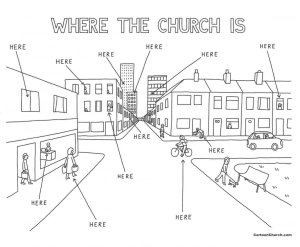
You may have heard the story of a recent conversation between the Devil and God. Gleefully the devil says, “Well, God, looks like I have beat you this time.  My virus has shut down all your churches just as I planned.”  God replies, “You are correct that the church buildings are closed down. But the church is not, for the church are the people and they are very much alive, some doing extraordinary things to protect my people.”

That reminds me of a conversation I had with a person driving into the town where I began my ordained life. When he saw my clerical collar, he rolled down his car window and asked where the Episcopal church was.  I hesitated a moment and then said, “Well, the church is the teller in that bank over there, and down the road  the owner of the radio station and back there is the mayor in city hall and over there is the salesman in the hardware story.  That’s where the church is. But if you want to know where the building is it’s two blocks over on the left.”  I’m sure I gave him more information than he wanted, but it does follow God’s rebuke of the devil.  The drawing says it all!!

Jesus in Matthew 10 put it this way:

5 These twelve Jesus sent out with the following instructions: “Go nowhere among the Gentiles, and enter no town of the Samaritans, 6but go rather to the lost sheep of the house of Israel.”

To paraphrase: “GO, partner with me in my mission, not to some foreign place but right here in your community.”

That call comes to us, again, to “GO, Proclaim by word and example the Good News of God in Christ,” as the Episcopal Church’s Baptismal Covenant states.

A new favorite hymn of mine says it well:

Go my children with my blessing, never alone.

Waking, sleeping, I am with you; you are my own.

In my love’s baptismal river, I have made you mine forever….

Go my children, fed and nourished, closer to me,

Grow in love and love by serving, joyful and free….

Amen.