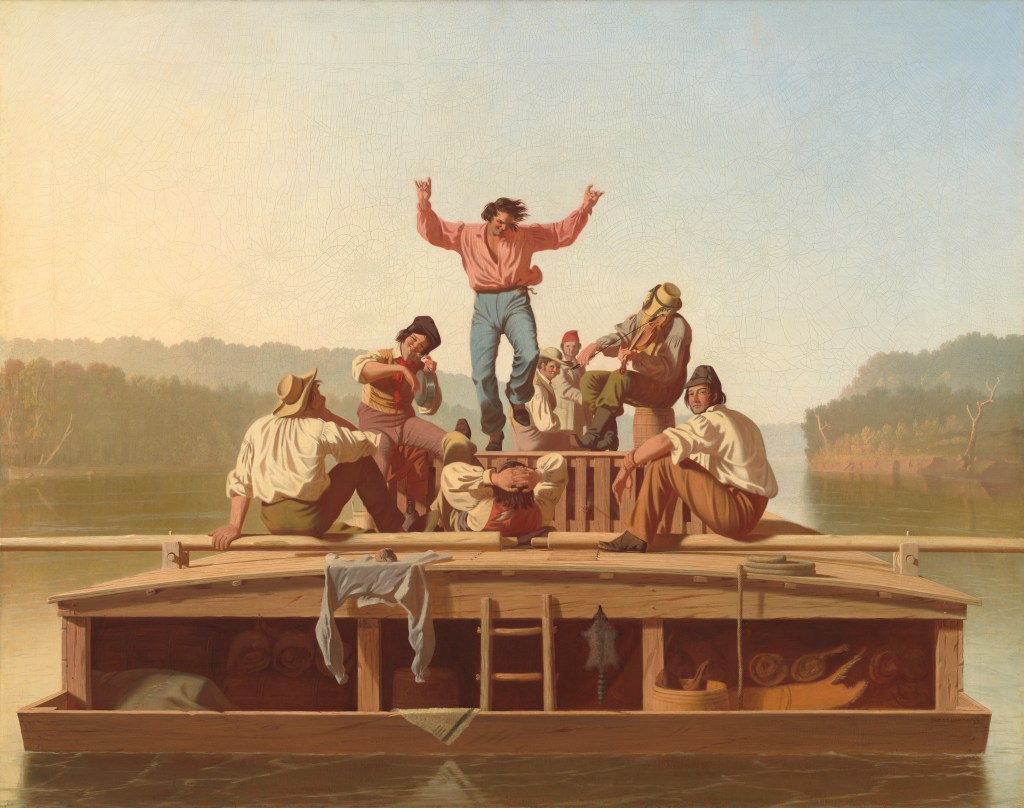
Dennis Raverty, writing for The Living Church, recently took a closer look at a widely-distributed 19th century print of a painting by George Caleb Bingham, titled The Jolly Flatboatmen.
The Jolly Flatboatmen, George Caleb Bingham, Public domain, via Wikimedia Commons
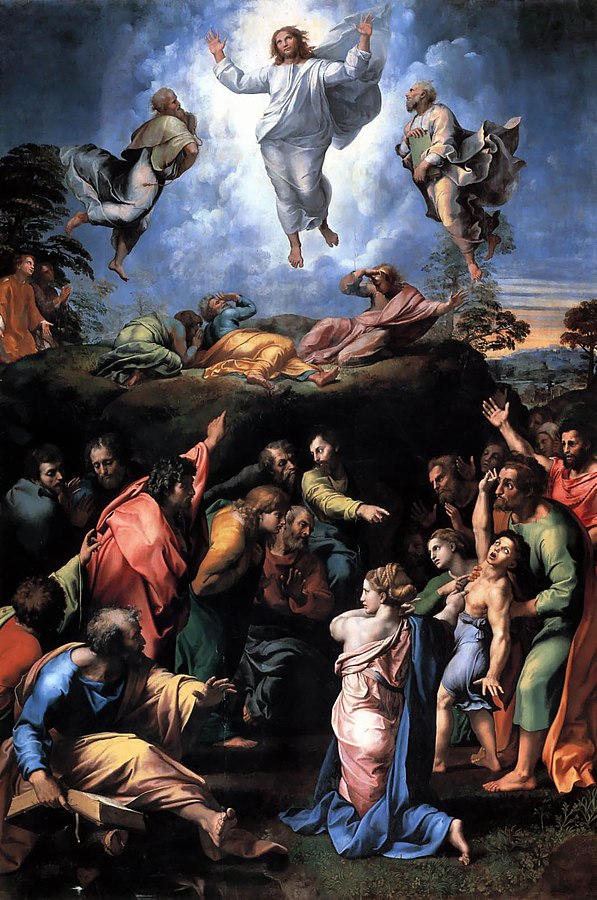
When the engraving was distributed to American Art-Union subscribers in 1846, some objected that the realistic subject matter was “uncouth.” Raverty believes that Bingham was intentionally mirroring a far more lofty painting by the Renaissance master Raphael, The Transfiguration of Christ. In “quoting” Raphael, as Raverty expresses it, Bingham makes the clear implication that “life on the Western frontier transforms people, and helps them realize their innate Christlike potential.”
The Transfiguration of Christ, Raphael, Public domain, via Wikimedia Commons
Raverty writes, “The gift of discernment demanded by the painting is the ability to see the latent Christ even in the most humble and coarse of subjects. Seeing the High Renaissance references in this lowly genre piece of daily life on the river required a similar act of recognition.”
Recognizing Christ at work in our daily lives requires understanding Christ as living and active in the world we encounter. Bingham’s gift of highlighting daily life transformation reaffirms our own aspirations to see Jesus often in the people and situations around us. As Raverty concludes, “By elevating the ordinary, as Bingham has done in this painting, the artist transfigures it, and at the same time challenges viewers to discern the hidden image of the glorified Christ in their otherwise mundane, everyday reality.”
Cursilllistas who practice living “the Fourth Day” ask themselves each week, “Where have I seen Christ in action?” A good question for those of us who seek to follow Jesus.
Novelist Qiu Xiaolong, in his 2000 (English translation) novel Death of a Red Heroine (Book 1 of the Inspector Chen series), writes, “When you wear the mask, the mask becomes you.” I’m thinking about masks today for many reasons, mostly because my mask hurts my face. I am learning to take my mask off by listening to God and integrating God’s call on my life with a psychoeducational practice of emotional sobriety.
In SMART Recovery groups, people come to learn emotional sobriety as a pathway to peace from any and all kinds of addictive behavior. We recognize, understand, and act to change our own actions in relationship to our feelings and thoughts. One of my rule-of-life principles is to remember, “I am fearfully and wonderfully made” (Psalm 139:14). Coming to know this about myself was not as simple as meditating on the psalm or listening to other people compliment me, reward me, or praise me – especially when who they were complimenting and lauding was my mask and not me. Participating in SMART Recovery and practicing the skills taught there helps me embody the words of God, to recognize my authentic self in God’s words, to understand myself as God sees me, and to act in a way congruent with who I am as a child of God.
I’m reminded of another quote – this one from the 1998 film version of Alexandre Dumas’s classic The Man in the Iron Mask: “I wear the mask. It does not wear me.” I’ve learned to make a conscious decision about my mask rather than letting it control my life. I recognize the illusion my mask creates – the way it separates me from God – and I understand how to take my mask off so that it does not wear me, does not become me.
One of the SMART Recovery exercises is on unconditional self-acceptance (USA) and asks that I challenge negative thoughts I have about myself, detect my own irrational/worldly thoughts, and connect with the rational thoughts that demonstrate my worth and goodness based on facts I can sense. My action is to turn to God and remember that “I am fearfully and wonderfully made”– it’s ok to take off my mask so the world can see how God created me!
De-masking – showing the world my beautiful face – is a truth-telling that came easily as a small child. Jesus asks us to reach God through childlike wonder because, when we are children, we haven’t yet been told to put on masks; as children we haven’t hidden our beautiful faces from our Creator. My prayer today is that we each examine our faces and ask, “What mask am I wearing? What’s stopping me from taking it off?” After all, God wants to see your beautiful face!!
We are all missionaries. By our own cultural heritage, by our own geographic setting, by our training, education, life experience, and unique access to certain people, we are to bear the beams of God’s light, and life, and love, knowing that God is with us and that God will provide. – Br. Curtis Almquist, SSJE
U.S. National Park Service photo
Summer is such a great time for travel, or for a stay-cation – for getting outside our daily routines and perhaps exploring a few new things, just a bit outside our comfort zone. Seeing, doing, learning, observing something new. It’s a great reminder that the things that strike us as “new” might be one of the “new things” that God is placing before us – perhaps to entice us to join in one of God’s “new things.”
It’s easy to forget that the things that strike us as “new” may be everyday stuff for lots of people. And vice versa: our habits may be startling “new things” to those who might not know us, our daily grind, or our “home” culture. No matter where we go or who we encounter, God is with us, as Brother Curtis reminds us. Whether or not we choose to be aware of God being with us, the people we encounter will be able to see “the beams of God’s light,” if we’re brave enough – and authentic enough – to let them shine through.
Recognizing our role as light-bearers can humble us. And embolden us, perhaps, to dare to live our fullest version of the life God is calling us to live.
Eugene Peterson’s The Message gives this interpretation to Matthew 5:16:
14-16 “Here’s another way to put it: You’re here to be light, bringing out the God-colors in the world. God is not a secret to be kept. We’re going public with this, as public as a city on a hill. If I make you light-bearers, you don’t think I’m going to hide you under a bucket, do you? I’m putting you on a light stand. Now that I’ve put you there on a hilltop, on a light stand – shine! Keep open house; be generous with your lives. By opening up to others, you’ll prompt people to open up with God, this generous Father in heaven.
“The longer I live the more deeply I learn the love – whether we call it friendship, family, or romance – is the work of mirroring and magnifying each other’s light.” – James Baldwin, Nothing Personal
After reading Matthew 10:40-42 I’ve been reflecting on what it means to give and to receive hospitality: How I might offer a “cup of cold water” – hospitality – to someone in need – or how I might receive it.
In the midst of my reflections, I had two telephone interactions with the IRS. Yes, the IRS whom so many of us fear!
The first call was regarding a non-profit whose contact and address information I’d been trying to update by mail for close to two years. When a letter from the IRS was miraculously forwarded to me, I filled out paperwork for the changes. And then I still waited. Finally, with a bit of trepidation, I picked up the phone and called the person whose name was on the letter. Within 20 minutes the changes were implemented by an incredibly helpful and gracious IRS representative. He ended our conversation with, “May God bless you.”
My second call was related to our personal taxes. I decided to save on our accountant’s fee and – perhaps bolstered by that recent experience – made the call to the IRS. Lo-and-behold, I ended up with another super helpful and gracious IRS rep who thanked me each time she had to put me on hold. She sorted everything out quite efficiently, and she thanked me yet again for my patience!
What they probably saw as routine actions made a deep impression on me. They made me feel as though I’d received a cup of cold, refreshing water – just like the cup of cold water Jesus refers to in Matthew 10:42.
That’s when I realized that most of my own acts of welcome are simply part of my daily or weekly routine.
As 21st-century disciples, we bear Jesus’ presence to whomever we encounter, whether it’s at home, at work, at the grocery store, or even on a service call. And we do this through simple, everyday acts of kindness. Because each simple, everyday act of kindness, of grace, embodies God’s love for our neighbor. Each simple, everyday act of kindness, of grace, bears witness to the extravagant welcome of God’s kingdom. Each simple, everyday act of kindness can grow and spread and lead to something greater – to more – when we offer it in Jesus’ name. Each simple, routine act of kindness can begin to transform our broken world into a world more attuned to God’s will for us and more aligned with God’s Kingdom values.
Those who know me have heard me quote the statistic that 99.2 percent of the church are laity. That is true across denominations in the U.S., and that means that all the clergy comprise less than one percent of the church. Laity – just like the ordained – are called to exercise their ministry 24/7/365. And if we laity leave “being church” up to the clergy, we’ll kill the ordained with too much work and too many expectations, while leaving the work of the Body of Christ largely unrealized.
A recent blog posted by Michael Piazza is titled “From Theology to Biography.” It is a powerful reminder of the work God has called all of us Christians – through our baptisms – to do as our everyday response to God’s claim on our lives:
“What does it mean for our theology to become biography? It can’t happen only when you are at church. It also must happen when you are fishing or filing. Ninety-nine percent of the ministry of the church takes place Monday through Friday in shops and offices and factories. The deep purpose of our lives must extend to every area of life, and our purpose also must extend beyond the boundary of our own lives. Rev. Dr. Martin Luther King, Jr. said:
“You ask why are we here, and I will tell you. We are here to serve. Success is not defined by the number of servants you have, but by how many people you serve.
“According to a parable Jesus told, only a fool thinks the purpose of life is gaining more and more. The most certain formula for misery is to have as your only purpose for rising in the morning and working through the day to be what you can accumulate for yourself.
“If you can summarize the purpose of your life with the words “me” and “mine” then you have succeeded in sentencing your soul to hell. Oh, not the hell of eternal fire, but the hell of a shallow, vain, and meaningless existence. Look at the great lives that have made this a better planet:
What if Beethoven had been only an organist?
What if Edison had been only a mechanic?
What if Rosa Parks had been only a seamstress?
What if Desmond Tutu had been only a priest?
What if Mother Theresa had been only a nun?
“Great people are those who have most enriched the lives of others. Isn’t it time for us to rise up to become great people?”
Keep, O Lord, your household the Church in your steadfast faith and love, that through your grace we may proclaim your truth with boldness,and minister your justice with compassion; for the sake of our Savior Jesus Christ, who lives and reigns with you and the Holy Spirit, one God, now and for ever. Amen. (Collect, Proper 6, Year A, RCL)
In the daily devotional of The Oriental Orthodox Order in the West, “Witnesses to Truth,” dated Friday, June 16, 2023, Abbot Lynn Bauman opened with quotes from playwright Tennessee Williams and theo-philosopher David Price:
No one is ever free until they tell the truth about themselves and the life into which they’ve been cast…. We are all here to be a witness to something, to be of some aid and direction to other people. – Tennessee Williams
The first truth we have to tell is the truth of the culture of outrageous violation we find ourselves in. Our essential self is violated from early days in our lives. There’s no other word for it. We have to heal ourselves with truth. This is work, and it often goes slowly. – David Price
Witnesses to Truth, Abbot Lynn Bauman, 2023
Abbot Lynn goes on to say, “We are here as witnesses – to both be in and watch the world from our vantage point, and speak its truth no matter how difficult that may be for us, but also more importantly to be of aid and direction for other people. That is a divine calling – a higher purpose, and it gives direction and meaning for our lives. Obviously, the stakes are high as we perform this task (duty or vocation) as we feel it.”
I read “Witnesses to Truth” on Friday, June 16, then turned to the Revised Common Lectionary (RCL) to prepare for Sunday, June 18.
God winked. Abbot Lynn, RCL year A, and I were thinking alike, it seemed.
The collect for Proper 6 (Sunday closest to June 16 and printed at the beginning of this article) prays for our steadfastness in proclaiming the truth and ministering in justice and compassion. And the selected scriptures for Proper 6 weave into this truth-telling-tapestry, too.
Personally, I find that balancing my bold proclamations of truth with my ministering with justice and compassion requires continual awareness, patience, practice, and prayer. I require a full team of support to keep my balance. I am grateful to my accountability partner, my family, my community, and God’s voice and presence for reminding me moment-by-moment to shift my weight a little this way or that in order that I don’t fall. I shout for joy when I see old things in new ways and new things from different perspectives, and I am learning that part of staying centered is accepting help and hearing God’s voice when it comes out of the mouths of others.
In Track 2 of Proper 6, Year A, the appointed Psalm is 100. It is a joyful shout to God – a great, bold proclamation of truth. “Give thanks to [God] and call upon [God’s] name,” says the psalmist. Listen to this psalm set to music by Adam Wright of The Corner Room. “Sometimes, we unknowingly stumble upon a life-long pursuit and don’t immediately realize its impact. For Adam Wright, that life-long pursuit is setting Scripture to music, a resource to help God’s people engage and treasure the Bible more deeply. [Adam] arrang[es] each piece into a singable work that makes memorization and meditation a joy.” (https://www.cornerroommusic.com/ )
Yet, boldly proclaiming God’s name is not our only call; we are also called to minister with justice and compassion. Our Psalm 100 shout of joy is tempered, this week, by our Gospel instruction from Jesus, from which we hear:
…proclaim the good news, ‘The kingdom of heaven has come near.’ Cure the sick, raise the dead, cleanse the lepers, cast out demons…I am sending you out like sheep into the midst of wolves; so be wise as serpents and innocent as doves. Beware of them, for they will hand you over to councils and flog you in their synagogues; and you will be dragged before governors and kings because of me, as a testimony to them and the Gentiles. When they hand you over, do not worry about how you are to speak or what you are to say; for what you are to say will be given to you at that time; for it is not you who speak, but the Spirit of your Father speaking through you.” (Matthew 9:35-10:23)
We are called to proclaim with boldness and minister with justice and compassion, and, by the Spirit, with boldness and shouts, we can.
Jesus did; the apostles did; through the generations our abbas and immas have, and now we do.
To adapt the words of Henri-Frederic Amiel to this writing: Life in this space-time is short, and we have too little time to journey this way together, so gladden each other’s hearts whenever you can by being swift to love and make kindness. Be bold to proclaim the name of God, and minister with justice and compassion…and may the blessing of God – Father and Mother, Incarnate in Jesus, and Holy Spirit – be with you now and always.
This month marks the 64th anniversary of my ordained ministries in The Episcopal Church, 58 of them before I finally retired full-time in 2017. Among the many tasks of those years, liturgical planning for Easter Day and Season services was certainly one of the more important for me. Looking back I think I got most of them right in their emphasis on the Resurrection and what it means to live in the holy reality and mission of the Risen Christ. Until this year!
In my current home parish of St. Mary’s Church in Ardmore, PA we are being served by a gifted young rector who arrived just months before the Covid pandemic hit us in March 2020. And St. Mary’s is his first parish as a rector. Yet he has guided us through two years of Zoom services with notable technical skills, pastoral sensitivity, and liturgical creativity, especially in Easter. Once we returned to “in person” services none of this has stopped. And this Easter he has folded into every Sunday liturgy a dimension that has warmed my baptismal heart. So much so that I could only exclaim to myself, “Why didn’t I ever think of this!”
Simply stated, the connection between the Risen Life of Christ and Baptism is made manifest and explicit at the outset of the service. Following the traditional Easter acclamation a Remembrance of Baptism begins the liturgy. It contains an opening prayer, three petitions, a summary prayer and then during the singing of the Gloria the congregation is generously sprinkled with holy water. It unfolds in about five minutes and continues with the usual Collect of the day and the appointed Lessons.
This Remembrance is not in the Book of Common Prayer or in any of the official alternative services. It’s a blend of Roman Catholic and Lutheran (ELCA) texts. In any future Episcopal worship revisions I believe something like it should be included. It’s a rite that would anchor the solemn and joyful realities of Baptism in the practice and mindfulness of the Church.
This concluding Remembrance prayer sets the tone for us to remember our own baptisms:
O God, through the waters of baptism, you have birthed us into the family of Christ, bathed us in forgiveness, and enlivened us in the Spirit, and for all these gifts, we are thankful. AMEN.
Mandy Patinkin as Inigo Montoya, The Princess Bride
Shakespeare, in Romeo and Juliet, has Juliet ask, “What’s in a name?” In what’s become a famous soliloquy (Act 2, Scene ii), Juliet wonders why her family and Romeo’s should keep their love from being known.
Semiotics, the study of signs and symbols and their use in communication and meaning making, has been applied by philosophers, linguists, anthropologists, theologians, and others. Ferdinand de Saussure (1857-1912) was a Swiss semiotician who worked in the subfield of semiology, focusing on the bilateral nature of the sign – the signifier and the signified. Saussure taught that words only have meaning in social context. What I say and think I mean only have meaning when you hear it and assign it value.
In The Princess Bride, a 1987 comedy-adventure film based on the 1973 book of the same name, Inigo Montoya says to Vizzini, “You keep using that word. I do not think it means what you think it means.”
Finnish academic Osmo Wiio’s somewhat satiric, yet accurate, laws of communication, state, “If communication can fail, it will.”
I live in Texas. Our Legislature meets every two years. In the last several sessions, one topic has held traction in the House and the Senate – anti-LGBTQ (especially anti-trans) legislation. Session after session, activists and advocates in the legislature, in the lobby, and in the public square have thwarted efforts to disenfranchise LGBTQ Texans. This year was different.
Texas, as of Friday 19 May 2023, is near enacting a law banning diversity offices in public universities. SB14 passed and will go to Gov Abbot, who says he will sign it. This bill bans minors from receiving trans-affirming medical care. The House has approved SB15 which bans transgender athletes from participating in sports based on gender. A bill that would have ended a law criminalizing homosexuality in Texas did not make it to the floor.
What’s in a name?
My name is Brandon. It hasn’t always been, but it is now.
He and She are signifiers of gender. The person to whom the pronoun refers is the signified. My pronouns are he/him. I am male.
How do you know what someone means when they use a word to describe a group of which you’re a part? Does the word really mean what you think it means?
Supporters of SB14, during the hearings, described transgender Texans as a “social contagion.”[1]
Communication fails.
Even Jesus’ Law of love:
43 “You have heard that it was said, You must love your neighbor and hate your enemy. 44 But I say to you, love your enemies and pray for those who harass you 45 so that you will be acting as children of your Father who is in heaven. He makes the sun rise on both the evil and the good and sends rain on both the righteous and the unrighteous.46 If you love only those who love you, what reward do you have? Don’t even the tax collectors do the same? 47 And if you greet only your brothers and sisters, what more are you doing? Don’t even the Gentiles do the same? 48 Therefore, just as your heavenly Father is complete in showing love to everyone, so also you must be complete.[2]
We enter a covenant with Jesus and reaffirm it again and again at Baptism:
I will follow the apostles’ teaching; I will be in community, break bread, pray; I will resist evil, repent, return; I will proclaim by word and example the Good News; I will seek and serve Christ in ALL PERSONS; I will LOVE my neighbor as myself; I will strive for justice and peace among all people; I will respect the dignity of every human being.
This love that Jesus teaches – of whose name we seem to have forgotten, whose signified is nearly lost, whose meaning seems absent these days – this love of Jesus we have allowed to fail to be communicated to our neighbors In Biblical Greek “love” is ἀγάπη (agape), considered the highest form of love – that between God and God’s Son – incarnational love – sacrificial love – perichoretic love – mysterious love. Nothing should be desired more or shared more than the love we receive from heaven.
When we promise to live baptismally, repeating those words everytime we support a newly baptized sibling in Christ, what are we signifying? What do we really mean? Do our words and actions toward all our neighbors, no matter their name, demonstrate the love of God – Three-in-One?
Several months ago, I returned to the gym for the first time since the pandemic started. It wasn’t easy. Not because I was physically incapable of resuming regular exercise, but because working out at the gym was no longer a daily practice. I made excuses not to go. However, as I eased into a new pattern of working out, I began to feel better. As I expanded my regimen, I felt my muscles firming up. I felt much better physically, mentally, and spiritually. And a bonus was my joyful reunion with many of my former “workout buddies.”
The church where I serve describes itself as a spiritual gym. It’s where we work out in ways that shape our character and our values. Just like physical muscles, our spiritual muscles call for specific exercises – such as worship, prayer, and Bible study – to stay in shape and stretch our faith.
Church is not only a place where we find the tools for our spiritual workout. It’s also where we find community to guide, support, and encourage us. Worshipping with fellow parishioners deepens our faith as we practice together what it means to be a follower of Jesus. Praying together transforms us and our church community.
A spiritual gym – like a physical gym – brings people together from different locations, generations, and life situations. We all are blessed with different gifts, which we share with one another, growing stronger together. We may even discover new gifts, which, in turn, are strengthened from learning and practicing – exercising – together.
And although our spiritual workouts transform our lives and community withinthe “gym,” they are primarily meant to prepare us for daily life outside the “gym,” in the world. Our spiritual workouts and mutual support strengthen us so that we can be Jesus’ hands and feet wherever God may lead us.
The Gospel for this week reminds us, “I came that they may have life, and have it abundantly” (Jn 10:10). For many, Jesus’ promise seems laughable, as we have faced the isolation enforced by Covid prevention measures and now the reduced attendance many congregations are experiencing. The past few years have cramped our vision and promoted scarcity thinking. Fear cripples our imaginations, and perceiving abundance challenges our common sense.
In Isaiah 54:2 the prophet reminds the Israelites to think bigger: “Clear lots of ground for your tents! Make your tents large. Spread out! Think big! Use plenty of rope, drive the tent pegs deep” (The Message). Like Israelites returning from exile, we in the post-Covid church are called to widen our vision and our embrace. Open our doors to welcome unfamiliar people and experiences. Sharpen our vision to perceive who our supporters and our allies are. Be courageous to invite contributions – both monetary and intangible gifts. Partner with both modest givers and big spenders alike.
Last week’s Gospel story of two dispirited disciples walking to Emmaus has always invited my speculation: What was the “tell” that allowed the two breaking bread with Jesus to, at last, recognize him? When the Risen Christ broke the bread, did they catch a glimpse of the nail holes in his hands? Was it the distinctive way he blessed the bread, or broke it, or poured the cup of wine that tipped them off? Perhaps it was the way he said “Abba” as he asked God’s blessing for the meal? Or the gestures he used as he handed food and drink to the others at table with him?
I like to think that the real giveaway was his hospitality – the way he embodied the message of open-handed abundance as he presided at the meal. “Enough is as good as a feast.” All who dine with Christ experience abundant life.
Jesus challenges believers to see him in the people we encounter every day – the stranger on the road, the surprise visitor, the people at our table, even those who are not our favorite companions. Where we see Jesus, we are called to see the abundance that he brings. As we widen our vision and our embrace, we enlarge the site of our tent – we make plenty good room, and shift our perception from scarcity to a heightened awareness of gift and opportunity. For us personally and for our society, our recovery – from pandemic, from hard-fought elections, from the dangers of everyday living and the fear of the unknown – may well depend on our ability to incarnate the abundance Christ promises. “Risen Lord, be known to us in the breaking of the bread.”






 Living God's Mission