Can you move the dial?

Flickr – Liz West – Sundial

by Fletcher Lowe

There is a significant movement within the English Anglican Church that is creatively focusing on the calling of all the baptized in their daily life and work.  Illustrative of that is this article by the Bishop of Leicester: 

Moving the dial towards everyday faith, by Martyn Snow, Bishop of Leicester

Inspiring Everyday Faith is a way of highlighting why and what is important in Christian discipleship. In the past 20-30 years, we have not been terribly good at equipping people for living their Christian faith in the whole of their lives. The Church has tended to focus on its own life, or its own outreach projects, and forgotten that for most people the majority of their time is not spent involved in church projects – it’s spent in their workplaces, home, social. Equipping people for faith in those contexts must be core to what the Church is all about. I think there has been a change in that over time, but during this pandemic and lockdown – as in so many other areas – it has brought new questions into focus.

Nick and I have a running joke about who first coined the phrase Everyday Faith. All I can say is it has ‘made in Leicester’ stamped on it, and we use that as our strapline now! Using that language of everyday faith has certainly been very significant. My role as bishop is to hold people to account and for them to hold me to account in what we decide under God we are called to be and do. We use the following questions to help each of us in this discernment:

  1. How are you enabling others to grow in the depth of their discipleship?
  2. How are you growing in numbers of disciples?
  3. How are you growing in loving service, enabling others to grow in loving service?

We have found it important that such questions are adopted across the whole life of the diocese….- Other ways … putting lay ministers’ licensing services and commissionings on the same standing as ordination in the life of the diocese. When I license a new clergy person in a parish, we have a ritual of partnership in ministry, so looking very clearly at joining a team of ministers within that church context –

Recently, we’ve done an exercise of gathering stories about faith during lockdown. We’ve had a particularly prolonged lockdown in Leicester, as you may know. We’ve asked people right across our churches what they have been learning about faith in this particular context. Those stories have been fascinating. There has been a sense in which it has shifted the dial along the scale. People are asking – 

+ Is my Christian faith something I do with a particular group of people in a particular building at a particular moment in time?  through to 

+ Is my Christian faith something I do in the whole of life?

The dial has been shifted during this period to what, actually, faith is about! What I do in my own home, what I do when I’m online, talking with my friends. Increasingly people are realising that we should all take responsibility for this. It’s not something somebody else does for me – I need to be enabling the practices that enable my faith to grow in my own home and in my workplace. I think the dial has been shifted and we’re starting to see more about everyday faith.

Ultimately, the more we’ve talked about everyday faith, the more we’ve started to understand the key role that lay ministers play in enabling the whole people of God to live out their faith in the whole of life.

In my own work, I’ve encountered numerous lay ministers lacking confidence, wondering what their role is and how they can best express their gifts within the body of Christ. As we’ve started to explore everyday faith – especially with the questions that are raised within the workplace, or within social networks – lay ministers have started to see that this is their area of expertise. They’ve struggled with questions about how to live out faith in these contexts themselves, and therefore their ministry can be focused on how they enable others to grow in their faith in those contexts as well. I think there’s been an encouraging shift in that sense and a growth in that understanding of clergy and lay ministers working together to enable the whole people of God in their everyday faith.

Whose miracle?

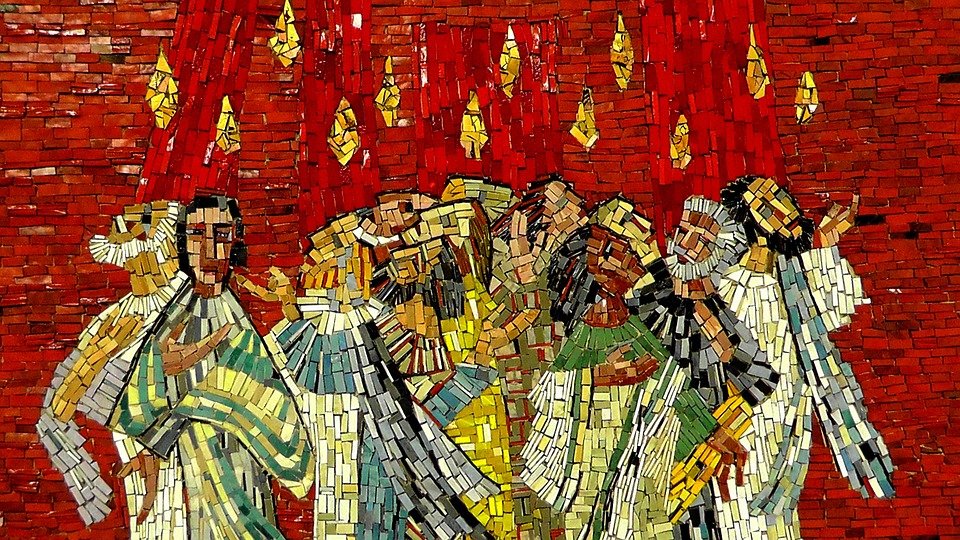
Pixabay – music4life

by Demi Prentiss

This past Sunday was the Feast of Pentecost, and many Christian churches celebrated “the birthday of the church,”reading a passage from Acts 2.  That story tells of tongues of fire lighting on the heads of Jesus’ apostles, and amazingly the apostles were understood by a crowd drawn from across the Mediterranean world, as though in their own language.  I’m always surprised to be reminded that that story is not Gospel. It’s not part of the four books of the Bible – Matthew, Mark, Luke, and John – that recount the story of the life, death, and resurrection of Jesus of Nazareth. It’s told by the Gospel writer Luke, who leads off his Gospel sequel – the Acts of the Apostles – with that amazing tale.

I’m surprised because I think of that story as foundational to God’s dream for us as children of God. Eric Law’s understanding of that story offers a lens that inspires me to see multiple levels in familiar Bible stories and in many moments of life as a Christian. In his book The Wolf Shall Dwell with the Lamb, Law offers the insight that the Pentecost story reveals two miracles, not just one.

Most of us see the “miracle of the tongue” right away, as the text says the apostles “began to speak in other languages, as the Spirit gave them ability.” (Acts 2:4) And then the text goes on to reveal that the crowd “was bewildered, because each one heard them speaking in the native language of each.” (Acts 2:6) A “miracle of the ear”! Between the apostles speaking and the crowd hearing, who could say which miracle was operating?

Law is clear that for those of us who are often silenced, and whose voices too often go unheard, the miracle that God unleashes is the miracle of the tongue – the gift of strength and courage to speak God’s truth. And for those of us who hold power and are accustomed to exercising it, the miracle of the ear is the true gift – the miracle of truly hearing those who speak, even though they may tremble to say the words out loud. Discerning which miracle we might pray for – or claim – is the work of a lifetime. As we live our lives in response to God’s covenant with us – sealed for us in our baptism – may we seek to discern when God urges us to claim the power of the tongue, and when to exercise the receptivity of the ear.  And may our choices be guided by the incarnate God known as the Word.

‘May God bless my screw driver…’

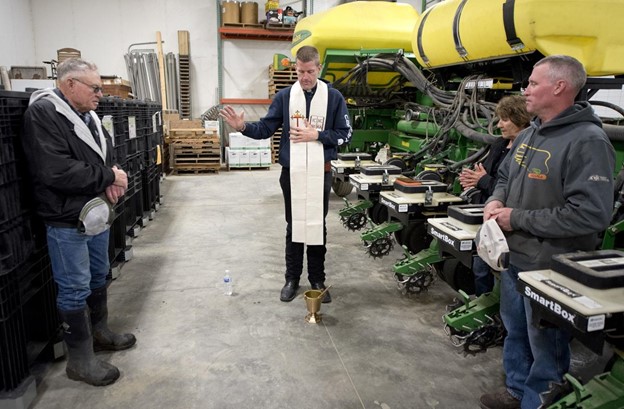
The Rev. Andrew Sohm blesses seed at the Newcastle farm of Sy and Ellen Kneifl, shown with their son Chad, on May 1 [2019]. The pastor at Catholic churches in Newcastle, Ponca and Jackson, Sohm annually visits the farms of parishioners who ask him to bless their seeds and fields during planting season. – Tim Hynds, Sioux City Journal

by Fletcher Lowe

Blessing the farms and the fields, blessing the boats and the bait….  So in more rural times, congregations gathered as a way of asking God’s blessings. What were our rural friends asking God’s blessings on, but the means of production: farms, fields, boats, bait, for a good harvest and a good catch. The Latin word for ask is rogare, hence Rogation in our Episcopal liturgy.

What about Rogation Days, the three days prior to Ascension Day, when we traditionally ask for God’s blessing on agriculture and industry? Is that an idea whose day is past because we are a more urban, industrial, technological society?  I don’t think so.  Aren’t our needs still the same – to ask God’s blessings upon our means of production? “Means of production” relates, whether it be rural or urban. 

In congregations I have served on Rogation Sunday, the 6th Sunday after Easter, people have been invited to place in a basket small symbols of the means of production in their lives: a screw driver, a computer chip, an appointment book, a prescription pad, a measuring spoon, a cell phone, etc.  At the Offertory they were processed up along with the money and the bread and wine with a prayer, asking (rogare) God’s blessings upon those whose labor is represented in those symbols.  All of us have our own means of production that enable us to live our daily lives regardless of our situation at home or community or work, whatever occupies our time and energy.  

What are your means of production?  As you identify them, would you rogare, ask God to bless them, and rogare, ask God to bless you in your daily life?

Marks of resurrection

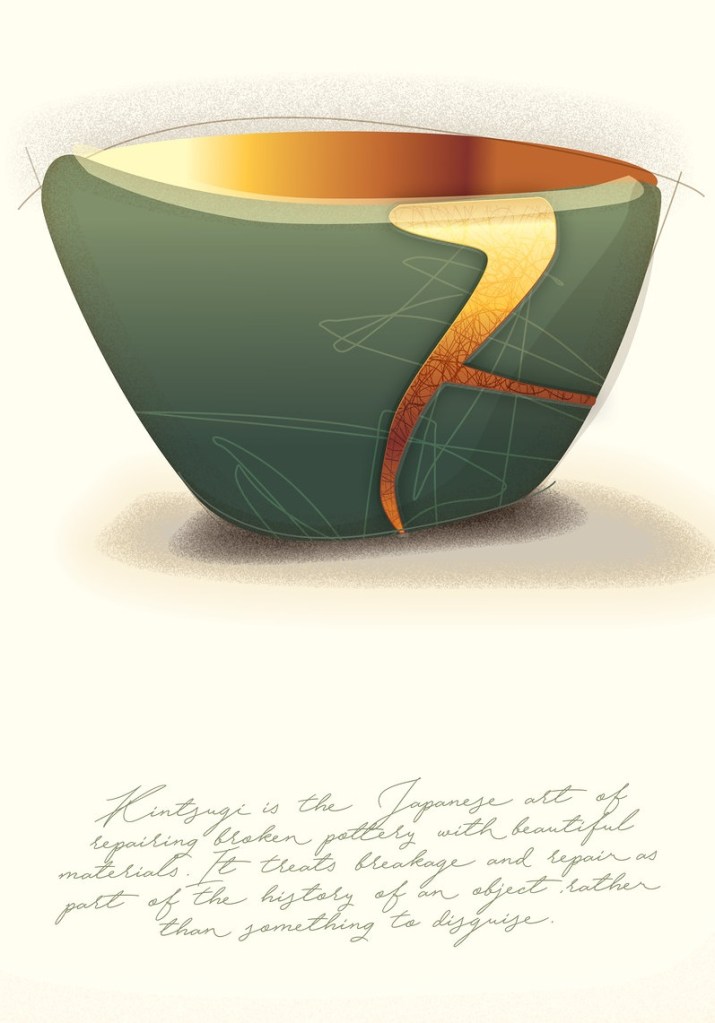
Flickr photo – Martin Howard – Kintsugi art white8

by Demi Prentiss

The Christian year – and, I hope, our daily lives as Christians – revolve around two transformational cycles: incarnation and resurrection. In the Christian kalendar, each of those two cycles begins with gestation, a time of examination, reflection, and growth (Advent and Lent). That season is followed by a time of celebration, begun with a feast day and extending far beyond the holy day itself – Christmastide and Eastertide.  And after the rejoicing, we enter the “ordinary time” of integration, as we use the time following Epiphany and Pentecost to incorporate the learnings of the cycle into our daily lives and work.

We are well into Eastertide, and, for me, the lesson of Thomas the Doubter is still looming large.  Like many in 2021, I find myself in the midst of a whirlwind of political wrangling, pandemic distrust, and civic tug-of-war that seems not unlike first-century Palestine. I’m seeing the Thomas story not so much as a lesson for unbelievers as a model of what Christ is calling each of us to do.

To affirm his identity, and to restore the trust of his doubting friend, what does the resurrected Jesus do?  He shows us his scars. He’s willing to expose his wounds, and to invite his friend to touch them. He allows himself to be shockingly vulnerable.  And he claims those scars as the marks of his resurrection.

The Incarnation calls on us to “be green,” to begin a new life, to allow Christ to live inside us and through us.  And through the Resurrection, we are called to allow our scars to be far more than signs of our hard-fought battles. In his risen body, Christ declares that our scars are the marks of our resurrection. As we become vulnerable enough to show those scars, we both model and proclaim the work of resurrection in our lives.

Our daily lives often bring scars. Some we are ashamed of, and some are marks of honor. May we have the courage to allow others to see and take strength from our scars. May they be for us and for those we encounter signs of our resurrection.

Is the Church too ‘woke’?

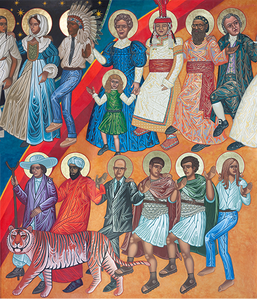
Some of the Dancing Saints at St. Gregory of Nyssa, San Francisco; by iconographer Mark Dukes.

by Demi Prentiss

N.T. Wright is an English New Testament scholar, a Pauline theologian, and an Anglican bishop. He recently responded to an article in the British weekly magazine The Spectator, which accused the Church of England of embracing anti-racism as its “new religion.” In The Spectator’s letters, Wright address the question, “Is the Church too “woke”?

“…the ‘anti-racist’ agenda is a secular attempt to plug a long-standing gap in Western Christianity. The answer is to recover the full message, not to bolt on new ideologies….

“The church was the original multicultural project, with Jesus as its only point of identity. It was known, and was for this reason seen as both attractive and dangerous, as a worship-based, spiritually renewed, multi-ethnic, polychrome, mutually supportive, outward-facing, culturally creative, chastity-celebrating, socially responsible fictive kinship group, gender-blind in leadership, generous to the poor and courageous in speaking up for the voiceless.

“If this had been celebrated, taught, and practised, the church would early on have recognised ecclesial racism for what it is…. If it has taken modern secular movements to jolt the church into recognising a long-standing problem, shame on us.

“But the answer is not to capitulate to the current ‘identity agenda’…. The answer is teaching and practicing the whole biblical gospel.”

As Wright reminds us, asking whether the church should or should not be “woke” is missing the point.He asserts that the early Christians in that “attractive and dangerous” community – “multi-ethnic, polychrome, mutually supportive, outward-facing….and courageous in speaking up for the voiceless” – knew they were called and commissioned as allies and champions of all those that society drove to the margins. And since that time, racism has played a large part in derailing the church’s commitment to that vision.

Glenn Packiam, commenting on Wright’s letter, adds, “It’s a shame that it took secular theories to diagnose [the church’s] error. But that should not make us reject those theories. We can allow them to wake us up.”

In response to those who urge the church to call out racism, we can most faithfully honor our baptismal promises by holding ourselves and our congregations accountable to that radical, “attractive and dangerous” vision of a scandalously inclusive Body of Christ. May we dare to proclaim the whole gospel and work to build the Body of Christ as a whole, life-giving, embracing community that embodies the good news the world longs to hear.

God in the bond market?

by Fletcher Lowe

Over the years in the parishes I have served, I have been visiting members where they work.  The conversations usually go: What do you do here?  What is the Sunday-Monday – the Faith/Work – connection with what you do here?  This latter question is, for most all of the church members, the first time that question has been raised for them.  Yet where they work is the place where they spend most of their God-given time and talent.  What an indictment of the Church! 

Here are the words of one businessman, David Wofford, I visited. The words he wrote (pre COVID-19) describe his “Aha!” to that second question:   

Excuse me? Faith at work?  I’m not a priest or a rabbi. It’s not my job to heal the sick or mend broken souls. I’m just a “used-bond salesman.”  These were my initial thoughts when Fletcher said he wanted to visit me at work to discuss faith at work.

Upon his arrival, Fletcher surveyed my work area. The space is a large trading floor with people sitting in front of several monitors blinking price action in the bond market. Everyone sits almost elbow to elbow and it can get a bit loud. The two of us then moved to an office for a little privacy. I tried to explain that the atmosphere in my office was closer to that of a fraternity house and not exactly like a place of worship. We work hard, do a good job, and at the same time, have a lot of fun.  More often than not, that fun is similar to the fun we had in elementary school.

After asking for more details about my job, Fletcher thought a bit and he said something that opened my eyes. My faith was all around me. It is there when I try to help my accounts meet their goals with honesty and integrity. If they are down, I try to cheer them up or put them at ease. The camaraderie with my colleagues is also a part of my faith. Many of us have worked together over twenty years in a very stressful occupation. We share lots of laughs. We pull together when times are tough.  Another salesman and I like to read “Forward Movement” on line during down time. There is also an email I receive from Fletcher entitled “On the Job Prayers.” I pass that around to some in my office to help alleviate some of the stress during the day.

I park across the street from my office. Each morning there is a little ritual on my walk. I thank God for my great family. I ask for Him to help me be a better father and husband. I thank Him for the opportunities I have and the friends around me.  I ask for His help when times are rough or a friend is in need. I thank Him for the sunshine or the rain. God walks me to work….and everyone in the office says I only park across the street because I’m a tight wad and can save $30 a month!!

Faith at work?  Even for a “used-bond salesman”? Believe it or not it can happen.

Peace be with you

by Demi Prentiss

Attainment of Inner Peace Flickr photo by Karthik Prabhu

St. Seraphim of Sarov is often quoted as having said, “Acquire inner peace and thousands around you will find their salvation.”

All during Christmas and Epiphany, we Christians have focused our awareness on the Light of Christ. As we walk our Lenten journey, we’re invited to practice silence and stillness, discovering Christ’s light within our own hearts as well as in the world around us. Our Lenten practices can help us nurture that light, grounding us in the peace that Christ’s presence brings.

The daily work of practicing inner stillness can free us to remember who we are – a Child of God, beloved and called. And in that clarity of our true identity, joy blossoms as quietly as a flower unfolding. That joy is the wellspring of the generosity – in terms of possessions and time, skills and spirit – that is the hallmark of one who follows Christ’s way of love.

Seraphim understands that joy as God’s irresistible gift – whenever we receive that joy and offer it to another, it sets the world alight.  “We cannot be too gentle, too kind. Shun even to appear harsh in your treatment of each other. Joy, radiant joy, streams from the face of one who gives and kindles joy in the heart of one who receives.” In the sharing and receiving, such a community of joy participates in the reign of God.

May our inner work in Lent lead us to the realization that our daily work – offering ourselves as such conduits of joy – can bring us to a place of true peace.

Hearts and Ashes

by Demi Prentiss

We’ve just celebrated Valentine’s Day, on the very same day as the lectionary reminds us of Jesus’ transfiguration, marking the shift from his Galilean ministry to his prophet’s journey to Jerusalem and the cross. We Christians are about to move from the festivities of Mardi Gras to the solemnities of Ash Wednesday and the 40-day journey that leads us to witness Christ’s transit from death to life.

This liminal week reminds us that love is the catalytic transformational force that God brings into the world. Love – the love that made St. Valentine a martyr – gives us new eyes to perceive God’s transformational work all around us. Love – the love that announced “This is my beloved. Listen!” – created light in the darkness and lights each of our lives.  Love – the love that tenderly reminds us that we are dust – proclaims that we are made in the very image and likeness of God.

As we embark on the journey of Lent, may we remember that our calling is not to religious athleticism, demonstrating by our strenuous practice that we are worthy of God’s love. As God reminds us, in the words of the prophet Amos, “I hate, I despise your festivals, and I take no delight in your solemn assemblies.” (Amos 5:21)  Our calling, instead, was proclaimed by Micah: “He has told you, O mortal, what is good; and what does the Lord require of you but to do justice, and to love kindness, and to walk humbly with your God?” (Micah 6:88)

This Lent, may we walk the Way of Love, remembering that “Go” is an essential element of the Christian life.  Go out from the comfort of church pews into the challenges of daily life. Go beyond our timeworn practices to experience a new perspective. Go into respectful relationship with unmet neighbors and unfamiliar cultures, to look into the eyes of siblings we’ve never met.

May our journey this Lent awaken us to new life, as we walk into the immensity of the reign of God.

Pick your ‘Pathway’

by Fletcher Lowe

 “Throughout my career, I have heard lay leaders and professionals yearning for affordable, accessible education, training, and resources to support their ministries,” WOW!! Those words come from Dr. Julie Lytle, the Director of Distributive and Lifelong Learning, speaking of Pathways for Baptismal Living, developed out of the Episcopal Bexley Seabury Seminary. “We’ve created Pathways as a resource hub in response. It is designed for people to enter where they want and need so they can discern, explore, and deepen their faith and respond to God’s call.”

Over 20 courses, workshops, events, and activities are available and can be taken in the order that best suit personal interests and needs. There are programs for discernment, personal enrichment, licensure in cooperation with the local bishop, and ways to meet church-wide imperatives. The programs are designed with opportunities for personal reflection as well as live and asynchronous online interaction with the instructor and other participants.

One of Pathways’ signature offerings is coming Sunday, February 14, 6:30-7:30pm, Eastern. “Sharing Stories of Baptismal Living” will air live, featuring Byron Rushing.  Known as a politician, public historian, community organizer, and Christian, Rushing has said, “If Jesus was not in the legislature, I wouldn’t be there either.”  He currently serves as vice president of the Episcopal Church’s House of Deputies and spent 25 years as a representative in the Massachusetts state legislature.

Register here to participate in the Feb. 14 conversation.  I hope to “see” you there and then.

Baptised into Light

by Pam Tinsley

YouTube – CBC News Jan. 20, 2021

Like so many, I found Amanda Gorman’s inauguration poem, “The Hill We Climb,” inspiring.

I’m reminded of the promises we make at baptism by her closing verses:

When day comes we step out of the shade,

aflame and unafraid,

the new dawn blooms as we free it.

For there is always light,

if only we’re brave enough to see it.

If only we’re brave enough to be it.

In John’s Gospel Jesus is the light of all people, and his light shines in the darkness. Jesus then invites us to be brave enough to see his light and to be his light in the world. Each question posed at baptism also asks us to be Christ’s light in the world: Will we teach, pray and gather – even if by Zoom? Will we persevere in resisting evil and then repent when we stray? Will we model the Good News by our words and our actions? Will we love one another? And will we strive to make our world more loving and more just?

Whenever we live into our baptismal promises – wherever we are and however minor our actions might seem – we shine a light that others can see. We might heal someone’s wounds with a kind word; we might lend a listening heart to a shut-in – or someone wearied by the persistent isolation of quarantining; we might encourage a spirit of community; we might help someone make an appointment for a covid-19 vaccination. This is how we reveal Christ’s presence in the world.

Even in the midst of pandemic, racial injustice, social and political turmoil, and isolation, we can be brave enough to look for and to see Christ’s light – there in the seemingly never-ending shade. For, as Ms. Gorman reminds us, there is always light.