by Fletcher Lowe
I live in Richmond, VA, a reasonably large metropolitan area. There are several Episcopal churches from which people can choose. The congregation that I rectored several years ago made a conscious identity decision—to be known for its creative liturgy and for its community and international outreach. To make that happen, the system of our congregational life was molded to affect that. That meant having a liturgy team that could think out of the box. It meant taking some initiative both toward community needs and international connections.
Every congregation makes decisions about its identity, some conscious, others not so. It has a system that is designed to produce certain results. The systemic question is, going back to the earlier discussion of 2 blogs ago, is your mission statement where your congregational system is? The actual mission statement may be something that is unwritten, but really lived into—different from the one stated, yet securely at the heart of a congregation’s life. It’s how that congregation really functions and operates, its modus operandi. For example, a congregation’s mission statement may read that it believes in lay ministry, but practically its system only prepares/trains/honors laity who serve/minister in the congregation, e.g. lay eucharistic ministers, church school teachers, altar guild members.
So let’s take a congregation that really wants to live into a mission statement to empower the 99%, the lay folks, in their daily lives—the lives they live outside the church walls. Then conscious decisions are made in terms of its liturgy, pastoral care, communication, and formation which support that decision. For example, in liturgy, how do the Sunday- and week-day- liturgies enhance the calling of all the Baptized. Through sermons, prayers of the people, the Dismissal? On occasion are there liturgies or litanies that recognize the lay members in their work? Are there frequent Ministry Moments when congregants share their Sunday-Monday connection? Depending on the congregation’s past, this may mean a systemic change. But engaging with the questions makes clear the congregation’s desire to match its mission statement with its actual systemic actions.
The truth remains: A congregation’s system, not its statements, is what produces the kinds of members who fulfill that system.
So how do we redesign a congregation’s system? Stay tuned.

 apprised of who we are and what we bring to the table of life. That is our offering….
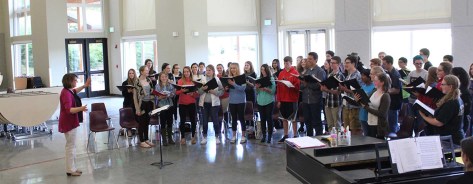 As the exquisite voices of these young women and men filled the church, the hearts of the audience were profoundly moved. My husband and I sat enchanted for over an hour as we listened to arrangements of sacred and secular music. For some arrangements the singers surrounded us, their voices blending sweetly behind and above us. At times our experience was almost transcendent, and by the concert’s end we felt renewed, even transformed.
 Here’s the story. It’s about a mother and her nine-year-old daughter. Where is justice in it?
 A large part of living our ministries in daily life is cultivating the ability to perceive where God is acting, and then aligning ourselves with what God is up to. Understanding ourselves as co-creators with God – partners in a whole-life commitment to increasing love and justice in the world – is a life-giving, purposeful way of living God’s dream for our lives.
 The church I attend is a “noisy church.” When worshipping in the church, we can easily hear voices from the narthex. Sunday school classes meet in the parish hall directly beneath the church, and we often hear our children’s “joyful noise”. Our church is also located on a busy street corner, not far from a fire station, so that during a service, if you don’t hear a group of motorcycles roaring by, you’ll hear the siren of an ambulance responding to someone in need!
 “Ultimate concerns” may vary from freedom, to personal integrity, to success in one’s career. We see the Spirit at work in all who choose love and justice as their primary values. Their choice of love and justice as primary has the quality of faith. We have a common ground. Our faith in the reality of God is not provable by reason. Others’ commitment to love and justice as ultimate values is similarly unprovable. Faith as our ultimate concern puts as all on the same street. We celebrate and join with people of no faith in any work – “mission” in good word – to make any part of daily life more loving or more just.
 Living God's Mission