Room at the table

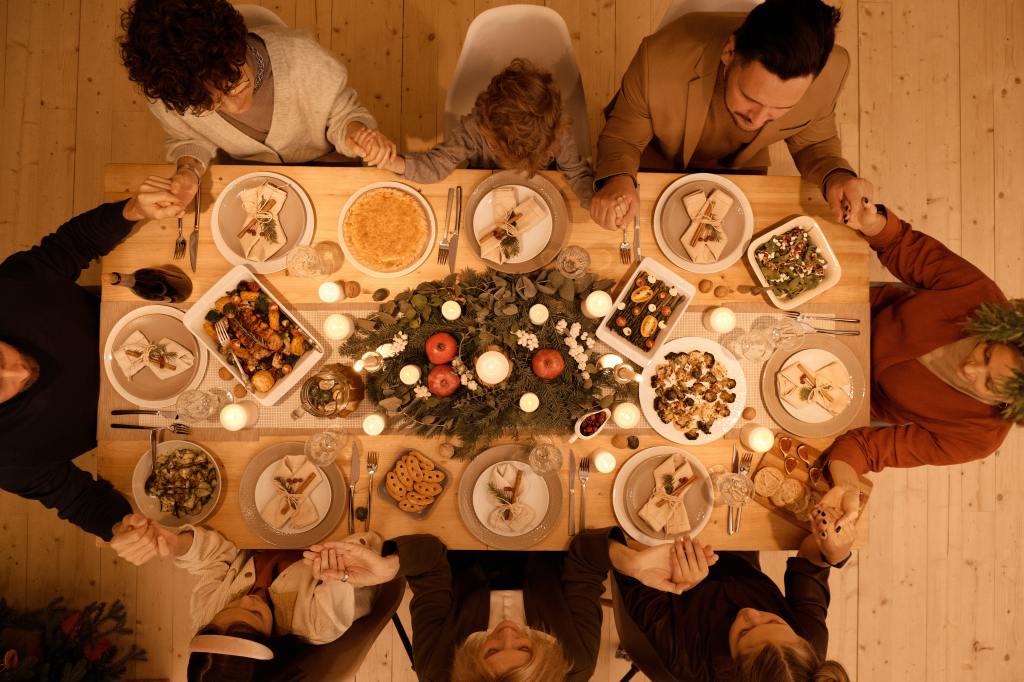
Photo by Nicole Michalou

by Demi Prentiss

The Gospel for this week reminds us, “I came that they may have life, and have it abundantly” (Jn 10:10). For many, Jesus’ promise seems laughable, as we have faced the isolation enforced by Covid prevention measures and now the reduced attendance many congregations are experiencing. The past few years have cramped our vision and promoted scarcity thinking. Fear cripples our imaginations, and perceiving abundance challenges our common sense.

In Isaiah 54:2 the prophet reminds the Israelites to think bigger: “Clear lots of ground for your tents! Make your tents large. Spread out! Think big! Use plenty of rope, drive the tent pegs deep” (The Message). Like Israelites returning from exile, we in the post-Covid church are called to widen our vision and our embrace. Open our doors to welcome unfamiliar people and experiences. Sharpen our vision to perceive who our supporters and our allies are.  Be courageous to invite contributions – both monetary and intangible gifts.  Partner with both modest givers and big spenders alike.

Last week’s Gospel story of two dispirited disciples walking to Emmaus has always invited my speculation: What was the “tell” that allowed the two breaking bread with Jesus to, at last, recognize him?  When the Risen Christ broke the bread, did they catch a glimpse of the nail holes in his hands? Was it the distinctive way he blessed the bread, or broke it, or poured the cup of wine that tipped them off? Perhaps it was the way he said “Abba” as he asked God’s blessing for the meal? Or the gestures he used as he handed food and drink to the others at table with him?

I like to think that the real giveaway was his hospitality – the way he embodied the message of open-handed abundance as he presided at the meal. “Enough is as good as a feast.” All who dine with Christ experience abundant life.

Jesus challenges believers to see him in the people we encounter every day – the stranger on the road, the surprise visitor, the people at our table, even those who are not our favorite companions. Where we see Jesus, we are called to see the abundance that he brings. As we widen our vision and our embrace, we enlarge the site of our tent – we make plenty good room, and shift our perception from scarcity to a heightened awareness of gift and opportunity.  For us personally and for our society, our recovery – from pandemic, from hard-fought elections, from the dangers of everyday living and the fear of the unknown – may well depend on our ability to incarnate the abundance Christ promises. “Risen Lord, be known to us in the breaking of the bread.”

Naming baptismal promises

by Brandon Beck

The patron saint of my home church is Mark.

I live in a town named for Mark on a river named for Mark.

Archaeological surveys show that people have inhabited this land for around 12,000 years, and Spanish settlers, under the leadership of conquistadors and missionaries, settled here around 1648.

The names of the river and town recognize Spanish colonialism – San Marcos; the name of the church recognizes the subsequent Anglo invasion – St. Mark’s. But what became of the indigenous names?

My friends Mario Garza and Maria Rocha strive for justice and peace every day by remembering and speaking the language of their people – the people of this land – the Coahuiltecan People, by educating others about the history of this land and its people, and by living their own heritage as modern Coahuiltecans authentically.

The Feast of St. Mark is a time when our church gathers at the San Marcos River for baptisms, blessings, and barbecue (actually fried chicken, but I like alliteration).

As we promise together to strive for justice and peace among all, and pledge to respect the dignity of the Earth and every human being – when we gather at the river to pray with St Mark and all the Saints – may we remember those who predate us and our names.

Ministers of hope

by Pam Tinsley

Photo by Karolina Grabowska;   Photo by cottonbro studioPhoto by RODNAE Productions

“Jesus said to them again, ‘Peace be with you. As the Father has sent me, so I send you.’” (John 20:21). This verse, from the Gospel reading for the Second Sunday of Easter, has been my earworm this past week. Jesus appears to his disciples after his resurrection as they huddle together in fear behind locked doors and speaks these comforting – and challenging – words to his disciples.

Jesus’ words are also for us, his 21st-century disciples. Our baptismal promise to “proclaim by word and example the Good News of God in Christ” calls us to leave the shelter of our churches and homes. We are called to go forth into the world as ministers of the resurrection – ministers of hope.

This message is echoed in a timely blog by Prince Rivers for the Alban Institute, Go beyond the sanctuary. Rivers reminds us that the number of those worshiping in church is not an indication of church health. Instead, health is reflected in the ministry that takes place outside of the church building and in the wider community. This is lay ministry. This is ministry in daily life. And, as Rivers writes, “The post-resurrection narratives in the Gospels clearly point us to ministry beyond the sanctuary.”

When Jesus sends us into our broken world to be ministers of love, compassion, justice, reconciliation, we are also sent to serve as ministers of hope. And where we are sent is as individual as each of us is.

Yet, we may wonder whether we have the tools to proclaim the Good News by word and example. We may doubt whether we are sufficiently prepared to do so. Here’s where regular worship and Christian community support us. Worship and Christian fellowship offer means for easing those doubts. And, as we learn from Thomas’s experience in the upper room, doubt nourished by curiosity can lead to revelation, transformation, and empowerment.

So, during this Eastertide, I invite you to consider how you might serve as a minister of the resurrection, offering hope through your love, care, and concern to those you encounter in your daily life. 

Walking to Jerusalem

by Brandon Beck

My four-year-old friend and I, along with his mother who is the Director of Children and Family Ministries here, went to the local Christian bookstore yesterday to look for craft supplies for the upcoming Palm Sunday children’s formation lesson.

The mother and I were chatting as we walked from the parking lot to the store when the child cried out, “I don’t want to walk all the way to Jerusalem!”

She and I stopped and laughed and hugged him. We reassured him that we were walking to the store in plain-sight in front of us, the one he’d been to with us many times before. I asked, “What do you know about Jerusalem from stories we tell?”

He said, “It’s too far away to go because Jesus was there, and we don’t have a time machine,” with big tears in his eyes.

“Is Jesus far away now?” I asked.

“No,” he said, perking up a little bit.

“How do you know?” (This is a question I’ve started asking him because he asks me most of the time when I say something, especially if it’s an answer to a question he asked me.)

He made the Sign of the Cross and said, “God loves me, so I can love everybody.”

“So where’s Jesus?”

“Everywhere!”

With his rediscovered joy, he assisted his mother and me in selecting craft objects for the church busy bags with an Easter theme – scratch art crosses and eggs, sticker craft scenes of the tomb, little coloring books of Jesus’ last week – and while we gathered supplies for the art response to the Palm Sunday teaching, he got more and more excited about walking to Jerusalem. His understanding of metaphor grows more each day. As we gathered different colors of felt to make “cloaks” to lay along a cardboard “road” and told him the story of Jesus coming into Jerusalem, he found a donkey craft to contribute. He found some pieces of fur and asked if there were other animals on the way to Jerusalem. He wanted to know if there were rocks and how we would put rocks on the road with the cloaks.

When we left the store with our supplies, he asked me to tell the story about Jesus and the apple. “The one that the owl tells,” he said.

It took me a minute, but then I caught up with him.

He has a Cuddle Barn (™) Bible Story Talking Owl. One of the Stories the mama owl tells her baby is from Genesis. After our “walk to Jerusalem,” my little four-year-old friend wanted to hear me tell the story of Genesis, and he so aptly aligned the Christ with the Father and the Spirit.

My telling of Genesis differed a little from the Owl’s, included some liberation and feminist and queer interpretation, and had a sillier serpent than that to which most people are probably accustomed. I also included a little lesson especially for him about why we keep our clothes on at school linked to the nakedness Adam and Eve learned when they ate the apple and how it wasn’t so much about being naked as it was about listening, trusting, and loving God.

As the disciples walked with Jesus to Jerusalem, in support of his subtle-yet-not-so-subtle protest of corruption and injustice, they listened to and retold his stories/parables. They talked with each other about the metaphor and meaning of all that he said and did. May our Passover remembrance this year, our reenactment of his Palm Sunday journey, our celebration of his Empty Tomb, be signs of Justice moreso now than ever before.

Lent is for roadwork

by Demi Prentiss

We’re just two weeks into Lent. Whether we’ve given something up or taken something on, the discipline is just beginning to pinch. Or maybe we haven’t yet settled on a Lenten discipline. Br. Jim Woodrum of the Society of St. John the Evangelist offers this advice:

It may be that there is a laundry list you have prayerfully assembled to tackle this Lent. You are not going to get to everything. Pick one or two things and then stick with those. Hold these intentions as a focus of your prayer with Jesus and ask him to heal and transfigure them. In this way we can turn a season of discipline into a lifetime of discipleship.

Lent as a season of healing and transfiguration seems almost counter-intuitive. Many of us have been taught to look at Lent through the purple lens of sacrifice, mortification of the flesh, fasting, and self-denial. Though all of those practices are intended to be life-giving, the word “transfiguration” calls up images of Mt. Tabor and Jesus’s radiance, not the sackcloth and ashes of Lent.

For engineers, “roadwork” means tearing up what’s damaged and re-laying a serviceable road – healing the highway. For athletes, “roadwork” means conditioning, putting in hours and miles to build stamina and strength. It’s a discipline that prevents injury and imbeds essentials of movement.

For me, in my walk as a Christian, Lent is the season of “roadwork,” in both senses. I am grateful for several “mountain top” experiences along my life journey. And I have to admit that Jesus’s deflating “you have to leave the mountaintop” has proved, for me, more life-giving than the flash of revelation. Not just because “all good things must come to an end.” More because in the valley, on the journey, through the daily grind and the ebb and flow of everyday life, that is where the lessons become real, and the habits are formed. That is where the durable transformation happens.

The Rev. Erik Parker, “The Millennial Pastor,” puts it this way:

In the process of faith, in the journey of Lent, through our time spent in communities of faith, we are TRANSFORMED. In the waters of baptism, through the hearing of the Gospel alongside our siblings in faith, through the Bread and Wine made Body and Blood, we are changed to our very core. Transformed from sinners into God’s beloved, made holy and righteous by the One who meets us with forgiveness and grace. 

The mountaintops feel great; they are respite for the moment. But it is along the way of faith that God is making us into new creations, into the people that we were first created to be in Christ. 

May our faith communities, like the waters of baptism, immerse us in the discipline of Lent, marinating us in Jesus’s way of healing and transformation.

Always we begin again

by Brandon Beck

In January, many of us celebrate the promises of our lives together in our church through annual parish meetings and parochial reports.

Some of us celebrate a Recovery Sunday with liturgical, musical, and educational focus on the sacramental and covenantal relationship of recovery people and programs among us.

Some of us celebrate Lunar New Year – this is the Year of the Rabbit, in case you were wondering – respecting the dignity of the diversity of ways of being people in this world.

Wikimedia – Triquetra

Perhaps we lifted up the saintly Rev. Dr. Martin Luther King, Jr., on his birthday and will again on the day, in April, when he was taken from his earthly mission by gun violence.

Perhaps we held memorial vigils in remembrance of the genocidal violence of the Holocaust.

These are all parts of life in the church in January.

Supposedly, St. Benedict said, “Always we begin again.” This 6th century Italian hermit-turned-father of monasticism drew people into themselves, onto a path he followed, and along The Way with his divinely inspired meditations and writings, contemplations, and connections.

Whether or not he actually said, “Always we begin again,” is neither here nor there; for, we do always begin again.

What better way to live into the promises of our baptismal covenant than to weave these two sacred triangles together – God, ourselves and others with past, present, and future?

What symbols in the church, in nature, in your life remind you of this idea?

I see the triquetra and think of these 6 words which I say with gusto every time I witness a baptism because they remind me that always we begin again, together, to expand Love for creation: believe, continue, persevere, proclaim, seek, strive. These words that begin the versicles of our covenantal pledge weave together God, ourselves and others with past, present and future in a spinning, spiral, triquetra that always begins again and helps us celebrate just as we do every January, every year and shall every day.

Amen.

Seeking and serving

Angel Tree at MCAS Cherry Point, NC – Photo by Pfc. Nicholas P. Baird

by Brandon Beck

“To seek and serve all persons” is on my mind this time of year, as it is every year during Advent.

Advent is my favorite liturgical season – with the deep blue hues of the vestments and altar hangings, the lessons and carols of the season, the waiting and anticipation, the hot chocolate and crafts.

I value sharing in the preparation for and service of a community Friendsgiving event for families who receive diapers and parenting support at our local parish church. Turning to hanging the greens with special care for our Angel Tree participation, I am drawn more deeply into the sense of waiting and watching this season – but in an active way – in a seeking and serving way.

How can I fulfill my promise of baptismal living while waiting in anticipation, I wonder?

Perhaps, as in the Advent II lectionary reading from Isaiah, I will actively wait in the Spirit of the Lord:

“He shall not judge by what his eyes see,

or decide by what his ears hear;

but with righteousness he shall judge the poor,

and decide with equity for the meek of the earth.”

May we recognize and respond to every opportunity to meet those, like ourselves, who need a friend today and every day, for in them is Christ.

Editor’s note: PBL welcomes Brandon Beck as the newest writer to join our blog schedule. See our “Who we are” page to learn more.

Grateful Turkey

by Pam Tinsley

Each year, in early November, our daughter-in-law helps our granddaughter, Sienna, make a “Grateful Turkey” out of construction paper. This year Sienna was old enough to cut Turkey’s feathers out, make its eyes, and put socks on its feet. Sienna tells Katie what she’s grateful for, and Katie writes each item on a feather. With the addition of each feather, Sienna’s “Grateful Turkey” grows more and more grateful until it has a full complement of colorful feathers.

So, just what is 3½-year-old Sienna grateful for? “Spending time with my family; Daddy playing with me before he goes to work; Omi and G’Dad babysitting me even when I’m sick; Emma showing me how to use my inhaler; Momma and our coffee/hot cocoa dates.”

Eleven of Grateful Turkey’s twelve feathers involve other people. The lone feather that doesn’t expressly refer to others reads, “the goody bag I got on Halloween.” Yet, in some ways even that feather is expressing gratitude for others. You see, this Halloween Sienna was quite ill and spent the evening at urgent care instead of trick or treating. The thoughtfulness of others helped her have a bit of Halloween after all!

Sienna’s Grateful Turkey is more than a pretty Thanksgiving decoration. It’s a symbol of the quality time that she spends with her mom. It’s a symbol of how she thoughtfully considers and thanks God for blessings. It’s a sign of her openness to God’s love and how God is already transforming this little one.

We are all called to live lives of love, care, generosity, and gratitude. We are called to love what God loves: our neighbor, ourselves, and all of creation. In short, we are called to be God’s Grateful People, sharing our gratitude with a flourish.

Receiving and being

Pexels.com – Hassan Ouajbir

by Demi Prentiss

For those of us who choose to be partners in baptismal living, we aim to live our lives following Jesus, walking the road he described as The Way. One frame for that style of living is to understand the life we live as abiding in sacrament. I’m not talking about The Sacrament: the Body and Blood of Christ.  Instead, I mean sacrament as “outward and visible signs of inward and spiritual grace.”

When I examine my life through that lens, I notice that I often move between receiving sacrament and being sacrament.  In life, I’m frequently receiving those signs of grace, those signs of God at work:  a smile, a life-giving word, a gift of time, a token of encouragement, a flood of forgiveness.   What I notice less often – and usually only in after-the-fact reflection – are the times God’s grace allows me to BE sacrament: being the cup of water for a thirsty soul, laying down time or money as a life-giving sacrifice, allowing God to transform my poor offering to anoint another with healing and support. Most of those occasions are less the fruit of my own work, and more of God making the most of my offerings. And I notice that often, the catalyst for moving me from receiving to being is heartfelt gratitude. That seed produces the fruit of generosity.

Our faith communities move along that same continuum between receiving and being. We who gather with our siblings in Christ often come together to receive: washing, feeding, anointing, blessing, and fellowship.  Gratitude and the power of God enable us to become water, food, healing, and forgiveness – blossoming into God’s justice, peace, love, and resurrection in a hurting world. It takes faith to open our eyes to perceive God at work, in and through us, and our communities. Commissioned by our baptism to be co-creators with God, we can learn to recognize that we are receivers of God’s grace, and that we can be bearers of that grace to those around us. That work – observing God at work in the world and joining as God’s partner – is the essence of baptismal living.

Church is just the beginning!

by Pam Tinsley

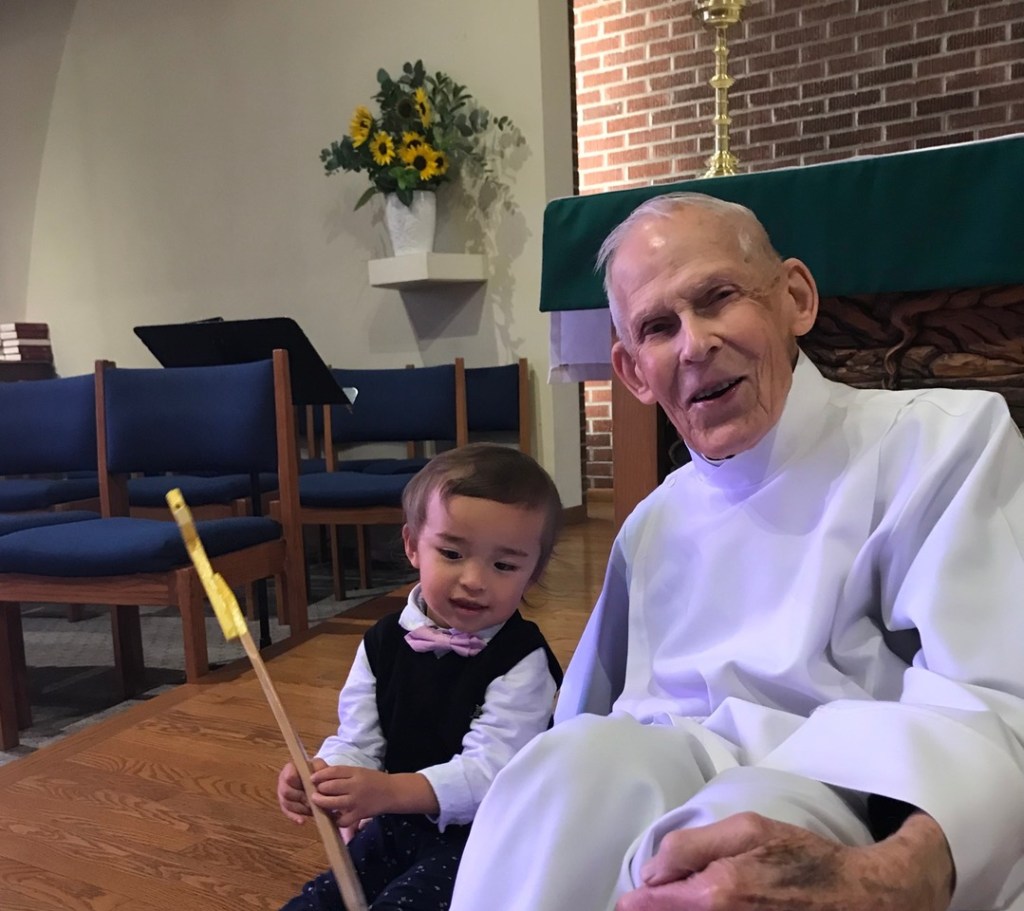
Fr. Ed Sterling and friend.
Photo courtesy of St. Andrew’s Episcopal Church, Tacoma, WA

“Go in peace, remember the poor, visit the sick, love and forgive one another, and praise the Lord always, Alleluia! Alleluia!” says 101-year-old retired priest Fr. Ed Sterling energetically as he sends the congregation forth at the end of worship. We have been nourished by the Word of God and Eucharistic meal; we have praised God and prayed for the needs of our world, our community, and our church; we have been forgiven; and we may even have renewed our baptismal promises. In fact, church is just beginning!

As our dear departed friend, the Rev. Fletcher Lowe, used to say to us, our time in church with fellow parishioners is like being at a basecamp. Just as a basecamp is integral to supporting and equipping hikers who are headed to the mountaintop, the church equips us for our baptismal pilgrimage in daily life. The church walls cannot be our destination. We are sent forth every Sunday, just as Jesus sent his first-century disciples. We are sent out through our church doors to be the church by serving God in our daily lives. And we serve God in our daily lives by proclaiming the Good News of God in Christ by word and action and by being Christ’s body in the world – by living in peace, remembering the poor, visiting the sick, loving and forgiving one another, and praising the Lord always.

Alleluia! Alleluia!