Celebrating work

by Demi Prentiss

The Book of Common Prayer offers this collect for Labor Day (BCP, p. 261):

Almighty God, you have so linked our lives one with another that all we do affects, for good or ill, all other lives: So guide us in the work we do, that we may do it not for self alone, but for the common good; and, as we seek a proper return for our own labor, make us mindful of the rightful aspirations of other workers, and arouse our concern for those who are out of work; through Jesus Christ our Lord, who lives and reigns with you and the Holy Spirit, one God, for ever and ever. Amen.

“All we do affects … all other lives: So guide us in [all] the work we do….” God calls us to bring God into every aspect of our daily lives, and aim to make our work holy, an expression of our relationship with God – regardless of whether our work is paid or unpaid.

How can we better remember – not just on Labor Day, but throughout the year – the work that the vast majority of people in our churches do, every day – work that is beyond the church walls?  How can we equip people to work for and with God, in our work as well as in our worship? So that we are equipped to recognize

  • the hopeful expectation of Advent among, for instance, all those in the medical profession – doctors, orderlies, researchers, lab techs, administrators;
  • the joyful celebration of Christmas and Easter among, God willing, those in the field of education – students, aides, teachers, janitors, principals, parents, and presidents;
  • the penitence and spiritual growth of Lent within and among the people involved in the legal profession – paralegals, judges, guards, lawyers, inmates, court reporters, legislators;
  • the overwhelming animating spirit of Pentecost among those in performance and entertainment careers – musicians, scenic artists, writers, dancers, directors, roadies, editors.

What if we take a page from the Black Lives Matter movement and dare to “say their names” – of their vocations – in our prayers and liturgies? What if, in addition to blessing backpacks as we head back to school, we extend our blessings to all those working in schools and colleges? And on St. Francis Day, as we bless the animals, we also bless all who interact with God’s creatures – as vets or zookeepers or scientists or pet caregivers? What other times and seasons might we dedicate to celebrating the Monday through Saturday lives of God’s people?

The psalmist prays, “[O Lord,] Prosper the work of our hands; prosper our handiwork” (Ps 90:17).  May our churches help us grow in our understanding that “our common life depends upon each other’s toil” (BCP, p. 134), through recognizing the ministry that each of us exercises through our daily work. And may God’s love flow into us and through our work, drawing us into Beloved Community.

‘The real play goes on….’

Editor’s Note: This is almost certainly the last piece Fletcher Lowe wrote in this life. Less than 12 hours after he emailed it to me, Fletcher died in his sleep, in his apartment in Richmond, VA. His wife, who proofread this blog entry before Fletcher sent it, believes he may have had a premonition that it was his last writing.

The Rev. Canon J. Fletcher Lowe

In addition to his many Episcopal Church honors and recognitions, Fletcher, who was named a a correspondent of the year in 2019 by the Richmond Post-Dispatch (RTD), was a founding member of the Virginia Interfaith Center and was executive director from 1998 to 2004. He also was a member of the RTD Opinions’ Community Advisory Board. Here you’ll find one of his columns.

by Fletcher Lowe

“The real play goes on after you leave the theater.”   Words of wisdom from a Broadway actor whose name I have unfortunately lost. 

But I do remember former US Senate Chaplain Richard Halverson, who put those words specifically in a Christian context: “Whether you are a pilot, plumber, pastor, physician, or working to meet innumerable legitimate human needs at an office, construction site, or home, you are working for God!” 

The question is, how often do Christians feel that at their work bench, they are working for God?  According to a recent Center for Faith at Work survey, only 30% of Christians “can clearly see the work they are doing is serving God….”  In my own personal survey – having visited over 400 Christians in their places of work – about 80% said our conversation of connecting faith with work was the first time that subject had ever been raised.  What an indictment on the Church, that the place where Christians who work spend most of their God- given time and talent is not a focus of interest for the Church?  Is this not at the core of what our faith is about?  “The real play does go on after you leave the theater.”  A congregation, rightly perceived, serves as a launching pad, a filling station, a base camp where people go for support before going to “the real play.”

That is why, for some of us, the Dismissal at the end of worship is the most important part of the Sunday Liturgy. What are the hymns and readings and prayers and sermons all about but helping “equip the saints for the work of ministry.” (Ephesians 4:12) Preparing for the launch, getting the fuel for the journey, being supplied for the hike. “And now Father, send us out to do the work you have given us to do….”  “Let us now go forth into our worlds of work and community and home, rejoicing in the power of the Spirit.” (Book of Common Prayer, p.366, adapted)

‘Whose church? God’s church!’

by Demi Prentiss

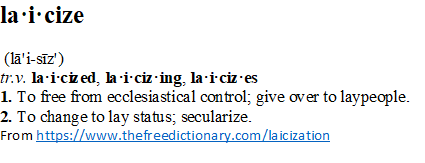
For the church in the 21st century, this definition of “laicize” is missing the mark, What’s needed is a word that speaks of laity assuming their rightful place in the church, as the “first order“ – both historically and in terms of numbers. I’m searching for a term to describe the laos – the whole people of God – as a collaborative partnership between people who exercise their ministries in the world and people who focus their ministries within the institution that is the church. Because what I see as the future for Christianity world-wide is the laicization of the church – the establishment of “right order” to our orders of ministry: laity, bishops, priests, and deacons.

I’m not talking about kicking clergy out of the church, or making the church “secular” (whatever that might mean). Both laity and clergy are called to share in the leadership and governance of the church; the three orders of ordained leadership are valuable, alongside the lay order. Deacons, priests, and bishops function as icons of the leadership a Beloved Community requires. They are windows through which we can see more clearly and deeply the roles that all Christians are called to play, nearly every day. All people, in their life and work, are called to

  • serve the community and bridge between the church and the world, as deacons do;
  • convene, bless, feed, teach, and offer forgiveness, as priests do; and
  • oversee, exercise authority, and hold the system accountable, as bishops do.

The three orders of clergy are important to the functioning of the church, but they are not the church, in and of themselves. As a matter of fact, in the early 21st century, among Christian denominations the ordained account for 0.8 percent of the people who are the church. If the laity abdicate their roles and leave the ordained to be the only recognized church leaders, we’ll work them to death.

I’m also not talking about turning all the church buildings into chic homes and trendy restaurants. The rise of the “nones” (who name their religious affiliation as “none”) and the uncertainties of post-pandemic culture have led many to speculate that shrinking Sunday attendance numbers are the death knell of the church. In many small towns, closed churches seem to outnumber functioning faith communities.  “Old Church Bakery” is trending as a business name.

In the same way that the chant “Whose streets? Our streets!” focused the Black Lives Matter movement, perhaps a similar chant might galvanize faith communities: “Whose church? God’s church!” May we all be people of God.

What I am calling for is celebrating the fact that the church is not a building but the Body of Christ. And we might consider recognizing that the model for our current adaptive challenge is not the first century – the beginnings of the church. More germane, as my friend Mark Dunwoody maintains, is the Dark Ages, the second half of the first millennium (about 500-1000 CE). Much like the early third millennium (2000 CE-present), that time was roiled with political unrest, uncontrolled plague, warring princes, and political instability.  During that time, the church stepped into the power void left by the collapse of the Roman Empire. The best among Christian leaders became the voice of the people, standing for the common good and in opposition to the excesses of royalty.

What might happen if, in this post-pandemic world, the laity steps into leadership of a vast number of smaller and more focused faith communities? What if we shifted away from today’s model serving 154 million believers in 380,000 churches, in the midst of a population of 328 million? What might we accomplish by seeking to become a church of committed groups of under 100 people? What if, more essential than declaring our religious affiliation, we sought to live the Way of Jesus and to welcome our neighbors into the work of creating Beloved Community? How might our church institutions seek to encourage the health of each faith community, regardless of size?

Whose church? God’s church! May we all be people of God.

Bending imagination toward hope

Wipf & Stock, publishers

by Demi Prentiss

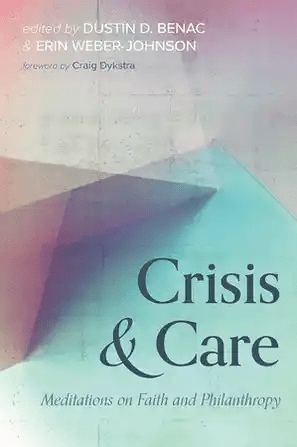
Dustin B. Benac and Erin Weber-Johnson are the editors who compiled the recently published Crisis and Care: Meditations on Faith and Philanthropy. The book examines the outpouring of care and funding that seemed to be unleashed by the crisis of the world-wide COVID-19 pandemic. In an Insights column for the Lilly Family School of Philanthropy, the editors wrote, “We could not have imagined a year like 2020 and yet, as an abundance of care rose to meet the gravity of crisis, we encountered people acting in new and life-giving ways. Their combined words and witness bend our imaginations toward hope.”

Benac and Weber-Johnson point to “shared philanthropic imagination” as igniting the generosity that helped support institutions, non-profits, and individuals through the adaptive challenges that threatened to overwhelm them. From the learnings gleaned through the pandemic, they offer four touchstones to guide all of us forward:

    1. Everything is an experiment.
    2. Generosity and justice shape a shared future grounded in a faithful, fragile belonging.
    3. Making space for tension is a significant act of generosity.
    4. Philanthropic imagination emerges on the edge of certainty.

It strikes me that living each day in the loving, life-giving, liberating pattern of Jesus is an incarnation of philanthropy – literally, the love of people.  Our usual understanding of philanthropy involves generous donations of money to support worthwhile causes.  I believe that even those of us who can’t claim the identity of philanthropist can use these statements to guide us toward generosity as an every-day lifestyle.

Taking Benac and Weber-Johnson’s touchstones as our guideposts for living, wouldn’t we all be better “people lovers” – just what Jesus called us to be?  Can we use these four statements to “bend our imagination toward hope”?

‘That’s who I am! That’s what I do!’

ILO / Apex Image

by Pam Tinsley

“That’s who I am! That’s what I do!” responded the gas station attendant to our heartfelt “Thank you!” for pumping our gas. Our interaction with him was a cheerful interlude during an otherwise long day of travel. Our previous stops at rest areas had felt a little odd since people still seemed cautious about interacting closely because of the pandemic. Then, in a small eastern Oregon town several miles from the freeway on a 101-degree afternoon, this cheerful guy brightened our day – simply by showing us the joy he took in his job.

That cheerful “That’s who I am, and that’s what I do” stays with me. What if all of us who are baptized repeated these words regularly to remind us of our baptism and baptismal ministry? When we remember to place Christ at the heart of our daily activities, those seemingly routine activities can take on new meaning. They can even become transformational. Maybe if our own attitudes might be transformed so that we feel the same joy as the gas attendant, and we then become leaven for the world around us.

Work blessings

by Fletcher Lowe

Facebook – IPRO – Intentional Professional – 11/19/19

I meet once a month with a small group of friends to discuss their experiences as Christians in their places of work. The discussion-starter is usually an article related to some aspect of the workplace.  Recently we talked about an article entitled “5 Ways to Bless Others with Your Words at Work,” published by the Theology of Work.  The underlying scripture was Numbers 6:24-26: The Lord bless you and keep you.  The Lord make his face to shine upon you and be gracious unto you.  The Lord lift up his countenance upon you and give you peace.  I added James 3:10: From the same mouth come blessing and cursing.

As we discussed each one of the five ways of blessing, we saw how it related not only to the workplace but to all other aspects of daily life.  For your own reflection let me share them:

  1. Express Welcome.  We felt that being approachable was at the heart of welcome.
  2. Eliminate Blame Shifting. It does involve holding people accountable, but focusing on the fault, not the person; the “sin, not the sinner.”  Also acknowledging that risk-taking is an asset that leads to some failures.  And that failures often lead to growth, more than successes.
  3. Reconciling Broken Relationship. This we really struggled with, for often people bring outside baggage into the workplace that triggers brokenness. And even within an organization/community/family it can be difficult to resolve, but try we must.
  4. Be Careful Not to Judge.  We found this to be connected with Blaming, looking to the fault, not the person.
  5. Show Appreciation: How important is this!!  Expressing gratitude – especially to those whose work is less glamorous or visible – is so very valuable and affirming.

The article concludes with these words:

Empowered by Christ

When we use our words to bless others, we do so knowing that we’ve been blessed in the same ways through our relationship with Jesus. Jesus welcomes us just as we are; makes us blameless – and therefore unafraid and unashamed – before himself and God; reconciles us to himself; and even describes us as “fearfully and wonderfully made.” Because we enjoy his kindness and friendship, we are empowered to extend blessing to those around us.

What if work *WAS* worship?

by Demi Prentiss

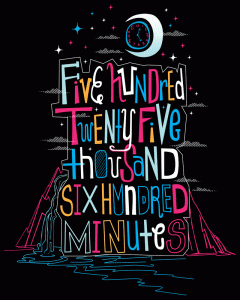
The musical Rent helps us know the math: “Five hundred twenty-five thousand six hundred minutes…. How do you measure … a year?”

Live.Love.Life – WordPress.com

How do you spend your year’s minutes?

  • Well, there’s work. Fifty weeks x 40 hours a week = 2,000 hours = 120,000 minutes.
  • Not to mention sleep. Fifty weeks x 7 days x 7.5 hours = 157,500
  • Just those two commitments eat up 277,500 minutes – more than half our year – leaving slightly more than 248,000 minutes – a bit over 4,100 hours.
  • And of course, there’s eating, and commuting, and personal time. . . .

Not too long ago, most faithful worship attenders spent an hour a week in worship – 3,000 minutes annually, leaving out two weeks for vacation. Not much time, in the scheme of things. And that’s if you’re attending worship every blessed week.

What if those 3,000 minutes – barely more than one half of one percent of our yearly minutes – expanded to fill much of our waking life? What if all of life was worship? What if worship became, for us, like breathing – something we do all the time, that becomes the very basis of our lives?

Philosopher and theologian James K.A. Smith has said, “If all of life is going to be worship, then the sanctuary [or the nave] is the place we learn how.”  

Imagine what life might be if, when we attended worship, the people at the front of the room were not called “worship leaders,” and instead were “worship starters,” as Fuller Theological Seminary professor Matthew Kaemingk calls them.  

Kaemingk and scholar Cory B. Willson became “convinced that theologies of work need to be practiced, embedded, and embodied in communities of worship.…The fabric of faith and work needs to be slowly and intentionally woven back together over a lifetime of prayer and worship.”

Their book Work and Worship – Reconnecting Our Labor and Liturgy was the result.  In an interview about their book Willson says, “We hope our book will help pastors and worship leaders see themselves as servants to the priesthood of all believers. Their primary role in worship is to equip and empower believers to live out their priesthood at the front edge of God’s mission in the world: the workplace.” 

What if all the minutes of our lives – not just the ones spent inside the church walls – became an expression of our love for God and all that God has made?

Doing hard things with Jesus at our side

Flickr – Nurse Teresa Hiller administers COVID-19 vaccine.

by Pam Tinsley

A friend has been working in a local hospital’s Covid-19 vaccination clinic since early winter. Although most of those at highest risk of infection in our county have now been immunized and the demand has waned, recent expansion of eligibility to include those as young as twelve has prompted a bit of a surge in appointments.

Catherine had had a pretty routine day, when a grandmother arrived with her twelve-year old granddaughter. The grandmother was rather uneasy, perhaps uncomfortable with the hospital environment and the number of people waiting – masked and socially-distanced – for their shots. The girl, however, was extremely apprehensive about everything, not the least of which was the shot itself. The grandmother exacerbated her granddaughter’s anxiety by berating her and telling her that she was holding up the line.

Catherine paused, ignored the woman, looked into the girl’s eyes, and gently took her hand. She said that she understood the girl’s fear, and then whispered, “We can do hard things,” quoting from Glennon Doyle’s Untamed. The girl smiled shyly and held out her arm.

When Catherine shared this touching experience with me, I noticed that she – an ER nurse who’s seen it all – was choking back tears. I asked her to tell me more about what she experienced. She said that although the clinic was busy, she felt it was important to take the extra time with the girl, not just for her Covid-19 shot, but to help calm fears about future appointments. She said, too, that when she saw Jesus in the girl’s face, she realized that she, in turn, could be Jesus’ caring voice and hands. The girl, who also has Down Syndrome, needed even more respect and dignity shown to her, especially in the face of the overly anxious grandmother. And, Catherine reminded me that we all can do hard things when we remember that we’re walking with Jesus.

Can you move the dial?

Flickr – Liz West – Sundial

by Fletcher Lowe

There is a significant movement within the English Anglican Church that is creatively focusing on the calling of all the baptized in their daily life and work.  Illustrative of that is this article by the Bishop of Leicester: 

Moving the dial towards everyday faith, by Martyn Snow, Bishop of Leicester

Inspiring Everyday Faith is a way of highlighting why and what is important in Christian discipleship. In the past 20-30 years, we have not been terribly good at equipping people for living their Christian faith in the whole of their lives. The Church has tended to focus on its own life, or its own outreach projects, and forgotten that for most people the majority of their time is not spent involved in church projects – it’s spent in their workplaces, home, social. Equipping people for faith in those contexts must be core to what the Church is all about. I think there has been a change in that over time, but during this pandemic and lockdown – as in so many other areas – it has brought new questions into focus.

Nick and I have a running joke about who first coined the phrase Everyday Faith. All I can say is it has ‘made in Leicester’ stamped on it, and we use that as our strapline now! Using that language of everyday faith has certainly been very significant. My role as bishop is to hold people to account and for them to hold me to account in what we decide under God we are called to be and do. We use the following questions to help each of us in this discernment:

  1. How are you enabling others to grow in the depth of their discipleship?
  2. How are you growing in numbers of disciples?
  3. How are you growing in loving service, enabling others to grow in loving service?

We have found it important that such questions are adopted across the whole life of the diocese….- Other ways … putting lay ministers’ licensing services and commissionings on the same standing as ordination in the life of the diocese. When I license a new clergy person in a parish, we have a ritual of partnership in ministry, so looking very clearly at joining a team of ministers within that church context –

Recently, we’ve done an exercise of gathering stories about faith during lockdown. We’ve had a particularly prolonged lockdown in Leicester, as you may know. We’ve asked people right across our churches what they have been learning about faith in this particular context. Those stories have been fascinating. There has been a sense in which it has shifted the dial along the scale. People are asking – 

+ Is my Christian faith something I do with a particular group of people in a particular building at a particular moment in time?  through to 

+ Is my Christian faith something I do in the whole of life?

The dial has been shifted during this period to what, actually, faith is about! What I do in my own home, what I do when I’m online, talking with my friends. Increasingly people are realising that we should all take responsibility for this. It’s not something somebody else does for me – I need to be enabling the practices that enable my faith to grow in my own home and in my workplace. I think the dial has been shifted and we’re starting to see more about everyday faith.

Ultimately, the more we’ve talked about everyday faith, the more we’ve started to understand the key role that lay ministers play in enabling the whole people of God to live out their faith in the whole of life.

In my own work, I’ve encountered numerous lay ministers lacking confidence, wondering what their role is and how they can best express their gifts within the body of Christ. As we’ve started to explore everyday faith – especially with the questions that are raised within the workplace, or within social networks – lay ministers have started to see that this is their area of expertise. They’ve struggled with questions about how to live out faith in these contexts themselves, and therefore their ministry can be focused on how they enable others to grow in their faith in those contexts as well. I think there’s been an encouraging shift in that sense and a growth in that understanding of clergy and lay ministers working together to enable the whole people of God in their everyday faith.

Marks of resurrection

Flickr photo – Martin Howard – Kintsugi art white8

by Demi Prentiss

The Christian year – and, I hope, our daily lives as Christians – revolve around two transformational cycles: incarnation and resurrection. In the Christian kalendar, each of those two cycles begins with gestation, a time of examination, reflection, and growth (Advent and Lent). That season is followed by a time of celebration, begun with a feast day and extending far beyond the holy day itself – Christmastide and Eastertide.  And after the rejoicing, we enter the “ordinary time” of integration, as we use the time following Epiphany and Pentecost to incorporate the learnings of the cycle into our daily lives and work.

We are well into Eastertide, and, for me, the lesson of Thomas the Doubter is still looming large.  Like many in 2021, I find myself in the midst of a whirlwind of political wrangling, pandemic distrust, and civic tug-of-war that seems not unlike first-century Palestine. I’m seeing the Thomas story not so much as a lesson for unbelievers as a model of what Christ is calling each of us to do.

To affirm his identity, and to restore the trust of his doubting friend, what does the resurrected Jesus do?  He shows us his scars. He’s willing to expose his wounds, and to invite his friend to touch them. He allows himself to be shockingly vulnerable.  And he claims those scars as the marks of his resurrection.

The Incarnation calls on us to “be green,” to begin a new life, to allow Christ to live inside us and through us.  And through the Resurrection, we are called to allow our scars to be far more than signs of our hard-fought battles. In his risen body, Christ declares that our scars are the marks of our resurrection. As we become vulnerable enough to show those scars, we both model and proclaim the work of resurrection in our lives.

Our daily lives often bring scars. Some we are ashamed of, and some are marks of honor. May we have the courage to allow others to see and take strength from our scars. May they be for us and for those we encounter signs of our resurrection.