 by Fletcher Lowe
“Prosper the work of our hands,” the Psalmist prays (90:17).
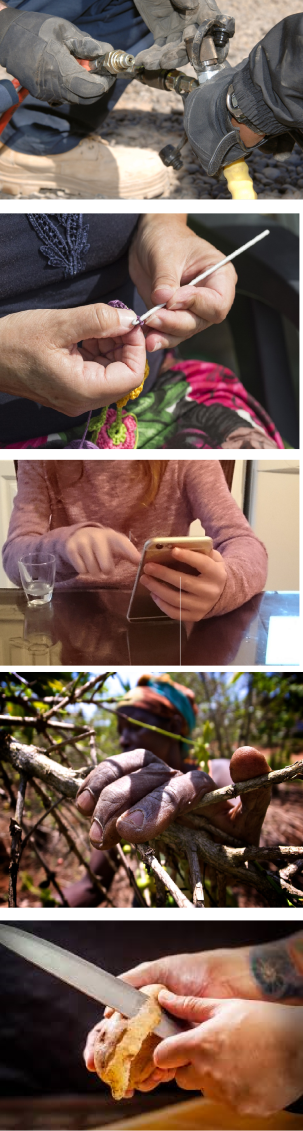
How often do we as Christians consider what the Psalmist asks: Connecting the use of our hands with our spiritual lives. In washing dishes, driving a car, using a computer (as I am now). In the work of the carpenter, the nurse, the surgeon, the chef, the manual laborer.
Our hands are a crucial part of our lives. Just imagine losing the use of them, like a quadriplegic friend of mine who can no longer do even the simplest tasks with his hand! Now don’t let me overplay this, but let’s pause a moment and reflect on that connection.
Martin Luther reflected that the handmaid on her knees scrubbing the kitchen floor was doing work that is just as sacred as the work of the priest kneeling at the altar saying Mass. We’re back to hands, again: Sacred hands, those of the handmaid as well as those of the priest.
The issue: How do we as Christians re-establish the connection between our daily “secular” lives and our “sacred” lives? How do we recognize that our distinctions between “sacred” work and “not-sacred” work might be artificial?
For many years as a priest I have been visiting parishioners where they work. We discuss the connection between their Sunday church lives and their Monday work lives. Many experience an “aha!” where they make the connection they had not sensed before. They begin to realize that, as Christians, what they do in their office is just as sacred as anything else in their lives – including church. (handmaid/priest)
It does lead to a different perspective/worldview (“Thy Kingdom come”), when my job is seen in the wider context of my relationship to God. That shifted perspective puts a new light on all we do. Then we join the Psalmist, asking God to bless the world and all creation through our work: “Prosper the work of my hands, O Lord.”
 This work of recognizing, celebrating, and engaging the laity as equal and essential partners in ministry is not limited to The Episcopal Church. Back in 2017, the Church of England launched a new program called
  In the days that led up to our contentious mid-term elections, I read an uplifting
 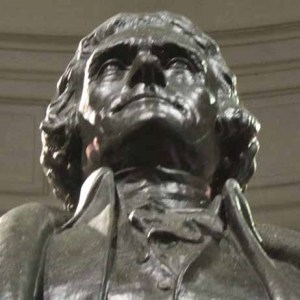 Our faith shapes our values. Not all of us are called to political office or public service. I certainly am not. Yet I am grateful to live in freedom in a republic, and I view my participation – by voting – in the political process as essential to my faith. For me, it is an expression of how Jesus commands me to seek and serve him by loving my neighbors – with God’s help. Just as I have been encouraged to pray for wisdom and integrity in exercising my right to vote and to pray for our nation and elected leaders – regardless of political affiliation – I encourage others to do so, as well. After all – in the words of Thomas Jefferson – we, the People, are the true leaders of our nation.
 I believe that our primary purpose in creation is to build a more loving and just world. And we are well on our way. Humankind has come a long way toward living in more loving and just ways – away from tribal chiefs, child sacrifice, and treating illness with spells and toward more democratic governments, more responsible care for the planet, and more effective health care by doctors and their helpers. We still have a long way to go in coping with climate change, in getting wealth out of politics, and in ending spouse and child abuse.
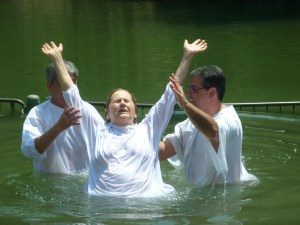 But for Bishop Ray and many others this centrality was only the beginning. The solemnity of Baptism has also to be entered into if the lives and ministries of the baptized are to be fully realized and manifest. Since most baptisms at the main service on Sundays are usually of infants or young children, it is understandable that the tone will be one of delight, joy, pride, even cuteness. That’s fine. But what about baptismal solemnity? How is that woven into the celebration and awareness of what is unfolding not only for the child but for the rest of us as well? In short, how do we understand and realize that being baptized is very serious, solemn business?
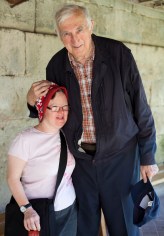


 God was making a body for Christ, Paul said. Christ didn’t have a regular body any more so God was making him one out of anybody he could find who looked as if he might just possibly do. He was using other people’s hands to be Christ’s hands and other people’s feet to be Christ’s feet, and when there was some place where Christ was needed in a hurry and needed bad, he put the finger on some maybe-not-all-that-innocent bystander and got him to go and be Christ in that place himself for lack of anybody better.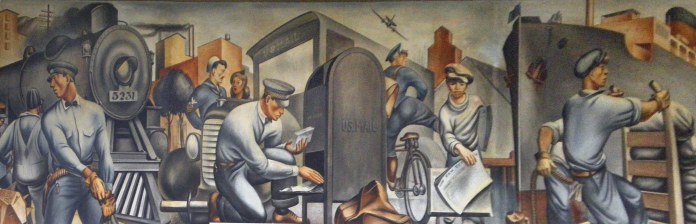
 It was a mail carrier, however, who slowly approached the altar with tears streaming down his face. He carefully laid his mailbag at the foot of the altar and turned to his priest. “No one has ever suggested that the work I do as a mail carrier might be holy,“ he said.
 by Demi Prentiss