by Pam Tinsley
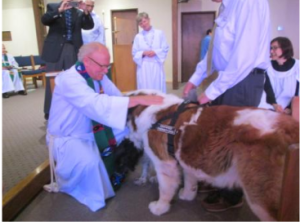 My church, like many, celebrates the Sunday nearest the Feast of St. Francis with a Blessing of the Animals. Pet blessings take place in different ways: outdoors following the service or in a church hall with the pets present throughout worship. My own church chooses to celebrate the Feast of St. Francis in the church with pets, appropriately leashed or constrained, “participating” throughout the service.
I look forward to the Sunday our pets join us in church. Yes, the dog hair on the pews is a bit messy, and there’s mild commotion during the service. (I’ve cringed when my elderly basset added some heartfelt “amens” during the sermon.) Yet, it’s an inter-generational experience that helps us share part of our personal lives, even if we don’t all have pets. A mother of young children said to me, “I love this Sunday because everyone here with pets frets about their behavior; now they understand how I feel every Sunday with my children in church, even though I know they are welcome!”
What I like most about this Sunday, however, is that it is a way to share stories of ministry from our daily lives. These stories are mostly shared without words, yet are reflected by our love and care for our four-legged, furry companions, or those in an aquarium or crate. Others witness that love and care for God’s creatures, as we tend to them, soothe the anxious ones, and gratefully bring them forward to be blessed and to be blessed ourselves as their devoted caregivers. And, sometimes professionals, such as veterinarians, humane society workers, and dog walkers, might receive special blessings. These stories of this ministry of caring for our beloved pets reveal a side of our “Monday through Saturday self,” which is blended on this one Sunday during our common worship.
Such opportunities to bring a personal part of our daily ministry together with our church lives seem to occur infrequently. It strikes me that, by making this a special occasion, we’re suggesting that church should be separate from daily life. Yet, if our Sunday worship is to shape our lives throughout the week, might we not also find a way to regularly share those stories of our daily ministry within the church, encouraging our congregations to recognize how each of us partners with God in God’s mission? A beginning might be modeled on the weekly prayer cycle for “The Baptized in Their Daily Life and Work” suggested by Demi Prentiss and Fletcher Lowe at http://www.RadicalSending.com. And, perhaps we might take another step and invite those who are being prayed for to come forward for prayers – just as we do with birthdays, anniversaries, and other milestones.

 by Demi Prentiss
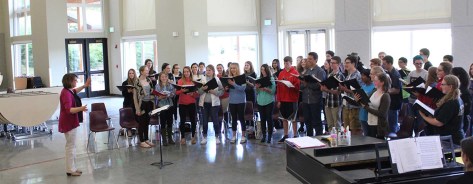 As the exquisite voices of these young women and men filled the church, the hearts of the audience were profoundly moved. My husband and I sat enchanted for over an hour as we listened to arrangements of sacred and secular music. For some arrangements the singers surrounded us, their voices blending sweetly behind and above us. At times our experience was almost transcendent, and by the concert’s end we felt renewed, even transformed.
 Here’s the story. It’s about a mother and her nine-year-old daughter. Where is justice in it?
 A large part of living our ministries in daily life is cultivating the ability to perceive where God is acting, and then aligning ourselves with what God is up to. Understanding ourselves as co-creators with God – partners in a whole-life commitment to increasing love and justice in the world – is a life-giving, purposeful way of living God’s dream for our lives.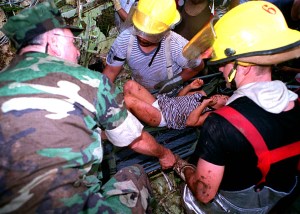
 The church I attend is a “noisy church.” When worshipping in the church, we can easily hear voices from the narthex. Sunday school classes meet in the parish hall directly beneath the church, and we often hear our children’s “joyful noise”. Our church is also located on a busy street corner, not far from a fire station, so that during a service, if you don’t hear a group of motorcycles roaring by, you’ll hear the siren of an ambulance responding to someone in need!
 Sarah also happens to be a gifted writer. As she struggled with her grief, she wondered whether there might be a way she could find healing for herself and, at the same time, help others who were widowed at a younger age. Seeking God’s guidance, she prayed and, with God’s help, she began her “healing journey.” She took a leave of absence from work and went on several meditation retreats. And now she is blogging in the hope that she might be able to offer insights and encouragement to others. As she reaches out to others in their grief, her writing brings her healing moments in her own grief.
 Living God's Mission