Jim Burklo, who serves as pastor of United Church of Christ of Simi Valley, CA, recently mused whether Christians might be able explain our faith in one paragraph in entirely non-religious language, with no reference to God or Jesus or the Bible. The challenge is increasingly experienced in everyday American culture, where growing numbers of people identify as “nones,” meaning people with no religious affiliation – now about 20 to 29 percent of Americans.
Burklo retired in 2022 as Senior Associate Dean of Religious and Spiritual Life at the University of Southern California. His blog, Musings, can be found at www.ProgressiveChristianity.org.
Burklo explains,
If we really believe that God is love, then we can describe the essence of our faith entirely in terms of that love, leaving out the G-word. Not that the G-word is bad: it is integral to the rich mytho-poetic language of our faith tradition. But if we want to get our message across to people who either don’t relate to the G-word, or associate it with bad experiences, we need to start with purely secular language.
I believe that if we practice this kind of secular description of our religious faith, we’ll do a better job of welcoming “nones” into it. And at the same time, we’ll go deeper in our own understanding and practice of our faith…..
So here is my paragraph, briefly describing Christianity in purely secular terms:
Out of billions of years of the universe churning with creation and destruction, a breathtaking reality has emerged: love. On earth, love has evolved from the bond between family members into a deeper love that is unconditional and universal. The emergence of this love marks a profound turning point in natural history. This love flows through deeply attentive, open, all-embracing consciousness. This love lifts people out of selfishness and shallowness and into lives of selfless compassion, creativity, service, and activism for justice. This love manifests in humble awe and wonder. This love is more extraordinary and beautiful than everyday prose can describe. It inspires poetry, music, ritual, and mythic narrative, and it brings people together in community to celebrate and practice it more fully.
The Christian church is one such community. Welcome to it!
How about you? In the context of your work, or school, or social club, or athletic team, or perhaps even your family, could you meet Burklo’s challenge? How fluent can we become in speaking “None”?
“We draw people to Christ not by loudly discrediting what they believe, by telling them how wrong they are and how right we are, but by showing them a light that is so lovely that they want with all their hearts to know the source of it.” – Madeleine L‘Engle
On September 7, 2023, on this site, Pam Tinsley offered wise words on the theme of conversation with God in her entry “Listen, Believe, Act.”
Our children need to see us having God conversations; they learn by imitating us, and we need to actively participate with them in reflection, wonder, and activity as they creatively and playfully develop their own way of conversing with God based on seeing ours.
On the internet, we find many ideas for Jesus crafts; these crosses made out of tumbling tower pieces (one example for how to make these) make for great co-created crafts between adults and kids in the process of forming kids who listen, believe, and act in conversation through listening and responding to God.
As we select our blocks for this cross, we can talk about how people are all made in the image of God. I wonder how we can tell that you and I are the same? How are you the same as people at school? How are you the same as God? I wonder how we know God Loves Everyone? How did you know which 10 blocks to pick?
As we pick the paint colors for our blocks, we extend the listening and responding to differences in God’s world. I wonder how God picks colors for skin? Why does God start to make us different from each other? Are we really different from each other in God’s eyes? How do we learn to see each other the way God sees us?
When we glue the pieces together, we read all of 1 Corinthians 12, half to one verse for each block, perhaps from The International Children’s Bible. It’s important to take time to listen and respond during each section – to be mindful and present with each block before attaching it to another and to remember that each of us is both individual and part of the whole body. I wonder which God-part I am? I wonder what it means if I try to be many gifts instead of just the one I’m given? What if I don’t know?
When the cross is complete, we show that we listened by responding in prayer: “Thank you, God, for helping me learn to listen and respond to your wisdom. Wow, God, you gave us Jesus in the symbol of the cross to remind us that You love us so we can love each other. Amen.’”
*For more learning fun, make more crosses to give as gifts!
Over the past several weeks I’ve noticed a common theme in several sermons and reflections. “Listen, believe, and act” were the words of wisdom that my late friend Rena offered to her son-in-law years ago. In another instance, an engaging preacher reminded the congregation that “gratitude, study, and reflection” are the principal components of discernment, that is, a conversation with God. The Cursillo/Come and See ministry in my diocese invites us to reflect during weekly small group reunions about our “spiritual practices, life-long learning, and spiritual action.” Daughters of the King take vows of prayer, service, and evangelism. And an Ignatian reflection phrased the same idea this way: find God in your life; identify what God is calling you to do; reflect on your own actions and motives; and then make a choice aligned with God’s desire.
Although the words themselves may vary, conversation with God is at the heart of each. Conversation means that we both listen to God and respond to God. We can listen for God’s voice in prayer and in the study of God’s Word, including the Bible and other sacred writings. We convey belief by expressing our gratitude to God. Regular worship – Eucharist, i.e., the Great Thanksgiving – is our faithful expression of gratitude.
As we look and listen for God’s loving presence in our daily lives through these spiritual practices, God also calls us to respond – to act. Each one of us is integral to Christ’s mission. For some, such as the saints, their part in Christ’s mission might be extraordinary. But for most of us, our part may seem quite ordinary and even insignificant and usually takes place in everyday life.
Yet, like a jigsaw puzzle with its many pieces, Christ’s mission needs each one of us. So, I invite you to engage in conversation with God and listen; believe and be grateful for how deeply God loves you; and respond by serving God in your daily life.
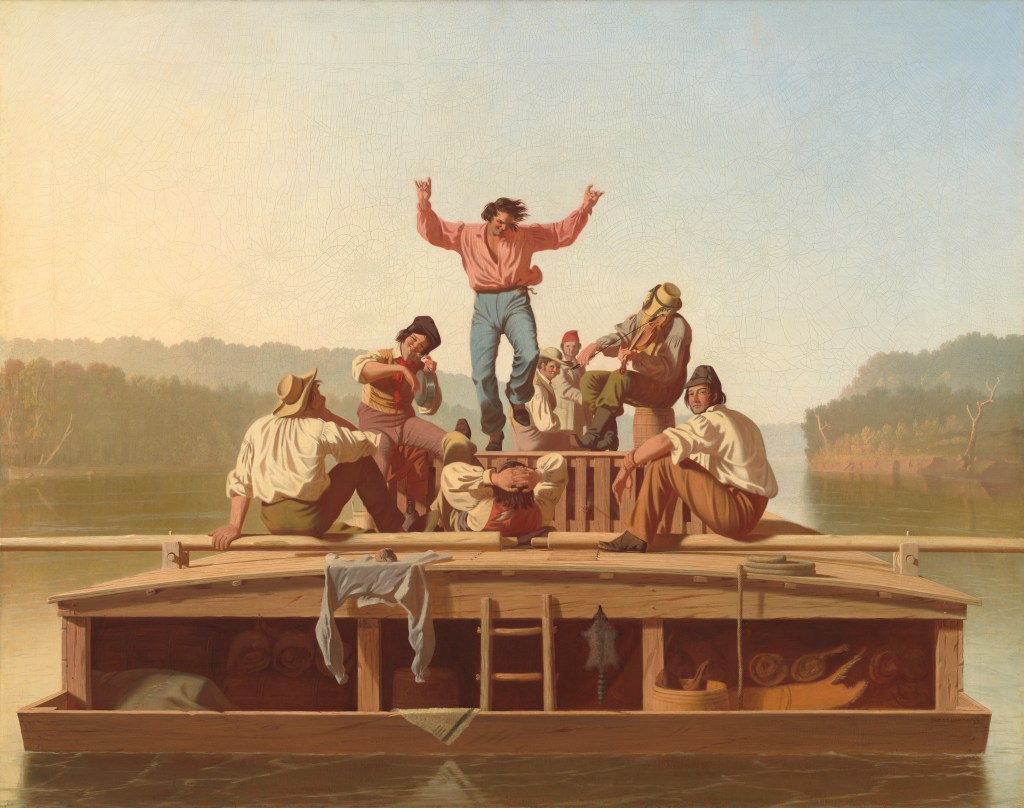
Dennis Raverty, writing for The Living Church, recently took a closer look at a widely-distributed 19th century print of a painting by George Caleb Bingham, titled The Jolly Flatboatmen.
The Jolly Flatboatmen, George Caleb Bingham, Public domain, via Wikimedia Commons
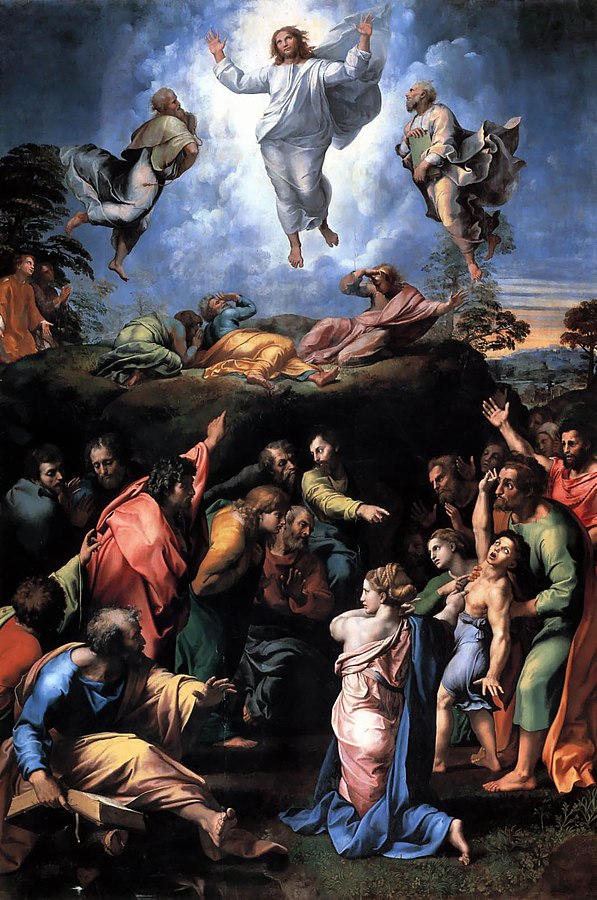
When the engraving was distributed to American Art-Union subscribers in 1846, some objected that the realistic subject matter was “uncouth.” Raverty believes that Bingham was intentionally mirroring a far more lofty painting by the Renaissance master Raphael, The Transfiguration of Christ. In “quoting” Raphael, as Raverty expresses it, Bingham makes the clear implication that “life on the Western frontier transforms people, and helps them realize their innate Christlike potential.”
The Transfiguration of Christ, Raphael, Public domain, via Wikimedia Commons
Raverty writes, “The gift of discernment demanded by the painting is the ability to see the latent Christ even in the most humble and coarse of subjects. Seeing the High Renaissance references in this lowly genre piece of daily life on the river required a similar act of recognition.”
Recognizing Christ at work in our daily lives requires understanding Christ as living and active in the world we encounter. Bingham’s gift of highlighting daily life transformation reaffirms our own aspirations to see Jesus often in the people and situations around us. As Raverty concludes, “By elevating the ordinary, as Bingham has done in this painting, the artist transfigures it, and at the same time challenges viewers to discern the hidden image of the glorified Christ in their otherwise mundane, everyday reality.”
Cursilllistas who practice living “the Fourth Day” ask themselves each week, “Where have I seen Christ in action?” A good question for those of us who seek to follow Jesus.
Novelist Qiu Xiaolong, in his 2000 (English translation) novel Death of a Red Heroine (Book 1 of the Inspector Chen series), writes, “When you wear the mask, the mask becomes you.” I’m thinking about masks today for many reasons, mostly because my mask hurts my face. I am learning to take my mask off by listening to God and integrating God’s call on my life with a psychoeducational practice of emotional sobriety.
In SMART Recovery groups, people come to learn emotional sobriety as a pathway to peace from any and all kinds of addictive behavior. We recognize, understand, and act to change our own actions in relationship to our feelings and thoughts. One of my rule-of-life principles is to remember, “I am fearfully and wonderfully made” (Psalm 139:14). Coming to know this about myself was not as simple as meditating on the psalm or listening to other people compliment me, reward me, or praise me – especially when who they were complimenting and lauding was my mask and not me. Participating in SMART Recovery and practicing the skills taught there helps me embody the words of God, to recognize my authentic self in God’s words, to understand myself as God sees me, and to act in a way congruent with who I am as a child of God.
I’m reminded of another quote – this one from the 1998 film version of Alexandre Dumas’s classic The Man in the Iron Mask: “I wear the mask. It does not wear me.” I’ve learned to make a conscious decision about my mask rather than letting it control my life. I recognize the illusion my mask creates – the way it separates me from God – and I understand how to take my mask off so that it does not wear me, does not become me.
One of the SMART Recovery exercises is on unconditional self-acceptance (USA) and asks that I challenge negative thoughts I have about myself, detect my own irrational/worldly thoughts, and connect with the rational thoughts that demonstrate my worth and goodness based on facts I can sense. My action is to turn to God and remember that “I am fearfully and wonderfully made”– it’s ok to take off my mask so the world can see how God created me!
De-masking – showing the world my beautiful face – is a truth-telling that came easily as a small child. Jesus asks us to reach God through childlike wonder because, when we are children, we haven’t yet been told to put on masks; as children we haven’t hidden our beautiful faces from our Creator. My prayer today is that we each examine our faces and ask, “What mask am I wearing? What’s stopping me from taking it off?” After all, God wants to see your beautiful face!!
We are all missionaries. By our own cultural heritage, by our own geographic setting, by our training, education, life experience, and unique access to certain people, we are to bear the beams of God’s light, and life, and love, knowing that God is with us and that God will provide. – Br. Curtis Almquist, SSJE
U.S. National Park Service photo
Summer is such a great time for travel, or for a stay-cation – for getting outside our daily routines and perhaps exploring a few new things, just a bit outside our comfort zone. Seeing, doing, learning, observing something new. It’s a great reminder that the things that strike us as “new” might be one of the “new things” that God is placing before us – perhaps to entice us to join in one of God’s “new things.”
It’s easy to forget that the things that strike us as “new” may be everyday stuff for lots of people. And vice versa: our habits may be startling “new things” to those who might not know us, our daily grind, or our “home” culture. No matter where we go or who we encounter, God is with us, as Brother Curtis reminds us. Whether or not we choose to be aware of God being with us, the people we encounter will be able to see “the beams of God’s light,” if we’re brave enough – and authentic enough – to let them shine through.
Recognizing our role as light-bearers can humble us. And embolden us, perhaps, to dare to live our fullest version of the life God is calling us to live.
Eugene Peterson’s The Message gives this interpretation to Matthew 5:16:
14-16 “Here’s another way to put it: You’re here to be light, bringing out the God-colors in the world. God is not a secret to be kept. We’re going public with this, as public as a city on a hill. If I make you light-bearers, you don’t think I’m going to hide you under a bucket, do you? I’m putting you on a light stand. Now that I’ve put you there on a hilltop, on a light stand – shine! Keep open house; be generous with your lives. By opening up to others, you’ll prompt people to open up with God, this generous Father in heaven.
“The longer I live the more deeply I learn the love – whether we call it friendship, family, or romance – is the work of mirroring and magnifying each other’s light.” – James Baldwin, Nothing Personal
On April 6, 2017, The Recovery Ministries of the Episcopal Church (RMEC) blog “Through the Red Door” entry (page 20, “I am not alone”) says, “My addictions served to hide me from myself. I practice sobriety in order to be authentic and to live a liberated life of love of self and others.” That entry begins by citing Romans 7:15-25, Paul’s “I do not do what I want” declaration, a powerful statement for Christians in recovery (and the rest of the Church) – one that can do as much harm as it does good.
Connecting this Pauline thought to recovery can be harmful by centering the idea that the person in recovery penitentially bears the burden of their “hurts, habits, and hangups.” (These are semiotic descriptors from Celebrate Recovery.) In addition, these words of Paul uphold an idea that we are powerless over our behavior.
I don’t believe that either of those thoughts is good, true, or beautiful. But the young author of that blog article thought so; he wrote:
[M]y personality problem wasn’t solved by going on the wagon or taking [a] pledge, but I’m glad that it wasn’t. Those defects of character challenge me every day to seek Christ more, and they have driven me to listen to others carefully and critically in order to discern who I am in Christ and what paths I might take to get closer [to God]. [my emphasis]
Six years later as I re-read these words I wrote for RMEC (yes, I wrote the above-referenced article), I know that I have been “falling upward,” as Fr. Richard Rohr would say, and I enjoy that feeling. I have not done this alone. I am glad that others help me regulate. And being in conversation with God and God’s people gives me the strength to abstain from so many things with which I used to engage that harmed my relationships with others. I’m grateful for people whose gifts differ from mine, who can use them assertively to teach me a way that might be better than that which I tried already. I am empowered by these siblings to use my gifts to achieve all to which I am called. I fall upward more readily when empowered by this communion of others.
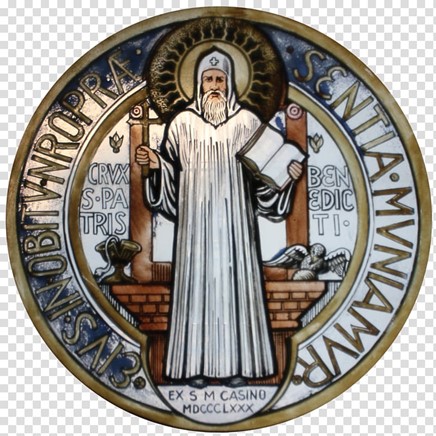
The Rule of St. Benedict (RSB) persists as a model guideline for community living, partly because it takes into account the diversity of needs of people of all ages and personalities and physicalities and so much more. (See excerpt below.) It also is flexible, noticing that you can’t tell what’s going to happen from time to time and situation to situation and person to person. RSB carries great wisdom in its flexibility; its “if-then” logic shows a “falling upward” insight that still benefits us some 1500 years later. This “if-then” logic equals The Way of Jesus, The Way of Love; I reframe 1 Cor 7:7, Benedict’s opening of RSB Chapter 40 (italics above)–“everyone has their own gift from God, one in this way and another in that” as “everyone has their own [needs], one in this way and another in that.”
In RSB, Chapter 40 (below), Benedict teaches sobriety to the men he had gathered together in communal living groups for work and prayer (ora et labora) near Subiaco, Italy, in the late 400s and early 500s. In 516, he wrote the RSB to help these men learn more about living in community and what Fr. Richard Rohr has come to call “falling upward” together.
This Chapter 40 isn’t about recovery and sobriety as we know it, yet it still applies in some modified ways. Wine is no longer a drink we use for sustenance, nor a drink we use to purify non-potable water. Yet, Benedict has wisdom even for those of us who seek to work and pray together where our strengths and weaknesses differ, especially where intoxicating substances are concerned. “We regulate each other…” “…no occasion for surfeit or drunkenness…” “…drink sparingly and not to satiety…” “…abstain from murmuring.”
These are not tasks for people with “hurts, habits, and hangups” only. (Side note – we ALL have “hurts, habits, and hangups.”)
These are not tasks just for people who are sinful and powerless. (Side note – if your theology is Pauline, we ALL are sinful and powerless.)
These are not tasks simply written to the ones who are separate because they have defects of character. (Side note – if you think that people in recovery are defective, take a look at the log in your own eye.)
These are tasks for everyone in the community, the Church, the world: regulate each other with love; no occasion for drunkenness; drink sparingly; abstain from murmuring; everyone has their own gift/need. This is the Way of Love. If you love God, then you love your neighbor – as they are, not as you would have them.
Much of what I wrote in 2017 for RMEC is still true to my view of myself and my recovery practice; much has also changed since. As I lean into studies of gnostic texts and contemplative prayer with The OOOW and reorder my hierarchy of values and as I build a family and discern an ordained vocation, my recovery practice looks more monastic and also incorporates more of outward work and prayer with and for others. I follow a daily office pattern, using contemplative and lectio divina prayer groups rather than 12-step groups for community and regulatory accountability. I take action to create and sustain recovery ministry outreach programs and provide lay pastoral care at my home church. I invite, welcome, and connect newcomers to church, seeking to connect not just my own but also the newcomers’ deep gladness with first our parish’s, then the community’s, then the world’s deep need (Frederick Buechner, Wishful Thinking, 1993).
We might feel alone sometimes as we seek to find answers to the perennial questions of “Why am I?” And “Where did I come from?” And “What am I doing here?” And “Where am I going?” But the truth is, we’re never alone. We have guides and companions journeying with us. We can all fall upward, actively be in recovery, be monastics, Walk in Love.
Go forth. Be kind. You are Love(d).
From the Rule of St. Benedict:
"Everyone has her own gift from God,
one in this way and another in that" (1 Cor. 7:7).
It is therefore with some misgiving
that we regulate the measure of others' sustenance.
Nevertheless, keeping in view the needs of the weak,
we believe that a hemina of wine a day is sufficient for each.
But those to whom God gives the strength to abstain
should know that they will receive a special reward.

If the circumstances of the place,
or the work
or the heat of summer
require a greater measure,
the superior shall use her judgment in the matter,
taking care always
that there be no occasion for surfeit or drunkenness.
We read
it is true,
that wine is by no means a drink for monastics;
but since the monastics of our day cannot be persuaded of this
let us at least agree to drink sparingly and not to satiety,
because "wine makes even the wise fall away" (Eccles. 19:2).

But where the circumstances of the place are such
that not even the measure prescribed above can be supplied,
but much less or none at all,
let those who live there bless God and not murmur.
Above all things do we give this admonition,
that they abstain from murmuring.
–Chapter 40: On the Measure of Drink
The Rule of Saint Benedict, translated from the Latin by Leonard J. Doyle OblSB, with introduction by Rev. David W. Cotter
Adapted for use at the archived OSB website with the division into sense lines for public reading of the first edition that was republished in 2001 to mark the 75th anniversary of Liturgical Press. Hardcover and paperback editions of Doyle’s translation are available. Even chapters adapted for women; odd chapters for men.
For as long as I can remember, our four-year-old granddaughter Sienna has prayed. When she was learning to talk, she would sit on our couch with a small Book of Common Prayer – just the right size for a child – and “say prayers.” Although only the words “the Spirit,” and “Amen” were discernible to our ears, she and God certainly knew what she was praying!
As Sienna got a bit older, she began to lead grace at dinner. She still insists that each of us take a turn thanking God before we eat. And before bed, Sienna and her mom sing “Jesus loves me” together. She especially loves the music at church (and Sunday school!), and whenever she’s at an Episcopal church, she follows along with “her Bible” – that small BCP – even though she can’t yet read!
On Sunday mornings in May while we were on vacation together, I would tune into my parish’s on-line worship service. Sienna quickly joined me. Together we sang the opening hymn, responded to the Liturgy of the Word, and listened to the Gospel reading.
Then the sermon began. Sienna seemed captivated, even as the preacher delved into a thought-provoking sermon about what it means to be human and about the Church’s role in the age of artificial intelligence. I couldn’t believe that this four-year-old was still paying attention! Then the preacher mentioned the soul. Without missing a beat, Sienna began to sing the familiar song, “I’ve got peace like a river, I’ve got peace like a river, I’ve got peace like a river in my soul.”
In all three synoptic Gospels, Jesus says, “Let the little children come to me.” Our experiences with Sienna are examples of how children give adults a glimpse of God’s Kingdom and how our littlest ones can minister to us. We need only to have eyes to see and ears to hear!
After reading Matthew 10:40-42 I’ve been reflecting on what it means to give and to receive hospitality: How I might offer a “cup of cold water” – hospitality – to someone in need – or how I might receive it.
In the midst of my reflections, I had two telephone interactions with the IRS. Yes, the IRS whom so many of us fear!
The first call was regarding a non-profit whose contact and address information I’d been trying to update by mail for close to two years. When a letter from the IRS was miraculously forwarded to me, I filled out paperwork for the changes. And then I still waited. Finally, with a bit of trepidation, I picked up the phone and called the person whose name was on the letter. Within 20 minutes the changes were implemented by an incredibly helpful and gracious IRS representative. He ended our conversation with, “May God bless you.”
My second call was related to our personal taxes. I decided to save on our accountant’s fee and – perhaps bolstered by that recent experience – made the call to the IRS. Lo-and-behold, I ended up with another super helpful and gracious IRS rep who thanked me each time she had to put me on hold. She sorted everything out quite efficiently, and she thanked me yet again for my patience!
What they probably saw as routine actions made a deep impression on me. They made me feel as though I’d received a cup of cold, refreshing water – just like the cup of cold water Jesus refers to in Matthew 10:42.
That’s when I realized that most of my own acts of welcome are simply part of my daily or weekly routine.
As 21st-century disciples, we bear Jesus’ presence to whomever we encounter, whether it’s at home, at work, at the grocery store, or even on a service call. And we do this through simple, everyday acts of kindness. Because each simple, everyday act of kindness, of grace, embodies God’s love for our neighbor. Each simple, everyday act of kindness, of grace, bears witness to the extravagant welcome of God’s kingdom. Each simple, everyday act of kindness can grow and spread and lead to something greater – to more – when we offer it in Jesus’ name. Each simple, routine act of kindness can begin to transform our broken world into a world more attuned to God’s will for us and more aligned with God’s Kingdom values.
Those who know me have heard me quote the statistic that 99.2 percent of the church are laity. That is true across denominations in the U.S., and that means that all the clergy comprise less than one percent of the church. Laity – just like the ordained – are called to exercise their ministry 24/7/365. And if we laity leave “being church” up to the clergy, we’ll kill the ordained with too much work and too many expectations, while leaving the work of the Body of Christ largely unrealized.
A recent blog posted by Michael Piazza is titled “From Theology to Biography.” It is a powerful reminder of the work God has called all of us Christians – through our baptisms – to do as our everyday response to God’s claim on our lives:
“What does it mean for our theology to become biography? It can’t happen only when you are at church. It also must happen when you are fishing or filing. Ninety-nine percent of the ministry of the church takes place Monday through Friday in shops and offices and factories. The deep purpose of our lives must extend to every area of life, and our purpose also must extend beyond the boundary of our own lives. Rev. Dr. Martin Luther King, Jr. said:
“You ask why are we here, and I will tell you. We are here to serve. Success is not defined by the number of servants you have, but by how many people you serve.
“According to a parable Jesus told, only a fool thinks the purpose of life is gaining more and more. The most certain formula for misery is to have as your only purpose for rising in the morning and working through the day to be what you can accumulate for yourself.
“If you can summarize the purpose of your life with the words “me” and “mine” then you have succeeded in sentencing your soul to hell. Oh, not the hell of eternal fire, but the hell of a shallow, vain, and meaningless existence. Look at the great lives that have made this a better planet:
What if Beethoven had been only an organist?
What if Edison had been only a mechanic?
What if Rosa Parks had been only a seamstress?
What if Desmond Tutu had been only a priest?
What if Mother Theresa had been only a nun?
“Great people are those who have most enriched the lives of others. Isn’t it time for us to rise up to become great people?”






 Living God's Mission