The work of the people

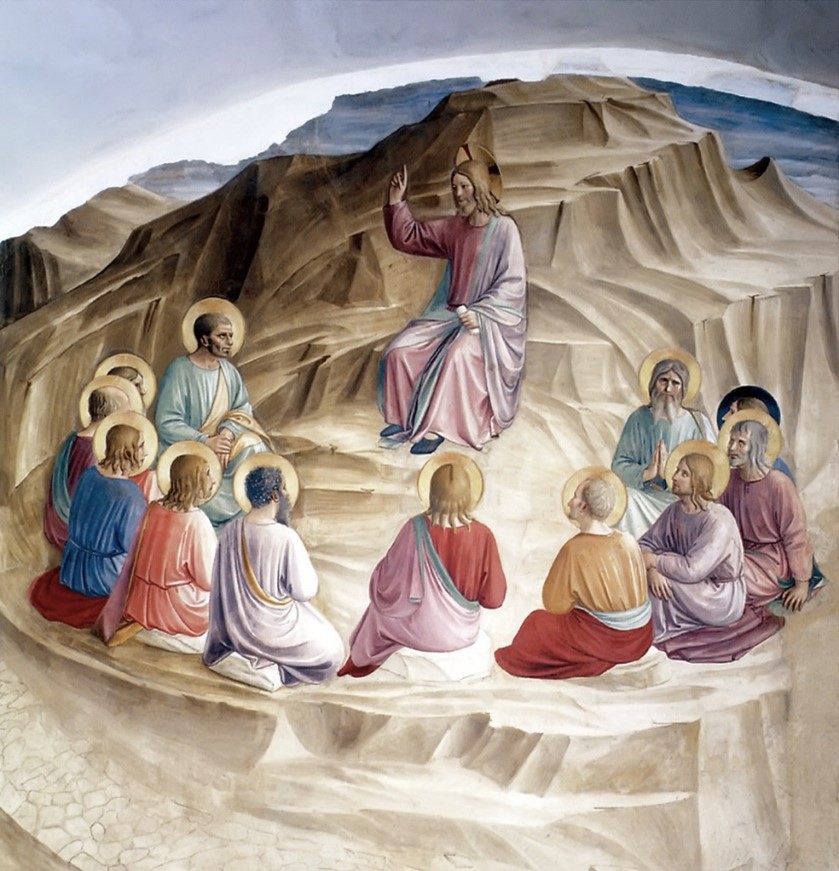
Jesus: Blessed are the peacemakers, for they shall be called the children of God. – Matthew 5:9 (The Sermon On the Mount by Fra Angelico, 1443)

by Demi Prentiss

I am a Christian. Sometimes – like the present election season – that’s a hard statement for me to make – depending on who’s in the room ready to jump to conclusions about what that means in terms of my beliefs.

The events of the past year have led me to articulate two guiding principles for myself:

  • I am called by my faith to ground my thoughts and my actions in gratitude, not grievance.
  • For me, “respecting the dignity of every human being” is a non-negotiable. All of us human beings on the planet are children of God, beloved and called – including the ones I would never vote for.

It’s not a popular sentiment, but I love the art of politics – the necessary work of governance required in a democracy. I love the “work of the polis,” from the Greek word meaning city or community. Being a city or community where the voices of the people are heard and honored is hard work. I love the push and pull, the argument and the compromise and the collaboration and the experimentation in bringing the vision of a self-governing, person-honoring polis to life. In some ways it parallels the work of liturgy, “the work of the people” as they worship. As in politics, the work of the worshipping community is diminished – some might even say invalid – if the dignity of each human being is not honored in the process.

I want to be an authentic Christ-follower. That is a risky undertaking, even in the best of times. Back in 2012, and again in 2024, Brian Zahnd offered 10 guidelines for Christian voters. I’ve listed my favorite five below. (Read the full list here.) The words can help shape our thoughts and our actions in our faith and in our political lives, seeking to honor both Christ and God’s people.

BZ’s Christian Voter Guide
1. The political process, while necessary, has little to do with how God is saving the world.
2. The fate of the kingdom of God does not depend upon political contests.
3. Don’t be naïve, political parties are more interested in Christian votes than they are in Christian values.
4. The bottom line for political parties is power. The bottom line for a Christian is love. And therein lies the rub….
10. It’s more important that your soul be filled with love than it is for your political team to win the game.

And Zahnd adds:

Love is patient and kind.
Love does not envy or boast.
Love is not arrogant or rude.
Love does not insist on its own way.
Love is not irritable or resentful.
Love does not rejoice at wrongdoing,
Love rejoices with the truth.
Love bears and believes all things.
Love hopes and endures all things.
Love never fails.
– St. Paul (1 Corinthians 13)

Seasons of surrender in service

by Pam Tinsley

I love the fall colors. There’s something mystical in the way that the leaves on deciduous trees slowly fade from deep green to brilliant shades of yellow, orange, and red. Sometimes I’m not sure what’s more spectacular to behold: a swathe of bright yellow aspens against the backdrop of pine trees or a canopy of brilliant orange maple leaves embracing the dark wet bark of their trunk. Trees in autumn are my favorite – that is, until spring when they clothe themselves anew with soft, little leaves of velvet!

When I ponder the beauty of the trees in the fall, I’m reminded that soon they will surrender their leaves. Their bare branches will reach toward the heavens, as their seemingly spent leaves cover the earth. Although their glory seems diminished, their work is now done. They slowly decompose and enrich the soil – from which new life will eventually blossom.

I think we can learn something about surrender from trees. If you’re like me, you might find it hard at times to let go of plans – our “gods” – and to let God’s Spirit lead. To let go and allow God to mold you into the person God has created you to be.

God’s Spirit also leads us differently in different seasons of our lives – just like the leaves on the trees. Each season has purpose and blessings. As followers of Christ, we might embrace seasons where our prayer life leads us to active ministry in the world, working with God to create a world where all of God’s children are loved and cared for. Likewise, as one season flows into the next, we may look backward and lament what seems to have been lost. When we lament, we risk not being open to and even missing the richness each new season offers. We may even find ourselves in a seemingly fallow season where “all we can do is pray.” Yet, as the trees teach us, even a fallow season can be lived in service to others, whenever we nurture our actions and nourish new life.

Mistakes allowed; uncertainty abides; love wins

Veil Nebula supernova remnant picture by the Hubble Space Telescope. Source: NASA

by Demi Prentiss

My extended, blended family is, probably like many other similar families, repeatedly in the throes of learning how to be with one another.  Lately, we have a mantra to fall back on when things get tough: “We are allowed to make mistakes.”  That’s not designed to avoid accountability, or foster a laissez faire attitude about not doing our best. It does, often, open a door to grace – recognition that human beings are fragile and prone to unforced errors, and often in need of toleration. We need safe space where we can risk and be wrong. Fail fast, learn from mistakes, seek forgiveness, and even when we fall down, persist in falling forward.

A priest friend, looking at the Genesis story of “The Fall” and Adam and Eve’s ejection from the Garden of Eden, often said that original sin had nothing to do with sex, and not even with lust for knowledge. “The original sin is the desire for certainty,” he would pronounce, with a wink to those who recognized the irony of his daring to be so certain.

We human beings – made in the image of God, say the prophets – really do seem to prefer black-and-white, cut-and-dried, take-it-or-leave-it dichotomies, with clear boundaries and the opportunity to categorize outcasts and insiders.  The only trouble is that Jesus – and the rest of the Trinity, apparently – are much less into stark differentiation and more into a willingness to focus on similarities rather than differences. That whole “God is love” thing.

As we seek to be followers of the Son of God, part of the walk of faith is the willingness to take the next step, following God’s calling, without the luxury of certainty. Christian theologian Paul Tillich wrote, “Doubt isn’t the opposite of faith; it is an element of faith.”[1] And author Anne Lamott answers, “[The] opposite of faith is not doubt, but certainty. Certainty is missing the point entirely. Faith includes noticing the mess, the emptiness and discomfort, and letting it be there until some light returns”[2]

“…until some light returns.” That’s a tough space to wait in. And Christians are called to speak out for God’s truth and light even when darkness appears to prevail. The Good News includes, “You shall know the truth, and the truth shall set you free” (John 8:32). God’s truth, revealed in the cosmos, reminds us that God’s incredible, enthusiastic diversity is a more trustworthy guide to truth than single-minded certainty. The “first testament” – all of creation – speaks that truth. Difference – and mess – everywhere!

Richard Rohr’s Daily Meditation for Aug. 31, 2024 offers a prayer from author Cole Arthur Riley, “A Prayer for Those Who Thought They Knew,” a “prayer for those who have left spiritual spaces of certainty”: 

God of wisdom, 
It’s hard to know what to say to a God claimed by those who have wounded us. Can we trust you? We have known what it is to exist in spiritual spaces that are more interested in controlling us than loving us. To have the room turn against us when our beliefs diverge from the group’s. We thank you for giving us an interior compass, an intuition that no longer trusts spirituality that feels like captivity. Free us from those spaces. But as we depart, keep us from relinquishing our own connection to the divine. Help us to approach you slowly in the safety of our own interior worlds before granting another spiritual space access to us. And when we’re ready, guide us into new and safe communities—communities capable of holding our deepest doubts, our beliefs, the fullness of uncertainty, without being threatened. May we approach shrewdly and carefully, for our own protection, as we search for spaces that honor the whole of us. 
Ase.
 

Riley offers this prayer to use with the breath: 

INHALE: I am free to not know. 
EXHALE: I can rest in mystery. 
INHALE: I may not know what I believe, 
EXHALE: but I know it will sound like dignity. 
INHALE: My doubts are sacred. 
EXHALE: God, stay close as I wander.

[1] Paul Tillich, Systematic Theology, Volume 2 (University of Chicago Press: Feb. 15, 1975), pp 116-7. Dec 08 . 2015

[2] Anne Lamott, Plan B: Further Thoughts on Faith, (Riverhead Books: 2005)

A new look at Paul

“Let us beat our swords into ploughshares ‘ – Bronze sculpture at the United Nations by Evgeny Vuchetich – Photo: Evan Schneider/Creative Commons

by Brandon Beck

For years, I’ve thought Paul was a petulant and recalcitrant problem. I shied away from him anytime he came up in theological discussion and assumed that he would be used to “clobber” me. I’m studying with New Testament scholar Dr. Shelly Matthews at Brite Divinity School now, and I’m learning to look at Paul in new ways, to grant him the grace that, with dignity and respect, I’ve always wanted him to grant me.

Recently, in Dr. Matthews class, we were discussing Paul’s letter to the Romans, and we read a chapter of a book by her former student Dr. Jimmy Hoke: Feminism, Queerness, Affect, and Romans: Under God? Before delving much further into Dr. Hoke’s work, let me remind you that only seven of the letters in The New Testament are considered authentic Paul – 1 Thessalonians, Galatians, 1 and 2 Corinthians, Philippians, Philemon, and Romans. Keeping this in mind is part of what is helping me look at Paul in new ways. Often what has been used against me in Paul’s writings has not actually been Pauline; it has been pseudo-Paul. That, of course, doesn’t mean it doesn’t hurt, but I can forgive Paul, and, by extension, forgive those who have misused him.

Dr. Hoke takes one of those passages that is Paul’s that is often used to “clobber” people who are LGBTQ+ and analyzes 1st Century Roman sexual politics as a lens through which to better understand what might be going on in the problematic passage, leaving me with a more hopeful way to view Paul not only in this letter but in the other Pauline letters.

As I’ve re-read Paul through my new lens of cautious hope, I’ve been able to remember that Paul was just a man, just a person afraid for his life and trying to protect his friends, just like all of us here now. I have remembered, as I re-read complex and difficult passages such as 1 Corinthians 11:2-16, that Paul was just as confused as the people he was trying to teach but was zealously striving to bring people together as they all were trying to realize their ideal forms in the Eschaton.

Reflecting on the ways that I am able to change my perspective on this historical and critical Christian figure, I wonder who among the people I know in my daily life I might need to consider from a new perspective? Is it the person who unintentionally brushed against me in the grocery story? The person who looked at me in a way I didn’t like on the bus? The priest whose sermon I didn’t agree with? The person who laughed when I thought it wasn’t appropriate? The person who took communion with me but won’t vote the way I will? Let me turn my swords into poughshares again today.

Infused with transfiguring love

by Pam Tinsley

During a small church gathering in early August, a group of us were reflecting on the Feast of the Transfiguration and the glory of God that Jesus’ disciples Peter, James, and John experienced. We talked about our own desires at times to linger in “mountaintop” experiences, resisting the call to return to our sometimes-messy daily lives. So, when the facilitator asked us what “transfiguration” looked like in our daily lives, the conversation shifted to how our lives – even at their messiest – might glorify God.

One story was especially poignant. Cindy had accompanied a good friend for her first chemo appointment. Being diagnosed with cancer is distressing enough. The anxiety around one’s first chemo appointment is even more so. Because Cindy is one of those people who radiates God’s grace – and glory – in pretty much everything that she does, I can’t imagine a better person to accompany anyone to such an anxiety-inducing appointment!

But it turned out that Cindy’s friend was equally at peace with the infusion process. The two of them decided to give names to the infusion bags. The most potent chemo drug happened to be in a red bag, so they called it the Red Devil. They also looked around the room at the other infusion patients and quietly offered prayers for them.

Cindy then felt a sense of peace, light, and God’s radiance. The infusion room – which typically is a room filled with fear and anxiety – had been transfigured by God’s presence into a sacred space. Cindy and her friend savored the sacred moment together.

Pondering this story, our little congregation realized how God transforms us spiritually by God’s radical love. And, like Jesus’ disciples, we can’t remain on the mountaintop and bask in the radiant glow of God’s love. Instead, we are called to return to the messy world so that we, Christ’s body, might radiate his love and glorify God.

Just for today . . .

[Your reading experience will be better on a larger format screen – laptop or tablet.]

by Demi Prentiss

This past week’s Gospel reading – “deny [your]selves and take up [your] cross and follow me” – inspired a convicting reflection on the scripture (Mark 8:27-38) by Brian Malison, a graduate of Luther Seminary, in their daily posting “God Pause”:

“Christianity has a PR problem. It is impossible to put a positive spin on the statement, ‘Come join our church and learn how to deny yourself.’  There are no books on how to diminish yourself. It just isn’t the American way. There are plenty that tell you how to maximize your potential or how to become your very best self, but self-help books on taking up your cross are rarely to be found. Which may be why Jesus isn’t popular. Unless, that is, you are sick and tired of keeping up, you have found the pursuit of happiness to end in disappointment, or you have discovered that your very best self is not someone you like. Then the alternative of following Jesus, who welcomes all and offers redemption, sounds pretty good. Losing one’s fake life for the sake of Jesus is actually gaining real life. Now, how do we market that?”

Almost as though he was responding to Malison’s search for a “self-denial” tool, my longtime friend Christopher Thomas, rector of St. Thomas the Doubter in Dallas, TX, recently offered this “prayer for daily use” to his congregation and his Facebook followers. It serves as a powerful reminder that living the baptismal covenant – the outline of the calling God has placed on our lives – is not “one and done.” It’s intended to be a daily pattern, a “just for today” surrender to the fullness of life that God desires for us.

May God lead us to practice our baptismal promises intentionally today and every day, experiencing God at work through us. That’s the self-denial that allows us to become our truest self – the image of Christ that God dreams for us. That’s the promised transformation – of self and of the world around us – that sells.

Εφφαθα  [Ephphatha]

by Brandon Beck

These days, little towns and suburbs of the big metropolises grow fast in Texas. Buda, a suburb of Austin, is no exception. In 2022, the population was reported to be about 16,000, yet this growing suburb is home to a bright promise of Baptismal Living – St. Elizabeth of DWTX.

St. Liz, as the Budans fondly call their little Buda mission, is served by Vicar Fr Mike Woods and his family. On Sunday, September 8, 2024, Fr Mike exegeted Mark 7:24-37 from the week’s lectionary Gospel reading. I’m quite sure most if not all of you experienced exegesis of this passage Sunday. I highlight Fr. Mike today for what I name his Baptismal Covenant Preaching of the Word.

When I name this Baptismal Covenant Preaching, I am highlighting a preaching that emphasizes an exegesis that includes an analysis of and call-to-action from a scripture passage that derives from all or part of The Episcopal Baptismal Covenant. Fr. Mike did that on Sunday, September 8, with Mark 7:24-37, yet he never even had to utter the words “baptism,” nor the words printed on pp. 304-5 of the Book of Common Prayer. Fr. Mike embodied the baptismal covenant and called all of us to do the same by sharing an analysis of Mark 7:24-37 that describes the Syrophoenician woman and the deaf man of Sidon and Jesus himself as people who need to be open to hearing from God, people who need simply to be open to new ideas, new ways of thinking and seeing, and to people not like themselves.

Fr. Mike spent time relating the word from v. 34 εφφαθα [ephphatha] to ideas of openness and how the need to be open to others and to hearing from God has not diminished but has in fact increased since the time in which the Syrophoenician woman reminded Jesus of this part of his own ministry. The Syrophoenician woman calls Jesus to be open to a blindspot, a cognitive dissonance, between how he’s treating her and what he’s been teaching. Εφφαθα – be open to me, to us, to difference.

Jesus’ own tomb is opened by that magic word – εφφαθα – just as Jesus becomes open to the need and faith of the Syrophoenician woman and then opens the ears and mouth of the man in Sidon. Just as so many of us begin our own words with a prayer of “May the words of my mouth and the meditations of my heart be acceptable to You, O God.” Open us. Open us.

Fr. Mike never had to say explicitly that we must remember our Baptismal Covenant, but we were reminded of it nonetheless, as he spoke to us of Mark 7:24-37 and εφφαθα – we were opened to new ways of thinking about this scripture and of applying it to our lives today.

As people who “seek and serve Christ in all persons, loving neighbor as self” and “strive for justice and peace among all people, and respect the dignity of every human being,” we cannot help hearing “εφφαθα,” as Fr Mike speaks it as a call to be open to every person in our midst today.

It might not be a Syrophoenician woman asking for healing for her daughter, but you might have a new kind of “neighbor” on whose behalf God is crying εφφαθα. Do you have ears to hear? Or shall Jesus come back and stick his fingers deep down in there?

On the website of St. Liz, the welcome message says, “We are an open, inviting, and inclusive community of Christ followers who seek to love our God and our neighbors by being a loving presence in the communities of Buda/Kyle and surrounding areas.” Sounds like Mark 7:24-37 and the Baptismal Covenant to me.

Εφφαθα – Make it so.

Holy work

“The glory of God is the human being fully alive.” – Irenaeus
(Photo by Zac Durant on Unsplash)

by Pam Tinsley

Almighty God, you have so linked our lives one with another that all we do affects, for good or ill, all other lives: So guide us in the work we do, that we may do it not for self alone, but for the common good; and, as we seek a proper return for our own labor, make us mindful of the rightful aspirations of other workers, and arouse our concern for those who are out of work; through Jesus Christ our Lord, who lives and reigns with you and the Holy Spirit, one God, for ever and ever. Amen. (Prayer for Labor Day, BCP, p. 261).

Do you think of the work you do or your job as holy? Maybe if you work in a church or serve in church ministry, you might consider that part of your life as holy work. But, I mean all of your work: your job; your household chores; raising your children or grandchildren; or serving your community. Do you think of that as holy?

Well, God does! Whatever work you do is holy because it is an integral part of you. And God loves you. All of you.

Too often, we consider only church-related activities – be they serving at worship, serving on church committees or vestries, participating in Christian formation – to be holy because we refer to it as ministry. We tend to segregate our secular lives from our spiritual lives without considering two important  factors:

  • God sees and loves our wholeness, and
  • our daily work matters to God.

Throughout Scripture we read about the dignity of work, beginning in Genesis with God’s own work of creation. After all, Jesus was a carpenter, and we know that his disciples’ occupations were important to them – fishermen and even businessmen. Luke the Evangelist was a physician. And in addition to the Apostle Paul’s ceaseless evangelism throughout the Mediterranean, he continued his work as a tent maker (Acts 18:3). Lydia, who became a convert after listening to Paul, was a seller of purple cloth. In his letters, Paul doesn’t call disciples to abandon their – and our – daily work. Instead, he encourages us to center our lives on Christ as we go about our labors.

And even today, our labors are woven into our worship at the Eucharist when we present the fruits of our lives and labors to God at the offertory. Then the gifts that God’s earth has formed, and human hands have made[1]– bread and wine – become the very gifts of God for the people of God.

So, during this Labor Day week – and, God willing, throughout the year – may we all be reminded of the holiness of the work that each one of us is called to, and may we honor God by offering it to God.


[1] Enriching our Worship, Eucharistic Prayer 3

We fall down and we get up . . .

by Demi Prentiss

Return

If you’ve stumbled and fallen, if your initial fervor and zeal have faded away, if you haven’t been true to your promise to love and serve God with your whole heart, if you’re keenly aware of your weakness, don’t be troubled. Don’t waste time wallowing in guilt and shame. Simply return, in repentance and faith, and offer yourself once again. There can be no doubt that God will welcome you with open arms. –  Br. David Vryhof, SSJE

 Amos (Botswana) and Jewett (USA), assist one another across the finish line in the 800-meter semi-finals at the Tokyo Olympics. (AP News photo)

Looking at the history of the Israelites, the stories of Jesus’s disciples, and the church as we know it today, Br. David sees our fervent desire to grow as God’s people combined with our daily – perhaps hourly – need to turn around and renew our relationship with God.

Mirabai Starr, author and teacher, has offered a fresh translation of the work of Julian of Norwich, a 14th century English mystic. Julian is thought to be the first woman to write a book in English which has survived. Starr reminds us that Br. David’s understanding of our need to return to the heart of God is not new:

Julian informs us that the suffering we cause ourselves through our acts of greed and unconsciousness is the only punishment we endure. God, who is All-Love, is “incapable of wrath.” And so it is a complete waste of time, Julian realized, to wallow in guilt. The truly humble thing to do when we have stumbled is to hoist ourselves to our feet as swiftly as we can and rush into the arms of God where we will remember who we really are. [1]

There was a time in my life when I would have dismissed these thoughts as “cheap grace.”  How could the journey of a holy life be so simple? Surely there had to be more to it – more effort, more toil and sweat. Not to mention more suffering and more cowering in fear of an angry God.  Somehow the spiritual life ought to be more stressful and dramatic – shouldn’t it?

Sometimes, I think, we resist the truth that God, who is love, longs for that magnetic love to compel our return. Longs for humility and God’s grace to outweigh our pride and our stubbornness.  Longs for us to practice persistence in surrender as the naturally-chosen life-giving path, back to the welcoming arms of our “prodigal father.” Our arrogant notion that the high drama of our suffering might persuade God to forgive us, though enthralling, is just not God’s way.

The story is told that, when asked what monks do all day in the monastery, the abbot answered, “We fall down and we get up, we fall down and we get up.”  In the Beloved Community, “fallen” is not our spiritual home.  God calls us to get up, and take the next step in grace.


[1] Mirabai Starr, introduction to Julian of Norwich – The Showings, xviii–xix. Quoted in Richard Rohr’s Daily Meditations (Wed., Aug. 14, 2024)

50 years later

by Demi Prentiss

Screen grab – The Philadelphia Eleven

Today – July 29, 2024 – is the fiftieth anniversary of the “irregular” ordinations in Church of the Advocate, Philadelphia of “The Philadelphia Eleven.”  The courage brought to life in those ordinations cracked opened the door to priestly ordination in The Episcopal Church for “others” of all sorts.

That day, “the earth [was] remade,” as one of The Eleven later described it.  The recognition that God’s call – like God’s love – extends to all God’s people has reshaped Episcopalians’ understanding of the Baptismal Covenant. (Book of Common Prayer, 304-305).

Have you seen Margo Guernsey’s documentary film The Philadelphia Eleven? Episcopal News Service explained, “The film tells the story of what it calls ‘an act of civil disobedience.’ The ordinations took place two years and a few weeks before the General Convention agreed that it was permissible for women to become priests and bishops. The 11 were harassed and received death threats.”[1]

In his welcoming remarks at the film’s premier, Bishop Daniel Gutiérrez (Diocese of Pennsylvania) said, “…the cataracts on the eyes of the church and society were removed” when the Philadelphia 11 were ordained. The event confirmed that “the divine image cannot be defaced or distorted by patriarchy, ignorance, hate, fear, marginalization or any of the -isms or constrictions we tend to create,” he said.

One of those eleven pioneers, Alla Renée Bozarth, wrote of that day:

Call
Inspired by “Mountain Moving Day,” 1911,  by the Japanese Feminist Poet, Yosano Akiko.

There is a new sound
of roaring voices
in the deep
and light-shattered
rushes in the heavens.

The mountains are coming alive,
the fire-kindled mountains,
moving again to reshape the earth.

It is we sleeping women,
waking up in a darkened world,
cutting the chains from off our bodies
with our teeth, stretching our lives
over the slow earth—

Seeing, moving, breathing in
the vigor that commands us
to make all things new.

It has been said that while the women sleep,
the earth shall sleep—
But listen! We are waking up and rising,
and soon our sisters will know their strength.

The earth-moving day is here.
We women wake to move in fire.
The earth shall be remade.[2]

[1] By Mary Frances Schjonberg, posted Oct 3, 2023

[2] Published in Womanpriest by Alla Renée Bozarth, Paulist Press 1978,revised edition Luramedia 1988, distributed by the poet; Gynergy by Alla Renée Bozarth, Wisdom House 1978; audio cassette Water Women by Alla Renée Bozarth, Wisdom House 1990, distributed by the poet; and Stars in Your Bones: Emerging Signposts on Our Spiritual Journeys by Alla Bozarth, Julia Barkley and Terri Hawthorne, North Star Press of St. Cloud 1990. All rights reserved.