The Lord is near

Photo by Alfons Taekema on Unsplash

by Demi Prentiss

The holy days we’ve just celebrated – All Hallows’ Eve (Hallowe’en), All Saints’ Day, and All Souls’ Day (Día de los Muertos) – form an autumnal triduum that, for me, is a hinge point in the Christian year, much like the Easter Triduum of Maundy Thursday, Good Friday, and Holy Saturday. These autumnal days are marked with rites and readings that point our imaginations toward end times and our mortality, alongside the Northern Hemisphere’s season of first frosts, fall color, leaf-raking, putting the garden to bed, and hibernation.  The ancient Celtic festival of Samhain (say “SAH-win”) recognizes the season as a time when the veil between the living and the dead is thin.  Many seasonal customs – pumpkin carving, bonfires, wearing masks and costumes, and even trick-or-treating – have grown out of Samhain traditions. The observance of Veterans’ Day early in November echoes the theme as we honor the lives of service members, living and dead and acknowledge their sacrifices.

The “autumnal triduum” offers us a chance to recognize that death is a part of life.  Just as the trees celebrate the harvest by going dormant, the shortening days call us to reduce activity and value what stillness and silence can teach us. We can begin to grapple with the mystery that dying can free us, disencumber us, so we can resonate with the “new thing” that God is beginning to set in motion. Fields that lie fallow for a season are primed for bearing fruit when the time is right. The cycles of nature remind us that this is an eternal, God-formed pattern.

This year’s lectionary readings between All Saints and Advent 1 continue to explore the immanence of the reign of God:

  • “For I know that my Redeemer lives…and at the last…I shall see God.” Job 19:26-27
  • “But for you who revere my name the sun of righteousness shall rise, with healing in its wings.” Malachi 4:2
  • “Now he is God not of the dead, but of the living; for to him all of them are alive.” Luke 20:38
  • “Surely, it is God who saves me; I will trust in him and not be afraid.  For the Lord is my stronghold and my sure defense, and he will be my Savior.”  Isaiah 12:5-6
  • “Blessed be the Lord, the God of Israel; he has come to his people and set them free.” Luke 1:68
  • “God is our refuge and strength, a very present help in trouble.” Psalm 46:1
  • “Be still, then, and know that I am God….“ Psalm 46:11
  • “He himself is before all things, and in him all things hold together.” Colossians 1:14
  • “Jesus, remember me when you come into your kingdom.” [Jesus] replied, “Truly I tell you, today you will be with me in Paradise.” Luke 23:43

As we claim our baptismal identity as beloved and called children of God, the autumn triduum reminds us to reflect on the paradox that shapes our calling:  truly, “we are but dust” AND “we are the image and likeness of God.”

God loves you, and you, and you!

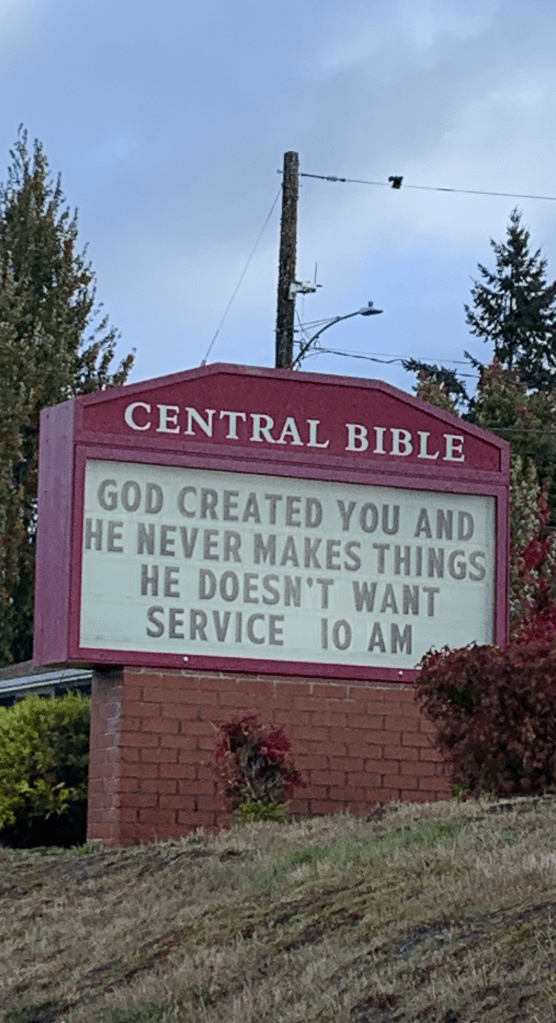
Photo by Pam Tinsely

by Pam Tinsley

“God created you and he never creates things he doesn’t want” is the message on the reader board outside a church I often drive by. What an important message for us today and every day, especially when we hear so many messages to the contrary!

God loves us, even when we try to hide our flaws. God loves us even when we pretend to be worthy. God loves us, even if we feel we’re unworthy. God loves us, especially when others tell us we are worthless. God knows us intimately – our sitting down, our rising up, and every word on our lips, as the Psalmist observes (Ps 139) – and still God loves us simply because God’s essence is love.

Today, the world stokes our fear and insists that we must choose sides. Choosing a worldly viewpoint serves only to intensify our feelings of separation from one another and from God. Again and again, Jesus and angels assure us not to be afraid. Playing on our fears sends the message – and especially to the weak, the lost, and the vulnerable – that God doesn’t love us; that God doesn’t care; that God has turned God’s back on us.

But God’s way is love, and love is God’s way of saying that none of this is true.

When we claim the truth that we are loved, we free ourselves from the shackles of fear and can open our hearts to receive God’s abundant love. We’re then called to respond to God’s love by walking in love, not fear, hate, or indifference. We’re called to put our love into action by reaching out to others, regardless of whether we believe that they are worthy. We’re called to pass on the never-ending love we receive because there is no end to God’s fountain of love.

And why should we choose love instead of fear? Because God created us and will never stop loving us. Because God created our neighbors and loves each and every one of them. And because God never creates anything that God doesn’t love.

Lord, have mercy — What a week!

Photo by Sarah RK on Unsplash

by Demi Prentiss

The stream of alarming news over the past week has been unrelenting:

  • Conservative activist Charlie Kirk was shot and killed in front of a crowd gathered at Utah Valley University.
  • Another school shooting in Colorado placed 900 high school students in lock-down, with two students critically injured and the shooter dead by his own hand.
  • The Israeli military ordered a full evacuation of Gaza City, home to about one million Palestinians.
  • Russian drones violated Polish airspace, eliciting a response from NATO forces.
  • Ukraine continues to resist Russia’s unremitting attacks, now in the fourth year of this most recent invasion, as Ukrainian civilian casualties continue to mount.
  • The French government collapsed following a no-confidence vote, ousting the prime minister.
  • Four hundred US federal agents raided a Hyundai plant in Georgia, detaining 475 workers, including hundreds of South Korean nationals.
  • US National Guard troops remain deployed in Los Angeles and Washington DC, with planned deployments in Memphis and Louisiana. Chicago, Baltimore, New York City, and Oakland, CA may also see similar deployments.
  • The nation observed the 24th anniversary of 9/11/2001, when terrorists crashed four passenger planes, demolishing our country’s illusion of invincibility.

Perhaps we have access to too many bad-news stories. Allowing even 30 minutes of news from around the world is enough to quench hope and feed despair. This week, I sought out dependable hope-bearers I’ve discovered thanks to the world wide web. Perhaps you’ll glean a bit of perspective and courage from three full-length articles that have bolstered my courage and raised my spirits. Each one, excerpted here, offers a helpful focus for action:

   “We often say that we will pray for the victims and their families, and pray we must. But our faith demands more from us. We must guard the hatred in our hearts and on our lips; it is hatred and righteous indignation that leads to violence. Jesus said plainly, ‘it is that which is on our lips and in our hearts that defiles us.’”
   “My Bishop Allan Bjornberg once said that the greatest spiritual practice … is just showing up.
“And in some ways Mary Magdalene is like, the patron saint of just showing up.
“Because showing up means being present to what is real, what is actually happening. She didn’t necessarily know what to say or what to do or even what to think….but none of that is nearly as important as the fact that she just showed up. She showed up at the cross where her teacher Jesus became a victim of our violence and terror. She looked on as the man who had set her free from her own darkness bore the evil and violence of the whole world upon himself and yet still she showed up.”
   “George W. Bush, who was president on that horrific day, spoke in Pennsylvania at a memorial for the passengers of the fourth flight, United Airlines Flight 93, who on September 11, 2001, stormed the cockpit and brought their airplane down in a field, killing everyone on board but denying the terrorists a fourth American trophy….
“[W]e can take guidance from the passengers on Flight 93, who demonstrated as profoundly as it is possible to do what confronting such a mentality means. While we cannot know for certain what happened on that plane on that fateful day, investigators believe that before the passengers of Flight 93 stormed the cockpit, throwing themselves between the terrorists and our government, and downed the plane, they took a vote.”

Pray. Show up. Courageously claim your identity.  And for heaven’s sake, connect with a community of like-minded souls, who can walk alongside you, strengthening your resolve. Such practices help us give life to the baptismal covenant that seals our God-given identity — “child of God, beloved and called.”

As we make our way “through many dangers, toils, and snares,”[1] may we be en-couraged to walk in our rabbi’s footsteps.


[1] John Newton, “Amazing Grace” hymn text.

Holy labor

Frieze at St Pancras Station, London

by Pam Tinsley

Almighty God, you have so linked our lives one with another that all we do affects, for good or ill, all other lives: So guide us in the work we do, that we may do it not for self alone, but for the common good; and, as we seek a proper return for our own labor, make us mindful of the rightful aspirations of other workers, and arouse our concern for those who are out of work; through Jesus Christ our Lord, who lives and reigns with you and the Holy Spirit, one God, for ever and ever. Amen. – Collect for Labor Day, Book of Common Prayer

As Labor Day approaches, I’ve been reflecting on the meaningfulness of work and how its function is being transformed by technology and Artificial Intelligence. Our work has meaning because it matters to God. From the beginning, humans have sensed that creation is alive with God’s presence, and our role has been to do God’s work in the world.

The Hebrew word “avodah” means “work, worship, and service.” The word used to describe worshipliturgy – means “the work of the people.” And when we place God at the heart of our daily work, the eternal is drawn into the temporal. It becomes sacramental. Labor is sacramental not only for what it produces but for how it shapes our human dignity, builds community, and reflects God’s creative purpose. Honoring workers, therefore, is also honoring the divine image in each person and the sacred character of each person’s daily toil.

Even as technology reshapes jobs and entire economies, our deeper vocation will not change. Work is not simply what we do to earn money. It is who we are as beings made in the image of God: people of faith and gratitude linking heaven and earth. Every job – from the humblest to the most prestigious – carries the same sacred title when offered to God.

Although work may take on new forms, on Labor Day we remember and commemorate the true essence of work: to worship, to give thanks, to serve, and to reflect the presence of Christ in all people and in creation. Work is holy because it is our destiny—not defined by tasks or paychecks, but by our identity as God’s holy people, made to love and to reflect God through the work of our lives.

On eagles’ wings

Jackie and Shadow, photo courtesy Friends of Big Bear Valley and Big Bear Eagle Nest Cam

by Pam Tinsley

Ever since a bald eagle flew over our son and daughter-in-law’s outdoor wedding – and a friend observed that eagles are a sign of blessing – I’ve been mesmerized when an eagle soars overhead. If I hear a murder of crows squawking fiercely, I’ll search the skies for a nearby eagle.

Recently, my fascination with eagles led me to follow the Big Bear Eagle Nest Cam. Jackie and Shadow have been nurturing their two eaglets, as they grow from newly hatched little fluff balls into full-sized eagles. But the real excitement has been watching the young stars Sunny and Gizmo learn, from observing their parents and then practicing. Arranging freshly delivered sticks around the nest helped them develop nest-building and bonding skills. They tussled over fish, and they watched their parents soar overhead and sometimes fend off other birds of prey. Of course, the highlight has been their “wingercizes” as they prepare to fledge!

I was struck by the similarities between Sunny and Gizmo and Jesus’ first disciples, who observed, practiced, and learned from Jesus. The same qualities lie at the core of our call today, as we learn to live and to love like Jesus. Observing, practicing, and learning are how we learn to “fly” – that is, to reveal Christ’s love in the world. The Holy Spirit guides us, even when we falter – just as Sunny and Gizmo are encouraged by their parents. We also can look to each other for encouragement and support.

Our spiritual practices of learning and worship ground us in God. Like our eaglets’ “wingercizes,” they help us grow deeper in our faith. They strengthen us to go where God calls us: to befriend the marginalized; to feed the hungry; to house the unhoused; and to speak truth to and about power – and always with love.

Likewise, we “fledge” every week. Church is like a basecamp or a spiritual gym: It prepares us to put our faith – strengthened by our “wingercizes” – into action in our daily lives. We practice our faith with love by going out into the world to do the work that God has given us, wherever we may land.

Choose spirit-filled!

by Pam Tinsley

How Full is Your Bucket Is the title of a book I read years ago for professional development.Authors Tom Rath and Donald Clifton’s premise is that each of us has an invisible “bucket,” and each interaction with another person can help fill our “bucket” by making us feel more valued, more positive. Conversely, when we say or do negative things, we diminish other people and ourselves. Those interactions affect our physical health; our mental health; our productivity; and even our longevity.

Each of us also has an invisible “dipper.”  When we use that dipper to fill other people’s buckets – by saying or doing things to increase their positive emotions and energy[1] – not only do we fill their buckets, but we also fill our own bucket.

I was reminded of this book on the first Sunday in Lent when we read in Luke’s Gospel that Jesus is full of the Holy Spirit as he is led in the wilderness by the Holy Spirit. It’s no surprise that Jesus is full of the Holy Spirit. After all, he’s just been baptized in the Jordan River by John the Baptist and anointed by the Holy Spirit. He’s also been affirmed as God’s beloved Son, with whom God is well-pleased. As Jesus fasts for 40 days in the wilderness, the devil keeps trying to empty Jesus’ bucket by tempting him.

At baptism, we, too, are anointed and affirmed. We’re sealed by the Holy Spirit and marked as Christ’s own – forever. Our buckets are full. They’re full of the Holy Spirit. They’re full of love – because God created us in love and for love.

Every day, throughout the course of our lives, each of us has multiple opportunities to fill someone else’s bucket – or to dip from it. Each such encounter is a choice. We can fill someone’s bucket, or we can dip from it. We do this by choosing to be loving and kind – especially in the face of adversity and even cruelty. By choosing to be kind we can profoundly shape our relationships, our health, and our spiritual well-being. This Lent, I’m choosing a daily practice of kindness. And I invite you to join me in this practice, as together we spread Christ’s love in a way that just might offer hope and healing to our hurting world.


[1] Tom Rath and Donald Clifton, PhD. How Full is Your Bucket (New York: Gallup Press, 2004), 15.

Not far . . .

Marked as Christ’s own forever – Instagram

by Edward Lee [From his parish’s daily 2025 Lenten Reflections written by parishioners]

And when Jesus saw that he [the scribe] answered wisely,  he said to him, “You are not far from the kingdom of God.”  Mark 12:34

And what was the scribe’s wise answer? A paraphrase of what Jesus had declared earlier when the scribe asked him, “Which commandment is the first of all?” Jesus’s reply, drawn from Hebrew scripture: “The first commandment is this: Hear, O Israel: The Lord our God is the only Lord. Love the Lord your God with all your heart, with all your soul, with all your mind, and with all your strength. The second is this: Love your neighbor as yourself. There is no other commandment greater than these.”

I am a “cradle Episcopalian” from birth (1934) and baptism (1935), all the way to becoming a bishop (1989). I am steeped in the language and liturgies of the Book of Common Prayer (BCP) the many texts of which have informed and nurtured my life as a disciple of Jesus, the Christ. And probably none more so than the above passage. For centuries it has been referred to as Jesus’s “Summary of the Law” with the “shall nots” of the Ten Commandments firmly echoing in mind and memory. In the current BCP it is incorporated in the text of “A Penitential Order” that can precede celebrations of the Eucharist. The emphasis in both contexts is on personal contrition, confession, repentance, amendment of life, and pardon; the getting our lives right with God, and therefore closer to God’s kingdom. Let’s be clear, it is a basic and faith-tested practice of Christian spirituality and discipleship. And still is when it comes to serious soul-searching.

However, over the years I’ve come to realize it is also a spirituality and discipleship for Christian community: how we relate to each other and our neighbors as deemed and demonstrated by Jesus; and live in the whole world that God with/in Jesus has “so loved,” and not just the church.

For me the operative biblical word is Covenant with a capital C. It’s about a holy relationship that is mutual and reciprocal, initiated by God in Christ, but beckoning us, even wanting us, to come and be nearer to God’s kingdom with all our capacities of heart, soul, mind, and strength, and not only our contrite confessions and repentance. It’s a radical hope and dare by God. Dare we reciprocate and embrace it?

The sacramental sign and action of this Covenant is Holy Baptism (BCP, p. 299ff) by which we are “sealed by the Holy Spirit in Baptism and marked as Christ’s own for ever.” Yes, marked for ever. This Lent let’s think, reflect, and pray about that holy claim on our lives. It can be risky, but I suspect we won’t get much closer to God’s kingdom if only we would let ourselves. 

I want to walk as a child of the light*

by Demi Prentiss

For me, darkness can feel big, oppressive.  Standing outside on a moonless night, or alone in a closed, utterly dark room, there are times that the darkness seems to grow, like a slowly expanding comforter that threatens to smother me. It can feel almost invincible.

Yet when the tiny beam of my penlight cuts through that darkness, it shrinks. It practically evaporates wherever the light touches it. And a path appears, guiding my vision ahead and allowing my footsteps to follow.

As individuals, we often underestimate what we have to give. When the darkness presses in upon us, we can hardly imagine that we might wield power against it. Br. Curtis Almquist, SSJE, warns against yielding to such fear: “If you were to say, ‘there doesn’t seem to be much light in me right now…’ you might be surprised. In a dark place, even a little bit of light will have a brilliant effect.” Almquist writes:

“Your own life is a … gift from God to the world. As followers of Jesus Christ, we are to bear the beams of God’s love and light and life, especially to those who wouldn’t otherwise know it. If you were to say, ‘there doesn’t seem to be much light in me right now…’ you might be surprised. In a dark place, even a little bit of light will have a brilliant effect.”

The little bit that each of us brings is enough.  And as more of us choose to let our little light shine, we increasingly become what God has created us to be, acting as a community of faith.  As John 1:3-5 reminds us, “What has come into being in him was life, and the life was the light of all people. The light shines in the darkness, and the darkness did not overcome it.”

May we grow daily in our vocation of being light bearers, overcomers of darkness.

* The [Episcopal] Hymnal 1982, Hymn 490

Loving yourself

by Brandon Beck

There is within us something so powerful and so denied that lest we evade it, avoid it, we are brought again and again to its face.  Be here, stand with it, risk being devoured by it.  For only in dying are we born into eternal life.  – Dr. Catherine Crews, clinical psychologist, Episcopalian, and monk living in Russellville, AR

My six-year-old step-son made this at school. He gave himself the “prad to be aliv” award (proud to be alive) after choosing to take the MMR vaccine at the beginning of the recent measles outbreak here in Texas. He demonstrated an amazing act of radical self love and love of others.

When we live into the promises of our baptism, when we carry out in word and deed the beliefs we affirm in our baptismal covenant, when we say “we will” in support of the growth and formation of each newly baptized person, we are also promising to practice The Great Commandment.

Sometimes I forget how difficult it is to be “Great Commandment” people. I can be a Jesus Follower in my heart and mind and teach those ideals to others only to wake up to the realization that I have not been living a “Great Commandment” life. And it’s less likely to be in the love of God or love of neighbor part where I’ve fallen short. I am a person who struggles to love myself.

I wonder about you. Do you also wake up to the realization that you have forgotten to love yourself as God loves you?

Dr. Crews teaches this very basic Jesus concept of love for self in a postmodern, psychology way – “There is within us something so powerful and so denied that lest we evade it, avoid it, we are brought again and again to its face.” Jesus summarized God’s command to Moses: “Love God, Love your neighbor, and while you’re at it Love yourself” (Bishop Michael Curry’s translation). That thing within us that we tend to deny is our own self-doubt and even self-hatred.

If we are in the world “respect[ing] the dignity of all people” but not loving ourselves, then we are not being “Great Commandment” people. We are not living our baptismal promises.

Dr. Crews calls us to “Be here, stand with it, risk being devoured by it.” “It” is that very self-doubt and self-hatred that we face in our ministry work, in times when we most love God and neighbor but lose sight of the value of our work because we struggle to see the fruit. But Dr. Crews reminds us, “only in dying are we born into eternal life.” And it is in those very promises we’ve made to God, others, and ourselves to love more, respect more, listen more, that we have to honor the dignity of ourselves just as we do the dignity of God and others.

Seasons of surrender in service

by Pam Tinsley

I love the fall colors. There’s something mystical in the way that the leaves on deciduous trees slowly fade from deep green to brilliant shades of yellow, orange, and red. Sometimes I’m not sure what’s more spectacular to behold: a swathe of bright yellow aspens against the backdrop of pine trees or a canopy of brilliant orange maple leaves embracing the dark wet bark of their trunk. Trees in autumn are my favorite – that is, until spring when they clothe themselves anew with soft, little leaves of velvet!

When I ponder the beauty of the trees in the fall, I’m reminded that soon they will surrender their leaves. Their bare branches will reach toward the heavens, as their seemingly spent leaves cover the earth. Although their glory seems diminished, their work is now done. They slowly decompose and enrich the soil – from which new life will eventually blossom.

I think we can learn something about surrender from trees. If you’re like me, you might find it hard at times to let go of plans – our “gods” – and to let God’s Spirit lead. To let go and allow God to mold you into the person God has created you to be.

God’s Spirit also leads us differently in different seasons of our lives – just like the leaves on the trees. Each season has purpose and blessings. As followers of Christ, we might embrace seasons where our prayer life leads us to active ministry in the world, working with God to create a world where all of God’s children are loved and cared for. Likewise, as one season flows into the next, we may look backward and lament what seems to have been lost. When we lament, we risk not being open to and even missing the richness each new season offers. We may even find ourselves in a seemingly fallow season where “all we can do is pray.” Yet, as the trees teach us, even a fallow season can be lived in service to others, whenever we nurture our actions and nourish new life.