by Brandon Beck
May the words of my mouth and the meditations of all our hearts be acceptable in your sight, O God, our redeemer. Amen.
We are a diverse people gathered here tonight. Each of us has our own reason for being here, yet we’ve gathered for a common purpose and in common prayer.
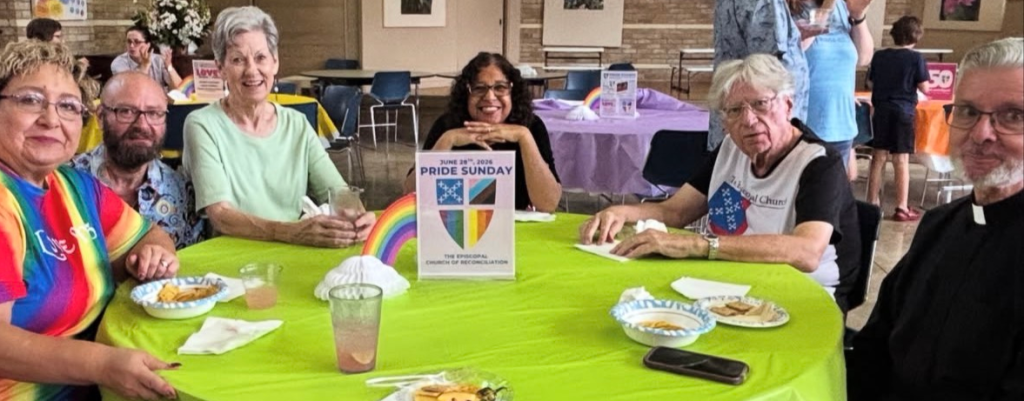
No matter what brought each of us here, we are celebrating this Pride Eucharist together. We hold, in common, our Pride in the victories and accomplishments of queer people and lift up positive visibility, increasing inclusion, and new ways of being welcoming in our communities.
We also mourn, resist, and act against continuing societal attacks against the queer community. We cry out for peace and justice among all people. We continue to strive for full and equal respect to be given to every human being, knowing that each and every one of us is made in the image of God. We still have to teach the world the truth of who we are.
Just within my lifetime, our church has accomplished major changes in welcoming attitudes toward queer persons. This year we are celebrating the 50th anniversary of the passage of significant church legislation concerning our community.
Presiding Bishop Sean Rowe is helping to mark this anniversary with a three-day event in September in Minneapolis. He, too, acknowledges that intersectional space in which we exist today— that space of celebration of all that has been accomplished, of mourning the hate still happening, and of the absolute necessity to continue to strive for something—anything—better.
50 years ago, at the 1976 meeting of the General Convention of The Episcopal Church two significant resolutions were passed that started a trend in church conversations toward Good News for queer people in our congregations. I want to share the language of the resolutions as they were written despite my own discomfort with the way our community is named in them. The word used is indicative of the time the resolutions were written, and our language of self-love and affirmation has evolved since then.
One resolution affirms, “that homosexual persons are children of God who have a full and equal claim with all other persons upon the love, acceptance, and pastoral concern and care of the Church,” and a second affirms, “That this General Convention expresses its conviction that homosexual persons are entitled to equal protection of the laws with all other citizens, and calls upon our society to see that such protection is provided in actuality.”
As we celebrate the fiftieth anniversary of the passing of those resolutions, the event that Presiding Bishop Sean Rowe, his staff, and our queer church leaders are preparing for in the fall in Minneapolis is appropriately called 50 Years in Pursuit of a Promise. We are still in pursuit of that promise the church made to us in 1976.
We may not be there yet, but we are still striving for that justice and peace and full and equal share in our church’s care and concern our General Convention voted to act toward.
As we celebrate who we are and how far we’ve come and also remember how far we still have to go, I think about the words we display on our church signs, bulletins, and bumper stickers – All Are Welcome.
In her 2006 book Radical Welcome, the Rev. Canon Stephanie Spellers writes, “We are already here: the strangers, the outcasts, the poor, the people of color, gay and lesbian and transgender people, young adults, and so many more. We resonate with our
church’s theology and traditions. We love our congregations and pray and labor for their health, growth and ministry. That does not mean we feel welcome.” (5)
She’s right. We are already here. And we always have been, but that doesn’t mean we always feel welcome to full and equal participation in our church, especially if we allow ourselves to unmask and to just simply be our whole selves.
Kentucky Latin Art-pop star Cain Culto recognized that lack of ability to be his full self in church all too well. He chose to leave church because he was already there but didn’t feel welcome.
Cain Culto is a first-generation child of Colombian and Nicaraguan immigrant parents, and he grew up as a bluegrass fiddle student and member of an indie Christian worship band.
In his own words he was “performing an inauthentic version of himself.”
In an interview about his experience coming out in church he said:
“It got really dark and painful, because my parents and loved ones and my church leaders were also joining in on all that language [of hate]. It’s one thing to get hate from random people online. They don’t know me, but it hurt when it was from people who knew me personally. It forced me to develop thick skin because of that year of my life. You have to build internal confidence. If I know I’m on my path and it feels true to me, you just learn to not put as much weight on them. We, as people, have to decide, are we living for the validation and approval of others, or are we living for our own souls?”
So often queer community holds experiences of church hurt like Cain Culto’s. And so we make our church elsewhere; our church becomes the venues of Cain Culto’s performances or Lady Gaga’s concerts, Drag Brunches or Underground Ballrooms, gay bars or friends’ houses, because we find the life of our own souls in the ritual and liberation of the sacred spaces we create on our own.
Cain Culto’s story is not that of every queer person in church, though. For their book American Teenager: How Trans Kids are Surviving Hate and Finding Joy in a Turbulent Era, journalist Nico Lang spent time with trans teenagers and their families. Nico is able to show a very different experience from Cain Culto’s through their story of Ruby Carnes who grew up and came out in an Episcopal Church in Houston, TX.
Nico writes:
In June 2021, St. Mary’s hosted a renaming liturgy for Ruby, a ceremony in the Episcopal tradition that marks the riddance of a transgender individual’s birth name in favor of the person it was their destiny to become.
As bursts of late afternoon sunbeams streamed through the skylight on that momentous Sunday, the church’s wooden pews teemed with [] faces, many of which belonged to family members and longtime friends. Just as some women have cotillions to mark their entrance into society, this rite of passage served a similar purpose: Surrounded by her dearest relations, Ruby would claim her womanhood for her own. She announced to the world not only a new name but also her true self after so many years of hiding.
The hour-long liturgical ceremony began with parishioners standing for an opening hymn and a song of praise before joining in a series of scriptural readings, including [Second] Corinthians 3:12-18, a promise that those who accept God’s love will be lifted toward the divine. “Now the Lord is the Spirit, and where the Spirit of the Lord is, there is freedom,” the passage reads in part. “And we all, with unveiled faces, beholding the glory of the Lord, are being changed into [God’s] likeness from one degree of glory to another.”
Episcopal rites are characterized by their soothing sameness, the comfort of already knowing the major plot beats. Worshippers have sung these exact numbers and read these parables aloud together dozens upon dozens of times throughout their lives, but placing Ruby’s journey at the center gave those familiar words new meaning.
Leading the church in a reflection, Ruby said that the verses from Corinthians represented being able to embrace herself fully and, by doing so, allow[ed] those around her to embrace her as well. Following a process of becoming that had sometimes proven turbulent, she proclaimed to her fellow churchgoers that the [scripture] offers a “message of peace.”
“It says that I shouldn’t worry about my body or what I wear, that I should just be who I am and be at peace with God,” Ruby said in her speech, towering above the altar as she addressed gatherers. “I think that message is something we all need to hear every day. So often we worry too much about things that don’t matter, no matter how real they may seem to us. I was so worried about what other people would think of me when I came out, but I really just can’t care about that. Jesus loves me, and he loves you, too. Frankly, that’s the most important thing to me.” (117-118)
As we continue to say “All are Welcome” and actively pursue ever more fervently the promise we made 50 years ago to queer people of full and equal claim upon the love, acceptance, and pastoral concern and care of the Church, I hope we see more stories like Ruby Carnes’s, which is rare and beautiful.
Fully and equally, I hope that when we meet people like Cain Culto in our pews and on our streets, we love them where they are, for who they are, so they, too, know Jesus’ love with that same immeasurable certainty we hear from Ruby; so that they too can proclaim without a doubt that they are welcome in our churches and, more importantly, in the world.
When God says through the prophet Isaiah (43:1-7), “I have called you by name. I will be with you. You are precious in my sight. I love you. I love you. I love you…” Let those be the only words of our mouths and hearts.
Just because we are here does not mean we feel welcome, but a little more love really can go a long way.
My mom recently told me that she wished everyone understood how important love and acceptance are to her as the parent of this queer and trans person. She was at a funeral and one of the three queer, adult children of our cousin, the deceased, stood up to speak to his mom’s small, rural, conservative church group – her daily companions in life – who didn’t know him, his brother, or either of their husbands and had not come to his trans brother’s funeral several years before. The son shared that he had told his mom, “You always made life easy for us. You gave us freedom to be who we needed to be even though that made your life hard.” He paused and looked at his mom’s neighbors. He said, “When I told Mom that last week, she looked at me and said, ‘It was never hard. All I had to do was love you.’”
All I had to do was love you.
I encourage you to leave here tonight and make plans to attend the “50 Years in Pursuit of a Promise” conference in September in Minneapolis with Presiding Bishop Rowe.
I encourage you to leave here tonight and ACT UP for your full and equal place in your church and in our society.
I encourage you to leave here tonight proud of who you are, proud of how much we’ve already accomplished, proud of your strength and resilience in the face of the oppression that still remains, and proud of the ways we’ll change hearts and minds for the next 50 years and more.
You are loved beyond measure. It was never hard. All any of us had to do was love you. Amen.

