by Pam Tinsley
 In the days that led up to our contentious mid-term elections, I read an uplifting article[1] about Episcopalians from both sides of the aisle who cited their faith as leading them into public service. Just as some people are called to teaching, to medicine, or to ordained ministry, others experience their vocation as public servants. Audrey Denney, who ran for Congress in California, believes that “. . . all people are called to serve God in whatever capacity that [they] have vocationally. Sometimes that’s taking care of a family at home . . . and sometimes that’s running for office.” A consistent thread cited by the candidates interviewed in this article is that their call to run for public office arose out of a desire to make a difference. That desire to make a difference was inspired by their faith.
These candidates also revealed that their faith has instilled within them a sense of integrity and a commitment to justice – be it economic, racial, or environmental. Denney even describes her vision for the future as seeking the kingdom of God, although she acknowledges that she doesn’t necessarily express it in such terms when she is in secular venues.
These individuals – Democrats, Republicans and Independents – are living out their faith in the midst of public service by striving for justice and peace, respecting the dignity of every human being, and loving their neighbors as themselves. Their faith has shaped their values, those same values that we see in the Baptismal Covenant (BCP p. 304-5).
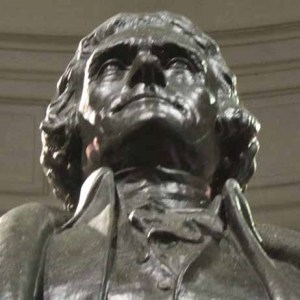 Our faith shapes our values. Not all of us are called to political office or public service. I certainly am not. Yet I am grateful to live in freedom in a republic, and I view my participation – by voting – in the political process as essential to my faith. For me, it is an expression of how Jesus commands me to seek and serve him by loving my neighbors – with God’s help. Just as I have been encouraged to pray for wisdom and integrity in exercising my right to vote and to pray for our nation and elected leaders – regardless of political affiliation – I encourage others to do so, as well. After all – in the words of Thomas Jefferson – we, the People, are the true leaders of our nation.
[1] Paulsen, David. “Candidates with Episcopal roots cite faith as inspiring, guiding campaigns for Congress.” Episcopal News Service. http://www.episcopalnewsservice.org/2018/11/02/candidates-with-episcopal-roots-cite-faith-as-inspiring-guiding-campaigns-for-congress.
 I believe that our primary purpose in creation is to build a more loving and just world. And we are well on our way. Humankind has come a long way toward living in more loving and just ways – away from tribal chiefs, child sacrifice, and treating illness with spells and toward more democratic governments, more responsible care for the planet, and more effective health care by doctors and their helpers. We still have a long way to go in coping with climate change, in getting wealth out of politics, and in ending spouse and child abuse.
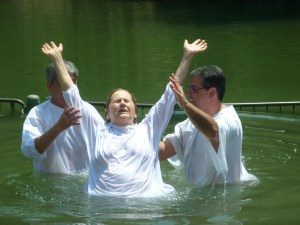 But for Bishop Ray and many others this centrality was only the beginning. The solemnity of Baptism has also to be entered into if the lives and ministries of the baptized are to be fully realized and manifest. Since most baptisms at the main service on Sundays are usually of infants or young children, it is understandable that the tone will be one of delight, joy, pride, even cuteness. That’s fine. But what about baptismal solemnity? How is that woven into the celebration and awareness of what is unfolding not only for the child but for the rest of us as well? In short, how do we understand and realize that being baptized is very serious, solemn business?
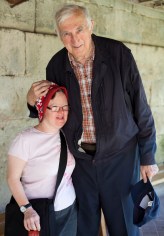


 God was making a body for Christ, Paul said. Christ didn’t have a regular body any more so God was making him one out of anybody he could find who looked as if he might just possibly do. He was using other people’s hands to be Christ’s hands and other people’s feet to be Christ’s feet, and when there was some place where Christ was needed in a hurry and needed bad, he put the finger on some maybe-not-all-that-innocent bystander and got him to go and be Christ in that place himself for lack of anybody better.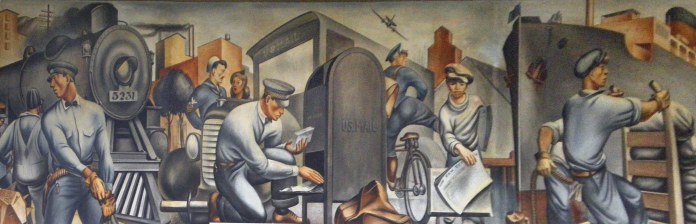
 It was a mail carrier, however, who slowly approached the altar with tears streaming down his face. He carefully laid his mailbag at the foot of the altar and turned to his priest. “No one has ever suggested that the work I do as a mail carrier might be holy,“ he said.
 by Demi Prentiss

 When Anna began her chemotherapy, she was invited to select a beautiful hand-made quilt from a nearby cupboard. The quilt would keep her warm during treatment. At each treatment, Anna was given the same quilt, which she wrapped around herself and from which she drew great comfort and peace. She told me that the quilt was almost like a “blanky.” She faithfully returned the quilt to the cupboard at the end of each treatment.
 The Rev. Dr. Sam A. Portaro, Jr. retired in December 2004 after 22 years of service as the Episcopal Chaplain at the University of Chicago. He was ordained in 1975 and served as Vicar at Church of the Epiphany in Newton, North Carolina, the Episcopal Chaplain to the College of William and Mary in Virginia, and Associate to the Rector of Bruton Parish Church in Williamsburg, Virginia. Sam graduated from UNC-Chapel Hill and Virginia Theological Seminary. He earned his D.Min. from Princeton Theological Seminary. He authored eight books, and his words continue to speak to the church.
 Living God's Mission