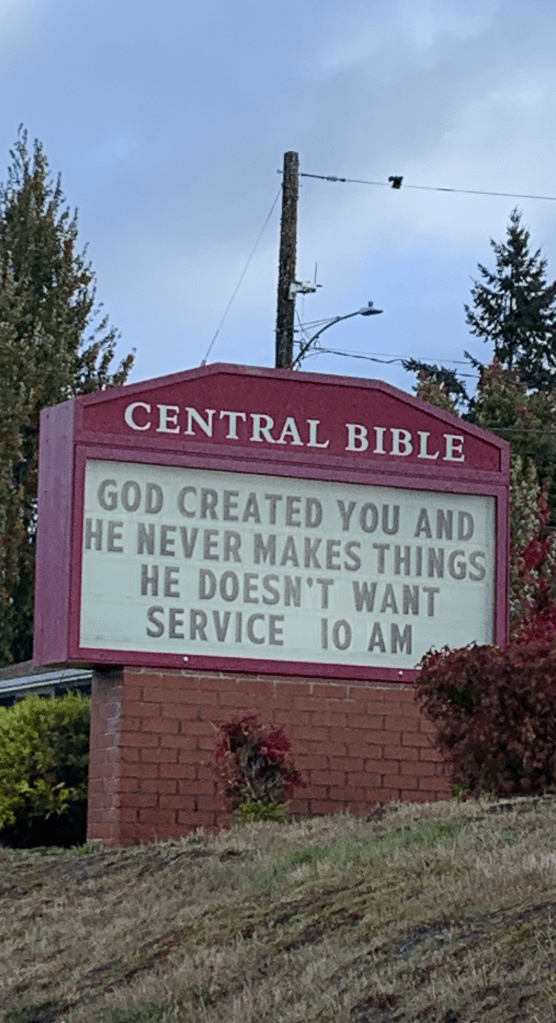
God loves you, and you, and you!

Photo by Pam Tinsely

by Pam Tinsley

“God created you and he never creates things he doesn’t want” is the message on the reader board outside a church I often drive by. What an important message for us today and every day, especially when we hear so many messages to the contrary!

God loves us, even when we try to hide our flaws. God loves us even when we pretend to be worthy. God loves us, even if we feel we’re unworthy. God loves us, especially when others tell us we are worthless. God knows us intimately – our sitting down, our rising up, and every word on our lips, as the Psalmist observes (Ps 139) – and still God loves us simply because God’s essence is love.

Today, the world stokes our fear and insists that we must choose sides. Choosing a worldly viewpoint serves only to intensify our feelings of separation from one another and from God. Again and again, Jesus and angels assure us not to be afraid. Playing on our fears sends the message – and especially to the weak, the lost, and the vulnerable – that God doesn’t love us; that God doesn’t care; that God has turned God’s back on us.

But God’s way is love, and love is God’s way of saying that none of this is true.

When we claim the truth that we are loved, we free ourselves from the shackles of fear and can open our hearts to receive God’s abundant love. We’re then called to respond to God’s love by walking in love, not fear, hate, or indifference. We’re called to put our love into action by reaching out to others, regardless of whether we believe that they are worthy. We’re called to pass on the never-ending love we receive because there is no end to God’s fountain of love.

And why should we choose love instead of fear? Because God created us and will never stop loving us. Because God created our neighbors and loves each and every one of them. And because God never creates anything that God doesn’t love.

The work beneath the work

by Demi Prentiss

There is holiness in our workpaid and volunteer, work we’re called to and work we resist, work that’s rewarding and work that drains us.  We come closer to making our life a prayer when we can discover that holiness. When we can perceive God present in the work itself.

My work colleague, Josh Anderson, composed this prayer and recently graced a staff meeting with his work.  For me, it opens a door into a new vision of holiness in the everyday.

A Prayer for the Work Beneath the Work

Before we begin,
let us remember that beneath every agenda there is a heart,
and beneath every report,
the quiet pulse of shared purpose.

We come together carrying many things—
tasks to complete, questions unresolved,
worries we haven’t yet named aloud.
The world beyond these walls feels unsteady,
and the ground beneath us sometimes shifts faster than we can find our footing.

Still, here we are.
Gathered.
Pausing before the work.
Listening for what is deeper than the noise.

Let us remember that even in seasons of change,
the Spirit does not abandon us.
It moves quietly among us,
in small mercies and steady hands,
in the grace of a kind word,
in the courage to keep showing up.
Stillness is not a waste of time—
it is the way the soul catches up to the body.
It is how we remember who we are
and why we do this work.

So may what is heavy find a place to rest.
May what is uncertain find patience.
May what feels fragmented find its wholeness again.
May what is hidden in shadow find light.

And may we—in this brief hour together—
remember that even in the work of planning and doing,
there is holiness.
That God is here,
in the silence before we begin,
in the words we will speak,
and in the quiet that follows when our work is done.
Josh Anderson

Church of the Hundred Acre Wood

by Brandon Beck

In 1924, British author AA Milne published a collection of poetry – When We Were Very Young – animal tales for his son Christopher Robin. His friend EH Shepard illustrated them. Number 38, “Teddy Bear,” was about a stuffed animal Milne had bought at Harrod’s as a gift for Christopher Robin after he and his son had visited the London Zoo and been enamored of their bear, Winnie. By 1927, Milne and Shepard had published four volumes of stories about Christopher Robin and Winnie-the-Pooh and his friends in the 100 Acre Wood. A century later, we have multiple stage plays and musicals, audio recordings and radio shows, comic strips, a Disney franchise and television series, and even a horror film based on Milne’s beloved Pooh Bear.

Psychologists and sociologists have correlated the characters of Winnie-the-Pooh to “personality types” as we are wont to do with our favorite characters in children’s stories. We believe that stories teach us about ourselves. Winnie-the-Pooh, for example, is a bear who is easy-going and tends to get along with everyone. He has been categorized as an Enneagram 9 – The Peacemaker. His pal Piglet, on the other hand, is quite anxious and cautious but is Pooh’s very best friend. He has been categorized as an Enneagram 6 – The Loyalist/Skeptic. We can go through all the characters thusly. We can even look into their Temperaments and MBTI.

Interestingly, some have even suggested that Christopher Robin might represent a mental health condition such as schizophrenia in which each of the animals is a personality within Christopher Robin himself. I disagree, however. I believe that children are infinite creatures of wonder, created in God’s image. The Winnie-the-Pooh stories provide an excellent insight into Christian Formation and Religious Education.

Remember Psalm 139:14 – “I praise you, for I am fearfully and wonderfully made.” What if each of us is like one of the Pooh characters, and Milne’s stories teach us how to be God’s family and also teach us how to be leaders in the church by seeing the gifts and strengths in those we are sent to form?

Our classrooms are full of Tiggers and Pooh and Eeyores and Roos; they are each fearfully and wonderfully made. Our job is not to make them “normal”; it is to understand and respect them – to fashion them for their vocation.

Let’s get rid of the word “normal.” Historically, we have been taught to set a “standard” and “expectation” – we have “excluded” those who didn’t “fit” – and taught to the “norm” in the one way that worked for the “normal” learner. When we teach thinking of any student, behavior, or lesson as “normal,” we set ourselves up for classroom “problems.”

“Normal” is an obfuscated word, though. From Latin normā – a carpentry term relating to “carpenter’s rule” and “square,” first used in English to mean “perpendicular.” It wasn’t until the 1800s that statisticians transferred the word to mean “most usual” in groups of measurements and soon sociologists adopted it as a construct for “most healthy.” So let’s delete “normal.”

Comedian-educator Hank Green offers this help in deleting “normal” in his video blog vlogbrothers: “What’s really important is that we trust ourselves, and we understand ourselves, and we love and respect ourselves–and we grant that same understanding and respect to the people around us.”

I don’t think Green meant to describe our Baptismal Covenant, but he does: “strive for justice and peace among all people…respect[ing] the dignity of all human beings.”

He goes on: “The world is one of infinite continuums [NOT] of two shiny boxes. When those two shiny boxes break apart into seven billion shiny boxes, it’s actually pretty beautiful.”

As religious educators committed to justice and dignity, we are called to see every learner as a shiny box full of potential – fearfully and wonderfully made – Pooh or Tigger or Eeyore or Roo – their own unique, gifted part of our 100 Acre Wood of Church.

Holy labor

Frieze at St Pancras Station, London

by Pam Tinsley

Almighty God, you have so linked our lives one with another that all we do affects, for good or ill, all other lives: So guide us in the work we do, that we may do it not for self alone, but for the common good; and, as we seek a proper return for our own labor, make us mindful of the rightful aspirations of other workers, and arouse our concern for those who are out of work; through Jesus Christ our Lord, who lives and reigns with you and the Holy Spirit, one God, for ever and ever. Amen. – Collect for Labor Day, Book of Common Prayer

As Labor Day approaches, I’ve been reflecting on the meaningfulness of work and how its function is being transformed by technology and Artificial Intelligence. Our work has meaning because it matters to God. From the beginning, humans have sensed that creation is alive with God’s presence, and our role has been to do God’s work in the world.

The Hebrew word “avodah” means “work, worship, and service.” The word used to describe worshipliturgy – means “the work of the people.” And when we place God at the heart of our daily work, the eternal is drawn into the temporal. It becomes sacramental. Labor is sacramental not only for what it produces but for how it shapes our human dignity, builds community, and reflects God’s creative purpose. Honoring workers, therefore, is also honoring the divine image in each person and the sacred character of each person’s daily toil.

Even as technology reshapes jobs and entire economies, our deeper vocation will not change. Work is not simply what we do to earn money. It is who we are as beings made in the image of God: people of faith and gratitude linking heaven and earth. Every job – from the humblest to the most prestigious – carries the same sacred title when offered to God.

Although work may take on new forms, on Labor Day we remember and commemorate the true essence of work: to worship, to give thanks, to serve, and to reflect the presence of Christ in all people and in creation. Work is holy because it is our destiny—not defined by tasks or paychecks, but by our identity as God’s holy people, made to love and to reflect God through the work of our lives.

‘The mass is never ended’

The Mass is Never Ended–Rediscovering our Mission to Transform the World, Revised 2023, By Gregory F. Augustine Pierce

by Demi Prentiss

Greg Pierce’s book The Mass is Never Ended maintains that the most important moment in the celebration of Holy Eucharist is the dismissal—the sending out of the faithful into the world to be alter Christi, “other Christs,” in service to the world in Christ’s name.

The Sunday celebrations of holy eucharist (“thanksgiving”) are not the completion of our week, a reward for our days of toiling in the vineyard. I like to think of our sharing the body and blood of Christ as fueling us for the journey ahead, propelling us back out into the chaos of daily life. Pierce concludes his book with the exhortation, “Stick close to the Mass. Do not let anyone or anything distract you from what it really is. Allow it to forgive you, to prepare you, and send you forth. Leave the church as if you have been launched like a rocket, embrace your mission to help make this a better world, and develop your own spirituality of work to sustain you.”

Our congregations are not the destination as we walk The Way of Christ.  Instead, they serve as “base camps” for our explorations of the world we encounter in our daily lives. If we need rest or healing or encouragement, the church offers resources to equip us, in order to send us out to explore further. Our calling is to the adventure of hiking the mountains, not exploring the amenities of the base camp.

Sacraments—outward and visible signs of inward and spiritual grace, as the Catechism reminds us—are more God’s gift than the church’s invention. The church over centuries has codified them as reliable signposts of God at work. “See that! Pay attention! God is up to something!”  The spiritual practices that the church encourages help train our eyes and hearts to recognize God’s presence working in the world.  Gathering as the Body of Christ, offering praise, confessing our sins, offering peace to all, and celebrating eucharist prepare us to join Christ beyond the church walls, out in the world.  With God’s help, may we seek to catch sight of and celebrate God at work practically everywhere.

Communicating God’s Love in the Workplace

by Pam Tinsley

I walked into the gym the other day and struck up a conversation with a friend I hadn’t chatted with in quite a while. Eventually, our conversation led to her work as a labor and delivery nurse and her consideration of retirement. She shared with me that, as much as she loves nursing, after 40 years the physical demands of the profession are telling her it’s time to slow down.

My friend’s voice revealed how conflicted she was about this major transition in her life. Nursing was what God put her on earth to do, she told me.  Even as a small child she and her family recognized her vocation because of the care she showed toward others.

She went on to describe nursing as her spiritual calling. She expressed it as life-giving – not only because of the new lives she helps moms deliver, but because of the people she comes in contact with, from colleagues to patients and their families. The relationships she forges with others, even for a short time in the hospital, are life-giving and life-changing.

“Ah,” I responded, “you’re living out your baptism. Nursing is your baptismal ministry.” No further explanation was needed. Instead, she told me about helping a woman in labor who spoke no English. With the aid of an interpreter, she communicated maintaining eye contact with the woman throughout the conversation – thus respecting her dignity. She then posed a last question through the interpreter: Do you have any questions for me? To which the woman responded, again through the interpreter, “I just wanted to tell you that I see God’s love in your eyes.”

My friend found the common language of God’s love to communicate with her patient. Sharing Christ’s love with another in need, even if only through her eyes, is one of the many ways she lives into her baptism through her spiritual calling as a labor and delivery nurse.

Have you had an experience in your daily life – at work, in the community, in the local supermarket – where your actions were shaped by your belief in a loving God and a commitment to your baptismal promises? How might another person’s life have been touched by that experience? How was your life changed?

Markings for the Baptismal Journey

by Edward L. Lee, Jr.

Here are several pertinent quotations for the journey of baptismal ministry in daily life.

“I believe that hope is awakened and revived, nourished by millions of solitary individuals whose deeds and works every day negate frontiers and the crudest implications of history. Each and every person, on the foundations of their own sufferings and joys, builds for all.” Albert Camus

To the question, What Does Love Mean?, come these responses by children:

“When someone loves you the way they say your name is different. You just know that your name is safe in their mouth.” Billy, age 4

“If you want to learn to love better, you should start with a friend who you hate.” Nikka, age 6

“You really shouldn’t say ‘I love you’ unless you mean it. But if you mean it you should say it a lot. People forget.” Jessica, age 8

“The role I see for Christianity is not that we’re to make all the world Christians. We are to serve the whole world, to bring it into brotherhood and sisterhood. Action on behalf of social transformation is such an essential part of being a disciple. It’s so essential that if it’s not there, we run the risk of religion declining into religiosity. What should be dynamite can become opium.” Fr. Niall O’Brien

“True liberation is freeing people from the bonds that have prevented them from giving their gifts to others.” Henri Nouwen

And finally:

“The Christian’s task is to so enjoy the Word in the world as to attest the veracity of the Word of God for all people in any and every event.” William Stringfellow

I’m Goin’ Fishing

by Fletcher Lowe

Peter-FishingIn John’s Gospel (21:1-14) there is a rather mundane, but, when we dig a little deeper, a quite profound Christian truth. After Jesus’ death and resurrection, some of the disciples are at the Sea of Galilee, and one of them, Peter, says, “I’m goin’ fishing.” As I said, it’s not very erudite, but it is profound: “I’m goin’ fishing.” He didn’t mean it in the same way that folks around a lake might suggest. They’re going fishing as a sport, as recreation, as a leisure activity. But for Peter, as you remember, it was his job, his work, his business; he was a fisherman by trade. So off he goes — to work. After a frustrating night of catching nothing, Jesus joins him and things change.

This is one of the times that Jesus appeared to his disciples after the resurrection. Remember two others? One was with those two discouraged disciples traveling on the road from Jerusalem to Emmaus. Jesus meets them along the way, and things change. The third was in a room where several of the disciples had been meeting, anxious and fearful about their future. Again, Jesus comes into their midst with the words, “Peace be with you.” And things changed.

It’s just like Jesus to be with people on their job, while they’re traveling, or when they’re meeting — in short, in the midst of the activities of their daily lives. That may seem all too obvious to you, but we don’t always make that connection between Christ and our daily lives. More often than not, there’s a gap, a gulf. So, for you, reader, what is the connection between Sunday and Monday, between your faith and your daily life?

We have those post resurrection appearances: Peter at work, two disciples traveling, several disciples meeting; examples for us of where Christ meets us in whatever occupies our daily life and work. And that is where each of us is called — to discover in our daily lives our particular calling and ministry. For that is where Sunday connects with Monday and where liturgy comes to life.

What is a successful congregation?

by Peyton G. Craighill

Thoughtful church leaders know that something is wrong with our congregations. The problem lies with the our definition of a successful congregation. The widespread assumption is that two features mark success in a congregation:

  1. A full church on Sunday morning.
  2. Offering plates with sufficient funds to support an effective church program.

According to our secular standards, this definition implies a good business plan for a congregation.

But this definition does not indicate why God established and continues to give life and power to our congregations. God sent his Son, Jesus Christ, into the world to proclaim Good News. Christ established his servant community, the church, to help him with his mission of love and justice in “all the world.” Through our baptism, we become grafted into Christ’s Body, the church. We accept his Great Commission to share in his mission with him, Monday through Sunday, in everything we do in our everyday lives.

Based on this paradigm shift,  our congregations are changed from “spiritual filling stations” on Sunday morning to “base camps” for mission, Monday through Sunday. How do we get our members to accept this new meaning of church life?

The first step is that you and I must live out our baptismal covenant – in particular, the five promises that we make at the end of the covenant – in every decision we make and every action we take in all of our daily life activities. We have to let Christ transform us from “me-centered” to “Christ-through-me-centered” lives. That change in vision is essential to influencing our congregations to accept a missional approach  instead of an attractional approach to defining success in our congregations.

Prayers for renewal

by Peyton G. Craighill

These prayers began life as collects in the Book of Common Prayer. With extensive editing, the author has re-shaped them as prayers for the renewal of the mission of the church through the movement for mission in daily life.

Almighty and everliving God, source of all wisdom and understanding, be present with us as we seek to renew the mission of your church as Christ’s mission working through us in all that we do. Teach us to seek first your wisdom and glory; Guide us to perceive what is your will, and grant us both the courage to pursue it and the grace to accomplish it; through Jesus Christ our Lord. Amen.

O God, You prepared your disciples for the coming of the Spirit through the mission of your Son Jesus Christ: Make the hearts and minds of us, your servants, ready through your Holy Spirit to receive Christ’s mission, that we may be filled with the power of the Spirit’s guidance in everything we do in our daily lives, through Jesus Christ our Lord. Amen.