by Demi Prentiss
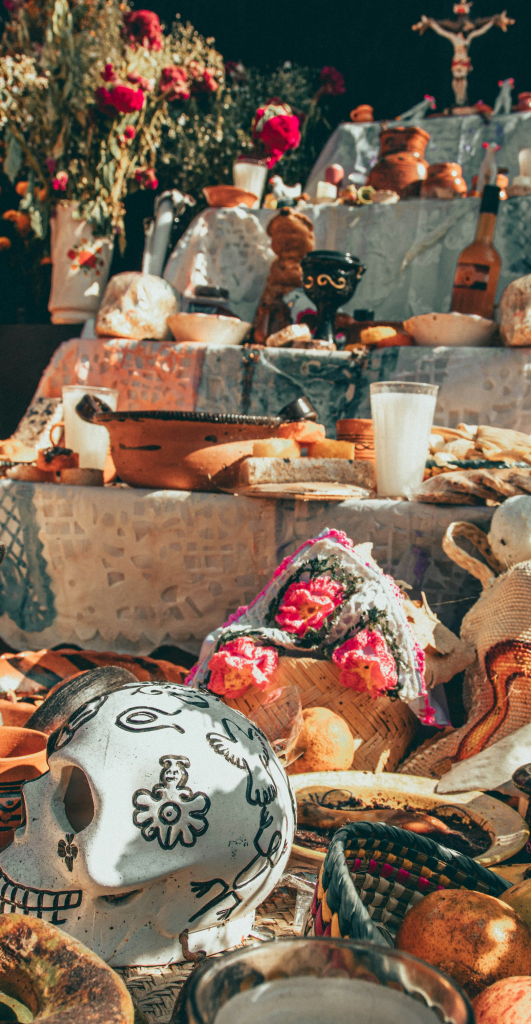
This week started off with what Diana Butler Bass’s Substack “Sunday Musings” terms “Allhallowtide – All Hallows’ Eve, All Saints’ Day, and the Day of All Souls (aka the Day of the Dead).” The three days cluster around the Celtic festival of Samhain (“SAH-win”), marking a pivot point into the darker time of year, when the boundary between this world and the Otherworld was thin. In the shortening days as we look toward Advent, Christian custom honors those ancestors in faith who have gone before us, and calls on us to remember them – not just the “saintly” parts of their life, but their every-day-ness, the fullness of who they were, and continue to be in our hearts and memories. Episcopal bishop Marc Andrus, in dialogue with Rupert Sheldrake, has suggested that on All Souls’ Day we name not only our own dead, but the creatures and peoples that have vanished from the places we live.
The New Testament, especially in the letters traditionally attributed to the apostle Paul, uses the Greek word hagios to refer to any living believer in Christ – not reserving it for the exceptionally virtuous, nor the dead who have been canonized. Traditionally in scripture, the English translation of hagios is “saint.” And for me, I find it helpful to think of this time of remembering the “saints” as honoring all souls, even if they’re not candidates for the official title of “Saint.”
In keeping with that more inclusive interpretation, Steve Garnaas-Holmes’s poem “Second string saints” offers a fresh look at sainthood:
God, we praise you for all those subtle saints
who have blessed our lives:
for the parents who endured many a midnight for us,
for the grandma who was often flustered and confused
but never stopped loving us,
for the coach who let us fail over and over
till we got it right—praise!
For the neighbor who never knew what to say
but was a deep, appreciative listener,
for the guy who never had it together
but who stumbled with such good humor—praise!
For the enemy who forgave us,
and the woman who always got our name wrong
but kept praying for us—praise!
For the odd old fellow who never fit in
and lived a rumpled, loving life—praise!
For the widow, so brokenhearted, who showed us
grief is bad weather one can live through—praise!
For all those who never managed to succeed
but who showed us how to be faithful,
who without triumph or miracles
taught us greatness of heart—praise!
For the regular people in whom your light shone
whether they knew it or not—praise!
For all the second string saints,
hobbled, broken, and flawed,
into whom you poured your grace to overflowing,
praise!
The poet, in offering praise to God for “subtle saints,” opens the door, not only for the dead but for the living – even including US, in all our ordinariness – to participate in the communion of saints. May that inclusion draw us into claiming the subtle ways that the spark of God – God’s mercy and love carried inside each of us – frees us “to be the blessing God sees us to be,” as Mara Stillson writes in the Luther Seminary blog “God Pause”. She goes on to say, “God’s love liberates the oppressed and marginalized. God’s love invites the wealthy and powerful to participate in this kingdom, here and now. God’s love offers a promise for all people which is much greater than anything the world can possibly offer.”
May we discover that spark – in us and in others – daily.

