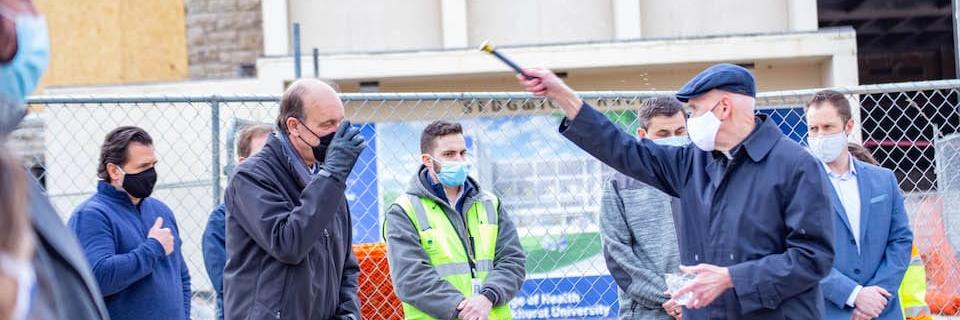
The Rev. Thomas B. Curran, S.J., president of Rockhurst University, blessing workers at a campus construction site. (Photo by Rockhurst University)
John O’Donohue was an Irishman – a poet, a philosopher, and a former Roman Catholic priest. He died in his sleep just days after his 52nd birthday in 2008.
His book Beauty: The Invisible Embrace carries the subtitle Rediscovering the True Sources of Compassion, Serenity, and Hope. He explores our intimate human relationship with beauty, calling it “a homecoming of the human spirit.”
In the midst of pandemic and war, our souls are parched for the strength, integrity, and imaginative connections that beauty calls forth. O’Donohue summons us to open ourselves to the beauty we can discover in the dailiness of our lives. As we do that, we find ourselves strengthened by the blessings of our daily work.
Blessing of your work
May the light of your soul guide you. May the light of your soul bless the work you do with the secret love and warmth of your heart. May you see in what you do the beauty of your own soul. May the sacredness of your work bring healing, light and renewal to those who work with you and to those who see and receive your work. May your work never weary you. May it release within you wellsprings of refreshment, inspiration and excitement. May you be present in what you do. May you never become lost in the bland absences. May the day never burden you. May dawn find you awake and alert, approaching your new day with dreams, possibilities, and promises. May evening find you gracious and fulfilled. May you go into the night blessed, sheltered and protected. May your soul calm, console, and renew you.
– by John O’Donohue, from To Bless the Space Between Us: A Book of Blessings
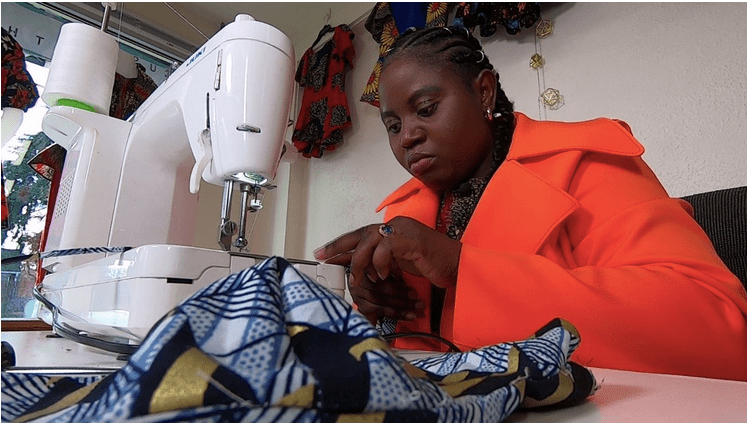
Nathalie Bajinya, owner of Undeniable Bajinya. Photo courtesy of King TV
Nathalie is a young business owner, entrepreneur, and mother of a toddler, expecting her second child. She was taught to sew by nuns in a Kenyan orphanage and now designs and makes beautiful clothes that combine African colors with French and American styles. During Nathalie’s early childhood, war raged in the Democratic Republic of Congo, and she and her siblings were forced to flee after their parents were murdered. The nuns recognized her gift and encouraged her to pursue her passion.
Faith and resilience led Nathalie to apply for refugee status in the US as a 14-year-old. She continued to sew; found community with both a local Refugee Choir and an Episcopal congregation; completed a business development program; started her own business at age 21; and then saved enough money to locate and bring her younger sister and brother to the US.
Yet, despite the trauma and hardship that she has experienced in her young life, Nathalie strives to encourage and support others in the name of Christ. She recognized that, although fellow refugees could speak English fluently, their inability to read and write limited their job prospects. So she began to hold reading and writing classes. And because of her own difficulties moving out of the foster care system at age 18, she began advocating for refugees – and others. When her shop was vandalized and a GoFundMe account was established on her behalf, she pledged to give any excess money to neighboring business owners whose shops were also vandalized.
Stitch by stitch, Nathalie sows and sews God’s love as she transforms the colorful fabric into clothing. Each choice of fabric and each stitch reflect the merciful and saving love that Nathalie has received from God and that she shares with others – through her encouragement of others, her Christlike actions, and her vibrant and unique fashion creations.
Baptism is about belonging and identity. When we know whose we are, we know who we are. We are “Christ’s own forever”! That is our truest, fundamental identity, which has the power to set us free. We already belong to God. Our struggle now is to become what we already are.
When I worked as a community newspaper editor and publisher, I often stood with parents and families sending their high school athletes and band members off to an away game or tournament. In Central Texas, along with admonitions to “be safe,” “play hard,” and “be a good sport,” always part of the send-off was the shout from at least one adult: “Remember who you are and where you’re from!” Part “do us proud” and part “don’t shame us,” those words also carried the message: “Be the amazing people we know you to be.” They were reminding teenagers that their behavior testified to their character, witnessed to their values, and proclaimed their true identity.
Teenagers aren’t the only folks who need reminding. As Br. Geoffrey offers in our lead-in, “our truest, fundamental identity … has the power to set us free.” Every time we renew our baptismal vows, or stand as witness to a baptism, we have an opportunity to remember the identity and behavior that makes us most truly who we are. Br. Geoffrey affirms, “As we promise to serve Christ in all persons, to strive for justice and peace for all people, to respect the dignity of every human being, we are proclaiming before God, before ourselves, and before all the world, ‘This is who we are!’” Each of us lays claim to our true identity: Child of God, beloved and called.
Through scripture and our faith community, as well as the day-to-day world we encounter, God reminds us again and again both who we are and whose we are. As we daily practice walking the Way of Love, our life-long task – our ministry in our daily lives – is to become what we already are.
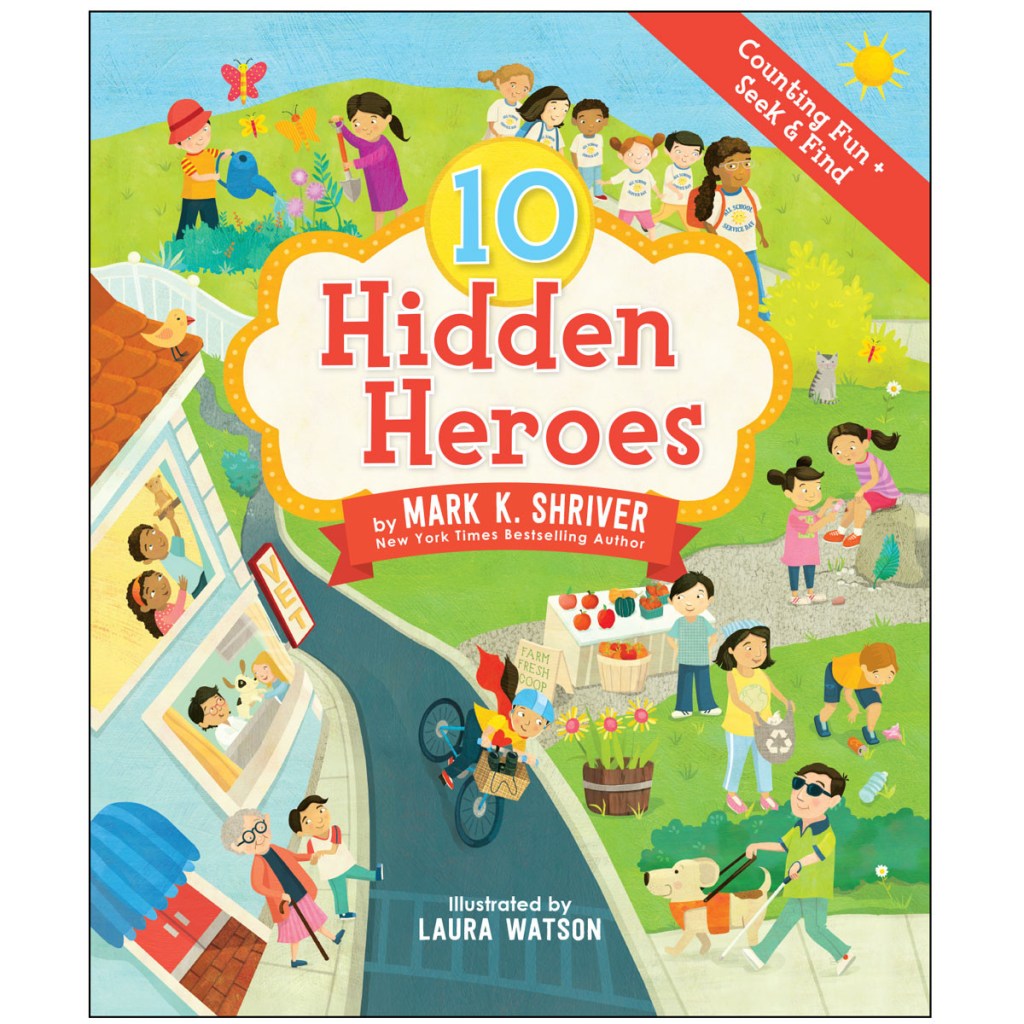
“Be Kind” were the words written on our 2½ year-old granddaughter’s shirt on the same day that a new book arrived. The cover of the book, 10 Hidden Heroes, shows children and adults helping others as they go about their everyday lives. Because I believe strongly in making our world more loving by living out our baptismal promises in daily life, I was eager to share this book with our little granddaughter.
She and I sat down together and searched through the pictures on each two-page spread. One set of pictures features hidden heroes nursing others back to health. Although one setting was in a hospital with nurses and doctors caring for patients, there was also a child tending to another child’s scraped knee and a girl caring for her injured cat. Another set of pictures highlights hidden heroes striving to protect the environment by planting trees, recycling, composting, and riding bikes. A boy stocking shelves in a food bank shows young readers how to serve those less fortunate. There are even hidden heroes who invent and do research to develop medicines and “treasures for humankind.”
Hidden Heroes author, Mark K. Shriver, is the president of Save the Children Action Network, and hopes that it can help children and their parents make the world a better place. When I read the book with our granddaughter, not only is she learning to count as she searches for the hidden heroes in the pictures, together we’re also making connections as we look to her family, friends, preschool, and community for examples of kindness and compassion. And this is a time for talking, too, about how she herself can be kinder and more compassionate.
Who are the hidden heroes in your life, and how might they inspire you – us – to make our world more loving and just?
Thomas Mousin, an Episcopal priest in the Diocese of Maine, has created daily Keeping Advent reflections for many years. Using scriptural passages he finds Advent themes and elaborates on them with apt insight and relevance. As a subscriber I have found them consistently evocative and pertinent in my baptismal journey to Christmas.
Just then a lawyer stood up to test Jesus. “Teacher,” he said, “what must I do to inherit eternal life?” He said to him, “What is written in the law? What do you read there?” He answered, “You shall love the Lord your God with all your heart, and with all your soul, and with all your strength, and with all your mind; and your neighbor as yourself.” And he said to him, “You have given the right answer; do this, and you will live.”
Luke 10:25-28
Be strong.
We can spend a lot of time thinking about the life to come. Such was the question asked by the lawyer who was testing Jesus. In one sense, Jesus answered clearly, saying these are the things you need to do. He also knew that the lawyer, having asked the question, already knew the answer.
But the truth of that answer has not to do with what ensures our eternal fate, but what it means to live each moment of each day. What does it mean to love God with all our heart, all our soul, all our strength, and all our mind? And what does it mean to love our neighbor as ourselves? These are the questions we work out in the everydayness of our lives.
When Jesus commended the lawyer on his response, he did not say, “You have given the right answer; you will do this and you will have eternal life.” Instead, he said, “You have given the right answer; you will do this and you will live.” We are meant to live, today in this moment and every moment, as we love God and our neighbor as ourselves for the life we are given today.
This week, the third week in Advent, began with Gaudete Sunday, the customary day for lighting the pink candle on the Advent wreath. Often thought of as honoring Mary the mother of Jesus, the pink candle signals a “breather” at the halfway point in Advent – an opportunity to “lighten up” the intensity of our Advent observances on our way to Christmas. A time to “let it be.” That same Sunday, Dec. 12, was the traditional day for celebrating the feast of the Virgen de Guadalupe, patron saint of the Americas. La Virgen appeared to Juan Diego as a pregnant indigenous woman and spoke to him in Nahuatl, his native language.
This past Saturday, the Center for Action and Contemplation featured a meditation and practice outlined by Brian McLaren, centering around the dimension that Mary brings to Christianity.
In Luke’s telling of the birth of Jesus, God aligns with the creative feminine power of womanhood rather than the violent masculine power of statehood. The doctrine of the virgin birth, it turns out, isn’t about bypassing sex but about subverting violence. The violent power of top-down patriarchy is subverted not by counterviolence but by the creative power of pregnancy. It is through what proud men have considered “the weaker sex” that God’s true power enters and changes the world. That, it turns out, is exactly what Mary understood the messenger to be saying: [read her Magnificat, especially Luke 1:48, 51, 52, 53]. . . .
“I desire mercy, not sacrifice” (Hosea 6:, Mt 9:13 and 12:17). Again and again, through scripture and witness, God calls us to practice generativity, not violence. In our daily lives, when our work springs from our gifts and our calling, we access God’s power as co-creators. We are empowered to change the world through love.
For years I commuted to Seattle, often by bus. I found the bus drivers to be courteous and helpful – some friendly, and others, business-like. And, like anyone who faces the public daily, they encounter gracious passengers and rude, even unruly, passengers while trying to treat them respectfully.
Linda Wilson-Allen takes her role as a bus driver to a whole new level. A 2013 article in the San Francisco Chronicle describes Linda as someone who “loves the people on the bus, knows the regulars, learns their names. She will wait for them if they are late, and then make up the time on her route. She would get out of the driver’s seat of her bus to help seniors.” One day, Linda even reached out to a passenger who was lost and afraid and then invited her to join her family for Thanksgiving dinner. Her kindness has touched people so powerfully that some passengers will let another bus pass by just so they can ride with Linda.
Linda’s story inspired the pastors of Menlo Park Presbyterian Church (MPPC). Because her job can be thankless and filled with frustrations from cranky passengers to traffic jams and breakdowns, they invited her to share with the congregation how she keeps such a positive attitude. Linda told them that her work is to minister to God’s people. She begins her day with prayer – at the crack of dawn. She asks God for guidance and how God might help her bless the people she encounters on her route. She asks God to help her shine light into dark places.
After she shared her story at MPPC, senior pastor John Ortberg reminded his congregation of the wider lesson we all can learn from Linda about ministry. He said, “My patients are my ministry. My clients are my ministry. My neighborhood is my ministry. My store is my ministry. I’m just going to go through every day and reach up to Jesus so that the power of the Holy Spirit is in me all the time, and then be a part of a little community here where I have people I can know and love and care about and serve for and who can help me grow, and then I’m going out. I will go out and bless.”
Many Episcopal congregations observe the Feast of All Saints in early November by renewing their baptismal covenant, that shared set of beliefs and practices that are recited by all baptized Episcopalians. While for many All Saints Day is a remembrance of the saints who have gone before us, that renewal of vows is a reminder that baptism marks the first step for many Christians in their journey with Jesus.
We can’t start a spiritual journey on a negative foundation. If we just seek God out of fear or guilt or shame (which is often the legacy of original sin), we won’t go very far. If we start negative, we stay negative. We have to begin positive—by a wonderful experience, by something that’s larger than life, by something that dips us into the depths of our own being. That’s what the word baptism means, “to be dipped into.”
Jesus is thirty years old when his baptism happens. According to Mark’s Gospel, he hasn’t said a single thing up to now. Until we know we’re a beloved son or beloved daughter or even just beloved, we don’t have anything to say. We’re so filled with self-doubt that we have no good news for the world. In his baptism, Jesus was dipped in the unifying mystery of life and death and love. That’s where it all begins—even for him! The unique Son of God had to hear it with his own ears and then he couldn’t be stopped. Then he has plenty to say for the next three years, because he has finally found his own soul, his own identity, and his own life’s purpose….
This is the good news of God for our hurting world: we are all beloved by God. That fundamental understanding equips us to “seek and serve Christ in all persons, loving [our] neighbor as [ourselves],” and, further, “respect the dignity of every human being.” (from the Baptismal Covenant, Book of Common Prayer, p. 305) In the midst of our brokenness and blindness, the truth of that belovedness is the good news that the world hungers for. It sets us on the path that early Jesus-followers called “the Way,” the Way of Love.
Rohr continues:
…. The only purpose of the gospel, and even religion, is to communicate that one and eternal truth. Once we have that straight, nothing can stop us and no one can take it away from us, because it is given only, always, and everywhere by God—for those who will accept it freely. My only job and any preacher’s job is to try to replicate and resound that eternal message of God that initiates everything good on this earth—You are beloved children of God
In August, Luther Seminary’s “God Pause” featured devotions written by Josh Kestner ’17 M.Div. who now serves as campus pastor for University Lutheran Church and Lutheran Campus Ministry at Clemson University, Clemson, SC. Reflecting on the hymn “Built on a Rock” (ELW 652), Kestner wrote,
“…[A]n important part of having faith is living out our faith with our bodies. We navigate the world, using our five senses. And, like Jesus, we try to use our bodies to partake in the coming kingdom of God. Verse 3 reminds us of the holiness that resides in us: “Christ builds a house of living stones: we are his own habitation.” It’s a blessing. And it’s an incredible, overwhelming responsibility. Faith is more than an intellectual thing. It’s an incarnational thing. And more often than not, we forget that. Spend some time today—whether in worship, in your community, or in your own home—asking God how you are being called to live in the world. And find confidence in the fact that your body is holy, and that you can do holy work.”
How might you become more aware of God’s presence, using your senses? Through sight? Hearing? Touch? Smell? Taste? How might you savor those sensations of God with you, within you, around you? How might those first-hand experiences of God guide and ground your daily life? What holy work might God be channeling through you?
Remember Kestner’s reminder: “Your body is holy, and … you can do holy work.”
In 2016, Fletcher Lowe emailed me out of the blue. He wanted to meet Episcopalians who were going to be at the 2016 Faith and Work Summit in Dallas, and a chain of emails had led him to me and Will Messenger at the Theology of Work Project. (Will and I are both Episcopal priests, as was Fletcher.)
Fletcher Lowe
We exchanged phone numbers and planned to meet at the opening reception. Fletcher promptly got off of the plane and, as I recall (my saved email fails me on the details), broke his foot. He had to get right back on the plane and go home to Virginia. We never met in person.
Our near-miss, however, led him to invite me and others from TOW to get on a Zoom call (in 2016!) to connect the work of the Episcopal faith and work group Fletcher headed (then called Episcopalians on Baptismal Mission and now Partners for Baptismal Living), to more evangelical faith-and-work efforts represented by the Summit. After a couple of fruitful discussions, Fletcher invited me to join the periodic conference calls held by the Steering Committee of EBM. I would say this was an afterthought, except that I don’t think Fletcher had afterthoughts. He was a master of intentionality.
I never really agreed to be a “Steer” – as he always addressed us in his convening emails – I just never really agreed not to be. Fletcher kept emailing me and I kept showing up for the conference calls and Zoom meetings. The group was always looking for more diversity on the steering committee, and while a middle-aged middle-class white lady is not that diverse, at that point I was the only Steer younger than the boomer generation, and (while I always describe myself as doctrinally orthodox but not culturally evangelical) I had connections in more evangelical parts of the church than many. Fletcher always welcomed me warmly to our discussions.
It’s hard to capture Fletcher’s enthusiasm in words. His obituary will give you a bit of an idea – I am exhausted just reading everything he started, most of which he managed to finish. He always began our calls by checking in with us and asking how we were doing and how we were working for justice and equity in our own corners of the world. (As he had worked deeply and carefully to help his parish reckon with their legacy regarding Robert E. Lee, I wish I could have heard what he would have said knowing he was being buried on the same day the Lee statue in Richmond came down.)
He had a grand vision to make Episcopalians overcome our deeply ingrained clericalism, and he would do that by any possible means. He would talk to anybody. He wrote a book (more on that in a minute). He worked informally through relationship-building; he worked bureaucratically through pushing for changes to our canons (for non-Anglicans in the house, canons are essentially the rules of how we run the church.) I didn’t even realize until I read his obituary that he was the driving force behind allowing Episcopal laypeople to assist with the distribution of bread and wine at the Eucharist and to take communion to shut-ins, two things that I take completely for granted as a priest in the 21st century. In Anglicanism, you can argue about polity and theology all day long but it really matters when you start changing the liturgy. Fletcher mattered. Fletcher thought people mattered. Fletcher thought people outside the church walls mattered.
Sometime between the foot-breaking incident and the Chicago Summit in 2018, Fletcher sent me the book he’d co-authored with another Steer, Demi Prentiss: Radical Sending. I read it, and then I was supposed to review it for this blog. I never did – I had two small children and several jobs, and life (and eventually a pandemic) got in the way. (When I opened it to write this reflection, I found my 2018 room key from the Hyatt inside of it.) I do not in the least think that Fletcher would mind that I briefly reviewed his and Demi’s book while writing a eulogy for him.
It’s a very good book. It uses one of his favorite metaphors – that of the church as “base camp” which sends out hikers/disciples to transform the world – and it looks at this theologically and practically. It deals honestly with the kinds of resistance that will emerge when you try to point out that the church doesn’t just belong to the clergy. It has lots of interviews with churches who have learned to radically send their people, and with laypeople in these churches who have learned to live out their baptismal covenant in their daily life and work. It has wonderful appendices with all sorts of plug-and-play stuff for the local congregation. You should read it.
[F]or some of us, the Dismissal at the end of worship is the most important part of the Sunday Liturgy. What are the hymns and readings and prayers and sermons all about but helping “equip the saints for the work of ministry.” (Ephesians 4:12) Preparing for the launch, getting the fuel for the journey, being supplied for the hike.
Fletcher planned his own funeral, a wonderful affirmation of his faith – of the church’s faith – in Jesus Christ who empowers the faithful in their daily work, who guides us as we walk (OK, Fletcher, hike) on our daily journey, who raises the dead and promises a new heaven and a new earth. The brief note he composed for the beginning of the bulletin is worth quoting in full:
To my family and friends. Thank you for joining in this service of thanksgiving to God for the life God has given to me. Believing as I do in the Risen Lord Jesus Christ, I know that there is life after [death] and that death comes as another event in my continuing life with Christ; that, as through Baptism, I have died and risen with Christ, so my death comes as part of that Baptismal journey. Thus this memorial service speaks rather to Easter than Good Friday, to a risen Lord, not a deceased prophet.
To my interfaith friends: I welcome you to this, my last earthly hurrah and I thank you for being present. That this service is clearly from my Christian tradition should not surprise you. We have been at our best when we have most fully lived within our own Faith tradition- and through the strength of those commitments, we have joined together in a united voice for the God of justice. As always, Peace, Shalom and Salaam, Fletcher.
Peace, Fletcher. I hope someday to see you face to face when I too have hiked to the top of the mountain.




 Living God's Mission