Last fall we were thrilled to watch our six-year-old granddaughter Sienna run cross country. (Yes, we are that kind of grandparents, the ones who beam with pride at pretty much anything she does.) When you run cross country, you encounter many obstacles: the terrain, the weather – especially in the wet Pacific Northwest, and your body itself. And running cross country was a huge milestone for Sienna because she suffers from severe asthma.
Despite her asthma, Sienna ran faithfully throughout the season. Not only did she work out with her teammates, but she also ran with her dad. And, whenever she ran, she had one goal. It wasn’t winning. It wasn’t how she placed.
Her sole goal was to do her best, to persevere and to run her race. And her favorite part of one race venue was running up the hill – at the end!
I’ve thought a lot about how healthy Sienna’s approach is. It’s also counter-cultural in today’s world which seems to value only winners, where the goal seems to be to find some way to “win” without doing the hard work that our values and our dreams demand.
We can apply this to our own spiritual lives when we seek to live our faith to our best – with love. Following Jesus isn’t easy. Following Jesus means to keep going, to persevere. It means putting one foot in front of the other, as we encounter obstacle after obstacle in the challenges and disappointments of everyday life. Just like Sienna’s obstacles to running her best in cross country are unique to her, our obstacles in living our faith to our best are also unique. And Jesus is with us always: during the easier stretches, through the unexpected obstacles, when we trip or fall, and as we persevere up the hill at the end of that long run after we’re already tired. In the end, it doesn’t matter to God whether we come in first or if we come in last. Instead, it simply pleases God when we live our faith to the best of our ability, every day.
The holy days we’ve just celebrated – All Hallows’ Eve (Hallowe’en), All Saints’ Day, and All Souls’ Day (Día de los Muertos) – form an autumnal triduum that, for me, is a hinge point in the Christian year, much like the Easter Triduum of Maundy Thursday, Good Friday, and Holy Saturday. These autumnal days are marked with rites and readings that point our imaginations toward end times and our mortality, alongside the Northern Hemisphere’s season of first frosts, fall color, leaf-raking, putting the garden to bed, and hibernation. The ancient Celtic festival of Samhain (say “SAH-win”) recognizes the season as a time when the veil between the living and the dead is thin. Many seasonal customs – pumpkin carving, bonfires, wearing masks and costumes, and even trick-or-treating – have grown out of Samhain traditions. The observance of Veterans’ Day early in November echoes the theme as we honor the lives of service members, living and dead and acknowledge their sacrifices.
The “autumnal triduum” offers us a chance to recognize that death is a part of life. Just as the trees celebrate the harvest by going dormant, the shortening days call us to reduce activity and value what stillness and silence can teach us. We can begin to grapple with the mystery that dying can free us, disencumber us, so we can resonate with the “new thing” that God is beginning to set in motion. Fields that lie fallow for a season are primed for bearing fruit when the time is right. The cycles of nature remind us that this is an eternal, God-formed pattern.
This year’s lectionary readings between All Saints and Advent 1 continue to explore the immanence of the reign of God:
“For I know that my Redeemer lives…and at the last…I shall see God.” Job 19:26-27
“But for you who revere my name the sun of righteousness shall rise, with healing in its wings.” Malachi 4:2
“Now he is God not of the dead, but of the living; for to him all of them are alive.” Luke 20:38
“Surely, it is God who saves me; I will trust in him and not be afraid. For the Lord is my stronghold and my sure defense, and he will be my Savior.” Isaiah 12:5-6
“Blessed be the Lord, the God of Israel; he has come to his people and set them free.” Luke 1:68
“God is our refuge and strength, a very present help in trouble.” Psalm 46:1
“Be still, then, and know that I am God….“ Psalm 46:11
“He himself is before all things, and in him all things hold together.” Colossians 1:14
“Jesus, remember me when you come into your kingdom.” [Jesus] replied, “Truly I tell you, today you will be with me in Paradise.” Luke 23:43
As we claim our baptismal identity as beloved and called children of God, the autumn triduum reminds us to reflect on the paradox that shapes our calling: truly, “we are but dust” AND “we are the image and likeness of God.”
This is Cyrus Cassells. He is a poet, an actor, a cultural critic, and a professor. He earned the Jackson Poetry Prize and the Lambda Literary Award; a Guggenheim Fellowship and a Pushcart Prize; the William Carlos Williams Award, a Lannan Literary Award, a nomination for a Pulitzer Prize, and was a finalist for the NAACP Image Award. He has ten books of poetry published, two books of original translations of Catalan poetry published, and a plethora of articles of cultural criticism especially in the genre of film studies. His upcoming publications include two novels, one about a fictional Harlem Renaissance poet and another an historical fiction based on the life of St. Damien and the colony for victims of Hansen’s disease he served in Hawaii.
Cyrus Cassells strives for justice and peace among all people, respecting the dignity of all human beings through his poetry. One of his earliest poems, “Soul Make a Path Through Shouting,” tells the story of Elizabeth Eckford, the young girl who bravely, symbolically integrated public schools in Arkansas in 1957. His translations of the poems of Francesc Parcerisas strive to preserve and amplify the Catalan language. Poems from his collection Beautiful Signorexplore the beauty of gay love. His experimental collection The Crossed-Out Swastika is research-based poetry telling the stories of young people facing the terror of World War II, and The World that the Shooter Left Us provides powerful commentary on violence in contemporary America.
When I pray Compline (Book of Common Prayer, p. 127) and repeat the Antiphon —
     Guide us waking, O Lord, and guard us sleeping;
     that awake we may watch with Christ, and asleep we may rest in peace.—
God brings many associations to me, especially ways that God is creating justice for me and for people like me in God’s world. Tonight, as I repeated this Antiphon, Cyrus Cassells came to mind. Cyrus Cassells’ poetry guides me waking and guards me sleeping as I watch with Christ for justice and peace in this world.
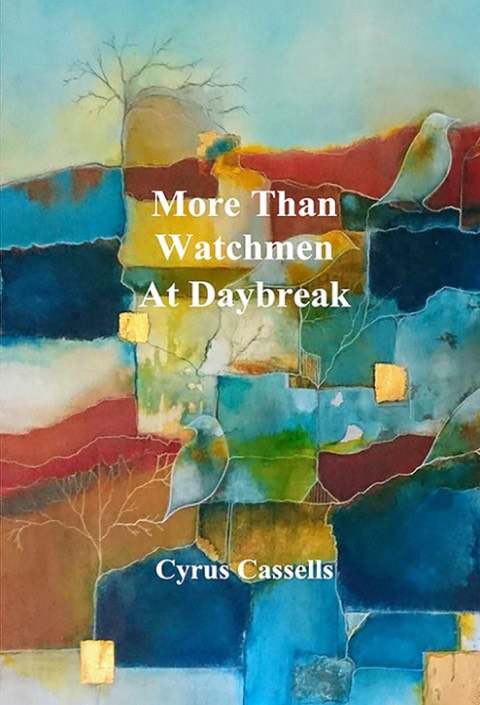
In 2019, Cyrus published a short collection of poetry he wrote while staying at Christ in the Desert Monastery for a writing residency. He took the title of his collection from Psalm 130:5-6:
I wait for the Lord; my soul waits, and in his word I hope; my soul waits for the Lord more than those who watch for the morning, more than those who watch for the morning.
     I’m thirsty, fallible,
     Incensed and restive in this desert monastery,
     But not yet resigned,
     Full of questions and parrying
     From wolf’s hour to blue hour
     To burgeoning dawn —
He is the “watchman” from Psalm 130 in today’s political and social climate. The watchman of Psalm 130 is not unlike the oracle the prophet Habakkuk saw, who, in Chapter 1, as read on Proper 26, Year C, Track 1, Sunday November 2, 2025, cries out:
     O Lord, how long shall I cry for help,
     and you will not listen?
     Or cry to you “Violence!”
     and you will not save?
That Psalm 130 watchman, that Habakkuk oracle, Cyrus in the desert today, me praying Compline now — we are all “not yet resigned.” We are all willing to strive for justice and peace among all people because, as Cyrus says in his poem,
     the soul says,
     Yes, I was there.
I was there, just as the watchman was, when she looked out of the monastery to cry to the monks, “The sun is up; it is time to pray.” I was there, just as the watchman was, when she looked out of the military fortification and shouted to those she protected, “They attack! To arms!” I was there, just as the watchman was, when he awoke from accidentally falling asleep, and cried, “Jesus! You are betrayed!” I was there, just as the watchman was, when we all knelt together and prayed:
     O God our Father, whose Son forgave his enemies while he
     was suffering shame and death: Strengthen those who suffer
     for the sake of conscience; when they are accused, save them
     from speaking in hate; when they are rejected, save them
     from bitterness; when they are imprisoned, save them from
     despair; and to us your servants, give grace to respect their
     witness and to discern the truth, that our society may be
     cleansed and strengthened. This we ask for the sake of Jesus
     Christ, our merciful and righteous Judge. Amen. (BCP, 823)

and

     Grant, O God, that your holy and life-giving Spirit may so
     move every human heart [and especially the hearts of the
     people of this land], that barriers which divide us may
     crumble, suspicions disappear, and hatreds cease; that our
     divisions being healed, we may live in justice and peace;
     through Jesus Christ our Lord. Amen. (BCP, 823)
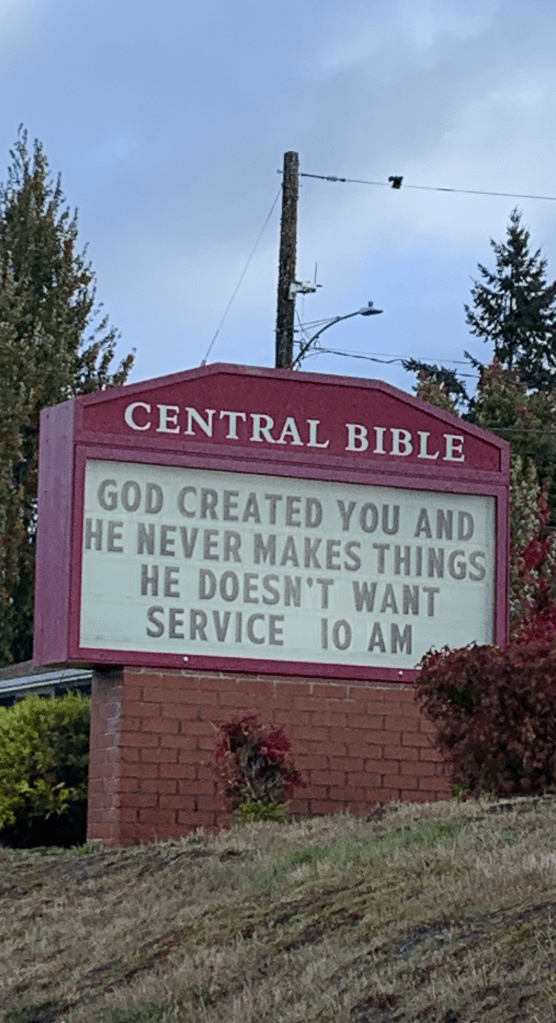
“God created you and he never creates things he doesn’t want” is the message on the reader board outside a church I often drive by. What an important message for us today and every day, especially when we hear so many messages to the contrary!
God loves us, even when we try to hide our flaws. God loves us even when we pretend to be worthy. God loves us, even if we feel we’re unworthy. God loves us, especially when others tell us we are worthless. God knows us intimately – our sitting down, our rising up, and every word on our lips, as the Psalmist observes (Ps 139) – and still God loves us simply because God’s essence is love.
Today, the world stokes our fear and insists that we must choose sides. Choosing a worldly viewpoint serves only to intensify our feelings of separation from one another and from God. Again and again, Jesus and angels assure us not to be afraid. Playing on our fears sends the message – and especially to the weak, the lost, and the vulnerable – that God doesn’t love us; that God doesn’t care; that God has turned God’s back on us.
But God’s way is love, and love is God’s way of saying that none of this is true.
When we claim the truth that we are loved, we free ourselves from the shackles of fear and can open our hearts to receive God’s abundant love. We’re then called to respond to God’s love by walking in love, not fear, hate, or indifference. We’re called to put our love into action by reaching out to others, regardless of whether we believe that they are worthy. We’re called to pass on the never-ending love we receive because there is no end to God’s fountain of love.
And why should we choose love instead of fear? Because God created us and will never stop loving us. Because God created our neighbors and loves each and every one of them. And because God never creates anything that God doesn’t love.
There is holiness in our work—paid and volunteer, work we’re called to and work we resist, work that’s rewarding and work that drains us. We come closer to making our life a prayer when we can discover that holiness. When we can perceive God present in the work itself.
My work colleague, Josh Anderson, composed this prayer and recently graced a staff meeting with his work. For me, it opens a door into a new vision of holiness in the everyday.
A Prayer for the Work Beneath the Work

Before we begin,
let us remember that beneath every agenda there is a heart,
and beneath every report,
the quiet pulse of shared purpose.

We come together carrying many things—
tasks to complete, questions unresolved,
worries we haven’t yet named aloud.
The world beyond these walls feels unsteady,
and the ground beneath us sometimes shifts faster than we can find our footing.

Still, here we are.
Gathered.
Pausing before the work.
Listening for what is deeper than the noise.

Let us remember that even in seasons of change,
the Spirit does not abandon us.
It moves quietly among us,
in small mercies and steady hands,
in the grace of a kind word,
in the courage to keep showing up.
Stillness is not a waste of time—
it is the way the soul catches up to the body.
It is how we remember who we are
and why we do this work.

So may what is heavy find a place to rest.
May what is uncertain find patience.
May what feels fragmented find its wholeness again.
May what is hidden in shadow find light.

And may we—in this brief hour together—
remember that even in the work of planning and doing,
there is holiness.
That God is here,
in the silence before we begin,
in the words we will speak,
and in the quiet that follows when our work is done.
                                 — Josh Anderson
In 1924, British author AA Milne published a collection of poetry – When We Were Very Young – animal tales for his son Christopher Robin. His friend EH Shepard illustrated them. Number 38, “Teddy Bear,” was about a stuffed animal Milne had bought at Harrod’s as a gift for Christopher Robin after he and his son had visited the London Zoo and been enamored of their bear, Winnie. By 1927, Milne and Shepard had published four volumes of stories about Christopher Robin and Winnie-the-Pooh and his friends in the 100 Acre Wood. A century later, we have multiple stage plays and musicals, audio recordings and radio shows, comic strips, a Disney franchise and television series, and even a horror film based on Milne’s beloved Pooh Bear.
Psychologists and sociologists have correlated the characters of Winnie-the-Pooh to “personality types” as we are wont to do with our favorite characters in children’s stories. We believe that stories teach us about ourselves. Winnie-the-Pooh, for example, is a bear who is easy-going and tends to get along with everyone. He has been categorized as an Enneagram 9 – The Peacemaker. His pal Piglet, on the other hand, is quite anxious and cautious but is Pooh’s very best friend. He has been categorized as an Enneagram 6 – The Loyalist/Skeptic. We can go through all the characters thusly. We can even look into their Temperaments and MBTI.
Interestingly, some have even suggested that Christopher Robin might represent a mental health condition such as schizophrenia in which each of the animals is a personality within Christopher Robin himself. I disagree, however. I believe that children are infinite creatures of wonder, created in God’s image. The Winnie-the-Pooh stories provide an excellent insight into Christian Formation and Religious Education.
Remember Psalm 139:14 – “I praise you, for I am fearfully and wonderfully made.” What if each of us is like one of the Pooh characters, and Milne’s stories teach us how to be God’s family and also teach us how to be leaders in the church by seeing the gifts and strengths in those we are sent to form?
Our classrooms are full of Tiggers and Pooh and Eeyores and Roos; they are each fearfully and wonderfully made. Our job is not to make them “normal”; it is to understand and respect them – to fashion them for their vocation.
Let’s get rid of the word “normal.” Historically, we have been taught to set a “standard” and “expectation” – we have “excluded” those who didn’t “fit” – and taught to the “norm” in the one way that worked for the “normal” learner. When we teach thinking of any student, behavior, or lesson as “normal,” we set ourselves up for classroom “problems.”
“Normal” is an obfuscated word, though. From Latin normā – a carpentry term relating to “carpenter’s rule” and “square,” first used in English to mean “perpendicular.” It wasn’t until the 1800s that statisticians transferred the word to mean “most usual” in groups of measurements and soon sociologists adopted it as a construct for “most healthy.” So let’s delete “normal.”
Comedian-educator Hank Green offers this help in deleting “normal” in his video blog vlogbrothers: “What’s really important is that we trust ourselves, and we understand ourselves, and we love and respect ourselves–and we grant that same understanding and respect to the people around us.”
I don’t think Green meant to describe our Baptismal Covenant, but he does: “strive for justice and peace among all people…respect[ing] the dignity of all human beings.”
He goes on: “The world is one of infinite continuums [NOT] of two shiny boxes. When those two shiny boxes break apart into seven billion shiny boxes, it’s actually pretty beautiful.”
As religious educators committed to justice and dignity, we are called to see every learner as a shiny box full of potential – fearfully and wonderfully made – Pooh or Tigger or Eeyore or Roo – their own unique, gifted part of our 100 Acre Wood of Church.
As this year’s Season of Creation draws to a close, I find myself reflecting on my experiences this past summer. First, a June retreat at The Sacred Waters Center for Restoration and Retreat led me to the shores of the Hood Canal, with the still-snowcapped Olympic mountains towering in the distance. I was greeted on my first morning by an eagle perched atop a pine tree, as if welcoming me to her home.
Then in July my husband and I drove through Rocky Mountain National Park to join a family reunion outside of Estes Park, CO. Words simply can’t describe the wondrous scene we witnessed above timberline: a majestic moose standing beside a lake; pikas calling to one another; a herd of elk resting in an alpine meadow; pristine streams flowing into lakes, reflecting the brilliant blue sky. We marveled at the mystery and beauty of God’s creation in the midst of our chaotic world.
The late Pope Francis wrote,
To sense each creature singing the hymn of its existence is to live joyfully in God’s love and hope. This contemplation of creation allows us to discover in each thing a teaching which God wishes to hand on to us, since for the believer, to contemplate creation is to hear a message, to listen to a paradoxical and silent voice. (Laudato Si, 85)
Yet, as we approached the summit of Trail Ridge Road, the highway that runs through the park, we were in bumper-to-bumper traffic. The paradox was stark. Nature was at its best, and humankind was at its worst. In our eagerness to experience God’s creation, we realized that we were actually contributing to its destruction. Embracing the Season of Creation means acknowledging how inextricably bound we are to creation. It’s also a call to action. We can join and support alliances that work to protect God’s creation. We can vote for public servants who share the imperative to protect and restore creation. And we can be mindful of our own actions.
The stream of alarming news over the past week has been unrelenting:
Conservative activist Charlie Kirk was shot and killed in front of a crowd gathered at Utah Valley University.
Another school shooting in Colorado placed 900 high school students in lock-down, with two students critically injured and the shooter dead by his own hand.
The Israeli military ordered a full evacuation of Gaza City, home to about one million Palestinians.
Russian drones violated Polish airspace, eliciting a response from NATO forces.
Ukraine continues to resist Russia’s unremitting attacks, now in the fourth year of this most recent invasion, as Ukrainian civilian casualties continue to mount.
The French government collapsed following a no-confidence vote, ousting the prime minister.
Four hundred US federal agents raided a Hyundai plant in Georgia, detaining 475 workers, including hundreds of South Korean nationals.
US National Guard troops remain deployed in Los Angeles and Washington DC, with planned deployments in Memphis and Louisiana. Chicago, Baltimore, New York City, and Oakland, CA may also see similar deployments.
The nation observed the 24th anniversary of 9/11/2001, when terrorists crashed four passenger planes, demolishing our country’s illusion of invincibility.
Perhaps we have access to too many bad-news stories. Allowing even 30 minutes of news from around the world is enough to quench hope and feed despair. This week, I sought out dependable hope-bearers I’ve discovered thanks to the world wide web. Perhaps you’ll glean a bit of perspective and courage from three full-length articles that have bolstered my courage and raised my spirits. Each one, excerpted here, offers a helpful focus for action:
“We often say that we will pray for the victims and their families, and pray we must. But our faith demands more from us. We must guard the hatred in our hearts and on our lips; it is hatred and righteous indignation that leads to violence. Jesus said plainly, ‘it is that which is on our lips and in our hearts that defiles us.’”
SHOW UP — From Nadia Bolz-Weber, reprising her reflection on Mary Magdalene in the wake of the 2012 mass shooting in an Aurora, CO movie theatre, killing 12:
   “My Bishop Allan Bjornberg once said that the greatest spiritual practice … is just showing up.
   “And in some ways Mary Magdalene is like, the patron saint of just showing up.
   “Because showing up means being present to what is real, what is actually happening. She didn’t necessarily know what to say or what to do or even what to think….but none of that is nearly as important as the fact that she just showed up. She showed up at the cross where her teacher Jesus became a victim of our violence and terror. She looked on as the man who had set her free from her own darkness bore the evil and violence of the whole world upon himself and yet still she showed up.”
   “George W. Bush, who was president on that horrific day, spoke in Pennsylvania at a memorial for the passengers of the fourth flight, United Airlines Flight 93, who on September 11, 2001, stormed the cockpit and brought their airplane down in a field, killing everyone on board but denying the terrorists a fourth American trophy….
   “[W]e can take guidance from the passengers on Flight 93, who demonstrated as profoundly as it is possible to do what confronting such a mentality means. While we cannot know for certain what happened on that plane on that fateful day, investigators believe that before the passengers of Flight 93 stormed the cockpit, throwing themselves between the terrorists and our government, and downed the plane, they took a vote.”
Pray. Show up. Courageously claim your identity. And for heaven’s sake, connect with a community of like-minded souls, who can walk alongside you, strengthening your resolve. Such practices help us give life to the baptismal covenant that seals our God-given identity — “child of God, beloved and called.”
As we make our way “through many dangers, toils, and snares,”[1] may we be en-couraged to walk in our rabbi’s footsteps.
Almighty God, you have so linked our lives one with another that all we do affects, for good or ill, all other lives: So guide us in the work we do, that we may do it not for self alone, but for the common good; and, as we seek a proper return for our own labor, make us mindful of the rightful aspirations of other workers, and arouse our concern for those who are out of work; through Jesus Christ our Lord, who lives and reigns with you and the Holy Spirit, one God, for ever and ever. Amen. – Collect for Labor Day, Book of Common Prayer
As Labor Day approaches, I’ve been reflecting on the meaningfulness of work and how its function is being transformed by technology and Artificial Intelligence. Our work has meaning because it matters to God. From the beginning, humans have sensed that creation is alive with God’s presence, and our role has been to do God’s work in the world.
The Hebrew word “avodah” means “work, worship, and service.” The word used to describe worship – liturgy – means “the work of the people.” And when we place God at the heart of our daily work, the eternal is drawn into the temporal. It becomes sacramental. Labor is sacramental not only for what it produces but for how it shapes our human dignity, builds community, and reflects God’s creative purpose. Honoring workers, therefore, is also honoring the divine image in each person and the sacred character of each person’s daily toil.
Even as technology reshapes jobs and entire economies, our deeper vocation will not change. Work is not simply what we do to earn money. It is who we are as beings made in the image of God: people of faith and gratitude linking heaven and earth. Every job – from the humblest to the most prestigious – carries the same sacred title when offered to God.
Although work may take on new forms, on Labor Day we remember and commemorate the true essence of work: to worship, to give thanks, to serve, and to reflect the presence of Christ in all people and in creation. Work is holy because it is our destiny—not defined by tasks or paychecks, but by our identity as God’s holy people, made to love and to reflect God through the work of our lives.
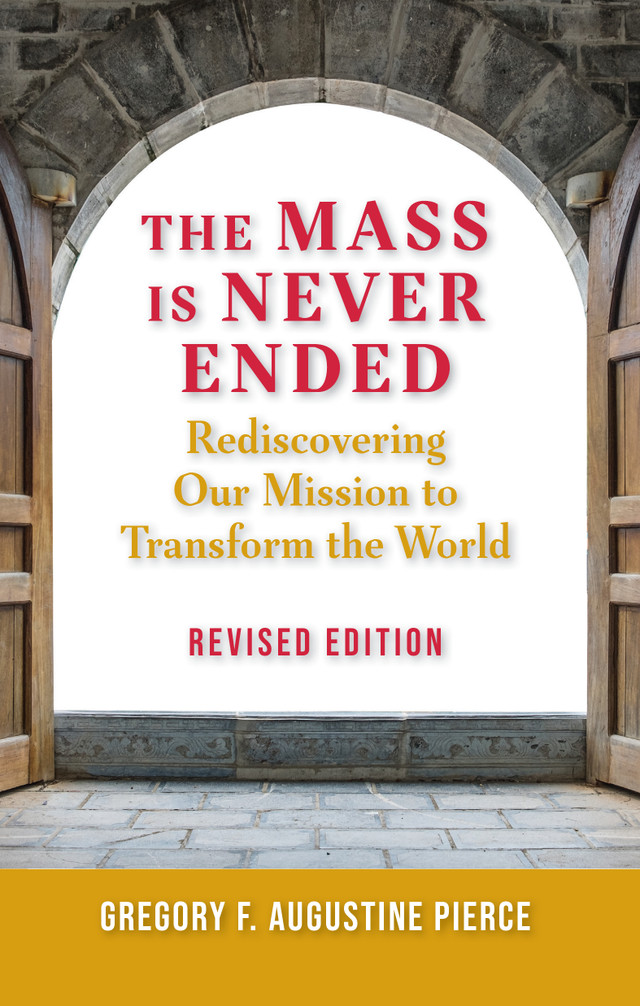
The Mass is Never Ended–Rediscovering our Mission to Transform the World, Revised 2023, By Gregory F. Augustine Pierce
by Demi Prentiss
Greg Pierce’s book The Mass is Never Ended maintains that the most important moment in the celebration of Holy Eucharist is the dismissal—the sending out of the faithful into the world to be alter Christi, “other Christs,” in service to the world in Christ’s name.
The Sunday celebrations of holy eucharist (“thanksgiving”) are not the completion of our week, a reward for our days of toiling in the vineyard. I like to think of our sharing the body and blood of Christ as fueling us for the journey ahead, propelling us back out into the chaos of daily life. Pierce concludes his book with the exhortation, “Stick close to the Mass. Do not let anyone or anything distract you from what it really is. Allow it to forgive you, to prepare you, and send you forth. Leave the church as if you have been launched like a rocket, embrace your mission to help make this a better world, and develop your own spirituality of work to sustain you.”
Our congregations are not the destination as we walk The Way of Christ. Instead, they serve as “base camps” for our explorations of the world we encounter in our daily lives. If we need rest or healing or encouragement, the church offers resources to equip us, in order to send us out to explore further. Our calling is to the adventure of hiking the mountains, not exploring the amenities of the base camp.
Sacraments—outward and visible signs of inward and spiritual grace, as the Catechism reminds us—are more God’s gift than the church’s invention. The church over centuries has codified them as reliable signposts of God at work. “See that! Pay attention! God is up to something!” The spiritual practices that the church encourages help train our eyes and hearts to recognize God’s presence working in the world. Gathering as the Body of Christ, offering praise, confessing our sins, offering peace to all, and celebrating eucharist prepare us to join Christ beyond the church walls, out in the world. With God’s help, may we seek to catch sight of and celebrate God at work practically everywhere.





 Living God's Mission