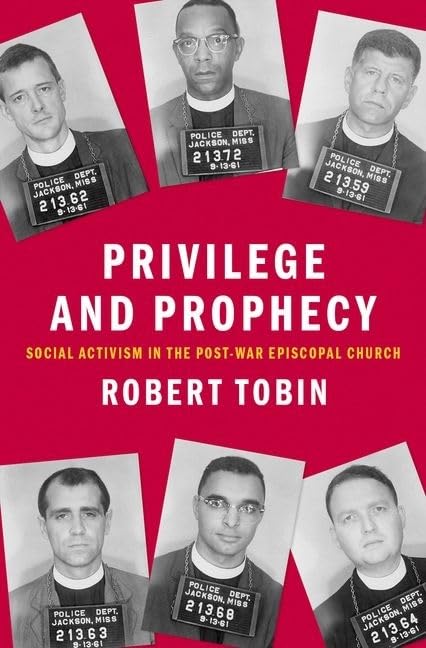
I recently learned about a book important to our Episcopal heritage. The Rev. Dr. Robert Tobin, chaplain at The Chapel of Sts. Peter and Paul at Old Royal Naval College inside the Maritime Greenwich UNESCO World Heritage Site, published Privilege and Prophecy: Social Activism in the Post-War Episcopal Church with Oxford University Press in 2022.
The Rev. Dr. Tobin draws upon extensive archival research to bring us this brilliant book in which he describes the people and situations that led The Episcopal Church into liberation theology and practice. He carefully reminds that The Episcopal Church has been and remains a catalyst for progressive change, but that doesn’t mean that The Episcopal Church has done everything right, fast enough, or well enough. He notes that the great progress in The Episcopal Church sometimes came at the neglect or oppression of black, female, LGBT, and working-class Episcopalians.
I believe that those of us who are putting ourselves daily into the world in ways that push against the status quo need inspiration in order to keep going. We must read ourselves into our continued commitment to justice and peace. We must read ourselves into our continued commitment to actively respect the dignity of every human being. Seeing ourselves in the lives of others, in the stories of people who did this work before us, can and should be a source of raison d’etre and will to keep on keeping on.
The Rev. Dr. Tobin provides the stories we need to hear. I commend his book Privilege and Prophecy to you as you seek purpose and joy in the work you do as change agents.
The Episcopal Church attracts people who know how to acknowledge their privilege and how to leverage that privilege for social justice action. The Episcopal Church learns from the past and grows in new directions for justice and peace. The people of The Episcopal Church recognize that the inherent dignity of every human being means that every person has some privilege in their own experience and offers that personally privileging experience for the good of others. The people of The Episcopal Church lift each other up and recognize Jesus in everyone, putting no one down.
My words are idealistic, I know. Of course, not every single person who calls themselves Episcopalian can be of the same mind. But we are a people of common prayer, so we have a common intention through that. I hope that as you read The Rev. Dr. Tobin’s Privilege and Prophecy that you will be inspired to continue to work for justice and peace and will find new ways within yourself to understand the dignity inherent in every other person of our shared world.
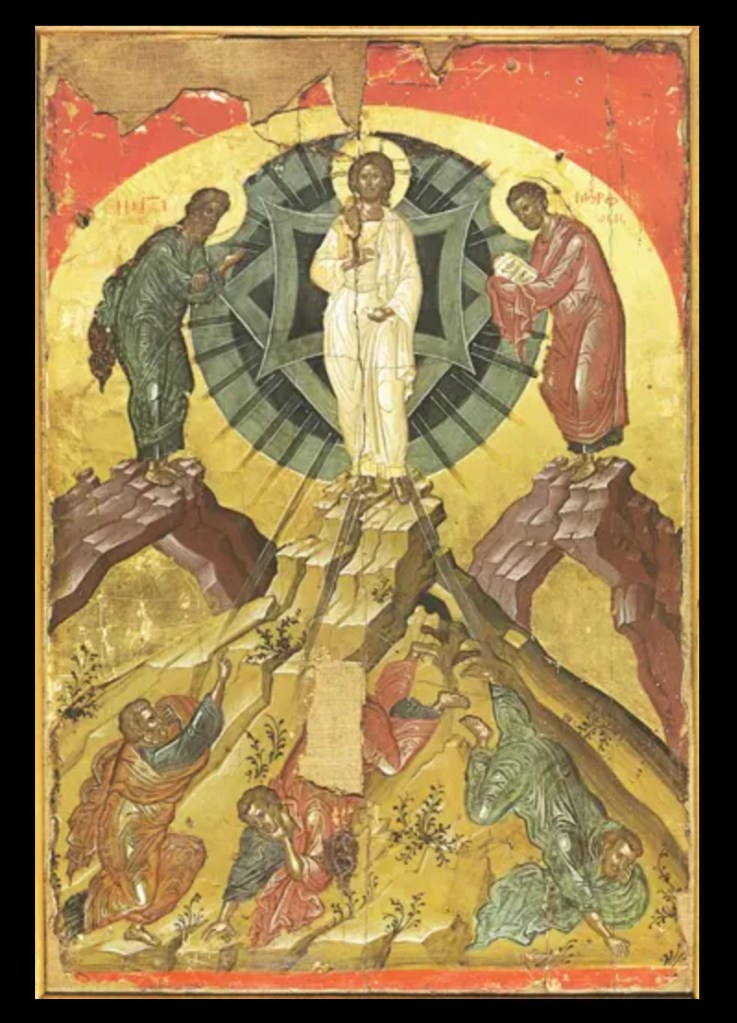
Icon of The Transfiguration written by Theophanes the Greek
by Brandon Beck
Wednesday, August 6, 2025 we celebrated the Transfiguration of Jesus. According to the Gospel of Luke, “about eight days after” Jesus foretells his death,
Jesus took with him Peter and John and James and went up on the mountain to pray. And while he was praying, the appearance of his face changed, and his clothes became as bright as a flash of lightning. Suddenly they saw two men, Moses and Elijah, talking to him. They appeared in glory and were speaking about his exodus, which he was about to fulfill in Jerusalem. Now Peter and his companions were weighed down with sleep, but as they awoke they saw his glory and the two men who stood with him. Just as they were leaving him, Peter said to Jesus, “Master, it is good for us to be here; let us set up three tents: one for you, one for Moses, and one for Elijah,” not realizing what he was saying. While he was saying this, a cloud came and overshadowed them, and they were terrified as they entered the cloud. Then from the cloud came a voice that said, “This is my Son, my Chosen; listen to him!” When the voice had spoken, Jesus was found alone. And they kept silent and in those days told no one any of the things they had seen. – Luke 9:28-36 (NRSVUE)
In the Anglican/Episcopal tradition, in addition to the August 6 Feast of the Transfiguration, the Transfiguration of Jesus comes to us during the Lectionary Cycle as well. This year, Sunday, March 2, was Transfiguration Sunday. At Church of Reconciliation in San Antonio, TX, we celebrated Recovery Sunday with Transfiguration Sunday. I had the privilege to bring the message that day. I share an excerpt from my Transfiguration/Recovery Sunday message with you on “Living God’s Mission” today:
Welcome to Recovery Sunday—Transfiguration Sunday—at the Episcopal Church of Reconciliation. My name is Brandon, and I’m speaking here today to support my own recovery journey.
I do Recovery one moment at a time, one day at a time, with the help of God, as I understand God. However you identify, whomever you love, and wherever you are on your own journey, I hope you find that you’re welcome here.
Recovery happens in AA, as well as in all other denominations of anonymous programs formed in the 12-step tradition. Recovery also happens in Celebrate Recovery, Positive Recovery, SMART Recovery, Refuge Recovery, and other recovery programs I’m still learning about. Whichever program you rely on—thank you. Thank you for your willingness to keep showing up and for showing up today.Thank you for your experience and your transfiguration.
You were one way and now you are completely different.
God has forgiven you; your face is unveiled; you have climbed the mountain and seen the glowing and transfigured face of Jesus; now everyone can see your face glowing because you were one way and now you are completely different.
Do you remember your first recovery meeting? It quite possibly was on a property much like this one…maybe even right here at Reconciliation, in fact. For those of us in recovery, our relationship with ourselves, with our loved ones, and with God felt broken; fortunately we found groups within which we learned to Reconcile with ourselves, others, and God.
If you haven’t ever been to a recovery meeting, I invite you to give one a try. Here at Church of Reconciliation at least six different recovery groups host approximately 30 recovery meetings each week; we gratefully welcome more groups and meetings all the time.
Because we all share here, through direct experience or in loving support, in the transfiguring power of recovery, we live into our name–we are Reconcilers. We all were one way and now we are completely different. For each of us, something transfiguring moved us to change. I feel that expressed in the readings we heard earlier.
Those readings for today include: a story about Moses from the book Exodus; Psalm 99; a brief statement from the 2nd letter of Paul to the Corinthians; and the story that gives today its “churchy” name―Transfiguration Sunday―an excerpt of the Gospel of Luke Chapter 9.
One of the reasons I love the Episcopal Church is its use of this Common Lectionary. In addition to connecting us with our interdenominational siblings, the lectionary helps us see how scriptures from all different parts of the Bible might connect together to tell a bigger story.
Today’s readings connect in the telling of transfigurations—stories of visible life changes. If so many stories of dramatic change are part of our spiritual heritage, then my dramatic change must be important too. I wonder if you have noticed how important your story is?
“I was one way, and now I am completely different.” I’m borrowing that quote to tie everything together today. It comes from The Chosen, a planned seven-season drama of the life of Jesus based on the text of the Gospels but with added characters, dialogue, historical context, and artistic imagination. The creator, Dallas Jenkins, does some outstanding work with The Chosen, giving us characters that defy traditional, oppressive stereotypes in order to remind everyone that they are part of the story.
And, in Episode 2 of Season 1 of The Chosen one of these characters who has been given new life speaks the line: “I was one way, and now I am completely different.” Mary Magdalene, played by Elizabeth Tabish, experiences a profound change at the end of the first episode, then, in episode 2, she explains it by saying, “I was one way, and now I am completely different.”
This is loving, life-giving, liberating, transfiguring, recovery Truth.
What changes Mary Magdalene’s character? She learns something from Jesus that I think those of us in Recovery learn during our journeys: We hurt ourselves and others because we don’t feel like we deserve love, but, it turns out, every single one of us is worthy of love, respect, and dignity.
In The Chosen, Jesus, played by Jonathan Roumie, looks at this woman when she is at rock bottom, and he sees the saint inside the sinner and calls her by name.
“Mary,” he says. When Mary hears Jesus say her name, everything changes for her. She becomes willing to turn her life and will over to God. She tells people, “I was one way, and now I am completely different. And the thing that happened in between was him.”….
(To hear the rest of the message, please visit the Reconciliation YouTube page. The March 2 message begins around minute 29; however, I recommend viewing the service in its entirety for the entire Transfiguration/Recovery experience.)