Angel Tree at MCAS Cherry Point, NC – Photo by Pfc. Nicholas P. Baird
by Brandon Beck
“To seek and serve all persons” is on my mind this time of year, as it is every year during Advent.
Advent is my favorite liturgical season – with the deep blue hues of the vestments and altar hangings, the lessons and carols of the season, the waiting and anticipation, the hot chocolate and crafts.
I value sharing in the preparation for and service of a community Friendsgiving event for families who receive diapers and parenting support at our local parish church. Turning to hanging the greens with special care for our Angel Tree participation, I am drawn more deeply into the sense of waiting and watching this season – but in an active way – in a seeking and serving way.
How can I fulfill my promise of baptismal living while waiting in anticipation, I wonder?
Perhaps, as in the Advent II lectionary reading from Isaiah, I will actively wait in the Spirit of the Lord:
“He shall not judge by what his eyes see,
or decide by what his ears hear;
but with righteousness he shall judge the poor,
and decide with equity for the meek of the earth.”
May we recognize and respond to every opportunity to meet those, like ourselves, who need a friend today and every day, for in them is Christ.
Editor’s note: PBL welcomes Brandon Beck as the newest writer to join our blog schedule. See our “Who we are” page to learn more.
For those of us who choose to be partners in baptismal living, we aim to live our lives following Jesus, walking the road he described as The Way. One frame for that style of living is to understand the life we live as abiding in sacrament. I’m not talking about The Sacrament: the Body and Blood of Christ. Instead, I mean sacrament as “outward and visible signs of inward and spiritual grace.”
When I examine my life through that lens, I notice that I often move between receiving sacrament and being sacrament. In life, I’m frequently receiving those signs of grace, those signs of God at work: a smile, a life-giving word, a gift of time, a token of encouragement, a flood of forgiveness. What I notice less often – and usually only in after-the-fact reflection – are the times God’s grace allows me to BE sacrament: being the cup of water for a thirsty soul, laying down time or money as a life-giving sacrifice, allowing God to transform my poor offering to anoint another with healing and support. Most of those occasions are less the fruit of my own work, and more of God making the most of my offerings. And I notice that often, the catalyst for moving me from receiving to being is heartfelt gratitude. That seed produces the fruit of generosity.
Our faith communities move along that same continuum between receiving and being. We who gather with our siblings in Christ often come together to receive: washing, feeding, anointing, blessing, and fellowship. Gratitude and the power of God enable us to become water, food, healing, and forgiveness – blossoming into God’s justice, peace, love, and resurrection in a hurting world. It takes faith to open our eyes to perceive God at work, in and through us, and our communities. Commissioned by our baptism to be co-creators with God, we can learn to recognize that we are receivers of God’s grace, and that we can be bearers of that grace to those around us. That work – observing God at work in the world and joining as God’s partner – is the essence of baptismal living.
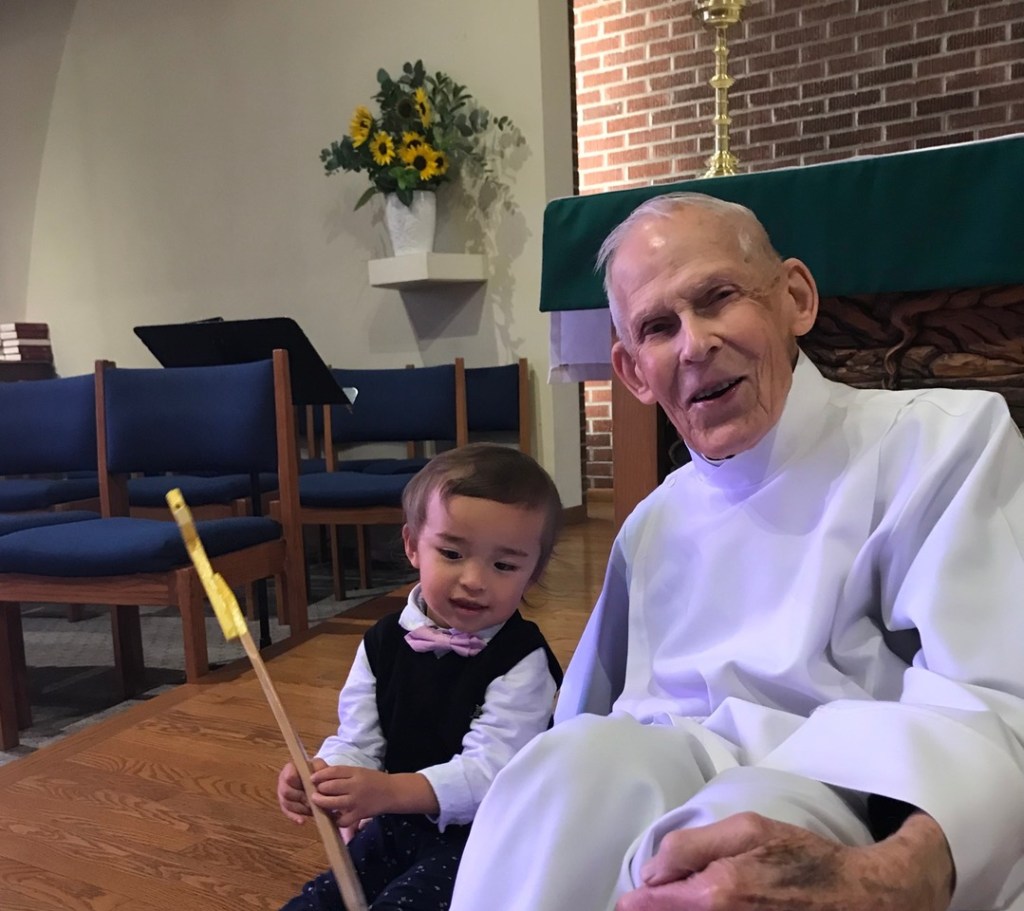
Fr. Ed Sterling and friend. Photo courtesy of St. Andrew’s Episcopal Church, Tacoma, WA
“Go in peace, remember the poor, visit the sick, love and forgive one another, and praise the Lord always, Alleluia! Alleluia!” says 101-year-old retired priest Fr. Ed Sterling energetically as he sends the congregation forth at the end of worship. We have been nourished by the Word of God and Eucharistic meal; we have praised God and prayed for the needs of our world, our community, and our church; we have been forgiven; and we may even have renewed our baptismal promises. In fact, church is just beginning!
As our dear departed friend, the Rev. Fletcher Lowe, used to say to us, our time in church with fellow parishioners is like being at a basecamp. Just as a basecamp is integral to supporting and equipping hikers who are headed to the mountaintop, the church equips us for our baptismal pilgrimage in daily life. The church walls cannot be our destination. We are sent forth every Sunday, just as Jesus sent his first-century disciples. We are sent out through our church doors to be the church by serving God in our daily lives. And we serve God in our daily lives by proclaiming the Good News of God in Christ by word and action and by being Christ’s body in the world – by living in peace, remembering the poor, visiting the sick, loving and forgiving one another, and praising the Lord always.
Odds are you’ve committed to memory – if not intentionally, then by massive culture-wide exposure – Disney’s anthem “Let It Go” from the movie Frozen. The song captures the emotional turmoil of a young queen, afraid and in hiding, as she struggles to accept her distinctive gifts and overcome her shame.
Let it go, let it go –
I’m one with the wind and sky.
Let it go, let it go –
You’ll never see me cry.
Here I stand and here I stay.
Let the storm rage on.
The song’s message of determined independence and courageous authenticity speaks to the hearts of many women and girls. The song has been claimed as an anthem by marginalized groups across the spectrum – people who identify as LGBTQ+, people with eating disorders and chemical addictions, people in prison, people with a variety of disabilities, and many others. The song’s authors say they created the lyrics to speak especially to those under constant pressure to be perfect.
In some conservative Christian circles, the song is criticized for what some perceive as a purely permissive message of “anything goes.” In this autumn season of letting go and loss, thanks to a post by Br. Geoffrey Tristram, SSJE, I’m seeing a different side of that “Let it go” message:
Let Go
When Jesus looks at you and me, and longs to fill us with his life, what does he see? Does he see someone too full already? It could be too much stuff; we may be overwhelmed by busy-ness; maybe you are filled with anger, or an inability to forgive. Imagine Jesus looking at you and saying gently, “let it go, let it go.” Let it fall away like the autumn leaves.
TheDomesticCurator.com
What might be filling us, consuming all the free space within us – the space that would enable us to be more open, more creative, more generous, more loving? More free to be genuinely who we are created to be? More free to let God set our agenda?
With God’s help, may we learn to let it go, whatever may be blocking our best, Christ-connected, co-creative selves. May we be liberated to see Christ at work, in ourselves and in others.
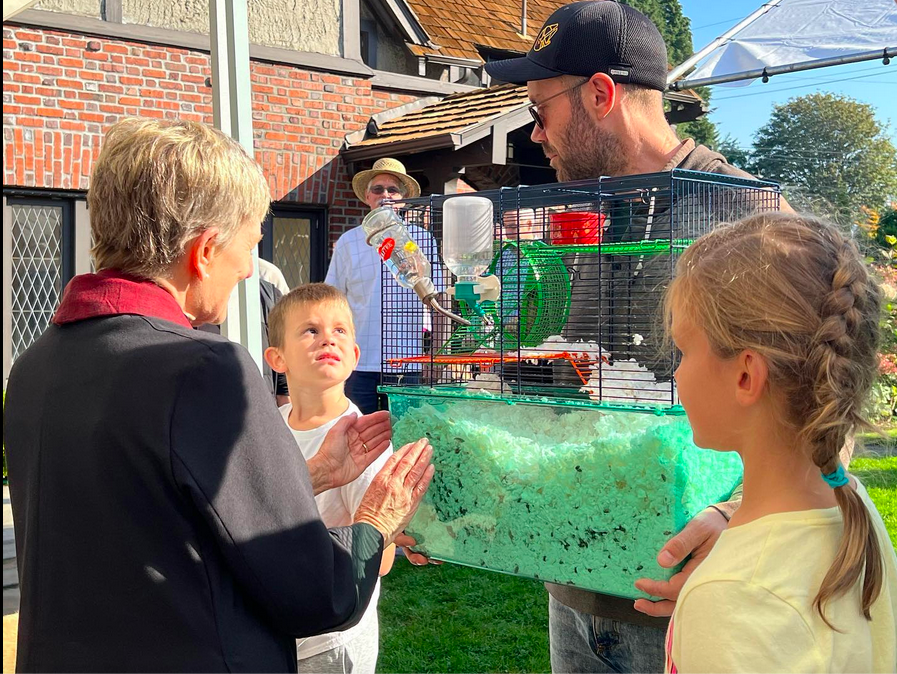
Blessing the family gerbils – Photo courtesy of Epiphany Parish, Seattle, WA
October 4 is the Feast of St. Francis of Assisi, and many churches celebrate by blessing pets. In the spirit of St. Francis, we offer God thanks for the animals that share our homes. Our pets teach us to love other creatures through their love for us.
We also offer our prayers for those whose vocations involve caring for our animals. With their gifts of gentleness, wisdom, and healing, veterinarians and veterinarian techs minister to our injured and ill pets. Certainly, too, they help our animals remain healthy. We offer thanksgiving, too, for dogwalkers and pet sitters who care for our pets, while we are at work or away.
Yet, today, the Feast of St. Francis points beyond the love we have for our pets and how that love helps us to learn to better love one another. Our love for God’s creatures also reminds us of the importance of caring for all of God’s creation on “this fragile earth, our island home” (BCP, p. 370). Unprecedented temperatures along with the proliferation of raging wildfires and violent hurricanes with their impact on human life and wildlife underscore how imperative it is for us to heal our relationship to creation.
When we promise at baptism to strive for justice and peace among all people and to respect the dignity of every human being, we must consider all the created world, as well. As baptized Christians, we are called to be faithful stewards of our planet – to strive to heal the damage that we have done to all of God’s sacred creation.
So, on this year’s Feast of St. Francis, I invite you to consider what you might do to honor, protect, and restore the beauty and integrity of God’s creation – with God’s help?
Each is an expression of the heart of God. When we choose to embody these words, we re-member God. Not simply recalling who God is and how God has touched us. We also re-present God to the people and places around us. We offer a spark of the Light within us to a broken and hurting world.
At first glance, these actions seem pretty straightforward:
Forgiveness involves opening – mind, hands, and heart.
Looking deeper, as we commit to practicing each of these God-expressions we cycle through all four:
Generosity prompts us to go beyond giving, to receiving the relationship that giving creates, being steadfast in our engagement, and opening ourselves to what comes to life through our generosity – sometimes in the most unexpected places.
When we operate out of thankfulness, our gratitude in turn becomes a gift. We’re invited to persevere in an attitude of gratitude, and we’re encouraged to open ourselves to perceive how much we can be thankful for.
Our steadfast faithfulness reminds us that we are forgiven as we forgive, that in giving we imitate God’s relentless generosity, and that our very lives represent a hymn of thanks to God the giver of all.
As we take the risk of forgiveness, being open and vulnerable, we offer a gift not only to “those who trespass against us”; we liberate ourselves, allowing thankfulness and faithfulness to shape our response to God’s love and grace.
We can enter this virtuous cycle at any point. We can bring any of these gifts – and all of them, if we choose – to any context we encounter. Our expression of these gifts ripples out from our context to touch others. And allowing this cycle to shape our lives offers us opportunities to express God’s goodness and participate in God’s Beloved Community.
Practice the presence of God, by joining the cycling adventure!
Ghassan is a minister. Ghassan’s ministry is as a travel guide. I met Ghassan in June on a pilgrimage to the Holy Land. And, although it might seem fascinating – even exciting – for one’s vocation to be a travel guide in the Holy Land, Ghassan faces innumerable challenges as he lives into his ministry and faith.
You see, Ghassan is an Israeli citizen who lives in Jerusalem. First and foremost, however, Ghassan is a Christian living – and ministering – in a country where Christians make up only 2% of the population. In Israel 74% of the population is Jewish, and almost 18% is Muslim.
Despite prejudice from colleagues and acquaintances because of his faith, Ghassan doesn’t hesitate to profess his belief in Jesus and to model the Good News. As Ghassan guides pilgrims through the Holy Land, his deep love of Christ radiates from his words and actions.
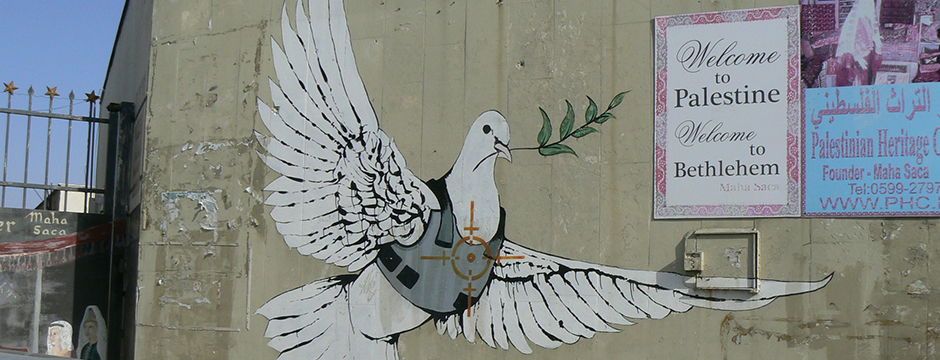
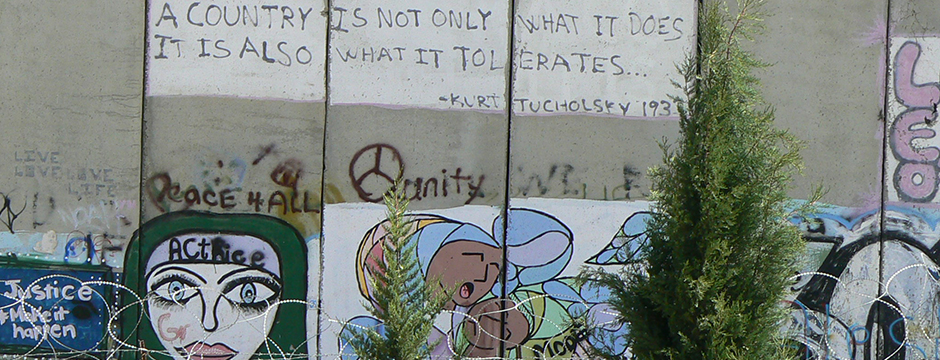
While Ghassan offered historical and political background information throughout the pilgrimage, his true passion – for seeking and serving Christ – was evident as he pointed out the oppression that his neighbor – the Palestinian – lives under. As our bus entered an Israeli settlement outside of Hebron, he pointed out the lush parks, playgrounds, pristine streets, shops, and public transit that the Jewish settlers enjoy. Moments later, he let the stark contrast speak for itself as the bus exited the settlement through the military checkpoint. Refuse was piled along the streets, and the Palestinians’ only source of water is from large plastic barrels atop the buildings, which are filled only weekly. Small boys sought to help support their families by selling trinkets to pilgrims. The sorrow in Ghassan’s voice and in his eyes communicated his respect for the dignity of every human being.
As baptized pilgrims and ministers in the world, we are invited by Jesus to be like Ghassan – to be transformed into Jesus’ hands and feet in the world. Our baptismal promises remind us that we are to open our hearts to the needs of our broken world and then to love and to serve others as Jesus would. And as we walk the path of love that Jesus walked, we show others the ways that we can transform our world into one of hope, healing, and peace.
Last month, as six new priests were ordained in the Episcopal Diocese of Olympia, the Bishop reminded the congregation and the ordinands that the foundation of all ministry is in baptism. Whereas priests have a particular ministerial role in the church, the baptized – as lay ministers in the world – are the foundation of all ministry in the church. In daily life lay people bear witness to Christ wherever they may be, whether in the home, in the workplace, in the community, in leisure, or the wider world. In their book, Radical Sending, Demi Prentiss and the late Fletcher Lowe describe being baptized as walking wet in the world.
As we were renewing our baptismal promises, I was given a bowl of water filled from the baptismal font and a cedar branch to cast the holy water on members of the congregation. We all were reminded to remember our baptism – and to remember the baptismal promises that we either make or which are made on our behalf: “Remember your baptism” with all of its solemnity.
And then I realized that the bowl of baptismal water I was carrying had spilled down the front of my alb. I was soaking wet! Soaking wet in the waters of baptism! What a profound reminder that when I was sealed by the Holy Spirit in baptism and marked as Christ’s own forever so many years ago, my baptism became the foundation of all of my ministry. It’s a reminder that I will always savor.
I am so done with “ordinary time.” When I was a child, before the “new” Book of Common Prayer (BCP) was adopted nearly 50 years ago, the long, green “learning” seasons had names: “Epiphany” and “Trinity.” Just like for Christmas and Easter, the time after the feast day was considered a season, an extended time to absorb the mystery and the learning signified by the preceding high holy day, so we might live them every day.
Increasingly, in recent years, we Episcopalians have adopted the Roman Catholic nomenclature of “ordinary time” for the period between the Feast of the Epiphany and Ash Wednesday, and between the Feast of Pentecost and the First Sunday of Advent. The collects for those Sundays are named for “the [ordinal number] Sunday after the Epiphany [or Pentecost].” And those ordinal numbers (first, second, etc.) are the source of the term “ordinary time.” In this case, “ordinary” isn’t supposed to imply “not special.”
Back in the old, pre-1978 days, we called those green seasons “the season of Epiphany” and “Whitsuntide / Trinity season.” The green seasons were an important part of both the Incarnation cycle and the Resurrection cycle: the purple season of reflection and preparation (Advent / Lent); the white season of celebration (Christmas / Easter); and the green season of growth and incorporation (Epiphany / Trinity). And for me, most important, the green seasons were all about the laity – seasons where practical theology, ministry, outreach, and formation took the lead over contemplation, self-examination, and specialized clergy-focused liturgies.
For me, calling it “ordinary time” seems to minimize those “lay” seasons. It’s easy to lose the idea that in those seasons, we look to manifest Christ’s presence (Epiphany), and recognize the Trinitarian perichoretic dance that draws all of creation into relationship with the Living God. “Ordinary time” is an “insider term” – it’s focused on what lectionary readings we’re using, rather than what we’re living into. I’m partial to the idea that every day – even in ordinary time – can bring an epiphany, if we’re willing to see God at work everywhere in the world. I’m convinced that we’re empowered every day – even in ordinary time – by God’s Pentecostal power, so that we can partner with the Holy Spirit’s work in our daily lives. Everyday faith, for people who live in relationship with an extraordinary God. No more “ordinary time.”
Here we are, caught in the liminal time between Ascension Day and Pentecost. Suspended in the “not yet,” unclear and unaware of the power in the “already.” Jesus’ departure from the disciples opens the door for the work of the Spirit, already living and active among them.
We’ve moved to our new town, and haven’t yet made new friends. We have the diploma, and have not yet landed the job. We know we’re pregnant, and have not yet become a parent. We have the diagnosis, and have not yet heard a plan of treatment. We have the facts, and we don’t yet know what to do with them. As Rachel Hosmer and Alan Jones remind us in Living in the Spirit, “God, the Holy Spirit, is always beyond us, on the move, creating and sustaining all things. The Holy Spirit is the Go-Between-God, a God who works anonymously and on the inside, as the beyond in our midst.”
The Rev. Anthony Wayne Schwab
In many ways, my friend Wayne Schwab lived his ministry standing on the threshold of “already” and “not yet.” Passionate about evangelism and passionate about the power from on high bestowed in baptism, Wayne worked to liberate the people of God to accept the “already” – the gift of “God with us.” And at the same time, he labored to persuade God’s people to live intentionally into the “not yet” – the fullness of God’s reign, being born in the world about us.
“The members are the missionaries,” he declared, inviting all to embark on the mission of living God’s Good News in every aspect of daily life. He sometimes seemed bewildered that good Episcopalians often seemed unable to grasp the idea, that we are all participating in God’s plan – and there is no Plan B. No matter where we find ourselves, we are salt and light and leaven – even if we’re unaware of our power.
My friend Wayne died May 19, having served nearly 67 years as an Episcopal priest. His passion for peace and justice, especially as realized through the ministry of all the baptized, was the unifying cord that wove through his entire life. Just this year his beloved Virginia Theological Seminary published his latest book How to Live Your Faith – Missional Members Work for a More Loving and More Just World With God’s Help.His many accomplishments are hinted at in his online obituary. His family will celebrate his life and remember his legacy on Aug. 13, 2022 in Hinesburg, VT. Partners for Baptismal Living (PBL) – the source of this ongoing blog – is one of Wayne’s contributions to the church. As we stand in this liminal, uncertain time – in the church and in the wider world – may we live into the role Wayne urged us all to play – bearers of God’s Good News, committed to increase love and justice in the world.







 Living God's Mission