Loving yourself

by Brandon Beck

There is within us something so powerful and so denied that lest we evade it, avoid it, we are brought again and again to its face.  Be here, stand with it, risk being devoured by it.  For only in dying are we born into eternal life.  – Dr. Catherine Crews, clinical psychologist, Episcopalian, and monk living in Russellville, AR

My six-year-old step-son made this at school. He gave himself the “prad to be aliv” award (proud to be alive) after choosing to take the MMR vaccine at the beginning of the recent measles outbreak here in Texas. He demonstrated an amazing act of radical self love and love of others.

When we live into the promises of our baptism, when we carry out in word and deed the beliefs we affirm in our baptismal covenant, when we say “we will” in support of the growth and formation of each newly baptized person, we are also promising to practice The Great Commandment.

Sometimes I forget how difficult it is to be “Great Commandment” people. I can be a Jesus Follower in my heart and mind and teach those ideals to others only to wake up to the realization that I have not been living a “Great Commandment” life. And it’s less likely to be in the love of God or love of neighbor part where I’ve fallen short. I am a person who struggles to love myself.

I wonder about you. Do you also wake up to the realization that you have forgotten to love yourself as God loves you?

Dr. Crews teaches this very basic Jesus concept of love for self in a postmodern, psychology way – “There is within us something so powerful and so denied that lest we evade it, avoid it, we are brought again and again to its face.” Jesus summarized God’s command to Moses: “Love God, Love your neighbor, and while you’re at it Love yourself” (Bishop Michael Curry’s translation). That thing within us that we tend to deny is our own self-doubt and even self-hatred.

If we are in the world “respect[ing] the dignity of all people” but not loving ourselves, then we are not being “Great Commandment” people. We are not living our baptismal promises.

Dr. Crews calls us to “Be here, stand with it, risk being devoured by it.” “It” is that very self-doubt and self-hatred that we face in our ministry work, in times when we most love God and neighbor but lose sight of the value of our work because we struggle to see the fruit. But Dr. Crews reminds us, “only in dying are we born into eternal life.” And it is in those very promises we’ve made to God, others, and ourselves to love more, respect more, listen more, that we have to honor the dignity of ourselves just as we do the dignity of God and others.

Seasons of surrender in service

by Pam Tinsley

I love the fall colors. There’s something mystical in the way that the leaves on deciduous trees slowly fade from deep green to brilliant shades of yellow, orange, and red. Sometimes I’m not sure what’s more spectacular to behold: a swathe of bright yellow aspens against the backdrop of pine trees or a canopy of brilliant orange maple leaves embracing the dark wet bark of their trunk. Trees in autumn are my favorite – that is, until spring when they clothe themselves anew with soft, little leaves of velvet!

When I ponder the beauty of the trees in the fall, I’m reminded that soon they will surrender their leaves. Their bare branches will reach toward the heavens, as their seemingly spent leaves cover the earth. Although their glory seems diminished, their work is now done. They slowly decompose and enrich the soil – from which new life will eventually blossom.

I think we can learn something about surrender from trees. If you’re like me, you might find it hard at times to let go of plans – our “gods” – and to let God’s Spirit lead. To let go and allow God to mold you into the person God has created you to be.

God’s Spirit also leads us differently in different seasons of our lives – just like the leaves on the trees. Each season has purpose and blessings. As followers of Christ, we might embrace seasons where our prayer life leads us to active ministry in the world, working with God to create a world where all of God’s children are loved and cared for. Likewise, as one season flows into the next, we may look backward and lament what seems to have been lost. When we lament, we risk not being open to and even missing the richness each new season offers. We may even find ourselves in a seemingly fallow season where “all we can do is pray.” Yet, as the trees teach us, even a fallow season can be lived in service to others, whenever we nurture our actions and nourish new life.

We are all missionaries

by Demi Prentiss

Missionary

We are all missionaries. By our own cultural heritage, by our own geographic setting, by our training, education, life experience, and unique access to certain people, we are to bear the beams of God’s light, and life, and love, knowing that God is with us and that God will provide.        – Br. Curtis Almquist, SSJE

U.S. National Park Service photo

Summer is such a great time for travel, or for a stay-cation – for getting outside our daily routines and perhaps exploring a few new things, just a bit outside our comfort zone.  Seeing, doing, learning, observing something new. It’s a great reminder that the things that strike us as “new” might be one of the “new things” that God is placing before us – perhaps to entice us to join in one of God’s “new things.”

It’s easy to forget that the things that strike us as “new” may be everyday stuff for lots of people. And vice versa: our habits may be startling “new things” to those who might not know us, our daily grind, or our “home” culture. No matter where we go or who we encounter, God is with us, as Brother Curtis reminds us. Whether or not we choose to be aware of God being with us, the people we encounter will be able to see “the beams of God’s light,” if we’re brave enough – and authentic enough – to let them shine through.

Recognizing our role as light-bearers can humble us. And embolden us, perhaps, to dare to live our fullest version of the life God is calling us to live.

Eugene Peterson’s The Message gives this interpretation to Matthew 5:16:

14-16 “Here’s another way to put it: You’re here to be light, bringing out the God-colors in the world. God is not a secret to be kept. We’re going public with this, as public as a city on a hill. If I make you light-bearers, you don’t think I’m going to hide you under a bucket, do you? I’m putting you on a light stand. Now that I’ve put you there on a hilltop, on a light stand – shine! Keep open house; be generous with your lives. By opening up to others, you’ll prompt people to open up with God, this generous Father in heaven.

“The longer I live the more deeply I learn the love – whether we call it friendship, family, or romance – is the work of mirroring and magnifying each other’s light.” – James Baldwin, Nothing Personal

‘Walk worthy of your vocation’

by Demi Prentiss

http://dtlifecoach.com/vocation/

The writer of Ephesians urges us to “walk worthy of the vocation to which you’ve been called.” (Eph 4:1) In the midst of daily life, that can be a challenge, especially in our daily work. In a recent blog, Bob Robinson offered six markers that distinguish a “job” from a “vocation.” He thinks the distinction is important.

Robinson founded the non-profit Reintegrate to equip “God’s people to reintegrate the Christian faith with vocation so that they can participate in God’s mission on earth.” He understands “vocation” to be “something bigger, something more meaningful, something that makes us want to get up in the morning.”

Robinson names six distinguishing factors of having a vocation:

      1. We are responding to a “calling” from a power greater than ourselves.
      2. We are tapping into our uniqueness, regardless of whether we’re paid for the work.
      3. We can engage some aspect of that “calling,” wherever we find ourselves.
      4. We are participating in a mission whose scope is larger than ourselves.
      5. We are aiming to manifest God’s love in life-giving ways, both large and small.
      6. We understand our mission to be increasing others’ experience of love at work in the world.

Participating in God’s mission of reconciliation can take many forms, expressing the nature of God whose name is love. Our vocations, sometimes manifested in our occupations, also show up in our home life, our hobbies, our service to others, and our relationship to the wider world:

      • While our job might be framing houses, our vocation might be creating homes.
      • While our job might be caring for children, our vocation might be shaping young people to be kind.
      • While our job might be driving a truck, our vocation might be safely delivering what people need.
      • While our job might be mopping the floor, our vocation might be providing clean, safe spaces for people.
      • While our job might be writing contracts, our vocation might be assuring fairness for all parties.
      • While our job might be serving restaurant meals, our vocation might be feeding the hungry, in body and in spirit.

Each of us, in our daily life and work, can touch the lives of those around us in ways that are liberating and life-giving, whenever we claim our vocation. In some ways, those of us in “ordinary” occupations are positioned to have even greater impact than those who are working as pastors and faith leaders, and not only because there are more of us. Often, seeing God at work through “ordinary” people speaks more clearly to those who are hungry for connection.

Find your vocation: change the world, starting from the inside out.

Be particular: Consider your own call

www,freepik.com

by Demi Prentiss

The call that God places on each person’s life sometimes shows up as their ministry. But more often, when we look more closely, our call is bigger than our ministry.  Our call could be described as the melody of God’s song in our life. Our ministry could be understood as the lyrics – changing, most likely, as the time and season change. Often, the chorus will come back again and again, with verses speaking to specifics along the way.

When we listen well, we can hear God’s song wherever we find ourselves – at home, at work, in the community, engaging with the wider world, in our leisure time, in church, and in the quiet place deep in our souls. When we attune ourselves – every fiber of our being – to God’s song, we participate in God’s reigning among us, here and now.

Jonathan Maury, a brother in the Society of St. John the Evangelist, speaks to the many expressions of God’s call that show up among us. He points to Paul’s reminder to the new Christians in Corinth:

“Consider your own call,” the Apostle Paul writes to the fledgling disciples of the Church in Corinth. Now of course Paul knows that every disciple’s call comes from Christ alone, that they are each and all chosen to serve and to be glorified in the one Lord. Yet Paul says, “Consider your own call.” From his own transformative encounter with the risen Christ, Paul also knows that each disciple’s vocation is unique. For just as each person is an image and likeness of the one God unlike any other, so too the circumstances, gifts, and mission of each disciple called into Christ’s mystical Body have a personally peculiar manifestation in each one. Paul says, “Consider your own call,” reminding us that each woman or man’s call will be transformed by God into a strikingly particular life of love and self-offering in Christ.

Each of us, in our daily lives that shape our unique story, has an opportunity to answer God’s tuneful call on our lives, in our own “personally peculiar” way, in practically every decision we make. Be particular!

It’s never too early for God’s love

By Pam Tinsley

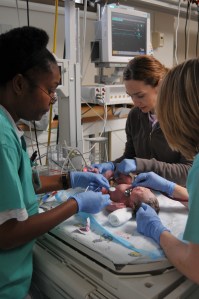
Medical staff members attend a newborn in the Neonatal Intensive Care Unit at Landstuhl Regional Medical Center. Photo by Phillip A. Jones

A reflection on Sacredspace.ie recently reminded me that God is present in all that I do, in the people I meet, and in the midst of each situation I’m in. Over the past several weeks, this has been particularly driven home for me.

Our family received the gift of God’s ongoing love during an extended hospitalization – though at the other end of the age spectrum from what fellow Living God’s Mission blogger Fletcher Lowe described several weeks ago. Serious pregnancy complications resulted in our daughter-in-law’s month-long hospitalization. In the midst of a record-breaking snowstorm and freeze, our granddaughter, Sienna, made her appearance – nine weeks early!

Parenting a newborn isn’t easy, and parenting a preemie calls for the support of community, not the least of which are the Neonatal Intensive Care Unit (NICU) healthcare providers. I marveled at their love and commitment as they braved severe weather conditions to care for Sienna and the other preemies. I also marvel at their choice of vocation to tenderly care for these tiny, delicate infants with equally tiny PICC lines, feeding tubes, and blood pressure cuffs. The devotion of Sienna’s nurses has transformed her room into a physically and spiritually nurturing sacred space. And several have shared that they pray for their little charges, as well as how their faith shapes their vocation, in other words, their baptismal ministry.

Strengthened by prayer in the midst of so many joys and fears, hopes and tears, we watch our son and daughter-in-law being transformed by God’s love and grace into loving parents. And they bear witness to Christ’s love in all that they do and say. Sienna and her parents are part of yet another family – the NICU family – and when she eventually graduates from the NICU, she and her parents will not only continue to have the support of those who’ve journeyed with them, but they will also support other preemie families – and share how Jesus was present in all that they experienced as they walked through this storm of uncertainty and danger to mother and daughter.

Baptism is serious business

by Edward L. Lee, Jr.

The late bishop of the Diocese of Northern Michigan, Tom Ray, rejoiced with many others when Holy Baptism was restored to its rightful liturgical centrality in the current Book of Common Prayer. It was no longer to be a private “after hours” event on Sunday (and often a social occasion too), but rather the very sacramental heartbeat of what it means for a person to be “sealed by the Holy Spirit in Baptism and marked as Christ’s own forever” (BCP, p. 308), and to live in Christian community.

But for Bishop Ray and many others this centrality was only the beginning. The solemnity of Baptism has also to be entered into if the lives and ministries of the baptized are to be fully realized and manifest. Since most baptisms at the main service on Sundays are usually of infants or young children, it is understandable that the tone will be one of delight, joy, pride, even cuteness. That’s fine. But what about baptismal solemnity? How is that woven into the celebration and awareness of what is unfolding not only for the child but for the rest of us as well? In short, how do we understand and realize that being baptized is very serious, solemn business?
Perhaps the words and wisdom of others can provide us with what is the tone and substance of this solemnity.  Here’s a sampling:

“Our life is not our own property but a possession of God. And it is this divine ownership that makes life a sacred thing.” – Rabbi Abraham Joshua Heschel


“I saw that God is everything that is good and energizing. God is our clothing that wraps, clasps, and encloses us so as to never leave us.” – Julian of Norwich


“The trouble with some of us is that we have been inoculated with small doses of Christianity which keep us from catching the real thing.” – Leslie Dixon Weatherhead


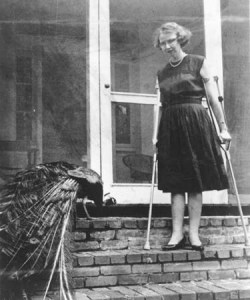
Flannery O’Connor

“What people don’t realize is how much religion costs. They think faith is a big electric blanket, when of course, it is the cross.” – Flannery O’Connor


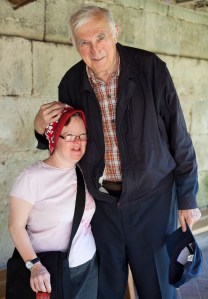
Jean Vanier with Kathy

“We are not called by God to do extraordinary things, but to do ordinary things with extraordinary love.” – Jean Vanier


“To say that God is love is now too soft a phrase because of the sentimentality that has gathered around the word in the usage of the West, which enables many modern Christians to overlook the fact that the essence of the Kingdom of God according to Jesus is righteousness.” – Harry F. Ward


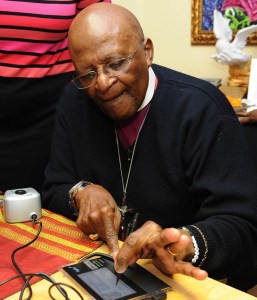
Desmond Tutu

“I cannot help it. When I see injustice, I cannot keep quiet. … The most awful thing that they can do is to kill me, and death is not the worst thing that could happen to a Christian.” – Archbishop Desmond M. Tutu

Ministry in daily life, baptismal living and dying, is both joyful yet solemn, the vocation that comes when we are “marked as Christ’s own forever.”

Healing gifts

by Fletcher Lowe

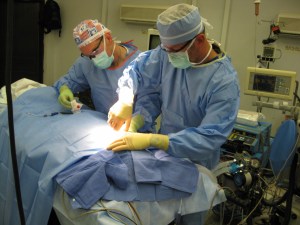
Air Force physicians in Afghanistan, 2009.

I am blessed to be treated by a primary physician who is not only a gifted and talented doctor, but a dedicated Christian.  Recently when I had some minor surgery, he said that the surgeon was also a man of faith and most probably would be praying before my and his other patients’ operations. I felt that I was in good Godly hands!

In the hospital unit where I was treated, both before and after surgery, I found the nurses and those who worked with them dedicated to what they were doing.  That experience reminded me of a passage from the Apocrypha, Ecclesiasticus (38: 1 ff) at a time when the medical profession was in its infancy:

Honor physicians for their services, for the Lord created them; 

for their gift of healing comes from the Most High…

And he gave skill to human beings that he might be glorified in his marvelous works. 

By them the physician heals and takes away pain;   God’s works will never be finished; and from him health spreads over all the earth….  Then give the physician his place, for the Lord created him; do not let him leave you, for you need him.  There may come a time when recovery lies in the hands of physicians, for they too pray to the Lord that he grant them success in diagnosis and in healing, for the sake of preserving life. 

Aware or not, those in the medical profession do bring God’s gifts of healing and provide a ministry to those of us who benefit from it. Thanks be to God!

Do you have a calling?

by Demi Prentiss

Most of us think of “a calling” as something for church people who are bound for ordination.  Those of us just trying to make our way in the world are more likely focusing on making a living and insurance coverage and work-life balance. “Calling” is not a concern for us, is it?

Mark Roberts’ recent blog begs to differ, looking at the letter Paul wrote to the Ephesians (Eph 4:1):

….This verse says quite plainly: “Live a life worthy of the calling you have received.” The context makes it abundantly clear that this exhortation was not only for pastors, missionaries, and other special workers. It was for all of those who would read or hear the letter we call Ephesians. It was written for ordinary Christian folk, people who, according to the Apostle Paul, had received a calling. (Ephesians 4:1 isn’t the only verse in the Bible that makes it clear all of God’s people are called. For a discussion of other verses that make this point, see this article on the De Pree Center blog “Do I Have a Calling? Or Is This Just for Special People?”)

Talking about that same Ephesians passage, which goes on to compare the Christian community to the human body, Frederick Buechner wrote in Wishful Thinking:

God was making a body for Christ, Paul said. Christ didn’t have a regular body any more so God was making him one out of anybody he could find who looked as if he might just possibly do. He was using other people’s hands to be Christ’s hands and other people’s feet to be Christ’s feet, and when there was some place where Christ was needed in a hurry and needed bad, he put the finger on some maybe-not-all-that-innocent bystander and got him to go and be Christ in that place himself for lack of anybody better.

“Anybody he could find who looked as if he might just possibly do….”   “…some not-all-that-innocent bystander….”  That sounds like it might be me!  What a thought, that God might tap me on the shoulder and get me “to go and be Christ in that place …for lack of anybody better.”

Calling – what some call “vocation” – is not restricted to church leaders. As Elizabeth Newman wrote for Baylor University’s Center for Christian Ethics, “Our vocation is a gift, not something we decide after assessing our skills and talents. To discover our vocation, then, we must learn to receive the abundant life God desires to give us.” And Howard E. Butt, Jr, founder of The High Calling, urges all Christians, no matter where they choose to devote their productive energy, to be “builders, following Jesus the builder – building our capacities and building other people up, building relationships and organizations, a company, a service, a breakthrough – building our ministry in daily life.”

‘You can’t not do this thing’

by Edward L. Lee, Jr.

David Brooks is one of my favorite writers and commentators. His twice-weekly op-ed articles in the New York Times are a must read for me. He isn’t just an opinion columnist or political observer. In my judgment he’s a serious moral philosopher for our age. I recommend reading his 2015 book, “The Road to Character.” In it he probes for moral depth by blending psychology, politics, spirituality, and humility in the pursuit of a virtuous life with authentic character.

In a 2016 Times column titled “Why America’s Leaders Fail” Brooks got to the heart of the matter when he wrote:

“Over the past few decades, thousands of good people have gone into public service, but they have found themselves enmeshed in a system that drains them of their sense of vocation.


“Let’s start with a refresher on the difference between a vocation and a career. A career is something you choose; a vocation is something you are called to.

“A person choosing a career asks, How can I get the best job or win the most elections? A person summoned by a vocation asks, How can my existing abilities be put in service of the greatest common good?


“A career is a job you do as long as the benefits outweigh the costs; a vocation involves falling in love with something, having a conviction about it and making it a part of your personal identity.


“A vocation involves promises to some ideal, it reveals itself in a sense of enjoyment as you undertake its tasks and it can’t be easily quit when setbacks and humiliations occur. As others have noted, it involves a double negative — you can’t not do this thing. … People with a vocation mind-set have their eyes fixed on the long game. They are willing to throw themselves toward their goals imaginatively, boldly, and remorselessly.”

For the Christian, baptism is a vocation and not a career; a call to serve, not an optional opportunity. It is indeed a part of our personal identity. It’s serious, solemn and yet joyful business. Isn’t that what we mean when after a person is baptized we pray, “Sustain them, O Lord, in your Holy Spirit. Give them an inquiring and discerning heart, the courage to will and to persevere, a spirit to know and love you, and the gift of joy and wonder in all your works”? (Book of Common Prayer, p. 308)

I believe so. Baptism is living and doing God’s mission. It’s a vocation. It’s a holy endeavor we cannot not do.