by Demi Prentiss
The writer of Ephesians urges us to “walk worthy of the vocation to which you’ve been called.” (Eph 4:1) In the midst of daily life, that can be a challenge, especially in our daily work. In a recent blog, Bob Robinson offered six markers that distinguish a “job” from a “vocation.” He thinks the distinction is important.
Robinson founded the non-profit Reintegrate to equip “God’s people to reintegrate the Christian faith with vocation so that they can participate in God’s mission on earth.” He understands “vocation” to be “something bigger, something more meaningful, something that makes us want to get up in the morning.”
Robinson names six distinguishing factors of having a vocation:
-
-
- We are responding to a “calling” from a power greater than ourselves.
- We are tapping into our uniqueness, regardless of whether we’re paid for the work.
- We can engage some aspect of that “calling,” wherever we find ourselves.
- We are participating in a mission whose scope is larger than ourselves.
- We are aiming to manifest God’s love in life-giving ways, both large and small.
- We understand our mission to be increasing others’ experience of love at work in the world.
-
Participating in God’s mission of reconciliation can take many forms, expressing the nature of God whose name is love. Our vocations, sometimes manifested in our occupations, also show up in our home life, our hobbies, our service to others, and our relationship to the wider world:
-
-
- While our job might be framing houses, our vocation might be creating homes.
- While our job might be caring for children, our vocation might be shaping young people to be kind.
- While our job might be driving a truck, our vocation might be safely delivering what people need.
- While our job might be mopping the floor, our vocation might be providing clean, safe spaces for people.
- While our job might be writing contracts, our vocation might be assuring fairness for all parties.
- While our job might be serving restaurant meals, our vocation might be feeding the hungry, in body and in spirit.
-
Each of us, in our daily life and work, can touch the lives of those around us in ways that are liberating and life-giving, whenever we claim our vocation. In some ways, those of us in “ordinary” occupations are positioned to have even greater impact than those who are working as pastors and faith leaders, and not only because there are more of us. Often, seeing God at work through “ordinary” people speaks more clearly to those who are hungry for connection.
Find your vocation: change the world, starting from the inside out.


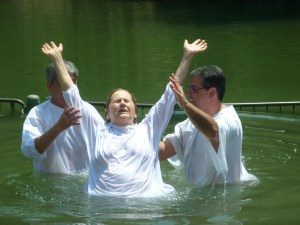 But for Bishop Ray and many others this centrality was only the beginning. The solemnity of Baptism has also to be entered into if the lives and ministries of the baptized are to be fully realized and manifest. Since most baptisms at the main service on Sundays are usually of infants or young children, it is understandable that the tone will be one of delight, joy, pride, even cuteness. That’s fine. But what about baptismal solemnity? How is that woven into the celebration and awareness of what is unfolding not only for the child but for the rest of us as well? In short, how do we understand and realize that being baptized is very serious, solemn business?


 God was making a body for Christ, Paul said. Christ didn’t have a regular body any more so God was making him one out of anybody he could find who looked as if he might just possibly do. He was using other people’s hands to be Christ’s hands and other people’s feet to be Christ’s feet, and when there was some place where Christ was needed in a hurry and needed bad, he put the finger on some maybe-not-all-that-innocent bystander and got him to go and be Christ in that place himself for lack of anybody better.
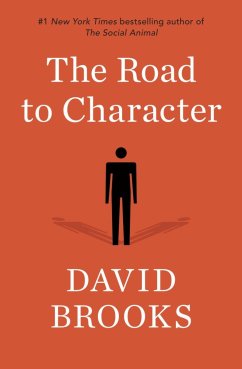 David Brooks is one of my favorite writers and commentators. His twice-weekly op-ed articles in the New York Times are a must read for me. He isn’t just an opinion columnist or political observer. In my judgment he’s a serious moral philosopher for our age. I recommend reading his 2015 book, “The Road to Character.” In it he probes for moral depth by blending psychology, politics, spirituality, and humility in the pursuit of a virtuous life with authentic character.
