Where do we find God’s kingdom?

by Fletcher Lowe

Several years ago, a friend of mine came to me and said that she felt a call to go to another country as a missionary.  In our conversation, I suggested that she spend a few weeks considering her current place as a teacher to be her mission field.  Later she came back with a new understanding.  She stayed in our city and developed a deep sense of calling with her teaching profession.

Kristina Muñoz, Aviano Elementary School gifted education teacher, watches students participate in a group exercise. Her passion is to help students learn and grow. (U.S. Air Force photo by Senior Airman Areca T. Bell/Released)

Perhaps that was what Jesus was trying to say to his 12 apostles in Matthew 9:5-7. He was explicit – Don’t go to the Gentiles or the Samaritans, rather go to the lost house of Israel.  As you GO, proclaim the good news: the kingdom of heaven is near. In short GO, but go to your own familiar territory. Now for some like Barnabas and Paul and countless others over the centuries, going to another place has been a calling.  But for most Jesus followers including you and me, our calling is right here.

We need to hear Jesus speaking to you and me where we live and move and have our being – namely our places of work, our communities and our homes.  You and I are called to GO there, to proclaim the good news: the kingdom. of heaven is near. If that sounds a bit grandiose and vague, let’s put some flesh on it.  Think the Baptismal Covenant.  It is our commissioning as the Baptized.  It spells out how we as the Baptized are to live into our Baptism daily, or in Jesus’ words: how we are to go to proclaim the good news that the kingdom of heaven is near.

Think about this for a moment:  Every time that you and I

  • Proclaim by word and example the good news of God in Christ,
  • Seek and serve Christ in all persons, loving our neighbor as ourselves;
  • Strive for justice and peace among all people and respect the dignity of every human being,

we are helping the kingdom to break through into real life.

The Lord’s Prayer reminds us: Thy kingdom come, thy will be done on earth as in heaven.  Whenever we do that “everyday” work – proclaim, love, seek and serve, strive, respect – we join forces with God in bringing God’s kingdom on earth.  So, let us GO forth into our worlds of home and work and community rejoicing in the power of the Spirit! Alleluia.

Seeing God at work

by Demi Prentiss

A large part of living our ministries in daily life is cultivating the ability to perceive where God is acting, and then aligning ourselves with what God is up to. Understanding ourselves as co-creators with God – partners in a whole-life commitment to increasing love and justice in the world – is a life-giving, purposeful way of living God’s dream for our lives.
So how do you see where God is acting? How can you tell?

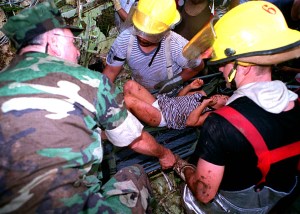
Look at events. In those events in our world that are clearly life-giving, it’s pretty easy to say, “Yes, God’s at work here.” But what about the terrible events? The heart-wrenching, “it-can’t-be” events? Take a page out of Fred Rogers’ book – look for the helpers. In the “Cajun navy” that jumped into john-boats to rescue neighbors and strangers when the floods came. In the three strangers who defended Muslim teenagers on a commuter train. In the teacher who spots the middle-schooler who’s being abused at home, or trafficked. In the midst of the brokenness around us, God is working in and through the helpers.

A young survivor is gently extracted from the wreckage of Korean Airlines flight 801 by U.S. Navy, U.S. Air Force, and Guam civilian rescuers.

Look at people. Especially, look at the people we tend to overlook – the bank teller, the cab driver, the grocery checker or bagger, the janitor, the bag lady. Look at those around you who are acquainted with grief (Is. 53:3). As you can, take a pause, take up your courage, and speak a word of hope or encouragement or simple acknowledgment of their humanity. Looking into their eyes, look for the light of God. You won’t always find it, particularly the first time. But practice makes it lots easier. The Celts claimed that the lark said, “Often, often, often goes the Christ in the stranger’s guise.”

Look at the world – both the natural and the created one.  All around us, God is showing up and showing off, as Reggie McNeal likes to say. In a leaf or a feather. In the music of the rain and the crash of a water fall. In the heart-grabbing poetry of inspiring architecture.  In the shadow of Earth pushing the twilight across the landscape until night falls. In the joy of an unexpected reunion.

Look inside your heart.  Take the time to notice what ignites your passion. Or what makes your pulse race.  Or unleashes tears. God’s invitation to partnership is showing up in those moments.

My friend Mary Earle often reminded me, “The Holy Spirit is a crass opportunist.” Pay attention to what you observe, and what you discern as God opens your eyes. As William Blake’s “Pentecost” reminds us, “Unless the eye catch fire, the God will not be seen.”

Noisy Church

by Pam Tinsley

The church I attend is a “noisy church.” When worshipping in the church, we can easily hear voices from the narthex. Sunday school classes meet in the parish hall directly beneath the church, and we often hear our children’s “joyful noise”. Our church is also located on a busy street corner, not far from a fire station, so that during a service, if you don’t hear a group of motorcycles roaring by, you’ll hear the siren of an ambulance responding to someone in need!

This all used to bother me until I realized that this noise – and seeming distraction – is actually a good reminder of where we are called to be – that we find Jesus out in the noisy, messy world, not simply in the peaceful tranquility of a sacred worship space.

And isn’t that really where church should be? Jesus calls us to be his followers. He calls us to learn from him and then to act, to be like him: to heal, to serve, to feed his sheep. Instead of remaining entirely separate, we – the church – are called to respond to people, to reach out to others, to be in the world. As much as we might like to remain inside the walls of the church, Jesus sends us out to serve as his body in the world.

Our “noisy church” is a good reminder, then, that our ministry as baptized Christians takes place whenever and wherever we intentionally listen to God and ask, “What is God doing here, right now, that I can join?”  Jesus sends us to live into our baptism in our daily lives. We transform our ordinary occupations into Christian vocation by becoming Christ-centered in our actions and words – even if we are not speaking direct words of evangelism.

Now, the challenge is to live that out every day, intentionally, in the midst of our noisy lives, on the noisy street corner – which may be your own home, the grocery store, or in your workplace! That’s where Jesus is!

Reaching Out in Mission

by Wayne Schwab

The Spirit is poured out on all for missions or ministries of love and justice.

At Pentecost, the gift of the Holy Spirit, God’s Spirit, to all makes every member a missionary.  Further, for the “eye of faith,” God is at work in everyone – every member and everyone beyond the church – in every creature and throughout the creation.

Prepare to meet and to work with people of other faiths by being secure in your own faith.  You do not have to be skilled in defining or interpreting all of its various beliefs and practices.  You do need to be at home with enough of its beliefs and practices to be at home in it.  Also, be free to be candid about your faith.  Where you are unsure about some parts of your faith, be free to say so.  Being candid affirms both you and the strength of the faith itself.  Most important, you are already on the firmest ground if you are at home with seeing God’s Spirit at work in your daily living and when you sense the Spirit’s help as you pursue your missions and your ministries. You are living a faith that works.

In our time, Paul Tillich has opened the door for us to ally ourselves with people of no faith. [Tillich, Paul, Dynamics of Faith, Harper & Row, 1957] Tillich has taught us to hear in people of no faith an “ultimate concern” which shapes their decisions and actions.

“Ultimate concerns” may vary from freedom, to personal integrity, to success in one’s career.  We see the Spirit at work in all who choose love and justice as their primary values.  Their choice of love and justice as primary has the quality of faith.  We have a common ground.  Our faith in the reality of God is not provable by reason.  Others’ commitment to love and justice as ultimate values is similarly unprovable.  Faith as our ultimate concern puts as all on the same street.  We celebrate and join with people of no faith in any work – “mission” in good word – to make any part of daily life more loving or more just.

Vision and mission statements

by Edward L. Lee, Jr.

In my 58 years of ordained ministry, 28 of them as bishop, I have crafted and read many vision and mission statements by parishes, church organizations, and dioceses. They all try to articulate the calling, purpose, and goals of their particular ecclesiastical and ministry enterprise. Collectively they are often a mixed bag of good intentions and wishful thinking, of real and unrealistic plans, of imaginative risk-taking or safe tasks for maintenance and survival. Some have passed my test of being Gospel-based and missional in scope, while many have soft-landed into a bland and predictable Sunday business-as-usual comfort zone.

Recently I came upon a parish’s vision/mission statement that caught my missional attention and ministry imagination. I pass it on for your consideration. What do you think? How does it strike you, or not? Full disclosure: it does pass my test of being Gospel-based and missional in scope. Read on:

OUR MISSION

Welcome all seekers;

Worship God in liturgy, music and prayer;

Equip all baptized persons for ministry; and

Engage as agents of Christ’s love in the world.


OUR CORE VALUES

Learning leads to God;

In giving and receiving care we encounter Christ;

Life in the Holy Spirit is beautiful.


OUR ASPIRATIONAL  VALUES

Community engagement and social justice;

Unconditional welcome and inclusion;

A community that calls forth the gifts of its entire people;

Becoming a racism-free and diverse community

that reflects the city where we worship.

Church of St. Martin-in-the-Fields, Philadelphia, PA

It’s all in how we receive

by Fletcher Lowe

Let me confess: I am addicted to the TV show Dancing with the Stars!  My wife and I met dancing and have been dancing together ever since, so watching Dancing with the Stars is a natural.  How does that relate to ministry?  Very simply.  The people who participate on that show minister to my wife and me in a significant way, providing us with a deep sense of joy and gratitude and well-being, with an opportunity to thank God for such talent and for our ability to enjoy it.  I have no idea about the religious backgrounds of any of those on the show.  That’s not the point.  What I do know is that they provide a real ministry to me.  Which is to say that ministry is not an exclusive Christian thing.  Nor does it depend on whether the individual has a sense of ministry.  It’s all in how we receive.

So I feel ministered to by all sorts and conditions of people.  Ministry is not just what I and other Baptized Christians try to offer in our neck of the woods, but it is also how we experience the ministry of others whether they realize it or not.

So, who are those who minister to you?  Certainly, your fellow Christians on the job or in your community or home.  And what about those other folks out there in your world?  Can we not celebrate their ministry also, even if they have no idea that they are ministering to us?  Just a thought for further discussion.  In the meanwhile, I will celebrate being ministered to by the folks on Dancing with the Stars!

P.S.  Would it not be a good Christian thing to do to let those folks know of their ministry to us?  I’m adding that to my to do list: thank the folks at Dancing with the Stars for their ministry to me and my wife.

Be like Thomas

by Demi Prentiss

Last Sunday’s Gospel reading offered the story about the disciple we often call “Doubting Thomas.” I think Thomas gets a bad rap. Merriam-Webster says the first known use of that term was 1883, so for most of Christian history we didn’t dismiss Thomas quite so easily. After all, he’s the disciple who also said, “Let us also go, that we may die with him,” as Jesus headed to Jerusalem, knowing there were plots to kill him. And when Jesus, at the Last Supper, said, “You know the way to the place where I am going,” Thomas was the one bold enough to say, “Lord, we do not know where you are going. How can we know the way?”
Thomas is the one who wants specifics, and is willing to follow Jesus into certain danger. When the other disciples claim to have seen Jesus after the Crucifixion, Thomas wants to see Christ’s wounds. And when he does see them, he doesn’t doubt – he believes. Not just that Jesus is alive. He proclaims that Jesus is both Lord and God – a specific and brave affirmation.

In our daily lives, can we be as brave as Thomas? Are we willing to look for Jesus in the places we work and play and study? And when we notice God at work in the world around us, are we willing to look directly at the bloody wounds and see Christ? Will we name our Lord and God, when we recognize God’s presence at work in unfamiliar places?

“Putting on Christ” in our baptism enables us not only to see God at work, but to be the hands and feet, ears and heart that put God’s love into action. Sometimes it’s hard to find the courage to do that. Sometimes, we can be as brave as Thomas.

A Healing Journey — and Helping Others

by Pam Tinsley

“Alleluia! Christ is risen! The Lord is risen indeed!” is our Easter acclamation. We are Easter people, people of the resurrection, living in the assurance that those who die, live forever in God’s eternal kingdom.

Yet, what about those who are grieving the death of a loved one, especially in times of celebration such as birthdays, anniversaries, weddings, and holidays? What about those who see others joyfully celebrating Easter, yet feel an aching hole in their own souls even though they believe fervently in the Resurrection? Can they, as they continue to mourn, even feel this joy?

Sarah, a dear friend of mine, was widowed a few years ago. Both Sarah and her husband were in their mid-fifties. Both of them expected him to recover from his illness, and when he didn’t, she and their young adult children were devastated. The grief she felt was numbing, even paralyzing at times. Her faith in Jesus and knowing how Jesus had suffered and despaired gave her glimmers of hope. Yet, in spite of being part of a strong church community and participating in a grief support group, she continued to struggle with her grief because, for the most part, the other participants were much older than she.

Sarah also happens to be a gifted writer. As she struggled with her grief, she wondered whether there might be a way she could find healing for herself and, at the same time, help others who were widowed at a younger age. Seeking God’s guidance, she prayed and, with God’s help, she began her “healing journey.” She took a leave of absence from work and went on several meditation retreats. And now she is blogging in the hope that she might be able to offer insights and encouragement to others. As she reaches out to others in their grief, her writing brings her healing moments in her own grief.

As Barbara Cawthorne Crafton wrote in a recent reflection, “Love transforms service, teaching us that there’s no such thing as a menial task. Love teaches us that, if nothing is beneath us, nothing will be beyond us. Love remains with us after our unstinting efforts have all failed — it doesn’t conquer all, as the old saying goes, but it bears all things without turning away from any of them.”

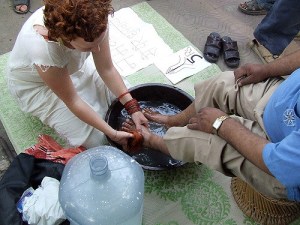
Sarah is discovering how true this observation is. When she decided to use her gift of writing to reach out to others, Sarah may not have consciously realized that she was following Jesus’ commandment to “wash the feet” of others. Perhaps we, too, might experience how our love in Christ transforms us by recognizing a gift God has given us, and then by giving our gift to help salve the wounds of others.

5 gifts for this Thursday

by Peyton G. Craighill

I have served many congregations in my life. But one thing is assured any of congregation. The service least attended is Maundy Service.

This a pity, because Christ gave five great gifts to us, the members of his Church, and we want to thank him for these gifts. The list is below:

  1. The most precious of these The Eucharist: (The Book of Common Prayer, on page 274, mentions this as “the Sacrament of Body and Blood”). Christ converted the Seder, which was an annual event, into weekly event.
  2. The Washing of Feet. The Washing of Feet must be understood in the context of the Jesus’ and his disciples’ lives. In that age, everybody wore sandals. Walking on dusty roads, their feet got dusty. And the lowest slave used to wash the feet of travelers before they entered the house.  Jesus was acting a parable when he washed his disciple’s feet. He meant to illustrate power in his Kingdom as servant power, rather than power this world of status, prestige, and arms. Servant power is the power of divine love, that can change this world. Its perfect illustration is crucifixion and resurrection of Christ.
  3. The New Commandment: Love one another as I have loved you. That means total unselfishness
  4. Eternal Life. The Collect the Maundy Thursday reads, “who in these holy mysteries gives us a pledge of eternal life…”
  5. Quoting of Christ: “Peace is my last gift to you…”

These five gifts of Christ, through Maundy Service – The Eucharist, The Washing of Feet, Servant Power, Divine Love, Eternal Life, Christ’s Peace. May every gift from Christ to you be real this Maundy Service this year.

Tapping the power of God’s Good News

by Wayne Schwab

Christianity has a unique message. God not only tells us how to live; God helps us to do it.

We are called to be loving and just in every relationship, in every part of life. Our problem is that we do not have the power to do it. We can go part of the way but not the whole way. By ourselves, we do not have the power to cope effectively with whatever blocks love and justice. We are weak. We need to be helped – to be saved – from the powers of evil, sin, and death. Where is such a power?  And can we share it?

The good news – the Gospel – is that the power we seek is at work in Jesus Christ and he shares that power with us.

The risen Jesus tells the disciples to continue his work, “As the Father has sent me, so I send you” (John 20:21b). The Father sent him to make clear that God’s power overcomes evil, sin, and death. Jesus has that power and shares that power – the Holy Spirit – with us. “He breathed on them and said to them, ‘Receive the Holy Spirit’” (John 20:22). Here is the help – the salvation – we need. We share Jesus’ power – the Holy Spirit – to love and to be just. We have the power, with Jesus’ help, to act and to act with confidence. The same Holy Spirit that Jesus breathed on his disciples two thousand years ago he also breathes on us. Therefore, with courage, we can act and can seek to do what we believe God calls us to do.

Our baptism and reaffirmation of faith are our commitment to join Jesus to make the world more loving and more just.

There are those in the world who believe an alternative idea.  In this other teaching, our disobedience has so offended God that someone has to pay the price by dying for us to be reconciled to God.  Jesus’ death on the cross pays the price or atones for our sin and evil.

Lay aside this substitutionary atonement with its theme of punishment.  Now, through the power of the Holy Spirit, with God’s help we can cope with evil, sin, and death.   Sharing in the power of the Holy Spirit, we are saved from our weakness, so that we can respond with love and justice to the challenges we face.