Blog

Wondering . . .

by Brandon BeckI Wonder book cover-Beck blog

Glenys Nellist says, “The Bible truly is a ‘wonder-full’ book.”[1]

The mission of Godly Play says, “Godly Play: Making meaning through story, wonder, and play. Nurturing spiritual lives by honoring the centrality, competency, and capacity of children.”[2]

Paul Simon says, “These are the days of miracle and wonder.”[3]

The Gospel of Thomas, Logion 2, says,

If you are searching, you must not stop until you find.
When you find, however, you will become troubled.
Your confusion will give way to wonder.
In wonder you will reign over all things.
Your sovereignty will be your rest.[4]

Glenys Nellist’s saying is the beginning of her “Note from the Author” in her 2021 Zonderkidz I Wonder: Exploring God’s Grand Story (An Illustrated Bible). This beautiful Bible is illustrated by Alessandra Fusi.

During Lent, I prefer to take on a practice rather than to fast from something – to take on deeper prayer, deeper wonder, and to reflect on the Way of Jesus, especially on the days he spent facing his own temptations in the desert and on the wonders I can wonder about the triduum.

Nellist says,

And high on a hillside, on the cross, Jesus said goodbye.
Goodbye, world,
  Goodbye trees,
Goodbye sunsets,
  Goodbye seas.
Goodbye friends,
  Goodbye Mom
Goodbye world.
  And everyone.
“It’s all finished,” whispered Jesus. And he closed his eyes and died.
Except – Jesus wasn’t finished.
And neither was God…

Then Nellist wonders

…why the sun stopped shining.
…how God felt when Jesus died.
…how Jesus’ friend Mary felt when Jesus died.

Spending time in contemplation with Nellist and Fusi, Godly Play, Paul Simon, The Gospel of Thomas – spending time in wonder – this is my Lenten practice.

What is yours?

#          #          #

[1] Nellist, Glenys. I Wonder: Exploring God’s Grand Story. Illustrated by Alessandra Fusi, Grand Rapids, MI, United States of America, Zonderkidz, 2021.

[2] Godly Play Foundation, http://www.godlyplayfoundation.org. Accessed 25 Feb. 2023.

[3] Simon, Paul. “Boy in the Bubble.” Graceland, Warner Bros, 1986.

[4] Bourgeault, Cynthia, et al. The Luminous Gospels: Thomas, Mary Magdalene, and Philip. Telephone, Texas, United States of America, Praxis, 2008.

 

Leaving the mountaintop

by Pam Tinsley

In churches that follow the Revised Common Lectionary, the Gospel we read on the last Sunday after the Epiphany – also, the Sunday before Lent – is about Jesus’ transfiguration (Mt. 17:1-9). Jesus leads his disciples Peter, James, and John up Mt. Tabor. On the mountaintop, as Jesus’ closest disciples behold his radiant face and clothing, they, too, are transformed: first by the change in Jesus’ appearance and then when they hear God speak: “This is my Son, the beloved.… Listen to him.” Although the disciples long to remain on the mountaintop to bask in this holy and awe-filled experience, Jesus reminds them that they live in the world. So they return down the mountain, but bearing this precious gift: a deeper understanding of who Jesus is.

Many of us have had a “mountaintop” experience, where we’ve wanted to linger, perhaps to savor it longer. Baptisms are like that for me. Not only do I witness the transformation of the newly baptized child or adult, I feel a change within myself, a deeper connection to Jesus and to his new disciple. And, with each baptism, the body of Christ – the Church itself – is transfigured.

Yet, as beautiful and awe-inspiring as baptisms are, our baptismal liturgy reminds us, like Peter, James, and John, that the light Christ brings into the world is not simply a wonder to cherish. Instead, we are called to action. We then take Christ’s light into the world to share with others. Certainly, we can’t confidently share the light of Christ in the world without a deeper understanding of Jesus. Through worship, Christian formation, and fellowship the church equips and transforms – yes, even transfigures – us.

Like Mt. Tabor, the church isn’t our destination; instead, it’s the spiritual training ground for our pilgrimage in daily life.

Partner with PBL

Those of you who are faithful readers of this blog, and those of you who have recently discovered us – you’re all invited to help support the work of Partners for Baptismal Living (PBL). We are asking for financial contributions to continue the work of PBL between now and the next Episcopal General Convention to be held in Louisville, KY, June 23-28, 2024. 

PBL partners with faithful Episcopalians to support and expand the ministry of all the baptized, as you’ll read in the letter below and in this Episcopal News Service article. Independently and as a participant in The Consultation, PBL supports living our faith in every aspect of our daily lives.

Please consider making a donation today, as a beginning of your Lenten journey toward Easter. Click on the “give” button here or follow the directions in the letter below to mail your check. We are grateful for your support. 

Dear friend,

I am writing you today on behalf of Partners for Baptismal Living (formerly Episcopalians on Baptismal Mission and creators of the LivingGod’sMission.org blog). We are a group which continually seeks ways to remind us Christians that we are all called to serve with Jesus because we have been baptized into the Body of Christ. Each of us is empowered by baptism to proclaim and live out God’s Beloved Community in our daily lives, here and now. We also recognize that it is easy to lose sight of this mission because of life’s many demands and distractions.  We are writing to you because we know you care deeply about the calling of all the baptized, 99% of whom are of the lay order.

PBL is a small group with church-wide impact. Our work leading up to the 2018 General Convention, and on the ground during the convention, created and passed Resolution C005. That resolution formed a task force that has worked to see baptismal ministry intentionally implemented throughout the church. A member of PBL served on the task force, which promoted passage of Resolution A037, “Establishing a New Standing Commission on Formation and Ministry Development,” during the recent 80th General Convention in Baltimore. The new standing commission, which met for the first time November 14-17, will focus on affirming, developing, and upholding the ministry of all the baptized.

PBL has no paid staff. We have no building or equipment to maintain. And because of the pandemic, over the past two years we have reduced many of our expenses by attending meetings virtually. We do, however, incur some expenses, which fall into two main categories:

  • Participation in the work of The Consultation, a collaboration of organizations in the Episcopal Church. Partnership with this group multiplies our impact.  —  $5,700 per triennium
  • Attendance and participation at General Convention, assuring that PBL’s voice and presence are known in the larger church.  — $6,300 per triennium

For each of the next two years, we have set a target of $6,000 to reach our $12,000 triennial goal.

We are asking YOU to help continue this transformational work and build on our continuing successes. Every gift makes a difference. If you’d like to sponsor a specific expense (brochures and stickers for General Convention, Consultation dues, etc.), we’d be happy to offer “sponsorship opportunities” tailored to your interests. And, because we are a 501(c)(3), we are happy to provide a tax statement for your contributions.

You can support PBL monetarily by

  • making an online donation at PBL’s blog site www.livinggodsmission.org  OR
  • mailing a check/money order made payable to Partners for Baptismal Living to:

            Partners for Baptismal Living

            c/o Pamela Tinsley, Treasurer

            4810 N. 28th St.

            Tacoma, WA 98407

Thank you for your generous support.

Demi Prentiss
PBL Co-Convener
 
P.S.  Your tax-deductible contribution to PBL’s work means more people will be on mission every day, wherever their daily life takes them. Your support makes a difference!

Always we begin again

by Brandon Beck

In January, many of us celebrate the promises of our lives together in our church through annual parish meetings and parochial reports.

Some of us celebrate a Recovery Sunday with liturgical, musical, and educational focus on the sacramental and covenantal relationship of recovery people and programs among us.

Some of us celebrate Lunar New Year – this is the Year of the Rabbit, in case you were wondering – respecting the dignity of the diversity of ways of being people in this world.

Wikimedia – Triquetra

Perhaps we lifted up the saintly Rev. Dr. Martin Luther King, Jr., on his birthday and will again on the day, in April, when he was taken from his earthly mission by gun violence.

Perhaps we held memorial vigils in remembrance of the genocidal violence of the Holocaust.

These are all parts of life in the church in January.

Supposedly, St. Benedict said, “Always we begin again.” This 6th century Italian hermit-turned-father of monasticism drew people into themselves, onto a path he followed, and along The Way with his divinely inspired meditations and writings, contemplations, and connections.

Whether or not he actually said, “Always we begin again,” is neither here nor there; for, we do always begin again.

What better way to live into the promises of our baptismal covenant than to weave these two sacred triangles together – God, ourselves and others with past, present, and future?

What symbols in the church, in nature, in your life remind you of this idea?

I see the triquetra and think of these 6 words which I say with gusto every time I witness a baptism because they remind me that always we begin again, together, to expand Love for creation: believe, continue, persevere, proclaim, seek, strive. These words that begin the versicles of our covenantal pledge weave together God, ourselves and others with past, present and future in a spinning, spiral, triquetra that always begins again and helps us celebrate just as we do every January, every year and shall every day.

Amen.

Just Plain Ministry!

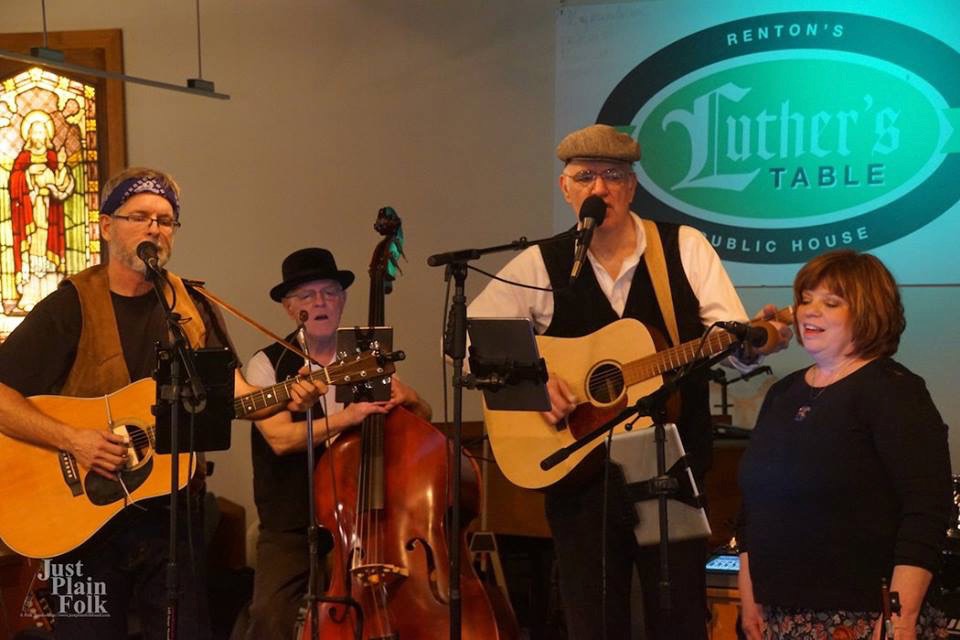
Just Plain Folk: Dave, Al, David, and Nadine

by Pam Tinsley

Dave, David, and Al met eight years ago on a music team for an Episcopal Cursillo/Come and See retreat weekend. David was a vocalist and played rhythm guitar; Dave sang and played guitar, banjo, and mandolin; and Al played double bass. In addition to contemporary church music, they also shared a love of folk music and immediately began getting together to play – even though they worship at different Episcopal churches, and 35 miles separate two of them. Nadine, a fiddler and vocalist, joined them for a Come and See Prayer and Share gathering, and Just Plain Folk was born. The foursome practiced weekly, periodically played in coffee shops and farmer’s markets, and had just begun to play at some retirement communities, when the pandemic struck. Ever resourceful and committed to their passion, Just Plain Folk found ways to practice while vaxed, masked, and distanced.

Fast forward to today when the band plays regularly at retirement communities and in their memory care units. Dave describes their gigs as a ministry, a vocation – that is, the place where, in the words of Frederick Buechner, his deepest gladness meets the world’s needs. Whenever Dave picks up his mandolin, he prays that he might become a bearer of Christ’s light to brighten their hearts, if only for an hour. The result? Residents sing and dance along to tunes they know from their youth, and fellowship is nurtured, as band and audience share amusing stories from their lives.

Then, the band moves into the memory care unit. There Dave observes a powerful transformation. As they begin to play, it’s clear that their music reaches deep into the residents’ souls, awakening something beyond memory. Seeing the joy in their faces, in turn, brings great joy to the band members themselves, as a powerful reminder of Christ’s eternal truth: In giving we receive.

When the members of Just Plain Folk first started, they were mostly looking to play music together and to enjoy some Christian fellowship. Little did they realize that God had other plans for them, and Just Plain Folk has become Just Plain Ministry!

Dueling lessons – Wise men or baptism?

by Demi Prentiss

In many Episcopal churches this past Sunday, preachers faced a daunting choice: “gold, frankincense, and myrrh” or “This is my … Beloved.” Matthew’s story of the visitation of the Magi (Mt 2:1-12) or his brief account of Jesus’ baptism by John (Mt 3:13-17).

For many of us, it’s hard to connect the visitation of the wise men from the East with Jesus’ baptism and the beginning of his ministry. Just last week, I ran across a question that has had me pondering most of the week: “What happened with Mary and Joseph as they raised the child Jesus, that they raised a devout Jewish boy who looked beyond the Chosen People to include Gentiles and outcasts as he proclaimed God’s good news?” Of course, there was the trip to Egypt (Mt 2:13-15). There was living in Nazareth near Sepphoris, a cultural crossroads of the Middle East.  There was Mary’s song about a lowly handmaiden, called blessed by a God who exalts the humble and meek (Lk 1:4-55). There was Joseph’s refusal to allow Mary to become an outcast (Mt 1:19).

The question’s author (whose name I’m still trying to rediscover) offers a striking answer: “the wise men.” Pondered nearly all her life by Mary, the foreigners who brought magnificent, prophetic gifts heralded the reign of God displacing the reign of Caesar. They foreshadowed a new way of ordering the world. 

That same holy reversal is at work in the baptism of Jesus. Blog author Herb Montgomery, writing for Patheos last week, offers a challenging way of seeing Jesus’ baptism – not as cleansing him from sin but as ending “his participation in the structures and values of society. It concludes his involvement in the moral order into which he was born.” [1]

From that position, Montgomery asks,

So what difference does it make for us as Jesus’ followers, as we start this new year, to interpret Jesus’ baptism not as repentance for personal sins but rather as rejection of the injustices of the current system? Jesus’ baptism was a cleansing with water, a preparing the way for something better to take root and spread.

What new ways of ordering our world are our baptisms preparing us to engage?

How does Jesus’ baptism – and the renewal of baptismal vows that are traditionally part of the observances of that day in many Episcopal churches – challenge us to denounce and turn away from the injustices we encounter in our world? How might we embody our baptismal calling in our daily lives?


[1] H. Waetjen, The Construction of the Way into a Reordering of Power: An Inquiry in the Generic Conception of the Gospel According to Mark, quoted with permission by Ched Myers in Binding the Strong Man: A Political Reading of Marks Gospel, p. 129. From “Jesus’ Baptism as Social Protest, Part 3” by Herb Montgomery.

10 lepers leaping?

By Xavier Romero-Frias – Own work, CC BY-SA 3.0, https://commons.wikimedia.org/w/index.php?curid=23287278

by Brandon Beck

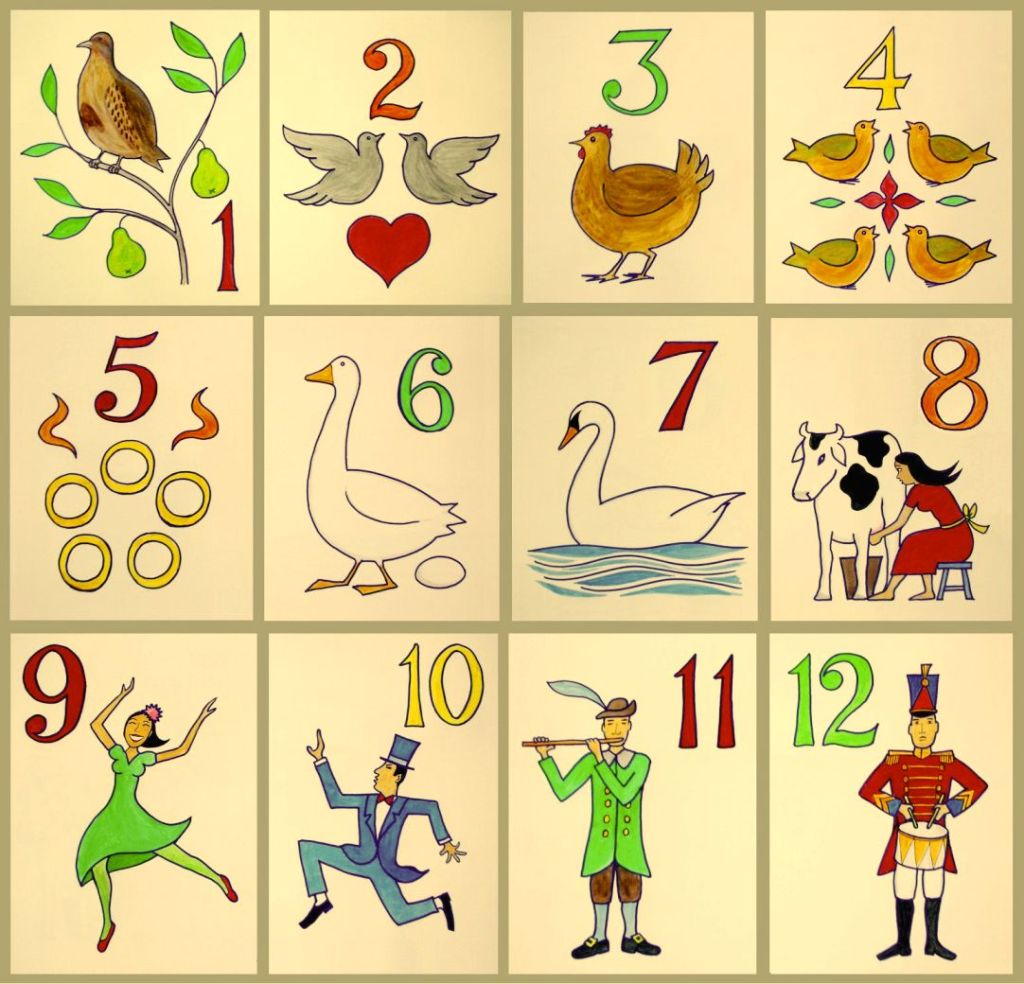
At a recent holiday gathering, my extended family and I discussed the traditional carol “The Twelve Days of Christmas.” Not everyone at the table observes the Twelve Days, so those of us who do shared our planned activities based on our traditions for each of the days and talked about the significance of the carol lyrics in our experiences.

One person shared that her favorite of the days is Boxing Day, especially now that she has young children. She said, “Giving to others is always important to me, but this one day, after the kids have opened presents from Santa, we go as a family out in the community and learn about and engage in some service outside of church.” She said all the kids – from the 4-year-old through the 12-year-old – have already developed a positive anticipation for Boxing Day and have started finding projects on their own. This year they were going to a local community center that had set up an emergency cold weather shelter to serve food and hand out blankets.

A family friend asked each of us which verse from the traditional carol was our favorite. I shared a story about how I had thought that the tenth day verse was “ten lepers leaping” and was about Jesus’s miracles and healings. I learned to laugh at myself just this year when someone at church pointed out that I had changed the lyric!!

That led us to pull out our phones and Google everything we never knew about this carol. I was pleasantly surprised to learn of symbolic connections in the lyrics to such things as the four Gospels, the five books of the Pentateuch, the 10 Commandments. What do you think the others might be? (Click here to check your thoughts!)

After Christmastide, we might struggle to remember that stillness we’ve just left in Advent – that anticipation we felt and relished while we waited with Mary and Joseph.

Now, we will receive people from around the world in the Scholars from the East on Epiphany. We will witness John baptize Jesus saying:

“This is the one I meant when I said, ‘A man who comes after me has surpassed me because he was before me.’ 31 I myself did not know him, but the reason I came baptizing with water was that he might be revealed to Israel.”

32 Then John gave this testimony: “I saw the Spirit come down from heaven as a dove and remain on him.  33 And I myself did not know him, but the one who sent me to baptize with water told me, ‘The man on whom you see the Spirit come down and remain is the one who will baptize with the Holy Spirit.’”

The seasons of Lent and Easter are not that far away – Jesus the newborn will be 33 before we know it.

We must make every effort to remember to love God, love our neighbor, and love ourselves – and to slow down, open our eyes in wonder, and to see Christ in each other – no matter what busy-ness is around us.

The 19th century Swiss philosopher Henri-Frederic Amiel offers a fabulous benediction to draw us deeper to that truth:

Life is short and we have never too much time for gladdening the hearts of those who are traveling the dark journey with us. Oh, be swift to love, make haste to be kind! (December 16, 1868. As translated in Amiel’s Journal: The Journal Intime of Henri-Frédéric Amiel (1885), by Mrs. Humphry Ward. Macmillan.)

Amen.

Advent letter from The Consultation

The Consultation – a consortium of progressive organizations in the Episcopal Church – has offered to the larger church some thoughts about General Convention, both reflecting on last summer’s challenging work and looking forward to the 81st General Convention scheduled for June, 2024.

Partners for Baptismal Living – the group that brings you this blog – participates in The Consultation, and invites you to read what we, along with our partner organizations, are thinking about the work ahead of us.

Find The Consultation’s Advent letter here.

For Christians throughout the earth, may your journey through Advent bring you to a joyous celebration of Christmastide! And for all people, may you know peace and joy as we enter 2023.

Fling wide the door

by Demi Prentiss

“Fling wide the door, unbar the gate!” The words of this Lutheran hymn (ELW 259) remind us that the essential work of Advent is opening – our gates, our doors, our hearts, our wallets, even our minds! God is doing a new thing, and perceiving it depends on our willingness to see or learn or do something new.

For some of us, flinging wide the door isn’t easy.  In the spirit of the homeowner who feels obliged to tidy up the house before the house cleaners come, we would just as soon keep the door closed until everything is “just right” – for guests, of course. And, if we’re willing to admit it, for Jesus as well. We’ll wait until we have the dust bunnies and the clutter under control before we feel comfortable letting God in to see where we live – including our hearts. It’s hard to admit that putting up a false front is a useless exercise when we’re talking about God: The One who’s nearer than breathing already knows how messy our lives are, behind our brave façade.

God already knows that inviting God – as vulnerable infant or as powerful spirit – into our lives means doing something that forces us to loosen control – stepping out of our comfort zone.  The Advent remembrance of that vulnerable child born in Bethlehem can offer us a glimpse of the power of vulnerability. God’s experience as a human being helps us remember that, as Madeleine L’Engle wrote, “To be alive is to be vulnerable…. When we were children, we used to think that when we were grown-up we would no longer be vulnerable. But to grow up is to accept vulnerability” (Walking on Water, 1980).

Brené Brown, self-described as a “storyteller/researcher,” has dedicated much of her life to understanding vulnerability. She is careful to distinguish vulnerability from compliance or weakness and to point out that vulnerability is a demonstration of courage. In her book Daring Greatly: How the Courage to Be Vulnerable Transforms the Way We Live, Love, Parent, and Lead, she writes, ““Vulnerability is the birthplace of love, belonging, joy, courage, empathy, and creativity. It is the source of hope empathy, accountability, and authenticity.” Because vulnerability is inescapable, she urges us to practice it intentionally. “If we want greater clarity in our purpose or deeper and more meaningful spiritual lives, vulnerability is the path.”

My prayer for all of us choosing to walk this reflective journey of Advent is that we may claim vulnerability – incarnate in the Son of Man – as a source of courage to dare greatly and to invite transformation.  As Brown urges, may we dare to “show up and be seen. To ask for what you need. To talk about how you’re feeling. To have the hard conversations.”  May God open us to receive the gifts of the Incarnation.

“Fling wide the door, unbar the gate!” And the Lord God Incarnate will come in.

Seeking and serving

Angel Tree at MCAS Cherry Point, NC – Photo by Pfc. Nicholas P. Baird

by Brandon Beck

“To seek and serve all persons” is on my mind this time of year, as it is every year during Advent.

Advent is my favorite liturgical season – with the deep blue hues of the vestments and altar hangings, the lessons and carols of the season, the waiting and anticipation, the hot chocolate and crafts.

I value sharing in the preparation for and service of a community Friendsgiving event for families who receive diapers and parenting support at our local parish church. Turning to hanging the greens with special care for our Angel Tree participation, I am drawn more deeply into the sense of waiting and watching this season – but in an active way – in a seeking and serving way.

How can I fulfill my promise of baptismal living while waiting in anticipation, I wonder?

Perhaps, as in the Advent II lectionary reading from Isaiah, I will actively wait in the Spirit of the Lord:

“He shall not judge by what his eyes see,

or decide by what his ears hear;

but with righteousness he shall judge the poor,

and decide with equity for the meek of the earth.”

May we recognize and respond to every opportunity to meet those, like ourselves, who need a friend today and every day, for in them is Christ.

Editor’s note: PBL welcomes Brandon Beck as the newest writer to join our blog schedule. See our “Who we are” page to learn more.