Can you move the dial?

Flickr – Liz West – Sundial

by Fletcher Lowe

There is a significant movement within the English Anglican Church that is creatively focusing on the calling of all the baptized in their daily life and work.  Illustrative of that is this article by the Bishop of Leicester: 

Moving the dial towards everyday faith, by Martyn Snow, Bishop of Leicester

Inspiring Everyday Faith is a way of highlighting why and what is important in Christian discipleship. In the past 20-30 years, we have not been terribly good at equipping people for living their Christian faith in the whole of their lives. The Church has tended to focus on its own life, or its own outreach projects, and forgotten that for most people the majority of their time is not spent involved in church projects – it’s spent in their workplaces, home, social. Equipping people for faith in those contexts must be core to what the Church is all about. I think there has been a change in that over time, but during this pandemic and lockdown – as in so many other areas – it has brought new questions into focus.

Nick and I have a running joke about who first coined the phrase Everyday Faith. All I can say is it has ‘made in Leicester’ stamped on it, and we use that as our strapline now! Using that language of everyday faith has certainly been very significant. My role as bishop is to hold people to account and for them to hold me to account in what we decide under God we are called to be and do. We use the following questions to help each of us in this discernment:

  1. How are you enabling others to grow in the depth of their discipleship?
  2. How are you growing in numbers of disciples?
  3. How are you growing in loving service, enabling others to grow in loving service?

We have found it important that such questions are adopted across the whole life of the diocese….- Other ways … putting lay ministers’ licensing services and commissionings on the same standing as ordination in the life of the diocese. When I license a new clergy person in a parish, we have a ritual of partnership in ministry, so looking very clearly at joining a team of ministers within that church context –

Recently, we’ve done an exercise of gathering stories about faith during lockdown. We’ve had a particularly prolonged lockdown in Leicester, as you may know. We’ve asked people right across our churches what they have been learning about faith in this particular context. Those stories have been fascinating. There has been a sense in which it has shifted the dial along the scale. People are asking – 

+ Is my Christian faith something I do with a particular group of people in a particular building at a particular moment in time?  through to 

+ Is my Christian faith something I do in the whole of life?

The dial has been shifted during this period to what, actually, faith is about! What I do in my own home, what I do when I’m online, talking with my friends. Increasingly people are realising that we should all take responsibility for this. It’s not something somebody else does for me – I need to be enabling the practices that enable my faith to grow in my own home and in my workplace. I think the dial has been shifted and we’re starting to see more about everyday faith.

Ultimately, the more we’ve talked about everyday faith, the more we’ve started to understand the key role that lay ministers play in enabling the whole people of God to live out their faith in the whole of life.

In my own work, I’ve encountered numerous lay ministers lacking confidence, wondering what their role is and how they can best express their gifts within the body of Christ. As we’ve started to explore everyday faith – especially with the questions that are raised within the workplace, or within social networks – lay ministers have started to see that this is their area of expertise. They’ve struggled with questions about how to live out faith in these contexts themselves, and therefore their ministry can be focused on how they enable others to grow in their faith in those contexts as well. I think there’s been an encouraging shift in that sense and a growth in that understanding of clergy and lay ministers working together to enable the whole people of God in their everyday faith.


God in the bond market?

by Fletcher Lowe

Over the years in the parishes I have served, I have been visiting members where they work.  The conversations usually go: What do you do here?  What is the Sunday-Monday – the Faith/Work – connection with what you do here?  This latter question is, for most all of the church members, the first time that question has been raised for them.  Yet where they work is the place where they spend most of their God-given time and talent.  What an indictment of the Church! 

Here are the words of one businessman, David Wofford, I visited. The words he wrote (pre COVID-19) describe his “Aha!” to that second question:   

Excuse me? Faith at work?  I’m not a priest or a rabbi. It’s not my job to heal the sick or mend broken souls. I’m just a “used-bond salesman.”  These were my initial thoughts when Fletcher said he wanted to visit me at work to discuss faith at work.

Upon his arrival, Fletcher surveyed my work area. The space is a large trading floor with people sitting in front of several monitors blinking price action in the bond market. Everyone sits almost elbow to elbow and it can get a bit loud. The two of us then moved to an office for a little privacy. I tried to explain that the atmosphere in my office was closer to that of a fraternity house and not exactly like a place of worship. We work hard, do a good job, and at the same time, have a lot of fun.  More often than not, that fun is similar to the fun we had in elementary school.

After asking for more details about my job, Fletcher thought a bit and he said something that opened my eyes. My faith was all around me. It is there when I try to help my accounts meet their goals with honesty and integrity. If they are down, I try to cheer them up or put them at ease. The camaraderie with my colleagues is also a part of my faith. Many of us have worked together over twenty years in a very stressful occupation. We share lots of laughs. We pull together when times are tough.  Another salesman and I like to read “Forward Movement” on line during down time. There is also an email I receive from Fletcher entitled “On the Job Prayers.” I pass that around to some in my office to help alleviate some of the stress during the day.

I park across the street from my office. Each morning there is a little ritual on my walk. I thank God for my great family. I ask for Him to help me be a better father and husband. I thank Him for the opportunities I have and the friends around me.  I ask for His help when times are rough or a friend is in need. I thank Him for the sunshine or the rain. God walks me to work….and everyone in the office says I only park across the street because I’m a tight wad and can save $30 a month!!

Faith at work?  Even for a “used-bond salesman”? Believe it or not it can happen.

Peace be with you

by Demi Prentiss

Attainment of Inner Peace Flickr photo by Karthik Prabhu

St. Seraphim of Sarov is often quoted as having said, “Acquire inner peace and thousands around you will find their salvation.”

All during Christmas and Epiphany, we Christians have focused our awareness on the Light of Christ. As we walk our Lenten journey, we’re invited to practice silence and stillness, discovering Christ’s light within our own hearts as well as in the world around us. Our Lenten practices can help us nurture that light, grounding us in the peace that Christ’s presence brings.

The daily work of practicing inner stillness can free us to remember who we are – a Child of God, beloved and called. And in that clarity of our true identity, joy blossoms as quietly as a flower unfolding. That joy is the wellspring of the generosity – in terms of possessions and time, skills and spirit – that is the hallmark of one who follows Christ’s way of love.

Seraphim understands that joy as God’s irresistible gift – whenever we receive that joy and offer it to another, it sets the world alight.  “We cannot be too gentle, too kind. Shun even to appear harsh in your treatment of each other. Joy, radiant joy, streams from the face of one who gives and kindles joy in the heart of one who receives.” In the sharing and receiving, such a community of joy participates in the reign of God.

May our inner work in Lent lead us to the realization that our daily work – offering ourselves as such conduits of joy – can bring us to a place of true peace.

Hearts and Ashes

by Demi Prentiss

We’ve just celebrated Valentine’s Day, on the very same day as the lectionary reminds us of Jesus’ transfiguration, marking the shift from his Galilean ministry to his prophet’s journey to Jerusalem and the cross. We Christians are about to move from the festivities of Mardi Gras to the solemnities of Ash Wednesday and the 40-day journey that leads us to witness Christ’s transit from death to life.

This liminal week reminds us that love is the catalytic transformational force that God brings into the world. Love – the love that made St. Valentine a martyr – gives us new eyes to perceive God’s transformational work all around us. Love – the love that announced “This is my beloved. Listen!” – created light in the darkness and lights each of our lives.  Love – the love that tenderly reminds us that we are dust – proclaims that we are made in the very image and likeness of God.

As we embark on the journey of Lent, may we remember that our calling is not to religious athleticism, demonstrating by our strenuous practice that we are worthy of God’s love. As God reminds us, in the words of the prophet Amos, “I hate, I despise your festivals, and I take no delight in your solemn assemblies.” (Amos 5:21)  Our calling, instead, was proclaimed by Micah: “He has told you, O mortal, what is good; and what does the Lord require of you but to do justice, and to love kindness, and to walk humbly with your God?” (Micah 6:88)

This Lent, may we walk the Way of Love, remembering that “Go” is an essential element of the Christian life.  Go out from the comfort of church pews into the challenges of daily life. Go beyond our timeworn practices to experience a new perspective. Go into respectful relationship with unmet neighbors and unfamiliar cultures, to look into the eyes of siblings we’ve never met.

May our journey this Lent awaken us to new life, as we walk into the immensity of the reign of God.

Baptised into Light

by Pam Tinsley

YouTube – CBC News Jan. 20, 2021

Like so many, I found Amanda Gorman’s inauguration poem, “The Hill We Climb,” inspiring.

I’m reminded of the promises we make at baptism by her closing verses:

When day comes we step out of the shade,

aflame and unafraid,

the new dawn blooms as we free it.

For there is always light,

if only we’re brave enough to see it.

If only we’re brave enough to be it.

In John’s Gospel Jesus is the light of all people, and his light shines in the darkness. Jesus then invites us to be brave enough to see his light and to be his light in the world. Each question posed at baptism also asks us to be Christ’s light in the world: Will we teach, pray and gather – even if by Zoom? Will we persevere in resisting evil and then repent when we stray? Will we model the Good News by our words and our actions? Will we love one another? And will we strive to make our world more loving and more just?

Whenever we live into our baptismal promises – wherever we are and however minor our actions might seem – we shine a light that others can see. We might heal someone’s wounds with a kind word; we might lend a listening heart to a shut-in – or someone wearied by the persistent isolation of quarantining; we might encourage a spirit of community; we might help someone make an appointment for a covid-19 vaccination. This is how we reveal Christ’s presence in the world.

Even in the midst of pandemic, racial injustice, social and political turmoil, and isolation, we can be brave enough to look for and to see Christ’s light – there in the seemingly never-ending shade. For, as Ms. Gorman reminds us, there is always light.

Gifted

by Demi Prentiss

Creative Commons arsenat29 – G-55801-U1H

For many of us whose faith is shaped by the traditions of the Christian year, we’ve been thinking about gifts for two or three months. From well before Christmas Day all the way through Jan. 6, Epiphany, we’ve been asking questions:

  • What gift can we choose to put under the Christmas tree to convey our love to those we cherish?
  • How do we best prepare our hearts and homes for celebrating God’s greatest gift to each of us – the Christ Child, God incarnate?
  • How can we join with the Three Kings in offering our gifts to Immanuel?

At this point in the Christian year, our attention has moved on to the baptism of Jesus, traditionally the focus of the readings on the first Sunday after Epiphany. We’ve moved from focusing on gifts to getting down to the work of ministry. In the context of our own baptism, and of the Baptismal Covenant, perhaps that “doing” focus overlooks an important message that baptism conveys, to us and to the world:

Because of God’s gifts to us, and because of the covenant between us and our Creator that baptism represents, we can claim an important part of our identity. We are not only gifted; we are also gift.

Baptism sets in motion God’s sending of each of us into the world as God’s gift. Our person, our presence, and our distinctive perspective on the world – all God-given – are gifts that no one else can offer. Wherever we find ourselves, we have a part we can play that is unique. It is that self-offering that is the essence of our ministry in the world. We best serve as God’s ambassador when we show up as the precious, gifted, and called Child of God we are created to be. Claim that. Claim your identity as God’s gift for healing the brokenness confronting you. Perhaps less by what you do than simply by being who you are – a Christ-bearer. Be the change you long to see. Be the gift that keeps on giving.Because of God’s gifts to us, and because of the covenant between us and our Creator that baptism represents, we can claim an important part of our identity. We are not only gifted; we are also gift.Because of God’s gifts to us, and because of the covenant between us and our Creator that baptism represents, we can claim an important part of our identity. We are not only gifted; we are also gift.

How race shapes baptismal living

by Fletcher Lowe

We at Partners for Baptismal Living have been exploring how race impacts our daily lives. There is a major contrast.

Here are conversations with two African Americans.  A former CEO of a large Richmond, VA hospital said that white privilege is subtlety present as he interacts with white folks in the workplace. He has also been aware that in promotion, his path has been harder than others who were white, having been passed over even when he felt he was more qualified.  An African American lady, shared that fear was omnipresent when she goes out – fear of police pulling her over because she is in the wrong neighbor or driving too fancy a car.  In stores she always gets a receipt lest she be accused of stealing.  She also feels that the playing field is not level with both her race and her gender being liabilities.

Now for the contrast.  For the white folks we have conversed with, the racial issue is less the backdrop of one’s daily life. Awareness of race comes less from how it affects these whites directly and more from how it affects people of color connected to their work situations. A friend who is in Virginia state government’s office of Conservation and Parks mentioned how they are reaching out to employ more people of color in his agency and how they are training the Park rangers in dealing with situations of racial harassment among visitors.  A head of a mental health non-profit spoke of how his agency works with Black congregations to help them help their members overcome the mental illness stigma that sometimes prevents them from getting treatment.

Some of us white folks are often blinded by our racial assumptions.  The CEO mentioned above was in the church building of the multiracial congregation of which my wife and I are a part.  In came a couple of white tourists for the building has historical significance. They began a conversation with the CEO and asked him how he liked his job as the sexton. Without losing a beat, he replied, “I am not the sexton, I’m the Senior Warden!”

As each of these people is a committed Christian, it raises the question for us: How do we work to level the playing field, to work so fear is not a constant undercurrent. The Advent message of preparation for the coming of the Prince of Peace calls us to work for that peace among races that manifests itself in diversity, equity, and inclusion.

Embrace your call

by Demi Prentiss

“There is not a single Christian who has not been equipped by God for the particular tasks which God has given him or her. There are no exceptions. All of us are ministers of God and ministers of the Church. All of us have been equipped in some way to participate in this important mission.”

Br. David Vryhof

The Society of St. John the Evangelist chose “minister” as their Word for the Friday after Thanksgiving. They drew inspiration from a message preached by Br. David more than four years ago – before the 2016 Presidential election, before COVID-19, before the economic downturn linked to the pandemic. One of the great lessons of 2020 has been reinforcement of the message: The church is not a building; the church is the people of God, on mission. The fear and isolation we are experiencing reminds us, viscerally, that our faith community is a lifeline in our daily practice of faith. And every single one of us plays a vital part.

Br. David goes on to remind us that our primary mission responsibilities are to teach others and, always, to proclaim God’s Good News – to collaborate in God’s work of wholeness among us, bringing compassion and healing to all we encounter.

You are ministers of God in the world, laborers sent into the harvest…. You are the means he has chosen to extend his love and grace into all the world.  Embrace your call.”

What’s your brand?

by Demi Prentiss

Are your shoes Nikes? Is your workout gear Under Armour? Is your car a Tesla? Or a Ford? Or a Toyota? Does your hoodie say Mystics or Storm? Does the logo on your sweats stand for Harvard or Howard or Texas State?

What we wear brands us. Often, people who meet us can instantly know something about our loyalties and our values, just by reading the signs of what we are wearing or driving – even without badges or bumper stickers.

Being “branded” used to mean carrying a scar – an identifying mark seared in the flesh that made clear what “herd” you belonged to. Now “branding” is a communication essential: Distinctive logo plus well-placed promotion can mean recognition that “boosts your brand,” adding value.

Being baptized is a branding experience. We are, with water and with oil, “marked as Christ’s own forever.” We may not choose to recognize it, and we may not be scarred, but it’s permanent. For some of us, that brand is recognized and valued, as we are reminded by those who love us that we a “child of God, beloved and called.” For some of us, we are treated as “knock-offs” and devalued. For many of us, claiming our authentic brand is a struggle, especially when we have been persuaded that we must be “fakes.” Sometimes it’s hard for us to “own” our brand – that baptismal mark may align us with a crowd we don’t really feel part of. And every once in awhile, remembering that we carry Christ’s brand, we have the courage to be the person we were made to be – loving and just, caring and creative, a beloved child of God.

When the saboteurs in our inmost thoughts attack us, when the disparaging outside voices wear us down, may we hear the Truth that sets us free: “See, you have nothing to fear. I, who made you, will take you back. I have chosen you, named you as My own.” (Isaiah 43:1, The Voice) Our hearts carry the Creator’s indelible mark, and it calls us to wear our baptismal brand “with pride, with dignity, and with integrity.”

Who will equip the saints?

by Fletcher Lowe

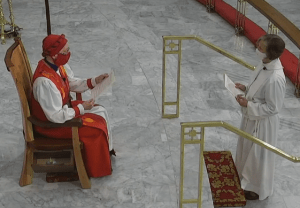
The ordination of Gwynn Crichton (Facebook Live screen shot) September 14, 2020, at St. Paul’s, Richmond, VA

…making some apostles, some prophets, some evangelists, some pastors and teachers to equip the saints for the work of ministry.

So the Episcopal bishop, in quoting Ephesians, began the consecration of my good friend, Gwynn, as a priest recently.

I heard those words as I “attended” virtually her ordination. Aside from my joy in joining with her as she enthusiastically responded and celebrated, my mind began to look at the service through the lens of how the new priest is called to empower the Baptized in their daily lives. Although the service was specially about her calling, there were some nuggets reminding both her and us of her calling to empower us all in our calling as a holy priesthood (1 Peter2:5).

For all members of your Church in their vocation and ministry that they may serve you in a truly and godly life. we pray to you, O) Lord. 

Those words, coming early on in the Litany for Ordinations, reinforces Ephesians, underscoring that all the Baptized have vocations and ministries.

When my friend was examined by the bishop, some of these words resonated:

All Baptized people are called to make Christ known as Savior and Lord and to share in the renewing of his world, and You are to nourish Christ’s people from the riches of his grace and strengthen them to glorify God in this life and in the life to come.

Then I heard words that, in this specific case, are for the priest, to radiate out to all the Baptized:

Will you do your best to pattern your life in accordance with the teachings of Christ, so that you may be a wholesome example to your people?

Will you persevere in prayer, both in public and in private, asking God’s grace both for yourself and others, offering all your labors through the mediation of Jesus Christ and in the sanctification of the Holy Spirit?

Along with these relevant quotes from the service, one other thing struck me.  Because of the virus, there were only ten people in person at my friend’s service.  It reminded me of one of my visions about the relationship of Baptism and Ordination.  My vision is that when we have fully restored the centrality of Baptism, the major sacrament, in the life of the Church, Baptisms will take place in packed cathedrals amidst trumpet sounds and full processions with choirs and crosses and banners! Ordinations, on the other hand, being a minor sacrament, will take place in smaller venues with a few friends and family in attendance!

Anybody share my vision?