What EBM stands for, in a nutshell

by Peyton Craighill

I belong to a “subversive” organization known as “EBM – standing for Episcopalians on Baptismal Mission (the organization that sponsors this blog). Its goal is to convince all Christians that they should take their baptismal vows seriously by living them out in all their daily-life activities, Monday through Sunday.

And (this is the “subversive” part), their congregations are supposed to help them do this!

This means converting our congregations from “shelters” (protecting their members from the stormy blasts of life), into “base camps” – inspiring, directing, equipping, and supporting their members for their missions in their daily lives, wherever Christ leads them on their journeys.

The typical “shelter” congregation places their primary emphasis on “Come” to church on Sunday mornings. The “base camp” congregation primarily emphasizes “Go” out in your daily lives to serve Christ’s mission, Monday-through-Sunday.

Danger! Baptismal Water!

I Am Baptizedby Demi Prentiss

On Sunday the preacher, referencing Luke’s story of the baptism of Jesus, reminded the congregation, “The baptized life is risky business.” She shared an excerpt from a poem by Richard Jespersen in the book I Am Baptized:

Danger!

Baptismal water!

A relentless undertow of grace,

crosscurrents pulling us in over our heads

and out of our depth in Christ;

the drowning of the self-as-god

and the rising of the self-in-Christ.

God buries in a watery grave everything not of God

and raises to new life everything of God,

our watery Good Friday and Easter….

In water,

we see reflections of the world as it is.

In baptismal water, we see reflections of the world as it will be,

and we are changed.

To live the baptized life

is to follow

the way of the water and Word.

To live baptized is to walk wet.

The risk in walking wet is the risk of vulnerability. While fear holds us back and imprisons us, the courage to allow ourselves to be vulnerable sets us free, to live fully into the identity God dreams for us.

Walk wet. Walk with Jesus, who reminds us, even in the midst of the storm, “Courage! It’s me. Don’t be afraid.” (The Message, Mark 6:50)

With thanks to The Rev. Joy Daley, rector of the Episcopal Church of St. Thomas the Apostle, Dallas, TX

Radical Sending – shifting ‘Come’ to ‘Go’

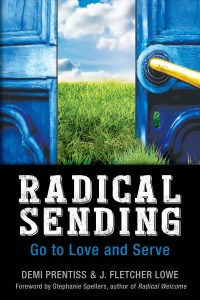
radical-sending-full-rgbby Peyton Craighill

Many church people rate the success of a congregation by two measures: one, the size of the congregation on Sunday morning, and two, the size of the offering on the Sunday service.

These are “Come” measures of success.

But that’s not enough for the new Presiding Bishop of the Episcopal Church. Bishop Michael Curry measures the success of a congregation in terms of “Go” considerations: how many members of that congregation are living the Good News of Jesus Christ in everything they do, Monday through Sunday.

Radical Sending is about turning congregations from a “Come” congregations to a “Go” congregations. The emphasis on “Come” is important – but the emphasis “Go” is even more important! When new members are introduced to Christ and are not challenged and supported to serve in Christ’s mission in their daily lives, the mission of the congregation fails in its mission to serve Christ!

The best section of the book introduces the metaphor “base camp” for the congregation. Mountain climbers can’t succeed in their mission without base camp.

Similarly, for us Christians, we can’t succeed in our mission to serve Christ’s mission in our daily lives without a base camp. And that base camp for us is our congregation. We come to church on Sunday morning to be sent out empowered and redirected to serve Christ in his mission throughout the week ahead.

Justice now as well as then

by Wayne Schwab

This week’s post is a recent podcast featured on The Member Mission Network website:

Welcome to another adventure in love and justice.  I’m Wayne Schwab of the Member Mission Network.  We help people to live better every day.  This time two stories about justice – one from the present, one from the past.

The present day story is about lawyer, Alicia.  She defends criminals.  Each client wants a miracle.  That result is usually unavailable.  So she is under great pressure.  Yet, she never yells or raises her voice with clients or staff.  How does she do it her colleagues and staff ask.  And so do we.  For the answer, a story from the past.

Jesus loved to dine with people who were social outcasts.  Some religious leaders of the Jews were shocked and angry.  In their mind, good Jews were supposed to avoid outcasts.  “Why does he eat with those people! (They were wrong-doers and tax collectors working for the Roman oppressors.)  He’s breaking our laws!”  The religious law governing Israel could be applied unfairly and outcasts could be treated unjustly as a result.  Jesus corrects the injustice by eating with the outcasts over and over.  Jesus says those leaders interpret wrongly.  He is not against the law itself.

Jesus is living God’s justice.  When people’s customs are unfair and abusive, Jesus breaks those customs and laws – even when he angers others so much they want to kill him.

Where does he get the power to befriend social outcasts in the face of threats to his life?  From the Holy Spirit – from God’s power at work in him.

The good news is that the Holy Spirit, God’s power for justice, works in us too!  That’s Alicia’s story.   Criminals are outcasts and Alicia befriends them by taking their cases.  How does she keep her cool?  She says, “God helps me to be patient.  I’ll keep asking God to help me to be patient.”  God supports Alicia’s patience and her clients get a decent defense.  Regardless of the outcome, she has done what she could for justice – with God’s help.

So that’s today’s adventure in justice.

For more, see membermission.org.

Who are we blessing?

Blessing the Backpacks - photo by Moses Leos III, Hays Free Press, Aug. 26, 2015
Blessing the Backpacks – photo by Moses Leos III, Hays Free Press, Aug. 26, 2015

by Fletcher Lowe

Did your congregation recently have a blessing of the backpacks as your students went off to school?  It’s becoming more and more an add-on to our Episcopal Liturgical calendar. Questions come to mind:

  • Were the students themselves and their parents also blessed?
  • What about the teachers and professors and the school administrators and their staffs and the principals and the members of the school and university boards—were they too blessed?

Well, they were blessed at St. Matthew’s Episcopal Church in Chesterfield County, VA.  Those added blessings broaden the backpack “liturgy” to include and affirm those who are giving their God-given time and talent to the all-important educational enterprise.

Soon many congregations will celebrate St. Francis by having a blessing of the animals.

  • What about the “owners’ of those animals—will they, too, be blessed?
  • What about those who work in pet shops and zoos?
  • What about veterinarians and their co-workers?
  • What about SPCA and animal rescue workers and those who provide temporary care and shelter to foster animals?

Will they, too, be blessed and affirmed for their ministries with God’s blessed pets?  I hope so.  If not we are missing a significant teachable moment and opportunity to affirm the calling that people have in their daily life and work.

And then there is

  • Labor Day and
  • Luke’s Day (those in the medical profession) and
  • May 1- Lawyers’ Day and
  • August 15th Mary’s day (parents), etc…

Our Liturgical calendar is filled with opportunities to celebrate and affirm the ministries of the Baptized as they offer their God-given time and talent day by day.

What about Rogation Sunday (the sixth Sunday of Easter) when the means of production not only of farm and fishing but of all of us can be offered up as symbols of our daily life and work?

All of this helps a congregation connect with the real world of those who come in and are fed in order to go out into their worlds of home and community and work, rejoicing in the power of the Spirit.

What is God’s mission?

by Wayne Schwab

Need a fresh and still biblical way to describe God’s mission?

God is on mission to make the world more loving and more just.

Wherever we meet love or justice, we are meeting God at work.

Wherever love or justice are weak or missing, God is at work to bring them.  Look around.  You will see signs of God at work somewhere, somehow.

Read the biblical story that way.  As the story unfolds, we are slowly getting the message that God does not want violence; God wants love and justice.

So, love at home but also be sure that you are fair with each other.

So, be just and pay fairly at work.  Pay fairly because you know and love your co-workers.

Seek to be loving and just and you are already part of God’s mission.  Open “eyes of faith” and see God helping you to love and to be just.