I recently attended a workshop about the theology of stewardship, where the speaker, Bishop Greg Rickel, shared an unexpected story. He began by addressing our discomfort with discussing money in the church (at least the Episcopal Church), why he was an advocate for year-round stewardship, and why it is a good idea to separate time and talent from the annual pledge drive.
After talking about stewardship and ministries within the church, Bishop Rickel then shared a remarkable story. As a parish priest, he had invited each member of his congregation – young and old – to leave a symbol of their vocation at the foot of the altar. A fifth-grader brought her math homework; a nurse, her stethoscope; and a grocery clerk, his name tag.
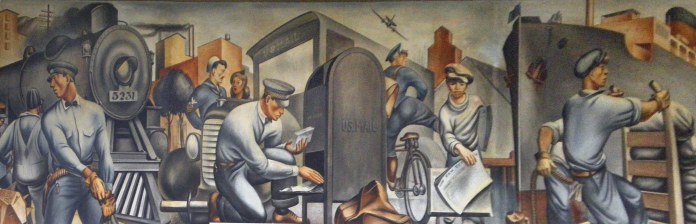
It was a mail carrier, however, who slowly approached the altar with tears streaming down his face. He carefully laid his mailbag at the foot of the altar and turned to his priest. “No one has ever suggested that the work I do as a mail carrier might be holy,“ he said.
God invites each of us to holy work. For some, that work might be within the church. For most, that work is outside the church. Our work – be it compensated or not – is to do the work God has given us to do out in the world as baptized Christians. All of our work is, indeed, holy work.
Christians aren’t commissioned to “go” to church. Christians are meant to BE the church. Yet, in many faith communities, we are taught that we need permission, or facilitation, or membership, or professional guidance to participate in Christ’s mission.
That thing you attend on Sundays? That’s not church– that’s a corporate worship service, and they are not the same thing. It is part of the thing, but not the thing itself.
Church wasn’t originally about corporate worship as much as it was about doing life together. It’s about community. Helping one another. Walking together through all of life’s ups and downs. In fact, the early church was so dedicated to this that they practically met daily– they needed each other.
Michael Coghlan – Flickr
They shared meals together. They prayed together. They talked about their days, celebrated in the beautiful moments, and uplifted one another during the hard moments. They were inseparable friends, because Church was designed to be a committedcommunity.
In this way, “church” has nothing to do with a building, very little to do with a worship service on Sundays, but is actually more about having a circle of committed friends who are dedicated to walking through life, together. It’s about having a group of people in your life who you know will never leave you stranded and alone, no matter how hard life gets, or how badly you screw up.
The truth is that church is the web of relationship, the community that equips us to be Christ’s body in the world. Wherever we find ourselves, our baptism means we are to stand up for what Jesus stood for: feeding the hungry, clothing the naked, standing with the marginalized, welcoming the stranger, resisting injustice, and always, always embodying the love that the world thirsts for.
Being part of a church can help us do that. But anyone who chooses to stand with Jesus may do so, regardless of whether they are members of a church community. And being part of the Jesus Movement means, in the words of James the Just (Acts 15:19), “So here is my counsel: we should not burden these outsiders who are turning to God.” In addition to praying for “those whose faith is known to [God] alone” (BCP p.391), we might just want to seek them out and partner with them.
We in the Church are accustomed to making a distinction between the clergy and the laity. We do that so often and so automatically that we’ve lost an awareness of the historical context for those two words.
In The Complete Book of Everyday Christianity, authors Robert Banks and R. Paul Stevens offer a humorous view of how artificial that distinction is:
In common speech clergy is a term used to describe a religious official, certain members of a religious order or a pastoral leader of a church or denomination.
Its counterpart is laity – the untrained, uneducated, common members of the church. This two-people approach to the church is anachronistic and unbiblical (see Laity). We look in vain in the Bible for laypersons in the sense of untrained, unequipped and not-called. Those words available in the ancient world to describe laypeople (in the common sense) – laikos and idiotes – were never used by inspired writers to describe Christians. Instead we are introduced to the whole people of God – designated by the word laos (the people) – who, including leaders, together are the true ministers. The Greek word for clergy (kleros) is used to describe the dignity and appointment of all the people to ministry. So paradoxically the church has no laypeople in the usual sense of that word and yet is full of clergy in the original meaning of that word.
On the Fourth of July, some friends of ours hosted a backyard barbecue that included folks from their neighborhood, and I had the opportunity to meet Anna. As we chatted, I learned that she is a cancer survivor, and she shared a story about her chemotherapy experience that changed not only her health, but also her life.
When Anna began her chemotherapy, she was invited to select a beautiful hand-made quilt from a nearby cupboard. The quilt would keep her warm during treatment. At each treatment, Anna was given the same quilt, which she wrapped around herself and from which she drew great comfort and peace. She told me that the quilt was almost like a “blanky.” She faithfully returned the quilt to the cupboard at the end of each treatment.
At the end of her very last treatment, Anna went to return the quilt. Instead of accepting the quilt, the nurse said to her, “Oh, no, this is yours to keep!” Anna was deeply moved when she realized that the quilt was a gift that had been made for her. She thought about the love that went into making a quilt for a stranger. Anna reflected about this wonderful – almost mystical – bond she felt with the anonymous quilter. Anna then realized how much the anonymous quilter had ministered to her throughout her cancer treatment. She felt truly blessed.
Anna herself is a seamstress, even though she had never done much quilting. She decided right then and there that she would combine her gift for sewing with love and prayers, and that she would make prayer quilts for the chemotherapy infusion clinic. She wanted to give to others the same peace and comfort she had experienced during those long, hard and sometimes spiritually lonely months.
Anna’s story has stuck with me. When she was too weak to pray herself, she drew strength and comfort from the quilt – a gift made out of love by someone Anna would probably never meet. Anna shows us how a simple act of kindness can change another life – and can also open our eyes to ways we might minister to others.
What gift or talent do you have that you might share in order to bring love, peace or hope to someone else?
The Rev. Dr. Sam A. Portaro, Jr. retired in December 2004 after 22 years of service as the Episcopal Chaplain at the University of Chicago. He was ordained in 1975 and served as Vicar at Church of the Epiphany in Newton, North Carolina, the Episcopal Chaplain to the College of William and Mary in Virginia, and Associate to the Rector of Bruton Parish Church in Williamsburg, Virginia. Sam graduated from UNC-Chapel Hill and Virginia Theological Seminary. He earned his D.Min. from Princeton Theological Seminary. He authored eight books, and his words continue to speak to the church.
by Sam Portaro
Given the myriad talents, skills, gifts, and passions of the diverse collective of the baptized, the scope of ministry is nearly limitless. Yet most definitions of ministry are crabbed and cramped, limited to the relatively small body of Christians represented in the orders of bishop, priest, and deacon. Moreover, an appreciation of the worth of each person as a valued, contributing component of creation suggests that just as there is no place where God is not, there is no place where ministry is not practiced. …
Still, “lay ministry,” with scant exception, is most often conceived as an extension of the work of the institutional church. Assistants in the liturgy. Lay visitors to the sick and shut-in. Lay workers with responsibility for specialized work like parish administration, education, youth, or music. With considerable fanfare and self-congratulation, churches offer training, licensing, and opportunity for “lay ministry” with no apparent awareness that limiting lay ministry to institutional tasks is selfish and self-serving. It is as though lay ministry has no validity beyond the bounded walls of “church.” …
When “enabling the ministry of the laity” means institutional control over lay energies, deploying lay gifts in service to institutional ends, furthering the work of the institutional church with volunteer and low-wage workers, then the true “enabling” in such initiatives is the perpetuation of this institutional captivity. Lay ministry is not the corralling of lay energies for the service of the institutional church. Lay ministry is the living expression of every baptized person’s vocation in daily life. … most Christians might well be surprised to learn that their whole life has been and is a ministry.
— from Transforming Vocation by Sam Portaro, Church Publishing (an imprint of Church Publishing Incorporated, New York), 2008, pp. 68-70.
Posted by Edward L. Lee, Jr., bishop of Western Michigan, retired
“How do we teach love?” was the provocative question posed by 16-year old Maria Gonzalez as she addressed the House of Bishops during General Convention. Despite her soft-spoken voice and age, Maria’s wise words are powerful and reflect her passion as an advocate for others. Not only was Maria part of the Official Youth Presence, this past spring Presiding Bishop Michael Curry had selected Maria to represent The Episcopal Church at the 62nd Session of the United Nations Commission on the Status of Women in New York City in March.
The members of the General Convention Official Youth Presence addressed the House of Deputies on July 9. The Official Youth Presence was established by an initial resolution in 1982. The members are permitted seat and voice by the rules of the House of Deputies and participate in committee hearings and floor debates. Maria Gonzalez appears on the front row, wearing red.* Photo: Mary Frances Schjonberg/Episcopal News Service.
Maria tells us that her baptismal promises have strongly influenced both her worldview and beliefs. Her promises ground her when she observes the lack of love she sees, especially in human rights abuses in the world around us. They also inspire her to challenge injustices by urging The Episcopal Church to be more loving and inclusive in order to change the world.
How do we teach love? Maria’s impassioned address reminds us that our children and youth learn not only from what they specifically are taught at home, in school, or in church, but also from what they hear and see around them – love, hate and indifference. It’s apparent from Maria’s words and actions that she has been nurtured by adults who witness God’s love by living into their baptismal promise to continue in the Apostles’ teaching. As Maria reminds us, in order to walk in love and to share and teach God’s love, we need to be loved and be loving – in word and actions. In other words, love and compassion teach love and compassion.
Maria’s life-giving words reflect her baptismal ministry of transforming our world into a more loving place. Her address reminds us that we, too, make those same promises: to seek and serve Christ in all persons; to love our neighbors; to strive for justice and peace among all people; and to respect the dignity of every human being. These promises are borne out of God’s love for every human being.
Maria’s message of love and of hope for the future – not only of the Episcopal Church, but also for our country and for humankind – is one that we all can learn from. I encourage you to watch Maria’s thoughtful and inspiring YouTube presentation. Her blog offers a summary of her talk.
*The members of the 79th General Convention Official Youth Presence are Georgia Atkinson, New Hampshire; James-Paul Forbes, Connecticut; Anthony Baldeosingh, Long Island; Wentao Zhao, Long Island; Alexander Ward, West Virginia; Andrew K. Kasule, Washington; Justin Mullis, Diocese of North Carolina; Helena Upshaw, South Carolina; Claire Parish, Western Michigan; Alexander Koponen, Indianapolis; Emily Jetton, Iowa; Luisa Van Oss, Minnesota; Michaela Wilkins, Texas; Cecelia Riddle, Kansas; Angela Cainguitan, Hawaii; Maria Gonzalez, Olympia; Diana Marcela Abuchar Sierra, Colombia; Fernando Jose Aguilar Sanchez, Honduras.
During Sunday services, following the heart-breaking news of children being separated from their parents at the border, we renewed our baptismal promises as we baptized a three-year old boy. Jake, his family, and his sponsors were seated together, filling the first two pews in the church. As the liturgy began, I was struck that Jake was on a border, too: He was about to cross the border into new life in Christ – and he was surrounded by his supportive family and church community.
Five Syrian refugees baptised at Easter.
Baptism is life-changing and is not to be taken lightly. We make promises to God, or promises are made on our behalf, as to how we will live our lives as faithful followers of Christ. We, the church community, not only promise to do everything within our power to support the newly baptized in their life in Christ, we also renew our own baptismal promises, one of which is:
Will you strive for justice and peace among all people, and respect the dignity of every human being?
This past Sunday’s baptism was particularly poignant. After the preacher assured us that Jake, strengthened by his participation in the Body of Christ, will grow in his faith and become an instrument of God’s grace and love, he reminded us, the congregation, that our own baptismal vows obligate us to put our faith into action. When we say that we will strive for justice and peace among all people and respect the dignity of every human being, we are promising to participate in God’s work of reconciliation and to help heal our world’s brokenness. We are promising to stand up for just treatment of the most vulnerable among us, especially those who are oppressed.
Today, the most vulnerable are innocent children who have been separated from their parents.
Putting our faith into action is serious ministry, and it takes place outside the doors of our churches. It takes place when we share our concerns with our neighbors; when we speak up against abuses of power; and when as citizens we engage with our civic and government representatives. Putting our faith into action is our baptismal ministry.
How will you strive for justice and peace among all people, and respect the dignity of every human being – today?
Adolph Eichmann, one of the Nazi officials who supervised the murder of countless human beings during the Nazi regime, was blinded by a systemic effort to eradicate certain groups of people. God was not a part of his equation.
Unlike Eichmann, Mahatma Gandhi and Martin Luther King, Jr. were each confronted by a system of laws that was unjust, and each had their eyes opened, factoring God into the equation of their lives.
So too with Jesus. He and the Pharisees had an ongoing conflict. One of many contentious occasions (Mark 2:23-3:6) focused on the Sabbath. The Pharisees were guardians of an intricate system of laws governing the Sabbath. To some extent they had reduced the practice of religion to following a set of laws. But here comes Jesus in a bit of civil disobedience, helping his followers glean the grain fields to resolve their hunger. Then Jesus goes on to restore a man’s withered hand. Both events took place on the Sabbath, contrary to Sabbath laws. Unlike the Pharisees, Jesus was not blind to human need – he was factoring his own divinity into the equation of his daily life.
During my ordained life part of my pastoral ministry has been to visit members in their places of work. The conversation begins with what do you do here. Then the second question: What is the faith connection with what you do here, the Sunday-Monday connection? I must tell you that for the vast majority – like 85% – this is the first time that that question has come to their consciousness. What an indictment of the church! For that work place is where they are spending most of their God-given time and ability. After some continuing conversation, most come to an “aha”: Their eyes open and they begin to see that their work – as a contract lawyer or a mortgage broker or a governmental official or a homemaker – is indeed their baptismal ministry. The “aha” comes as they factor God into the equation of their daily life and work.
The question is the same for each of us – for you and for me: How do we, as the Baptized, factor God into the equation of our daily lives?
The good people at Made to Flourish insist that work matters to God, and they push churches to integrate faith, work, and economic wisdom. A few months ago I read a recent blog post on Made to Flourish’s site by Courtney Reissig. (It’s excerpted here, and well worth your taking time to read the entire post.) I was reminded of an evening prayer (BCP p. 134 ) that asks God to “watch over those … who work while others sleep, and grant that we may never forget that our common life depends upon each other’s toil.” [italics mine]
Work that takes place outside the church – and especially work that is done by laity and isn’t rewarded by a satisfying paycheck – is often unrecognized in the life of our congregations. We say, “Stewardship is everything we do after we say ‘I believe,’” and yet we often overlook our fellow stewards – the “image bearers” who show us God in action, all around us in our daily lives. Reissig, who looks particularly at work that takes place in the home, asks us to think differently:
When you ate your breakfast this morning, did you think about the person who bought the groceries that made your morning possible? What about your clean clothes or mowed yard — did you notice the person who did those things? Maybe you are that person, but maybe you are married to that person. Regardless of who did the work, the reality is that there are many unseen things that happen throughout our days that keep our lives going. There are ordinary things that we do, that often go unnoticed, but that does not remove the value they bring to our lives.
Our homes, churches, communities, and neighborhoods are upheld by hidden, ordinary work. And in a society that often places value on work based on compensation, not contribution, I want to reframe the work conversation and bring it back to what God intended work to be about — bearing his image to a watching world.
One of the primary reasons I wrote Glory in the Ordinary is because I believe all work (paid and unpaid) brings glory to God. God made us to work. He works and we reflect him in our work in the world that he made. But I also know I’m a product of a culture that places value on certain types of work, namely paid or higher paid work. I don’t do a lot of paid work in a given day. Your churches are filled with people like me. Our days consist of just as much work as your spouse or friend who works in the marketplace, but for the most part people don’t see what we do. The impact of our work is long-term, so it’s hard to quantify how it contributes anything good to society (unless you measure in years, not days or weeks).
It’s important work. It’s needed work. It is also hidden work, and my hope in this conversation is that it sheds some light on all the unseen joys, struggles, and complexities that encompass the work of the home….
….Society is served by this hidden work. We marvel at a delicious meal, a beautiful landscape, a sparkling floor, or well-decorated home and sometimes forget that image bearers worked to make it all possible. We are bathed, chauffeured, fed, comforted, and cared for by fellow image bearers from infancy to death, and it’s beautiful in God’s eyes. It’s loving his world.
This is my hope for our conversation: As you serve the people in your churches, you will honor the work of the home as a vital contribution to the world God has made. God created us to work. And in the Lord, no ordinary work is ever completed in vain (1 Cor 15:58).
In The Episcopal Church (TEC), we are moving into a heavy emphasis on evangelism. But what is evangelism?
On Mission
Is it calling people to join the church?
or
Is it calling people to join the mission??
The Episcopal Evangelism Toolkit seems to say evangelism means calling people to join the church. A one-liner on the opening page reads, “As we share our stories, we practice becoming Beloved Community.”
When do we get around to practice becoming beloved agents of God’ mission?
The “Evangelism Charter” for TEC reads, “Through the spiritual practice of evangelism, we seek, name, and celebrate Jesus’ loving presence in the storied of all people – then invite everyone to MORE.”
What is the MORE?
Does Episcopal evangelism ever get beyond story-telling to story-living wherever we are?
Sunday, our pastor asked the children gathered in the front of the church, “What is mission?” Only one answer was offered, and it came from a third grader: “It is like finding something that is wrong and making it right.”
Is your church teaching this as the kind of mission that your evangelism is asking people to join?
Are your members ever getting this message about righting wrong? Do you ever move beyond becoming Beloved Community? Do you ever hear about becoming beloved agents of God’s mission wherever we are?
Or do you hold that back until “they are ready for it”? How does our church prepare the Beloved Community to be ready for it? If we take our cue from Nike and “just do it,” how will your church send the faith community out into their everyday lives, to “do the work God has given us to do, as faithful witnesses of Christ Our Lord”? (BCP, p. 366)
 It was a mail carrier, however, who slowly approached the altar with tears streaming down his face. He carefully laid his mailbag at the foot of the altar and turned to his priest. “No one has ever suggested that the work I do as a mail carrier might be holy,“ he said.
 by Demi Prentiss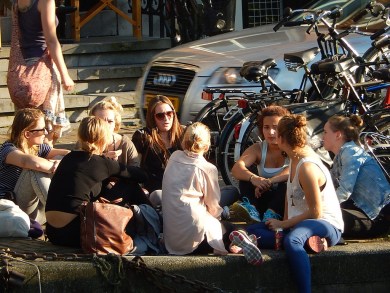

 When Anna began her chemotherapy, she was invited to select a beautiful hand-made quilt from a nearby cupboard. The quilt would keep her warm during treatment. At each treatment, Anna was given the same quilt, which she wrapped around herself and from which she drew great comfort and peace. She told me that the quilt was almost like a “blanky.” She faithfully returned the quilt to the cupboard at the end of each treatment.
 The Rev. Dr. Sam A. Portaro, Jr. retired in December 2004 after 22 years of service as the Episcopal Chaplain at the University of Chicago. He was ordained in 1975 and served as Vicar at Church of the Epiphany in Newton, North Carolina, the Episcopal Chaplain to the College of William and Mary in Virginia, and Associate to the Rector of Bruton Parish Church in Williamsburg, Virginia. Sam graduated from UNC-Chapel Hill and Virginia Theological Seminary. He earned his D.Min. from Princeton Theological Seminary. He authored eight books, and his words continue to speak to the church.

 During my ordained life part of my pastoral ministry has been to visit members in their places of work. The conversation begins with what do you do here. Then the second question: What is the faith connection with what you do here, the Sunday-Monday connection? I must tell you that for the vast majority – like 85% – this is the first time that that question has come to their consciousness. What an indictment of the church! For that work place is where they are spending most of their God-given time and ability. After some continuing conversation, most come to an “aha”: Their eyes open and they begin to see that their work – as a contract lawyer or a mortgage broker or a governmental official or a homemaker – is indeed their baptismal ministry. The “aha” comes as they factor God into the equation of their daily life and work.
 The good people at
 Living God's Mission