by Pam Tinsley
As we turn the pages of our calendars to January 2018, perhaps we look with hopeful expectation to the New Year. Perhaps we think of it as a fresh start. And it will indeed be a new year: although our rituals and the seasons lend continuity and a sense of familiarity, each day opens us to a new beginning.
We may even contemplate New Year’s resolutions! Yes, I know: within a week, 25% of resolutions will be history. By year’s end, fewer than 10% will have been fully kept.

As much as I’m not a particularly avid “resolutionist,” a newspaper article[1] recently caught my eye: The Only Way to Keep Your Resolutions. The author suggests that, if we rely on self-control and willpower, resolutions will fail. Instead, he contends, our emotions — specifically, gratitude, compassion and an authentic sense of pride (not “hubris”, but what I would call “inner joy”) — encourage us to behave in ways that result in self-control. When our values are focused outwardly toward others, rather than inwardly toward ourselves, we are more likely to make meaningful changes in our lives. In short, these qualities – gratitude, compassion and a sense of inner joy – are also the basis for establishing and sustaining relationships.
And, certainly, as followers of Christ, we understand that our values are shaped by Jesus’ values of love, compassion, gratitude and inner joy.
This insight is helping me reframe my own perception of resolutions and to consider how I might take steps to embrace Jesus’ values more fully in my daily life. What about you? How might your New Year unfold if you embrace Jesus’ values of love, compassion, gratitude and inner joy in your daily life?
[1] DeSteno, David. “The Only Way to Keep Your Resolutions.” The New York Times, December 29, 2017. https://www.nytimes.com/2017/12/29/opinion/sunday/the-only-way-to-keep-your-resolutions.html



 We also asked a handful of parishioners to share how they feel our church helps them to shine the light of Christ in the world. A small business owner said that her faithful Sunday worship and meaningful relationships within the church community help her to be a better wife, mother, grandmother, and a better boss. A millennial para-educator, who drives 30 minutes to attend our church, describes it as an anchor that rekindles her own lamp so that God’s light can shine through her when she pours herself out at a job she loves – but which is also a job filled with challenges. A high school teacher believes our communal worship helps him to recognize his students’ vulnerability as well as their sense of compassion and justice. During the week he seeks to bring God’s grace into his relationships outside the church. And a retiree realizes that she kindles the light of Christ through worship, study and service. Then she can be the light of the world outside of church walls and outside of church-related ministries when she helps at the local food bank and other community service activities.

 A recent
 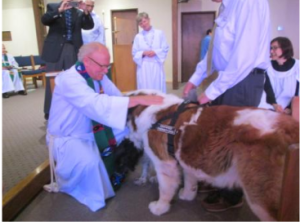 My church, like many, celebrates the Sunday nearest the Feast of St. Francis with a Blessing of the Animals. Pet blessings take place in different ways: outdoors following the service or in a church hall with the pets present throughout worship. My own church chooses to celebrate the Feast of St. Francis in the church with pets, appropriately leashed or constrained, “participating” throughout the service.