Communicating God’s Love in the Workplace

by Pam Tinsley

I walked into the gym the other day and struck up a conversation with a friend I hadn’t chatted with in quite a while. Eventually, our conversation led to her work as a labor and delivery nurse and her consideration of retirement. She shared with me that, as much as she loves nursing, after 40 years the physical demands of the profession are telling her it’s time to slow down.

My friend’s voice revealed how conflicted she was about this major transition in her life. Nursing was what God put her on earth to do, she told me.  Even as a small child she and her family recognized her vocation because of the care she showed toward others.

She went on to describe nursing as her spiritual calling. She expressed it as life-giving – not only because of the new lives she helps moms deliver, but because of the people she comes in contact with, from colleagues to patients and their families. The relationships she forges with others, even for a short time in the hospital, are life-giving and life-changing.

“Ah,” I responded, “you’re living out your baptism. Nursing is your baptismal ministry.” No further explanation was needed. Instead, she told me about helping a woman in labor who spoke no English. With the aid of an interpreter, she communicated maintaining eye contact with the woman throughout the conversation – thus respecting her dignity. She then posed a last question through the interpreter: Do you have any questions for me? To which the woman responded, again through the interpreter, “I just wanted to tell you that I see God’s love in your eyes.”

My friend found the common language of God’s love to communicate with her patient. Sharing Christ’s love with another in need, even if only through her eyes, is one of the many ways she lives into her baptism through her spiritual calling as a labor and delivery nurse.

Have you had an experience in your daily life – at work, in the community, in the local supermarket – where your actions were shaped by your belief in a loving God and a commitment to your baptismal promises? How might another person’s life have been touched by that experience? How was your life changed?

Core of priest’s calling: listening to laity

by Fletcher Lowe

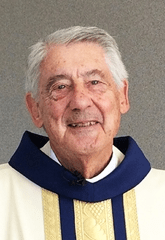
fr-bausch-by-Catherine-Love

Tom Roberts in the January 22, 2016 edition of the National Catholic Reporter shares the story of the Rev. William Bausch, a New Jersey Roman catholic priest.

As a young priest in the 1960s, while serving at St. Joseph Church in Keyport, NJ, Fr. Bausch was assigned to be the chaplain to a Christian Family Action group (known as Christian Family Movement in most dioceses). One of the rules of the lay movement required him to be silent until the meeting ended.

“I remember that they made me sit on my hands because if I can’t use my hands, I can’t talk. I was never so humiliated and humbled in my life,” he said …. “Not because I had to sit on my hands but because, forced to be silent for two years, I had to listen, really listen, to their stories of how, day after day, they struggled to be good Christians. Month after month, I listened to them struggling inwardly with shady practices at the company at which they worked, the politics of the workplace, the compromises they were forced to make, the fear of losing their jobs, difficulties with children — school, rebellion, drugs — trying to make ends meet, hardly ever getting a vacation, trying not to lose faith in hard times, struggles with prayer, not feeling God’s presence, doubts.”

Through his tenure as chaplain, said Bausch, “I knew I had found my priesthood’s core: that they, the laity, would teach me, not only the other way around.”

This “profound sense of reverence and respect” for the lives and gifts of laypeople deeply affected his approach to being a pastor. “I made it clear to the people from day one that I was there to promote and call forth the gifts and charisms they already had, to teach them who they were as a people of God, to support and learn from them….”

Blogger’s questions:

  • To the clergy: how might you facilitate listening to lay folks share their daily life stories?
  • To lay folks: how might you facilitate your clergy to hear your daily life stories?

Work as Worship

by Fletcher Lowe

As a change of pace, my blog for this week is a video that I discovered on a New Zealand Faith@Work site.  It visually tells the radical sending message.  Enjoy and be inspired!!

Living everyday life as a ministry

by Demi Prentiss

In the last week I’ve encountered two stories on the internet that spoke to me in a new way. The first, usually titled “The Last Cab Ride,”  been making the rounds since about 1999, according to Snopes, which puts it in the “glurge” category for its “feel good” quality. The author, Kent Nerburn, calls it “The Cab Ride I’ll Never Forget.” He tells the apparently autobiographical story of setting aside his own agenda in favor of the needs of a troublesome rider.

The second, “Being Generous Even On My Worst Day,” showed up in Episcopal Church Foundation’s Vital Posts blog. In spite of its title and being published in this season, it’s not an annual stewardship campaign pitch. Jeremiah Sierra, the author, instead talks about the transformative effect of being “stewards of our good will and the time we take to understand each other.”

Both of the authors make their way in the world in secular settings, though I’m inclined to think they would describe themselves as walking a spiritual path. Nerburn explicitly names his stint cab-driving as a ministry. Sierra, managing editor of Trinity News magazine, helps us see what “loving our neighbors as ourselves” really looks like.

Would these authors name writing or cab driving or editing as their baptismal calling? Perhaps not. But they would likely acknowledge that, with God’s help, their everyday work, at least every once in a while, has given them the opportunity to take action that has transforming results – in other words, to do God’s work.